|
This month's IEEE GlobalSpec Newsletter Challenge is:
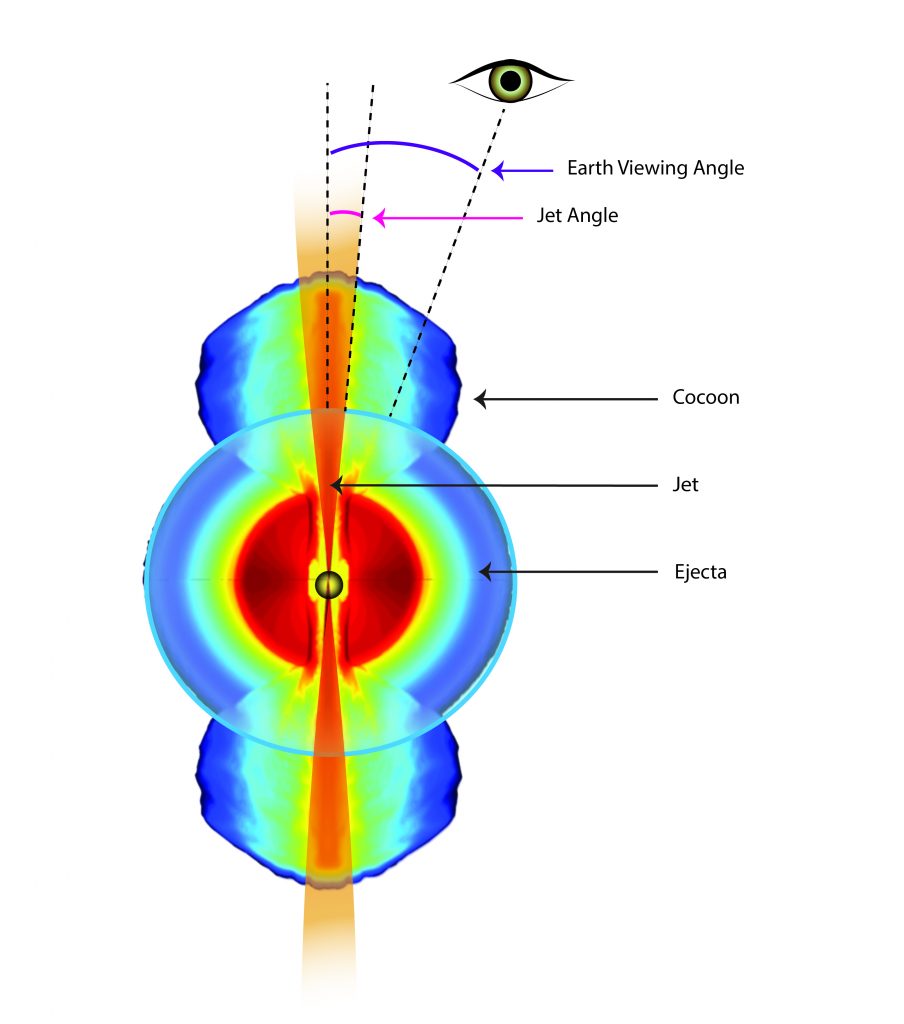
A jet of charged particles generated when two neutron stars collide and subsequently collapse into a black hole appears to be traveling faster than the speed of light when viewed from Earth. How is this possible?
And the answer is:
Einstein’s theory of special relativity states that nothing can travel faster than the speed of light. So the apparent superluminal velocity of the jet of charged particles is simply an illusion and arises as a result of a trick of perspective. The effect depends on the jet traveling at relativistic speeds (a significant percentage of the speed of light) and is magnified for relatively small angles between the observer’s line of sight and the astronomical event that generated the jet.
Since the light emitted by the jet at each point along its path of travel does not travel much faster than the jet itself, the distance between light emissions at each point appears to be shorter than it would be for a slow jet. From the perspective of Earth, the oldest light emitted by the jet arrives only shortly before the newest light emitted by the jet. Thus, the jet seems to have moved faster than light on its trip to Earth.
For example, consider a distant jet traveling at nearly the speed of light at an angle to Earth so that it has moved about 12 light-years directly toward our planet and about 9 light-years in the transverse direction across the sky. Using trigonometry, the jet has travelled a total distance of around 15 light-years on its path at an angle to Earth.
Consider an emission of light from the jet at the start of its trip. After 15 years, the light has moved 15 light-years. But during that time, the jet has moved 12 light-years toward Earth. So an additional light emission from the jet at the end of its trip lags the original light emission by only 3 light-years.
Consequently, an observer on Earth sees the jet’s entire trip taking place within 3 years. During this time, however, the jet appears to have moved 9 light-years across the sky. This apparent motion of 9 light years happening in the span of 3 years makes it appear that the jet is moving superluminally.
| 

 3
3


 Re: Superluminal Surprise: Newsletter Challenge (December 2018)


Good Answers: