Challenge Questions Blog

Challenge Questions

Stop in and exercise your brain. Talk about this month's Challenge from Specs & Techs or similar puzzles.

So do you have a Challenge Question that could stump the community? Then submit the question with the "correct" answer and we'll post it. If it's really good, we may even roll it up to Specs & Techs. You'll be famous!

Answers to Challenge Questions appear by the last Tuesday of the month.

Previous in Blog: Spring Stumper: Newsletter Challenge (March 2019)   Next in Blog: Hornswoggling Swordsman: Newsletter Challenge (May 2019)
Close
Close
Close
8 comments
Rate Comments: Nested

Challenging Charges: Newsletter Challenge (April 2019)

Posted March 31, 2019 5:01 PM
Pathfinder Tags: challenge question physics

This month's IEEE GlobalSpec Newsletter Challenge is:

To confirm the Standard Model of particle physics, scientists must verify that antimatter atoms have exactly the opposite charges of matter atoms. High-precision measurements of charge have been based on large quantities of matter atoms. Antimatter, however, is extremely difficult to produce. How, then, can its charge be measured precisely?

And the answer is:

The Standard Model of particle physics predicts that particles of matter have the exact opposite electric charge of their antimatter counterparts. To verify that this long-standing model is valid, scientists must measure and compare the charges of atoms of both matter and antimatter.

It has been relatively easy to find this value for matter because it is plentiful and stable. Scientists have found the electrical charges of normal atoms and molecules of matter to be neutral, or zero, to a high degree of precision. This is expected due to the balance of particles that form atoms: negatively charged electrons, positively charged protons and neutral-charge neutrons.

Matter neutrality has been verified by carrying out acoustic tests on SF6 gas held in a spherical capacitor and excited by an oscillating electric field. This experiment found that the magnitude of the electron charge differed from that of the proton by less than one part in 1021. (The difference in charge between electrons and protons is less than 1 x 10-21 qe, where qe is the absolute value of the electron charge.)

But this type of test requires macroscopic quantities of matter. An equivalent test can’t be performed for antimatter because it is extremely difficult to produce and store. Only tiny quantities have been made so far and it must be very carefully isolated because it is annihilated in an explosion of energy as soon as it touches ordinary matter.

Still, scientists managed to experimentally determine very precisely that atoms of antimatter have neutral charge just like atoms of matter. This was accomplished with an experiment on atoms of antihydrogen magnetically confined in the ALPHA-2 trap at CERN. The researchers repeatedly nudged the antihydrogen atoms with random electric fields and compared the number of atoms that escaped the trap to a case where the electric fields were set to zero potential. If the antihydrogen atoms had non-zero charges, the random electric fields would cause more of them to leave the trap than got away in the case of the zero-potential electric fields. The experiment showed that antihydrogen is charge neutral.

Reply

Interested in this topic? By joining CR4 you can "subscribe" to
this discussion and receive notification when new comments are added.

"Almost" Good Answers:

Check out these comments that don't yet have enough votes to be "official" good answers and, if you agree with them, vote them!
Guru

Join Date: Mar 2007
Location: by the beach in Florida
Posts: 33392
Good Answers: 1817
#1

Re: Challenging Charges: Newsletter Challenge (April 2019)
03/31/2019 8:25 PM

Through annihilation of matter and antimatter particles the energy released equals the total energy of 2 times the matter particle, which suggests that the matter and it's antimatter equivalent, is an opposite and equal charge...

__________________
All living things seek to control their own destiny....this is the purpose of life
Reply
Guru

Join Date: Apr 2010
Location: About 4000 miles from the center of the earth (+/-100 mi)
Posts: 9914
Good Answers: 1141
#2

Re: Challenging Charges: Newsletter Challenge (April 2019)

03/31/2019 8:46 PM

If a positron annihilates an electron, there is nothing left but gamma rays, so if antimatter and matter don't have precisely opposite charge, then the conservation of charge is invalid.

At CERN, positrons and antiprotons have been combined to create antihydrogen in the ALPHA experiment. Antihydrogen has been found to have the same spectrum as hydrogen.

https://home.cern/science/experiments/alpha

Reply
Guru

Join Date: Jul 2017
Posts: 520
Good Answers: 14
#4
In reply to #2

Re: Challenging Charges: Newsletter Challenge (April 2019) Elephant in the Room

04/02/2019 10:56 AM

Annihilation Above Hydrogen - Leftover Neutrons?

Has anyone mused about what happens to the nuclear particles which originally were neutrons if, say, Helium and anti-Helium annihilate? And for that matter, do the massive parts of the nuclei of hydrogen and anti-hydrogen annihilate or merely remain (briefly, at least, until becoming protons or being absorbed by some convenient, nearby nucleus) as a couple of bare neutrons? The total energy released by the interaction depends a great deal upon the difference. The gamma from annihilation of a neutron sized particle or two is significantly more energetic than an electron/positron gamma product.

______________

thewildotter

Reply
Guru

Join Date: Apr 2010
Location: About 4000 miles from the center of the earth (+/-100 mi)
Posts: 9914
Good Answers: 1141
#5
In reply to #4

Re: Challenging Charges: Newsletter Challenge (April 2019) Elephant in the Room

04/04/2019 9:43 PM

Antihelium is made up of two antiprotons, two antineutrons, and two positrons (antielectrons). A helium atom and antihelium atom meeting would result in each particle annihilating its antiparticle releasing gamma radiation.

Reply Score 1 for Good Answer
Guru

Join Date: Jul 2017
Posts: 520
Good Answers: 14
#6
In reply to #5

Re: Challenging Charges: Newsletter Challenge (April 2019) Feynmann ?

04/05/2019 9:38 AM

Feynmann or What Source ?

GA for concise anti-[massiveparticle] answer. Using it I see:
------------------------------------------------------------
"The antineutron ... differs from the neutron only in that some of its properties have equal magnitude but opposite sign. It has the same mass as the neutron, and no net electric charge, but has opposite baryon number (+1 for neutron, −1 for the antineutron).
...
Magnetic moment
The magnetic moment of the antineutron is the opposite of that of the neutron.[4] It is +1.91 µN for the antineutron but −1.91 µN for the neutron (relative to the direction of the spin). Here µN is the nuclear magneton. "
-----------------------------------------------------------
This is the first time I had seen(and assimilated) magnetic moment applied to something spinning with no net electric charge. At the risk of further exposing my ignorance, I am now wondering what all particles in physics with what all magic numbers(like charge and baryon number) give rise to magnetic moments and whether the magnetic moment arising from spinning baryons interact indiscriminately with magnetic moments arising from spinning electrostatic charge.
I bought Feynmann's QED book decades ago. Perhaps it is in there. I think I read it when I bought it but somehow I did not absorb enough to retain this generalization of magnetic moment. I do recall feeling that the content had less motivation than other Feynmann books I had read. I had started a new job at the time so not only did I have insufficient time to read carefully but I never got a round tuit for a reread.
Rixter, can you rattle off the numbered (0,+1,-1) parameters(charge,baryon number,..) which are capable of generating magnetic moments when spinning ? Or provide some concise reference I might inspect to get a more generalized concept of what magnetic moments actually are ? Or confirm that QED explains it well ? A shallow web search yields too much electrostatic charge oriented material relative to magnetic moment. I do see this: https://en.wikipedia.org/wiki/Anomalous_magnetic_dipole_moment Thanks for your patience and for being well informed. Perhaps you have all this concisely conceptualized. If you do, is there an executive summary of it knocking about ? I am curious in particular regarding whether quaternions (a mathematical discipline used by Maxwell to rewrite his component electromagnetics) and Heavyside's operational calculus (that Maxwell used to convince the electromagnetics community of his conclusions and is the four equation "Del" form we usually see today) apply to the entire zoo of sources of magnetic moments as well as they do to electric charge. Mathematically, are all these not commutative in an identical way, and are quaternions enough for a complete characterization or are octonions useful ?
Rephrased, did Maxwell have or was he very close to a full description of generalized magnetic behavior ?
_____________
thewildotter

Reply
Guru

Join Date: Apr 2010
Location: About 4000 miles from the center of the earth (+/-100 mi)
Posts: 9914
Good Answers: 1141
#7
In reply to #6

Re: Challenging Charges: Newsletter Challenge (April 2019) Feynmann ?

04/07/2019 11:09 AM

Spin of a quantum particle is not the same as classical spin, and the magnetic moment is not due to the charged particle rotating on its axis.

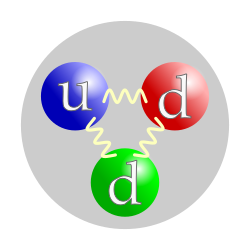
The neutron, while overall electrically neutral, is made up of 3 charged particles called quarks, so the neutron can have a magnetic moment.

Maybe this will help explain:

"Spin magnetic moment

From Wikipedia, the free encyclopedia Jump to navigationJump to search Main article: magnetic moment

In physics, mainly quantum mechanics and particle physics, a spin magnetic moment is the magnetic moment caused by the spin of elementary particles. For example, the electron is an elementary spin-1/2 fermion. Quantum electrodynamics gives the most accurate prediction of the anomalous magnetic moment of the electron.

"Spin" is a non-classical property of elementary particles, since classically the "spin angular momentum" of a material object is really just the total orbital angular momenta of the object's constituents about the rotation axis. Elementary particles are conceived as concepts which have no axis to "spin" around (see wave–particle duality).

In general, a magnetic moment can be defined in terms of an electric current and the area enclosed by the current loop. Since angular momentum corresponds to rotational motion, the magnetic moment can be related to the orbital angular momentum of the charge carriers in the constituting current. However, in magnetic materials, the atomic and molecular dipoles have magnetic moments not just because of their quantized orbital angular momentum, but, due to the spin of elementary particles constituting them (electrons, and the quarks in the protons and neutrons of the atomic nuclei). A particle may have a spin magnetic moment without having an electric charge. For example, the neutron is electrically neutral but has a non-zero magnetic moment because of its internal quark structure."

https://en.wikipedia.org/wiki/Spin_magnetic_moment

"The quark content of the neutron. The color assignment of individual quarks is arbitrary, but all three colors must be present. Forces between quarks are mediated by gluons."

https://en.m.wikipedia.org/wiki/Neutron

Reply Score 1 for Good Answer
Guru

Join Date: Jul 2017
Posts: 520
Good Answers: 14
#8
In reply to #7

Re: Challenging Charges: Newsletter Challenge (April 2019) Net Zero

04/07/2019 4:13 PM

Zero Charge Means "Net" Zero Charge Not Zero Electric Fields

OK. I just needed to realize that a [net] zero electric charge might be a patterned, dynamic, electrical charge distribution of likely non-spherical average symmetry whose charges total up to zero. Magnetic moments only come from moving charges with adequate sign asymmetry not baryon numbers nor from any more exotic magic.

GA for the references that enabled me to arrive at that level of detail. Corrections or tuning of any of my detail articulation welcome.

_______________

thewildotter

Reply
Guru

Join Date: May 2016
Posts: 1746
Good Answers: 87
#3

Re: Challenging Charges: Newsletter Challenge (April 2019)

04/02/2019 10:29 AM

Whatever you do requires some assumptions. Given an antiproton and a positron, you have to assume that charge quantum holds and that the charge is -1 for the antiproton, not -.987232746, and +1 for the positron. You also have to assume that the mass consists of the amalgamation of the subparticles modeled to make it up. Given those, you then predict the curvature of the particle path for a given velocity in a magnetic field and compare it with the curvature of the complementary particle under the same conditions in a detector. If they match and are opposite, then the charges and masses match.

Reply
Reply to Blog Entry 8 comments

"Almost" Good Answers:

Check out these comments that don't yet have enough votes to be "official" good answers and, if you agree with them, vote them!
Copy to Clipboard

Users who posted comments:

Jpfalt (1); Rixter (3); SolarEagle (1); thewildotter (3)

Previous in Blog: Spring Stumper: Newsletter Challenge (March 2019)   Next in Blog: Hornswoggling Swordsman: Newsletter Challenge (May 2019)

Advertisement
