|
 Plastics are part of our everyday lives. Upon waking up we reach for plastic toothbrushes, grab our plastic cell-phones, and so on. As I look around my cubicle I immediately identify ten things made from plastic. Normally I wouldn't see a problem with all my plastic possessions, but the other day I came across this entry in Engineering News. It had me thinking about when I was young and went out of my way to clip plastic six-pack rings before throwing them away. Plastics are part of our everyday lives. Upon waking up we reach for plastic toothbrushes, grab our plastic cell-phones, and so on. As I look around my cubicle I immediately identify ten things made from plastic. Normally I wouldn't see a problem with all my plastic possessions, but the other day I came across this entry in Engineering News. It had me thinking about when I was young and went out of my way to clip plastic six-pack rings before throwing them away.
The article was interesting but I wanted to know more. Thankfully charsley99 provided a link in the thread for consideration. I became increasingly interested and horrified as I continued researching, but I still wanted to see the garbage pile. So, like everyone else, I desperately tried to find the massive pile on Google Earth without any results. I realize that many people are unsure of the existence of this mass and its effects… which makes it a perfect controversy for me.
The environment has been in the news more and more lately with Al Gore's Nobel Prize win, the droughts in the Southern United States, and the wildfires in California. Now we learn that there is a floating trash pile (mostly comprised of plastic) that is reportedly twice the size of Texas, floating in the Pacific Ocean. The "Eastern Garbage Patch" is created and maintained by four circulating currents: the North Pacific current, the California Current, the North Equatorial Current, and the Kuroshio Current. These currents draw in marine debris and form a giant floating mass. Other names for this phenomenon include the "Great Pacific Garbage Patch" and the "Pacific Trash Vortex".
Plastics are not biodegradable but they are photodegradable, meaning that they are broken down by the sun into smaller particles; these particles become recognizable as plastic polymer pellets. Animals are mistaking plastic for their natural food and are consuming it. Greenpeace estimates that over a million seabirds and one hundred thousand sea mammals and sea turtles are killed each year from entanglement in abandoned fishing lines or plastic ingestion.
Researchers have been studying the effects of plastic consumption on the populations of marine-dwelling animals. One of the most studied animals is the albatross. These birds spend much of their time searching for food in the great oceans. Albatross mostly feed on cephalopods, fish, and crustaceans; however, these species are becoming harder to find. The albatross are now consuming whatever is floating in oceanic waters, much of which is plastic. Lighters, combs, bottle caps, and other assorted plastic pieces are what the adult albatross brings home to feed its young.
The Los Angeles Times did a five-part series on the seas entitled "Altered Oceans",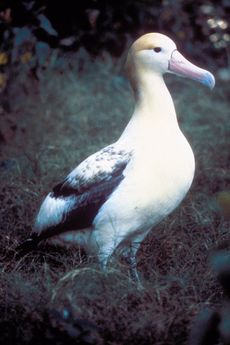 which included researchers studying albatross. This series talked John Klavitter, a wildlife biologist, who was stationed at atoll for the U.S. Fish and Wildlife Service. Klavitter examined a dead albatross chick by cutting open its stomach. Upon examination, it was shown that it contained bottle caps, a comb, and a golf tee amongst many other plastic pieces. Klavitter responded, "This is pretty typical… we usually find cigarette lighters, bucket handles, toothbrushes, syringes, toy soldiers–anything made out of plastic." which included researchers studying albatross. This series talked John Klavitter, a wildlife biologist, who was stationed at atoll for the U.S. Fish and Wildlife Service. Klavitter examined a dead albatross chick by cutting open its stomach. Upon examination, it was shown that it contained bottle caps, a comb, and a golf tee amongst many other plastic pieces. Klavitter responded, "This is pretty typical… we usually find cigarette lighters, bucket handles, toothbrushes, syringes, toy soldiers–anything made out of plastic."
Although this topic is new to me, it has been around for awhile. Plastics may seem like a cheap and easy solution for humans in many situations; however, it is contributing to a serious devastation of marine life. Only by altering human consumption of plastic can this problem be addressed. I want to make it clear that I am not advocating for the abolishment of plastic; however, I do think that people should be a little more conscious of how they are using and disposing of it.
What do you think?
- Is our environment fighting back against us for harm we've inflicted?
- Should preventing marine pollution be considered a priority?
- What can be done to address this issue?
This is part one of a three part series on plastics. Check back next week to find out the harm that plastic inflicts on humans.
| 


 Re: Poisonous Plastics - Part One


