Previous in Forum: Instrument Ground Cable   Next in Forum: What is the Secret to Making an AB DHRIO Work?
Close
Close
Close
42 comments
Rate Comments: Nested
Guru

Join Date: Apr 2007
Location: Buenos Aires, Argentina
Posts: 1679
Good Answers: 33

Wire Gauge for a Boat's Instrument Panel

04/14/2015 1:19 AM

Hello! I am planning to replace the instruments (Tach w/ hour meter, fuel level, oil pressure, water temp, voltmeter) and wiring of the instrument panel on my boat. It has got twin diesel engines which are about 5 meters apart from the helm and 7 meters from the fly bridge. The reason for doing so is that the readings in the instruments are no longer reliable, and the insulation of the wiring has lost flexibility due to exposure to fumes. As it seems to me that the old wires are over dimensioned, I did some research on the internet (Faria / VDO Instruments), which recommended 16 / 18 Gauge wires. Considering the distance from the engines to the instruments, do you consider those diameters as correct? Your opinions will be welcome!

__________________
the more I move, the deeper I get stuck !
Register to Reply
Interested in this topic? By joining CR4 you can "subscribe" to
this discussion and receive notification when new comments are added.

Good Answers:

These comments received enough positive votes to make them "good answers".

"Almost" Good Answers:

Check out these comments that don't yet have enough votes to be "official" good answers and, if you agree with them, vote them!
Guru
Engineering Fields - Instrumentation Engineering - New Member Hobbies - Automotive Performance - New Member Technical Fields - Education - New Member Fans of Old Computers - TRS-80 - New Member Hobbies - Musician - New Member

Join Date: Jan 2008
Location: Tucson, AZ
Posts: 1331
Good Answers: 30
#1

Re: Wire gauge for a boats instrument panel

04/14/2015 1:35 AM

Insulation sets VOLTAGE limit, wire gauge (how much copper) sets CURRENT limit.

Use BIG (smaller number) gauge wires where current is high, such as between alternator(s) and battery(s). If current is LOW, you can "get away" with using smaller gauge wires...typical example is between SENSORS and DASH gauges.

P.S. -- using larger gauge wire than necessary is NOT electrically harmful, just damaging to the pocketbook.

__________________
...and the Devil said: "...yes, but it's a DRY heat..!"
Register to Reply
Guru

Join Date: Aug 2014
Location: Port Macquarie N.S.W. Australia
Posts: 1071
Good Answers: 225
#2

Re: Wire gauge for a boats instrument panel

04/14/2015 2:11 AM

Wire size will depend on the current in the circuit.

A 12v circuit length of 15 metres AWG18 carrying 2 amps would drop 1.32v over its length. This is 11%, and is too high for practical purposes. If the supply was 24v, then the voltage drop would only be 5.5% which is borderline.

The figures for the same circuit using AWG16 would be :-

12v, 0.83v drop =7%

24v, 0.83v drop = 3.5%

Most instruments are unlikely to draw more than 2 amps, but many will be a lower voltage signal than 12v, so you would need to make a decision based on instrument signal voltages and currents.

A read of this article may help, that site has a lot of interesting stuff primarily regarding marine wiring.

Register to Reply
Power-User

Join Date: Jul 2014
Location: Savannah, GA. The post office decided to change my address again.
Posts: 253
Good Answers: 19
#3

Re: Wire gauge for a boats instrument panel

04/14/2015 2:18 AM

Keep in mind that the manufacturer probably had and engineer spec out the wiring on your boat, fires onboard when there is no help for miles in any direction are BAD!

I'd keep with the original wiring specs just to be safe, but it is your butt on the line NOT mine!

__________________
Never seem more learned than the people you are with. Wear your learning like a pocket watch and keep it hidden. Do not pull it out to count the hours, but give the time when you are asked.(Lord Chesterfield)
Register to Reply
Guru
Popular Science - Weaponology - New Member Safety - ESD - New Member Hobbies - Fishing - New Member

Join Date: Sep 2006
Location: Near Frankfurt am Main, Germany. 50.390866N, 8.884827E
Posts: 17996
Good Answers: 200
#18
In reply to #3

Re: Wire gauge for a boats instrument panel

04/15/2015 4:26 AM

GA

Well put and good advice.

There are also insurance problems possible in most westernized countries if the boat's original spec is not adhered to, as the insurance is usually based on that. If there is ever a claim, the assessors will go over the boat with a fine toothed comb, to find reasons NOT to pay out....

Also, the fusing is based not only just on the unit the fuse supplies, but also partly on the wire gauge used to get the power there.....types of fuses used:- fast, medium and slow can also play a role.....

As someone else mentioned, increasing the diameter of the wire is usually not a problem.....but reducing it certainly could be.

The OP is almost like the first of my signatures shown below:- "Wer nicht weiß, glaubt viel! "

"Those who know nothing, believe a lot!"

As you said, its his butt on the (power?) line, not ours!

__________________
"What others say about you reveals more about them, than it does you." Anon.
Register to Reply Score 1 for Off Topic
Guru

Join Date: Apr 2007
Location: Buenos Aires, Argentina
Posts: 1679
Good Answers: 33
#21
In reply to #18

Re: Wire gauge for a boats instrument panel

04/15/2015 8:19 AM

The OP is almost like the first of my signatures shown below:- "Wer nicht weiß, glaubt viel! " "Those who know nothing, believe a lot!"

Hello Andy, in my case I go for "wer nicht weiss ...FRAGT! (The one who doesent know: ASKS)

About your comment on insurance companies: I do agree with you about the "fine comb theory" and that is because their busines is collecting dough from their customers instead of paying!

Although Argentina concentrates the main number of leisure boats of South America, most are produced in small series on a (mainly) artisananl way. For this reason specifications are not as stringent as they are somewhere else.... and the insurance companie´s "comb" has the teeth far more apart.

As about my post: my original question is more related to make a more efficient wiring rather than to save some bucks by using thinner cables.

__________________
the more I move, the deeper I get stuck !
Register to Reply
Guru
Popular Science - Weaponology - New Member Safety - ESD - New Member Hobbies - Fishing - New Member

Join Date: Sep 2006
Location: Near Frankfurt am Main, Germany. 50.390866N, 8.884827E
Posts: 17996
Good Answers: 200
#29
In reply to #21

Re: Wire gauge for a boats instrument panel

04/15/2015 12:09 PM

You do what you want, but I think "down grading" anything is the wrong way to do it. Why re-invent the wheel and maybe not live to find out why something you design out was needed?

Furthermore, even opening up a question here is too my mind, not a good idea in such cases where accidents can happen, you might even get upset by some of the comments......possibly?

Furthermore, if I decided to do something, and it was wrong, I would want it to be MY bad idea, not one from someone else online!! Now that would get my goat!!

We here are not infallible.

Someone else mentioned I believe, being out at sea, way off the land and a serious fire and no power to move the boat.....One must always think in worst case situations, then you are LESS likely to become a statistic!

I have experienced just losing an engine in rough seas (off the coast near to Brightlingsea, UK) and passing over a sunken (not visible) wartime wreck that the chart says "No water at high tide!". All due to a stupid "lash up" of the engine's electrical system failing (Not my boat either!!). Nobody knows how we failed to hit the wreck, just lucky!!

The sea is VERY unforgiving!!! Cars just stop, but even that could be dangerous to life and limb....

For a simple example, when I put shelves up, I test them with my full body weight, around 90Kgs. If I think it may be even more heavily used, the wife is used as well.(I daren't tell you how much she weighs, but far less than me!)

I also built seating in our kitchen, on two walls (that I also put up!) that is "hung on the walls" as I hate trying to sweep up or vacuum between dozens of chair legs. After 7 years, with some HUGE people on it, sometimes double, no failures whatsoever....The heating rads I built under the seat, so that in a cold winter, you have a nice warm and comfortable seat to lounge on for up to 8 people.

The heating also works flawlessly and the extra warm air rises up behind the backs of the seating area, warming the whole kitchen very quickly!!

A bit over done, but we have never lost a shelf, or the seat or the unusual heating system..... I somehow doubt we ever will.....

I apply this sort of thinking to ANY job I am doing for myself or friends....I always try to err on the side of safety and long term usage, no matter what the job is.....

It usually takes longer and often costs a bit more, but the "peace of mind" is simply wonderful......

I have been around long enough to know that unforeseen things can happen, things that should never happen in a million years, but somehow they do.....

But please do whatever you want, its not my "butt" (or his either!) as someone else mentioned that is possibly in danger.....

(Sorry about any spelling mistakes, the CR4 spell checker is screwed!)

__________________
"What others say about you reveals more about them, than it does you." Anon.
Register to Reply Score 1 for Off Topic
Guru

Join Date: Apr 2007
Location: Buenos Aires, Argentina
Posts: 1679
Good Answers: 33
#30
In reply to #29

Re: Wire gauge for a boats instrument panel

04/15/2015 12:29 PM

I agree with you on how "safe" or fail proof things have to be done or built, and also experienced that things fail when you most need them! In this particular case I am just speculating on wiring alternatives and not looking for doing the rewiring using cheaper stuff. Finally: I will consider all advises and take the wrong decision 100% by myself

__________________
the more I move, the deeper I get stuck !
Register to Reply
Guru
Popular Science - Weaponology - New Member Safety - ESD - New Member Hobbies - Fishing - New Member

Join Date: Sep 2006
Location: Near Frankfurt am Main, Germany. 50.390866N, 8.884827E
Posts: 17996
Good Answers: 200
#32
In reply to #30

Re: Wire gauge for a boats instrument panel

04/15/2015 12:39 PM

Well done!

I feel you understood my standpoint on such things very well.....

Stay safe and fit!

__________________
"What others say about you reveals more about them, than it does you." Anon.
Register to Reply
Guru

Join Date: Jul 2007
Location: Commissariat de Police, Nouvions, occupied France, 1942.
Posts: 2599
Good Answers: 77
#4

Re: Wire gauge for a boats instrument panel

04/14/2015 2:27 AM

As it's the insulation that is driving your project, then if it were me, I'd renew like for like as regards cable sizes. That way your circuit protection equipment is still appropriate for the job.

__________________
Good moaning!
Register to Reply
Guru

Join Date: Apr 2007
Location: Buenos Aires, Argentina
Posts: 1679
Good Answers: 33
#6
In reply to #4

Re: Wire gauge for a boats instrument panel

04/14/2015 6:21 AM

pls thank you Mildred on my behalf! ;-)

__________________
the more I move, the deeper I get stuck !
Register to Reply
Guru

Join Date: Apr 2007
Location: Buenos Aires, Argentina
Posts: 1679
Good Answers: 33
#7
In reply to #6

Re: Wire gauge for a boats instrument panel

04/14/2015 7:39 AM

oops, the " you " was not intended to be there..

__________________
the more I move, the deeper I get stuck !
Register to Reply
Guru
United Kingdom - Member - Indeterminate Engineering Fields - Control Engineering - New Member

Join Date: Jan 2007
Location: In the bothy, 7 chains down the line from Dodman's Lane level crossing, in the nation formerly known as Great Britain. Kettle's on.
Posts: 32175
Good Answers: 839
#5

Re: Wire gauge for a boats instrument panel

04/14/2015 4:51 AM

Certainly do not replace with smaller cross-section conductors!

__________________
"Did you get my e-mail?" - "The biggest problem in communication is the illusion that it has taken place" - George Bernard Shaw, 1856
Register to Reply
Guru
Engineering Fields - Electrical Engineering - Been there, done that. Engineering Fields - Control Engineering - New Member

Join Date: Dec 2008
Location: Long Island NY
Posts: 15600
Good Answers: 981
#8

Re: Wire Gauge for a Boat's Instrument Panel

04/14/2015 9:19 AM

This is one of the scenarios that show that many people misunderstand the wiring codes. The current rating for a wire gauge is how much current the wire can safely handle before the wires self heating is likely to compromise the insulation and cause a fire to start. This is why the insulation material will change the current handling capability of a wire gauge. With the lower voltage, higher current conditions one finds on a boat the effective voltage drop becomes more of a problem than auto-ignition of wiring insulation. This is why the wire gauge recommended by the instrumentation manufacturer asks for a heavier gauge wire than you might anticipate. Follow their guidelines.

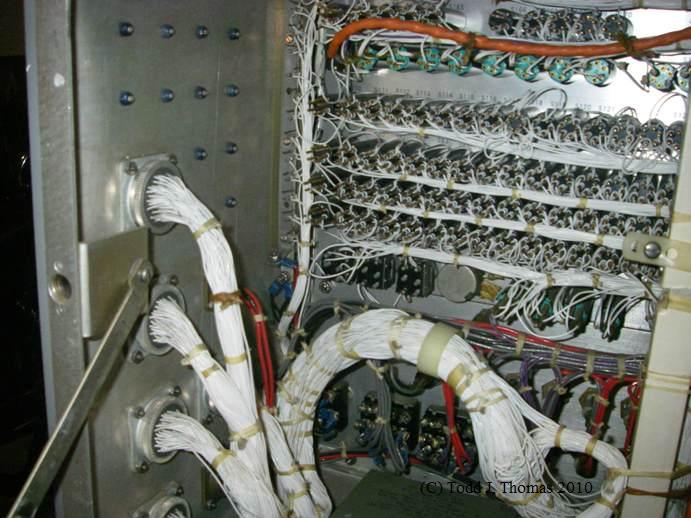
The only thing I would additionally recommend is the wires use multiple strand instead of solid conductors. Mechanical vibrations are your wiring enemy on a boat. Flexible multiple strand conductors are less prone to metal fatigue from constant flexing. You should also consider the aviation harnessing bundling technique of tying all of the wires together every couple of inches to reduce uncontrolled resonant flexing from happening.

A picture from the Orion P3 harness assembly.

__________________
"Don't disturb my circles." translation of Archimedes last words
Register to Reply
Guru

Join Date: Sep 2008
Location: Where the sun sets on OZ
Posts: 1381
Good Answers: 28
#17
In reply to #8

Re: Wire Gauge for a Boat's Instrument Panel

04/15/2015 3:09 AM

Beat me to it! Multi strand cables are a must. The drawback is that water is rapidly taken up the cable by capillary action and corrosion quickly cuts the number of conductors down to a less than ideal number and fire ensues. So to emphasise what i see as important, large gauge, multi strand, keep dry.

Jim

__________________
Where's the KaBoom? There should be a KaBoom!
Register to Reply
Guru
Popular Science - Weaponology - New Member Safety - ESD - New Member Hobbies - Fishing - New Member

Join Date: Sep 2006
Location: Near Frankfurt am Main, Germany. 50.390866N, 8.884827E
Posts: 17996
Good Answers: 200
#19
In reply to #17

Re: Wire Gauge for a Boat's Instrument Panel

04/15/2015 5:36 AM

What about possibly sealing where the insulation ends? Greasing the ends? To stop moisture ingress? Shrink fit tubing?

What do you feel would be a good idea?

I myself have sprayed (rightly or wrongly!) boat, caravan, car and trailer electrics with WD-40, and have never suffered further problems....Occasional re-usage, not to any time plan, just when I think about it.....seems to keep things hunky dory!!!

I don't quite know just how long I have been using WD-40, but 50 years is probably a reasonable guess.

I do not recommend it for things like locks or door cylinders because it can collect dust in such usage and that can cause problems.

But I have "recovered" a dusty door cylinder (improperly lubricated with thick oil) by cleaning with WD-40, just to free it and clean it up (which does not always work if stuff like sand has got in there by the way)....then used denatured alcohol to remove the WD-40, before using the correct "Wet then Dry" cylinder lock lubricant.

A lot of work....but on a Sunday.....no shops open.....worth a try!

__________________
"What others say about you reveals more about them, than it does you." Anon.
Register to Reply
Guru

Join Date: Apr 2007
Location: Buenos Aires, Argentina
Posts: 1679
Good Answers: 33
#22
In reply to #19

Re: Wire Gauge for a Boat's Instrument Panel

04/15/2015 8:25 AM

On my boat I actually use multistranded cables, solder connections and insulate with shrink tubing.

As 99% of my sailing is done in the Rio de la Plata (bluewater), marine corrosion is not an issue.

__________________
the more I move, the deeper I get stuck !
Register to Reply
Guru

Join Date: Feb 2008
Location: Large hole formally occupied by furry woodland creature.
Posts: 3385
Good Answers: 97
#31
In reply to #17

Re: Wire Gauge for a Boat's Instrument Panel

04/15/2015 12:37 PM

The rear of the cannon plug connectors shown in redfred's panel shot show the potting compound, used to seal the conductor stranding, and anti-vibration support. While this might be impractical for your application, the fact that there are 60 year old aircraft still flying that used these wiring techniques, is testimony to the effectiveness.

__________________
CRTL-Z
Register to Reply
Guru

Join Date: Feb 2008
Location: Large hole formally occupied by furry woodland creature.
Posts: 3385
Good Answers: 97
#28
In reply to #8

Re: Wire Gauge for a Boat's Instrument Panel

04/15/2015 11:34 AM

Ah! The P3....you couldn't get better duty than P3 aircrew. And I DO mean couldn't get, unless you had "connections" and I don't mean wiring harnesses. One of the first things an AE learns is building soldered cannon plug connections and wiring harnesses from scratch. The wires had ident branded in every so many inches and the id included the position along the wire. The schematics folded out over a 20' table.

__________________
CRTL-Z
Register to Reply
2
Guru
Hobbies - CNC - New Member

Join Date: Jul 2013
Location: Lost Wages Nevada
Posts: 1578
Good Answers: 55
#9

Re: Wire Gauge for a Boat's Instrument Panel

04/14/2015 10:01 AM

Check out this WEBSITE it explains the WHAT, WHY, and HOW of automotive wiring. I know you are wiring a boat but you are still running the same voltages and dealing with possible heat issues.

Good luck and happy boating.

P.S. There are only 2 days that a boat owner is happiest, The day he BUYS the boat and the day he SELLS the boat!

__________________
Though it does seem he frequently has a Swiss Army knife or Leatherman and a roll of duct tape with him.
Register to Reply Good Answer (Score 2)
Guru

Join Date: Apr 2007
Location: Buenos Aires, Argentina
Posts: 1679
Good Answers: 33
#13
In reply to #9

Re: Wire Gauge for a Boat's Instrument Panel

04/14/2015 9:03 PM

Interesting stuff! thank you! I have found a local supplier for those type of cables:http://www.cibasa.com/31conduc_auto.html

__________________
the more I move, the deeper I get stuck !
Register to Reply
Guru
Popular Science - Weaponology - New Member Safety - ESD - New Member Hobbies - Fishing - New Member

Join Date: Sep 2006
Location: Near Frankfurt am Main, Germany. 50.390866N, 8.884827E
Posts: 17996
Good Answers: 200
#20
In reply to #9

Re: Wire Gauge for a Boat's Instrument Panel

04/15/2015 5:44 AM

Edward Heath, the ex British Prime Minister, said this about sailing:-

"Ocean racing is like standing under a cold shower tearing up £5 notes!"

__________________
"What others say about you reveals more about them, than it does you." Anon.
Register to Reply
3
Guru
Safety - Hazmat - New Member Engineering Fields - Retired Engineers / Mentors - New Member Engineering Fields - Piping Design Engineering - New Member Hobbies - DIY Welding - New Member Fans of Old Computers - PDP 11 - New Member

Join Date: Feb 2007
Location: Stronger Than The Storm
Posts: 2394
Good Answers: 203
#10

Re: Wire Gauge for a Boat's Instrument Panel

04/14/2015 12:32 PM

The 16/18 gauge wires that you are considering using are sufficient, if not more than needed, for most low current instrumentation on a boat. A somewhat good "rule of thumb" guidance is that if it is sufficient for an automobile it will be sufficient for a boat since after all they are doing the same thing, in the same circuits, with the same instrumentation but in a different vehicle. In many instances the use in a boat is much simpler than in an auto. You should consider installing circuit protection (fuses/circuit breakers/other devices) in some of the instrumentation circuits or groups of circuits. It is one thing to have a problem on the shoulder of a road but much worse when 50 miles from the nearest land.

For my boats I use a few general guidelines which are very conservative:

Nothing smaller than 16ga stranded for low voltage circuits with little current in cords with waterproof jackets if possible. Physically group circuits with common fused feeds when possible. Place wires in bundles with wire ties and mounting clamps (stainless steel with rubber edges if available) and secure to frames or firm components of the boat. All wires are within the hull/cabin of the boat whenever possible. No electrical wiring in the sun or exposed to the weather to prevent degradation and physical damage. The devices wired in this manner would be electric tachs, fuel gauges, oil press, coolant temp, remote current indicators utilizing remote current indicator transformers, indicator lights, navigation instruments/electronics, etc. All wire terminations are done with crimp-on wire lugs and liquid-tape insulation at the lugs/wire juncture. Without jacketing use TFFN or similarly insulated wiring.

Higher current low voltage wiring would be the same but with appropriately sized conductors and more individual circuit breakers. Again, only use stranded wire with appropriate insulation and jacketing. Instead of "plier" type crimp tool use a large "bolt cutter" sized crimper or hydraulic crimper on lugs. Used on circuits such as anchor winches, davit winches, higher current devices, etc. Whenever possible use dc color coding of red/black/green or similar. For current indication consider using a remote current sensing transformer wired to the appropriate meter at the panel.

For 120/240v all circuits are run independently and not bundled with low voltage circuits. All circuit breakers and wiring are sized for the circuit load and operating load. I try to use at least yellow STOW cables whenever possible. No solid conductors or "landlubber" type wiring (BX, NM, UF, etc.). All shore line connectors are twist-lock at the boat and straight blade at the shore box. This prevents a "live" cord from falling into the water if the boat leaves without disconnecting the shore line.

No wiring is placed in wet locations in the bilge of engine compartment. All wiring is securely clamped and fastened to appropriately located anchor points.

If in doubt, do the better thing. If in doubt and you don't know how to do it better, ask the person who does know. I have had one of my boats for so long (my father and I built it) that it is more of a family member than most relatives are and I try to take care of it as such.

Good Luck, Old Salt

__________________
Any day on the green side of the grass is a GREAT DAY!, --- me +++++++++. I believe creativity is an inherent part of everyone. --- Kermit T. Frog
Register to Reply Good Answer (Score 3)
Guru

Join Date: Apr 2007
Location: Buenos Aires, Argentina
Posts: 1679
Good Answers: 33
#11
In reply to #10

Re: Wire Gauge for a Boat's Instrument Panel

04/14/2015 3:00 PM

Thank you a lot for your thorough explanation!

I coincide with your idea about cars and boats, and my concern about wire gauges indicated for cars is that distances are usually much larger on a boat .... and I dont want to run any risks placing smaller cable!

__________________
the more I move, the deeper I get stuck !
Register to Reply
Guru

Join Date: Feb 2008
Location: Large hole formally occupied by furry woodland creature.
Posts: 3385
Good Answers: 97
#12

Re: Wire Gauge for a Boat's Instrument Panel

04/14/2015 3:35 PM

I am not sure on how it would apply to marine installation, but we used what was called "exane" for railroad locomotive control wiring. It was the best wire I have worked with. We used it on the engine wiring, preparing the harness on a large sheet of plywood, routing the exane to the connection points represented by pegs or headless nials. This made it easy to bundle the harness with its various branches. We could then lay the completed harness on the engine and do the final routing and tying in. The exane was one color, requiring marking for ident.

__________________
CRTL-Z
Register to Reply
Guru

Join Date: Apr 2007
Location: Buenos Aires, Argentina
Posts: 1679
Good Answers: 33
#14
In reply to #12

Re: Wire Gauge for a Boat's Instrument Panel

04/14/2015 9:05 PM

I have found it:http://www.r-scc.com/exane

__________________
the more I move, the deeper I get stuck !
Register to Reply
Active Contributor

Join Date: Jan 2014
Posts: 15
#15

Re: Wire Gauge for a Boat's Instrument Panel

04/15/2015 12:06 AM

The temperature and oil pressure sender output is in resistance (ohms), and the tachometer is in Hz, thus the sizing should also take care of the resistance added to the senders.

Register to Reply
Guru
United States - Member - New Member

Join Date: Mar 2010
Location: In the pool because it is too hot.
Posts: 3054
Good Answers: 141
#16

Re: Wire Gauge for a Boat's Instrument Panel

04/15/2015 12:31 AM

Not only the admissible current but also mechanical vibration, heat, oil and more comes in play. The more strands the longer the life time. Make sure you use only tinned copper wire in marine applications.

Regular copper doesn't last long at sea.

__________________
Plenty of room here
Register to Reply Score 1 for Good Answer
Guru
Engineering Fields - Instrumentation Engineering - EE from the the Wilds of Pa.

Join Date: Feb 2006
Location: middle of nowhere, Pennsylvania
Posts: 2603
Good Answers: 63
#23

Re: Wire Gauge for a Boat's Instrument Panel

04/15/2015 9:37 AM

What is the problem here? The cost difference between a #12 and a #16 is double, but we are talking about cents per foot, not dollars. Even at an industrial distributor a 300VAC rated stranded #12 is only about $0.60/foot, and that is at least double what you can find this for if you hunt for it. For that small a cost difference, use what the manufacturer did.

The manufacturer has a larger gauge in place already, so running what they did should not be difficult.

For 24VDC instrumentation systems our customer's specs often require a minimum of AWG 16. You're at half the voltage (= double the current). Figures speak for themselves. Yes, this is may be a bit on the safe side, but is that a problem when you are out at sea?

__________________
Remember when reading my post: (-1)^½ m (2)^½
Register to Reply
Guru

Join Date: Apr 2007
Location: Buenos Aires, Argentina
Posts: 1679
Good Answers: 33
#25
In reply to #23

Re: Wire Gauge for a Boat's Instrument Panel

04/15/2015 10:41 AM

There is no problem at all here! I was actually wondering if it made any sense to use cables with a smalled cross section just for making the bundles more manageable. We are just talking about a couple of hundreds of feet, so money is no concern....

__________________
the more I move, the deeper I get stuck !
Register to Reply
Guru
Popular Science - Cosmology - Let's keep knowledge expanding Engineering Fields - Retired Engineers / Mentors - Hobbies - HAM Radio - New Member

Join Date: Dec 2006
Location: North America, Earth
Posts: 4528
Good Answers: 106
#24

Re: Wire Gauge for a Boat's Instrument Panel

04/15/2015 10:04 AM

The only thing that wasn't mentioned is the type of insulation. If the wires are going to be in contact with an engine or other high heat, they should have Teflon insulation. However, you may not be able to buy it locally, and it will be relatively expensive.

__________________
“I would rather have questions that can't be answered than answers that can't be questioned.” - Richard Feynman
Register to Reply
Guru

Join Date: Apr 2007
Location: Buenos Aires, Argentina
Posts: 1679
Good Answers: 33
#26
In reply to #24

Re: Wire Gauge for a Boat's Instrument Panel

04/15/2015 10:51 AM

In reply to your question: the wires to be removed are about 40 years old and have a regular PVC insulation. As said in the OP, I want to replace them mainly because the installation is not as neat as I would like it to be. They also have lost flexibility for having been exposed to the fumes old diesel engines leak. Tu put things simple: I don´t trust that installation!

__________________
the more I move, the deeper I get stuck !
Register to Reply
Guru
Engineering Fields - Electrical Engineering - Been there, done that. Engineering Fields - Control Engineering - New Member

Join Date: Dec 2008
Location: Long Island NY
Posts: 15600
Good Answers: 981
#27
In reply to #24

Re: Wire Gauge for a Boat's Instrument Panel

04/15/2015 11:26 AM

Teflon? While PTFE certainly has better characteristics than FEP for temperature stability, one has to be very careful because both chemistries are identified as Teflon. My personal preference would be to use thick wall Kapton Polyimide insulation. I know that some avionic regulators prohibit all Kapton insulation wire because of the attraction for better heat dissipation of thin wall wires led to early adoption insulation failures on some aircraft.

__________________
"Don't disturb my circles." translation of Archimedes last words
Register to Reply
Power-User
Hobbies - HAM Radio - New Member

Join Date: Oct 2008
Location: Houston, Texas
Posts: 252
Good Answers: 5
#33

Re: Wire Gauge for a Boat's Instrument Panel

04/15/2015 7:42 PM

Wire size is important but the type of wire is very important too. Check the ABYC They can tell you more about what it takes to safely wire a boat than nearly anyone.
http://portal.abycinc.org/?page=StandardsIndex
make sure to use tinned, stranded, wire. Saltwater seems to get everywhere on sea going boats. Without using tinned copper wire, the strands will quickly corrode and then you will be back in the land of noisy and intermittent connections.

Since you are not in the USA, it would be a very good idea to check on local codes for wiring on boats too. Some countries have very specific regulations for wiring and it would not do to be found non-compliant if you get into trouble. Insurance companies have been known to roll over and play dead instead of paying up, when things like unsafe/not to code wiring come up.

Have FUN!

TT3

__________________
If the software can detect, compensate, avoid, or correct an anomalous condition in the system, it is, by definition, a software problem-regardless of the root cause. In the long run, for most classes of problems, it is cheaper to fix it in the SW
Register to Reply
Guru

Join Date: Apr 2007
Location: Buenos Aires, Argentina
Posts: 1679
Good Answers: 33
#34
In reply to #33

Re: Wire Gauge for a Boat's Instrument Panel

04/15/2015 10:45 PM

As the Rio de la Plata -my playground- (200 km long by 60 to 200 km wide) and it´s delta offer thousands of great places to go, I probably will never go to the sea on it. I have no idea how many times (if) the previous owner sailed in salt water, but the wires to be replaced (regular non tinned multi-strand) are 40 years and show no signs of corrosion at all. So I will check if there has been any changes in the wiring codes (coast guard / Insurance companies), but probably will end use the same type for availability / cost. Thanks for your input!

__________________
the more I move, the deeper I get stuck !
Register to Reply
Guru

Join Date: Aug 2014
Location: Port Macquarie N.S.W. Australia
Posts: 1071
Good Answers: 225
#35
In reply to #34

Re: Wire Gauge for a Boat's Instrument Panel

04/15/2015 11:23 PM

Both of the main source rivers of that estuary are tidal to about 200km upstream so, while the area close to their mouths remains relatively fresh, there is obviously a fair amount of salt mixed with the fresh all through the outer Plate region, especially when turbulent weather disturbs the halocline and brings more salt to the surface.

So unless you remain inside the Barra Del Indio, the small extra cost of tinned copper wire could be a cheap insurance policy. Whether open sea or not, it's still a large body of water in which to look for a small boat.

Register to Reply
Guru

Join Date: Apr 2007
Location: Buenos Aires, Argentina
Posts: 1679
Good Answers: 33
#40
In reply to #35

Re: Wire Gauge for a Boat's Instrument Panel

04/16/2015 9:35 PM

The mighty source rivers of the Rio de la Plata are 3000+ km long and are the size of the Mississippi un the US. I live in Tigre (30 km north of Buenos aires) where the influence of tides is very scarce. Strong (SE / SSE and SW / SSW) winds play a major role in the height of the water: a SE can raise it´s level up to 4 meters causing flooding or by the contrary a mighty "Pampero" (SW blowing from the south pole over Patagonia) can expose the bed the of the river up to some hundred meters away from the coastline.

This is my lucky day, cause asking around I contacted a guy who had some hundreds of meters of tinned copper wire (surplus of a large installation in a tanker) he is willing to sell at a very reasonable price. He will provide the spools with a certificate of origin and the corresponding documents referred to Quality (to be filed in my boat´s documents folder).Nice map dated 1910. (Source: Encyclopaedia Britannica)

__________________
the more I move, the deeper I get stuck !
Register to Reply
Associate

Join Date: Dec 2014
Posts: 33
Good Answers: 2
#36

Re: Wire Gauge for a Boat's Instrument Panel

04/16/2015 10:23 AM

Selecting the correct wire for your boat is more complex than just knowing the distance and power requirement for the panel. Use only marine grade components, the distance from the power source(which needs over current protection) to the ground is used along with whether the conductors run in an engine space, how many conductors are in a bundle, raceway or sheath that determines the gauge. The conductors or cable must be labeled within 18" of the terminus. The color code of the wires must be observed. The American Boat and Yacht Council is the standards making authority. Blue Seas has an app to help select the proper wires but there are many other factors such as compliant terminals and techniques. If you are not prepared to do the work properly, you could install the gauges in the panel and have a qualified tech wire it up before installing the panel in the console. Don't forget to have wiring installed for your fire protection system if so equipped. This shuts down the power vent should the system discharge.

Register to Reply
Guru

Join Date: Apr 2007
Location: Buenos Aires, Argentina
Posts: 1679
Good Answers: 33
#41
In reply to #36

Re: Wire Gauge for a Boat's Instrument Panel

04/16/2015 9:59 PM

I will do this job with an electrician I hired (he´s gonna put the brains I will put the muscles) for doing the job together. I also will install a CCTV in the engine room, as well as a Halon Extinguisher system, cause some years ago a friend of mine was steering his brand new boat at full speed happily sitting in the fly bridge..... while the lower decks were in flames! (*) He eventually sunk in the middle of the river (20 miles away from the coast): fortunately he managed to make a distress call over his almost dead cell phone, being rescued by a coast guard helicopter only a couple of minutes before it was too late....

(*) caused by an incorrectly insulated turbo

__________________
the more I move, the deeper I get stuck !
Register to Reply
Associate

Join Date: Dec 2014
Posts: 33
Good Answers: 2
#37

Re: Wire Gauge for a Boat's Instrument Panel

04/16/2015 10:29 AM

I forgot an important factor. When prompted to select the voltage percentage loss, choose a minimum of 3%. One percent would be better for electronic gauge accuracy but is generally not available in table format.

Register to Reply
Guru
Popular Science - Weaponology - New Member Safety - ESD - New Member Hobbies - Fishing - New Member

Join Date: Sep 2006
Location: Near Frankfurt am Main, Germany. 50.390866N, 8.884827E
Posts: 17996
Good Answers: 200
#38
In reply to #37

Re: Wire Gauge for a Boat's Instrument Panel

04/16/2015 3:09 PM

Good point.

What could be done is to have a local to the gauge, voltage control of some sort....so that the errors can be reduced to a minimum....I believe cars do this, or they did, many years ago even!!

Assuming that the errors are of a value that needs to be corrected of course!

__________________
"What others say about you reveals more about them, than it does you." Anon.
Register to Reply
Associate

Join Date: Dec 2014
Posts: 33
Good Answers: 2
#39
In reply to #38

Re: Wire Gauge for a Boat's Instrument Panel

04/16/2015 4:31 PM

Or you could determine the drop across the whole instrument panel and adjust. The 18" for labeling should be 12" in my previous post.

Register to Reply
Guru

Join Date: Nov 2007
Location: Eastern Arizona mountains on Route 666 about a mile from God's country
Posts: 1676
Good Answers: 122
#42

Re: Wire Gauge for a Boat's Instrument Panel

04/20/2015 10:54 AM

Facing your situation I would:

Make a list of all affected circuits.

Determine the maximum current required for each circuit and itemize it into/onto the list.

Reference the IEE and/or NEC conductor rating charts (Allowable Ampacities of Conductors NEC 240.4(D)) to determine the correct wire-gauge size of conductor required for each instrument circuit based on the maximum current demand value of the circuit.

Reference the "Conductor Properties" table(s) to identify any/all resistance losses per foot of each conductor for each circuit length required.

Reference the IEE & NEC "Conductor Insulation Properties" table(s) to determine what type of insulation is best suited for use in a marine application environment using worst-case exposure conditions and maximum temperature exposure plus a 20% safety factor.

After combining all of this information I would then Obtain and review a copy of the current maritime electrical code and make sure everything meets all applicable installation methods and QC requirements.

__________________
They said; "Brain size?" I heard; "Train size?" so I said: "I'll take a small one, thank you."
Register to Reply
Register to Reply 42 comments

Good Answers:

These comments received enough positive votes to make them "good answers".

"Almost" Good Answers:

Check out these comments that don't yet have enough votes to be "official" good answers and, if you agree with them, vote them!
Copy to Clipboard

Users who posted comments:

70AARCuda (1); Andy Germany (6); Charles Tham (1); Crabtree (1); dvmdsc (1); JIMRAT (1); old salt (1); Original_Macgyver (1); Petor2 (3); Phys (1); PWSlack (1); r&ddoc (13); redfred (2); SHOCKHISCAN (1); spades (2); StandardsGuy (1); Turbotroll3 (1); Unredundant (3); Wrench twirler (1)

Previous in Forum: Instrument Ground Cable   Next in Forum: What is the Secret to Making an AB DHRIO Work?

Advertisement