No one speaks it anymore,and hardly anyone understands it.
A record (yes,a turntable: mechanical needle derived sound,amplified by analog tube amplifiers) of old English was played in my English class and very few words were understandable.
It sounded like a mixture of Irish brogue,German,and several other languages all pureed and blended into a smooth flowing effortless expression of the mind,that required a more dexterous tongue than is common today.
Even though I only understood a few of the words, I was left with a feeling of something lost,but I couldn't quite place the missing pieces,something that triggered a fragmented ancient memory from my DNA,or that 90 percent of the brain that is "unused".
Familiar,but not identifiable.
Sort of like overhearing a barely audible voice,or having a word on the tip of your tongue,but unable to say it,but desperately trying to grasp it.
Language is a living thing,and it evolves,changing over time as more societies and countries merge and new words are added,and new meanings are assigned to old words.
I could list many right off the top of my head that have changed in my generation.
I am sure you can too.
Not to mention the disagreement over punctuation;I will leave that discussion aside for now,and suffice it to say that the difference between a comma and a semicolon can have huge financial consequences.
So where is that Golden Standard of official "English",that beautiful river of emotion and intent that required no interpretation by lawyers or clergymen?
Whatever happened to it, it is gone and in some hauntingly indescribable way,I miss it.
__________________
"A man never stands so tall as when he stoops to help a child." "Never argue with a stupid person.They will drag you down to their level and beat you with experience" "To create an apple pie from scratch, first you must create a universe"
It is not so much what we have done with it, but every immigrant brings something with them to add to it, or subtract from it such as the failure to use pronouns, definite articles and such.
Since we have no kings over here (other than Elvis or Bob Wills), we need not use the King's English. Last time you Brits trying shoving something down our windpipes, we pretty such reloaded the gators and you boys in red were seen running the other way.
__________________
If it ain't broke, don't fix it. Just build a better one.
At one time, there was a debate as to whether the language for the United States of America was to be English, or whether it was to be German.
__________________
"Did you get my e-mail?" - "The biggest problem in communication is the illusion that it has taken place" - George Bernard Shaw, 1856
I guess we are all very familiar with these "universal" measurements, just imagine if someone had started with other units, we may have been using furlongs per firkin. I am not going to figure out the metric equivalent here.
Good question. I think the Avoirdupois has something to do with 1/16 of a pound. A troy ounce is related to a pennyweight (20 dwt to a troy oz). Prior to being in the jewelry business, I can't remember using the term troy ounce or pennyweight, except in a science or math class.
Here's something else I learned from the jewelry business. A carat (weight unit of a gemstone) = 1/5 gram. So a 5.00 carat diamond weight one gram! That's a big diamond!
__________________
Enjoy and be happy! Life is too short!
Yes. This makes for a good quiz question; "Which is heavier an Oz of lead or an Oz of gold?" It is, as you say, the gold. BUT a pound of lead is heavier than a pound of gold.
Jim
__________________
Where's the KaBoom? There should be a KaBoom!
It all depends on the crown's definitions and statutory units of ounces and pounds.
A Pound Sterling (£) worth of lead is very heavy compared to a Pound Sterling (£)
worth of gold.
Customary weight in the British system: Three definitions of the pound:
Units of Weight
The pound (lb) is the basic unit of weight (which is proportional to mass). Within the English units of measurement there are three different systems of weights. In the avoirdupois system, the most widely used of the three, the pound is divided into 16 ounces (oz) and the ounce into 16 drams. The ton, used to measure large masses, is equal to 2,000 lb (short ton) or 2,240 lb (long ton). In Great Britain the stone, equal to 14 lb, is also used. The troy system (named for Troyes, France, where it is said to have originated) is used only for precious metals. The troy pound is divided into 12 ounces and the troy ounce into 20 pennyweights or 480 grains; the troy pound is thus 5,760 grains. The grain is also a unit in the avoirdupois system, 1 avoirdupois pound being 7,000 grains, so that the troy pound is 5,760/7,000 of an avoirdupois pound. Apothecaries' weights are based on troy weights; in addition to the pound, ounce, and grain, which are equal to the troy units of the same name, other units are the dram (1/8 oz) and the scruple (1/24 oz or 1/3 dram).
That should be about as clear as mud. No wonder the 17th Century marked the beginnings of the metric system in both England and France, although France obviously became the first to adapt a metric system, it was not finalized actually until the beginning of the 20th Century with the addition of other fundamental base units.
__________________
If it ain't broke, don't fix it. Just build a better one.
Yes, you got it. GA To summarise; 1oz Avoir. = 28g x 16 - 1 pound Avoir. 1oz Troy = 32g x 12 = 1pound Troy. no need to say these are approximate. The Avoir. and Troy standards are not as precise as the modern standards for gram.
__________________
Where's the KaBoom? There should be a KaBoom!
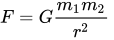
Yes, last time anyone checked, gravitation acceleration only changes minutely as one moves from one point on the planet's surface to another. This is because the first mass in the equation (Earth mass) is not a point mass at all, and really, neither is the object being allowed to fall in the vacuum. More rigorously, the size of the object does matter in the limit that it may no longer be considered to be a point mass, i.e., a large hollow sphere. The top of the ball is not accelerated identically to the bottom of the ball, so tell me does it matter in calculating the time at which it strikes the ground? Do we have to derive the gravitational force every time we put a new shape into play, or does symmetry rule out?
Why are the numbers magic ? Are all numbers magic ? Has an incantation or special blessing been applied to these numbers to set them apart from all of the ordinary numbers ? This is an engineering website so could these be specific mathematical numbers ?
Good Answers:
"Almost" Good Answers: