Previous in Forum: Select One of Different Sized Matrices Simulink (PLC Compatible)   Next in Forum: MCCB Dilemma
Close
Close
Close
9 comments
Rate Comments: Nested
Anonymous Poster #1

Neutral Shift

11/17/2016 5:41 AM

How to measure the Neutral to Ground voltages in ungrounded system?
If VT's are connected phase to ground it measures phase to ground voltages. To determine the neutral shift one need to know the neutral point. How is the neutral point derived?
Blackburn book says, Vng=V0. Thus neutral shift is the zero sequence voltage. but Isn't Vng=3V0?

Reply
Interested in this topic? By joining CR4 you can "subscribe" to
this discussion and receive notification when new comments are added.

Good Answers:

These comments received enough positive votes to make them "good answers".

"Almost" Good Answers:

Check out these comments that don't yet have enough votes to be "official" good answers and, if you agree with them, vote them!
Guru
Engineering Fields - Electrical Engineering - Been there, done that. Engineering Fields - Control Engineering - New Member

Join Date: Dec 2008
Location: Long Island NY
Posts: 15600
Good Answers: 981
#1

Re: Neutral Shift

11/17/2016 8:46 AM

Just because a transformer has no wire connecting the neutral (return) to Earth doesn't mean that it is ungrounded. There is still an uncontrolled high resistance path to ground through the wiring insulation.

__________________
"Don't disturb my circles." translation of Archimedes last words
Reply
Guru

Join Date: Dec 2010
Posts: 1686
Good Answers: 116
#2

Re: Neutral Shift

11/17/2016 12:47 PM

There is no neutral point in an ungrounded system.

If your ungrounded system is powered by a Y transformer winding [a grounded mid-point/common point of the Y would be called neutral] one must suppose you mean the voltage to ground of the centre of the star.

I think the Vo in the book is the physical voltage between the common star point of the winding and ground.

If you add the three VT voltages together, then the symmetrical positive and negative sequence voltages sum to zero, leaving the additive zero sequence voltages.

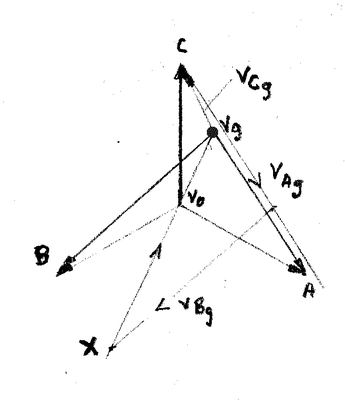
I have drawn a diagram below graphically summing the 3 VT voltages. In a real installation, the secondary windings of the VTs could be connected in "open delta" - VTs may have two secondary windings so both the "Y" voltages and the "open delta" voltages can be got simultaneously. For "open delta", "hot" of one VT secondary is connected to "ground" of the next, leaving one corner to be connected to meters or relays.

The symmetrical voltages to "star point" Vo are A-Vo, B-Vo, C-Vo.

A ground point Vg has been selected at random, with voltages to ground, the VT voltages VAg, VBg, VCg.

I have drawn in vectors VAg and VBg transposed to sum with VCg as the secondary winding voltages of VTs would sum. The open arrows > indicate their directions, please excuse the extension line of VAg, which I should have rubbed-out.

The sum of the 3 VT voltages is X-Vg. Note it is in phase with the Vo to ground vector and 3 times the length.

If the system were fed by a delta power winding or generator, the neutral point could be only theoretical but usefull as a concept to quantify unbalance.

Obviously, voltage from Vo to ground, results in a non-zero open delta voltage. If Vo were connected to ground by a resistor, such an offset could indicate an earth fault.

Reply Score 1 for Good Answer
Guru

Join Date: Dec 2010
Posts: 1686
Good Answers: 116
#9
In reply to #2

Re: Neutral Shift

11/18/2016 6:42 PM

The "Anonymous post" question was about "How to measure the Neutral to Ground voltages in ungrounded system?". There is not any neutral point, the centre point of a star winding which would be earthed in a system with neutral is the nearest, but since the proposal is that "Vng = Vo", this requires answer.

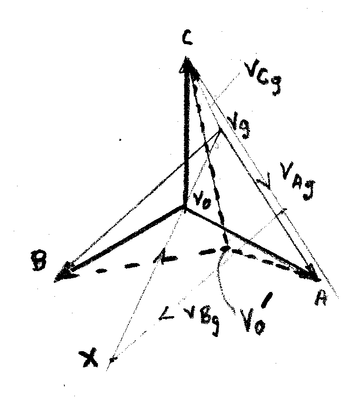
I have added a point Vo' with star voltages A-Vo', B-vo', C-Vo', which still give a symmetrical Δ voltage ABC.

Note VAg, VBg, VCg are unchanged.

But Vo' to ground is not the same as Vo to ground.

So the VT voltages to ground can give you a zero sequence voltage Vo, a useful single number unbalance indicator, but they cannot tell the middle "neutral" voltage of the Y winding.

Conclusion is that Vng ≠ Vo if the system is not earthed by connecting the neutral to earth through a resistor.

Direct connection of neutral to earth in a real system is still a resistance because a single earth rod is only ~30 ohm in good conductive soil and even substation earthing is usually specified 0.5 ohm.

67model

Reply
2
Guru

Join Date: Apr 2010
Location: About 4000 miles from the center of the earth (+/-100 mi)
Posts: 9910
Good Answers: 1141
#3

Re: Neutral Shift

11/17/2016 1:47 PM

If the system is truly ungrounded (isolated from ground) then you wouldn't measure phase voltage to ground or neutral voltage to ground. (It's like you are trying to measure voltage by just connecting one lead to the circuit.)

If there is a ground fault (low resistance to ground) on one of the phases, then that phase becomes "ground" and the other two phases and the neutral will have voltage with respect to ground.

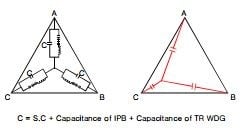
There is almost always some AC coupling through parasitic capacitance, and the relative coupling between the phases and ground will shift the neutral point, although the coupling impedance will generally be high.

This paper explains it.

Reply Good Answer (Score 2)
Guru

Join Date: Dec 2010
Posts: 1686
Good Answers: 116
#4
In reply to #3

Re: Neutral Shift

11/18/2016 7:41 AM

Rixter,

Your first two paragraphs can only confuse the questioner!

The first suggests a totally isolated system - which does not exist.

The second suggests the other two phases/neutral do not have a voltage to ground until one phase is "earthed".

Questioner's reference to VTs makes it clear this is a realistic (high voltage) system and question is about how voltages to a "neutral" point can be measured, with knowledge that the zero sequence voltage is relevant.

The commendable diagrams you add go on to show that capacitance to ground (and inductance of VT primaries and leakage resistance[not drawn!]) do cause phases and "neutral" to have voltages to ground of uncertain value - due to "unbalance" of a practical system which has no designed resistive earthing.

67model

Reply
Guru
Popular Science - Weaponology - New Member Safety - ESD - New Member Hobbies - Fishing - New Member

Join Date: Sep 2006
Location: Near Frankfurt am Main, Germany. 50.390866N, 8.884827E
Posts: 17996
Good Answers: 200
#8
In reply to #3

Re: Neutral Shift

11/18/2016 10:42 AM

Maybe I am clever, but your explanation made perfect sense to me......and several others here too, thanks.

Not confusing at all.....

__________________
"What others say about you reveals more about them, than it does you." Anon.
Reply
Guru
United Kingdom - Member - Indeterminate Engineering Fields - Control Engineering - New Member

Join Date: Jan 2007
Location: In the bothy, 7 chains down the line from Dodman's Lane level crossing, in the nation formerly known as Great Britain. Kettle's on.
Posts: 32175
Good Answers: 839
#5

Re: Neutral Shift

11/18/2016 8:57 AM

Is there another similar installation nearby that is available for study, perhaps?

__________________
"Did you get my e-mail?" - "The biggest problem in communication is the illusion that it has taken place" - George Bernard Shaw, 1856
Reply
Guru

Join Date: Jul 2016
Posts: 1367
Good Answers: 105
#6

Re: Neutral Shift

11/18/2016 9:01 AM

The Neutral point is the line to line voltage divided by the square root of 3.

The neutral shift is implied by the 3 voltages measured to ground by your VTs.

The extreme neutral shift is when one of your VTs measures 0V, indicating a ground (fault) on one of the 3 phase legs.

Reply
Guru

Join Date: May 2010
Location: Metro.Manila, Philippines.
Posts: 1269
Good Answers: 27
#7

Re: Neutral Shift

11/18/2016 9:20 AM

You are correct with your understanding of the theory...which are based on Ideal conditions!

Which in real world applications will be limited due to imperfections! Inperfections in materials, manufacturing, processes, etc., that need considerations.

Leakage currents is an example I believe you failed to consider and include in your analyses!

__________________
vsar
Reply
Reply to Forum Thread 9 comments

Good Answers:

These comments received enough positive votes to make them "good answers".

"Almost" Good Answers:

Check out these comments that don't yet have enough votes to be "official" good answers and, if you agree with them, vote them!
Copy to Clipboard

Users who posted comments:

67model (3); Andy Germany (1); PWSlack (1); redfred (1); Rixter (1); rwilliams (1); vsar (1)

Previous in Forum: Select One of Different Sized Matrices Simulink (PLC Compatible)   Next in Forum: MCCB Dilemma

Advertisement