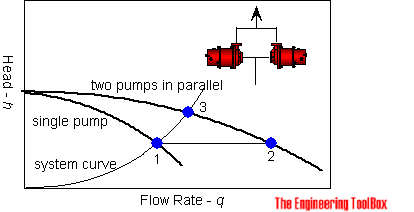
Scenario I: You three identical centrifugal pumps, operating point is whatever power input and 20 psig outlet pressure with 100 gpm. Placing these pumps in parallel (with a suitable change in pipe size as needed) will do what? I say you will have 20 psig with 300 gpm. That appears to be a trivial question. What do you say?
Scenario II: Again you are presented with the same three identical pumps as Scenario I, but this time you place the pumps in series. Each pump will increase the pressure by 20 psig at 100 gpm. What is the new pressure and flow rate, without changing the pipe at the discharge point? You may assume that whatever pressure is generated, the pump casings can withstand that. I say the outlet pressure is now 60 psig at 100 gpm. What do you say?
If you have a pump with output of 30 psig and 10,000 gpm operating in a plant basement, 30 ft below ground, and you have a 4" line branching off the main header (20" diameter) so that the pressure at the branch point is 35 psig, ignore the length of pipe and number of 90 degree turns, etc., and state what the pressure will be 5 ft above ground where this 4" pipe is discharged to a small heat exchanger rated for 150 gpm. The heat exchanger discharges back in the basement at the suction of the circulating water pump. I say the pressure will be about 15-17 psig, (wild guess).


 Parallel Pumps Versus Serial Pumps


 Re: Parallel Pumps Versus Serial Pumps




"Almost" Good Answers: