Previous in Forum: Garage Door Opener Shaft Drive Conversion   Next in Forum: 6.6-kV 1300-kW VPI HT Motor Failure
Close
Close
Close
22 comments
Rate Comments: Nested
Associate

Join Date: Jan 2010
Location: Singapore
Posts: 26

Voltage Induction in Control Cable by Adjacent Power Cable

12/29/2016 4:10 AM

Not sure where to attack this question from, so any help would be appreciated.

In a plant I am working in, we have pilot cables laid under ground next to 11kV cables (in the trench). We had some tripping which is coincident with the load changes (within the capacity) on one transformer causing tripping on other electrically unrelated feeder, there is a single earth fault on dc control circuit as well.

I'm trying to calculate approximately what the induced emf could potentially reach if I presume the pilot cable is laid at a set distance away from the HV cable.

Can somebody help me with formulae / method to calculate induced emf ?

Register to Reply
Interested in this topic? By joining CR4 you can "subscribe" to
this discussion and receive notification when new comments are added.

Good Answers:

These comments received enough positive votes to make them "good answers".

"Almost" Good Answers:

Check out these comments that don't yet have enough votes to be "official" good answers and, if you agree with them, vote them!
Guru
United Kingdom - Member - Indeterminate Engineering Fields - Control Engineering - New Member

Join Date: Jan 2007
Location: In the bothy, 7 chains down the line from Dodman's Lane level crossing, in the nation formerly known as Great Britain. Kettle's on.
Posts: 32175
Good Answers: 839
#1

Re: Voltage induction in control cable by adjacent power cable

12/29/2016 4:24 AM

It depends upon the impedance in the signal cable. For example a 4-20mA analog control signal is generally inert to induced voltages, particularly if it is galvanically isolated from ground/earth, which is why the technique is used.

  • Correcting the known earth fault in the control circuit is, therefore, a priority over calculating induced emfs.
  • The second priority is separating the cables to reduce/eliminate the cross-talk.
  • The third is changing to current signals rather than voltage ones.

Make it so!

__________________
"Did you get my e-mail?" - "The biggest problem in communication is the illusion that it has taken place" - George Bernard Shaw, 1856
Register to Reply
Associate

Join Date: Jan 2010
Location: Singapore
Posts: 26
#2
In reply to #1

Re: Voltage induction in control cable by adjacent power cable

12/29/2016 4:38 AM

Yes, I agree with your recommendations & can propose it as a solution, but first need to prove in ‘what & how it happened?’ and for that have to calculate if any significant voltage was induced in control cable because of current change in nearby power cable.

As correctly guessed by you, existing cables are unshielded, multicore cables (not twisted pair) & used for voltage signals. Relays on multiple feeders which caused tripping are set for 5msec pulse input.

Register to Reply
Guru
United Kingdom - Member - Indeterminate Engineering Fields - Control Engineering - New Member

Join Date: Jan 2007
Location: In the bothy, 7 chains down the line from Dodman's Lane level crossing, in the nation formerly known as Great Britain. Kettle's on.
Posts: 32175
Good Answers: 839
#3
In reply to #2

Re: Voltage induction in control cable by adjacent power cable

12/29/2016 4:55 AM

Why calculate? What information would it give other than "there is a problem"? Waste of time, because that's already known: three out of three priorities above have been agreed already in #2⇑. Calculating stuff only wastes more of it, because the problem has arrived after the design event, which is the true root cause, has been completed and the maintenance backlog, which is secondary, has been acknowledged.

  • If the cables were installed according to a design protocol, then its creation and enforcement would be time better spent - and there are protocols that organisations use already. The IEEE, for example, may already have one that can be used by reference from existing design procedures.
  • If cables were properly maintained, instead of allowing a known earth fault to persist to the point where a lone cry for help were made via a global anonymous Engineering forum such as this one, then that would be a better use of time.

Make it so!

<unsubscribes>

__________________
"Did you get my e-mail?" - "The biggest problem in communication is the illusion that it has taken place" - George Bernard Shaw, 1856
Register to Reply
Guru

Join Date: Dec 2016
Posts: 2914
Good Answers: 115
#4
In reply to #2

Re: Voltage induction in control cable by adjacent power cable

12/29/2016 9:02 AM

"... but first need to prove in ‘what & how it happened?’ ..."

Who is demanding proof? Management? In spite of the fact that the design violates best practices which have been known about for what, 70 years or so at the very least? What are they asking for? Proof that physics still works the same as it did back then?

Register to Reply
Guru
Safety - Hazmat - New Member United States - US - Statue of Liberty - New Member Engineering Fields - Chemical Engineering - Old Hand

Join Date: Mar 2011
Location: Lubbock, Texas
Posts: 14331
Good Answers: 162
#9
In reply to #2

Re: Voltage induction in control cable by adjacent power cable

12/29/2016 4:32 PM

Why using voltage signals rather than industry standard current signals?

You need to know the impedance of the trench, the ground, and any insulation (at least I hope that there is some) on the signal cable bundle.

Without insulation, all one really has is insultation. You could see effectively a transient as large as the field potential on the power cable (showing up as rate of change potential), and I assume your project is not HVDC, so a sudden trip on the field bus results in transients in all parallel runs of cabling to the field bus.

__________________
If it ain't broke, don't fix it. Just build a better one.
Register to Reply
Guru
Safety - Hazmat - New Member United States - US - Statue of Liberty - New Member Engineering Fields - Chemical Engineering - Old Hand

Join Date: Mar 2011
Location: Lubbock, Texas
Posts: 14331
Good Answers: 162
#8
In reply to #1

Re: Voltage induction in control cable by adjacent power cable

12/29/2016 4:28 PM

Energize!

__________________
If it ain't broke, don't fix it. Just build a better one.
Register to Reply
Guru
Engineering Fields - Power Engineering - New Member

Join Date: May 2007
Location: NYC metropolitan area.
Posts: 3230
Good Answers: 444
#5

Re: Voltage Induction in Control Cable by Adjacent Power Cable

12/29/2016 9:55 AM

Calculating the induced voltage is easy, but there are other questions to answer to determine if it is even necessary. Is this an old or new installation? If old, is this a new problem or one that has happened before? Has any work been done on any of the equipment attached to any of these cables? Have the trenches been subject to any heavy equipment movement or other disturbances? How long are the parallel runs?

What's the story behind the "single earth fault", what was the nature of the damage, where was it, how did it occur, how was it determined, how was it repaired, has the problem recurred since the repair, etc.?

Simply calculating the induced voltage will tell you....what the induced voltage is, unless it is unusually high it won't tell you how what the failure mechanism is. And if it is unusually high, you would expect more than one circuit to be affected.

__________________
“Tell me and I forget. Teach me and I remember. Involve me and I learn.” Ben Franklin.
Register to Reply
Associate

Join Date: Jan 2010
Location: Singapore
Posts: 26
#11
In reply to #5

Re: Voltage Induction in Control Cable by Adjacent Power Cable

12/29/2016 6:27 PM

1. This is an old installation, 20+ years.

2. There is no history of this kind of problem. But this kind of sudden load change also not experienced earlier.

3. Work was ongoing on the other feeder in the same switchboard, control supply for that feeder was isolated.

4. There was no heavy equipment movement on trench.

5. Parallel run is about 150m.

6. Single dc earth fault is still under investigation, not repaired yet.

To rule out different possibilities one by one, I need to calculate induced voltage. If you can help me with formula / method, at least I can get some idea.

Register to Reply
Guru

Join Date: Feb 2013
Posts: 2004
Good Answers: 31
#15
In reply to #11

Re: Voltage Induction in Control Cable by Adjacent Power Cable

12/30/2016 5:25 AM

I agree that finding the induced load is pointless as the tripping has already occurred.

First point of check is the work done on the other side of the board, if this is a new termination on an 11kV cable then check the stress cones are not touching, i.e. if the cores are crossed for phasing, and if there is less than 25mm at the point where the stress cones should be, (crossing), this can cause 27kV to be induced in the crossed cores and 27kV found on the phases.

The spacing between the control cable and 11kV cable should be no less than 110-220mm in the cable run.

Depending on your 11kV feeder type, XLPE, 3 core or single core, or PILC 3 core and the type of earthing used, this can cause induction. PILC cables normally do not have screened cores as the lead does this. XLPE has core screens and can be collectively screened. So if the cable is screened, earthed at the switchgear side only,there should be no induction.

Judging by your incomplete notes and information, which offer answers of pure speculation, I would look at the new work on the other side of the panel for the fault. Look at earthing of the cable and core separation on the termination. If a gland is installed and the type of metal the gland plate is made of.

Register to Reply
Guru

Join Date: Oct 2012
Location: 100 miles North from the World Center
Posts: 879
Good Answers: 42
#6

Re: Voltage Induction in Control Cable by Adjacent Power Cable

12/29/2016 11:45 AM

First of all I agree with above commentaries: usually you have to keep the standard distance

and protection measures. See for instance NESC [ANSI C2] Part 3: Safety Rules for Underground Lines.

If you intend to calculate the induced emf there are a lot of publication.

See for instance:

file:///C:/Users/user/Downloads/Calculation_Method_for_Normal_Inducedlon%20(1).pdf

The pilot wire has to be treated as a high voltage ,in my opinion, since it could transfer the

potential from a remote grounding grid in a ground fault case.

__________________
Julius
Register to Reply
Associate

Join Date: Jan 2010
Location: Singapore
Posts: 26
#10
In reply to #6

Re: Voltage Induction in Control Cable by Adjacent Power Cable

12/29/2016 6:16 PM

Can you share that pdf file please?

Register to Reply
Guru

Join Date: Oct 2012
Location: 100 miles North from the World Center
Posts: 879
Good Answers: 42
#13
In reply to #10

Re: Voltage Induction in Control Cable by Adjacent Power Cable

12/29/2016 11:40 PM

Sorry!

http://www.ijera.com/papers/Vol4_issue9/Version%206/W4906159166.pdf

__________________
Julius
Register to Reply
Guru
Engineering Fields - Electrical Engineering - Been there, done that. Engineering Fields - Control Engineering - New Member

Join Date: Dec 2008
Location: Long Island NY
Posts: 15601
Good Answers: 981
#7

Re: Voltage Induction in Control Cable by Adjacent Power Cable

12/29/2016 2:17 PM

Maxwell's equations will answer your question on how to predict coupling effects but going through this three dimensional analysis will not solve this problem. It might even put your job in jeopardy if your analysis is in error. Measuring the coupling effects can help you to convince management that you do understand what is happening so they might attempt your solution.

__________________
"Don't disturb my circles." translation of Archimedes last words
Register to Reply
Guru
Engineering Fields - Power Engineering - New Member

Join Date: May 2007
Location: NYC metropolitan area.
Posts: 3230
Good Answers: 444
#12

Re: Voltage Induction in Control Cable by Adjacent Power Cable

12/29/2016 8:27 PM

Thanks for the feedback, but you haven't convinced me that your problems have anything to do with induced voltage, especially since the parallel run is under 500ft and the cables are more than a foot away. I would be looking at old age, settling/compression/disturbance of the fill, degradation of the insulation, treeing, etc.

You may even find that the "...Single dc earth fault..." is related to the problem, as is the work on the other feeder.

If you insist that induced voltage is the place you want to start, then here's some good info to start with. You can finish with a search on the phrase "induced voltage on control cables", then start to do some real forensic engineering instead of following somebody else's SWAG. After all, why did it take 20 years for this problem to manifest itself??

__________________
“Tell me and I forget. Teach me and I remember. Involve me and I learn.” Ben Franklin.
Register to Reply
2
Guru
United Kingdom - Member - Indeterminate Engineering Fields - Control Engineering - New Member

Join Date: Jan 2007
Location: In the bothy, 7 chains down the line from Dodman's Lane level crossing, in the nation formerly known as Great Britain. Kettle's on.
Posts: 32175
Good Answers: 839
#14
In reply to #12

Re: Voltage Induction in Control Cable by Adjacent Power Cable

12/30/2016 4:30 AM

<...why did it take 20 years for this problem to manifest itself...>

According to #11⇑, it is a recent problem.

Smart money is on the DC ground fault that has been declared also as a recent problem; sort that out, and the problem goes away [11:8 favourite].

__________________
"Did you get my e-mail?" - "The biggest problem in communication is the illusion that it has taken place" - George Bernard Shaw, 1856
Register to Reply Good Answer (Score 2)
Guru

Join Date: Oct 2012
Location: 100 miles North from the World Center
Posts: 879
Good Answers: 42
#16

Re: Voltage Induction in Control Cable by Adjacent Power Cable

12/30/2016 4:36 PM

You may use formula no.D.1) from Annex D from IEEE 575:

[IEEE Std 575-2014 IEEE Guide for Bonding Shields and Sheaths of Single-Conductor Power Cables Rated 5 kV through 500 kV]

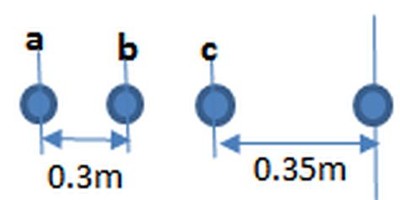
Ep=j*w*Ib*2/10^7*(1/2*LN(Sap*Scp/Sbp)+j*sqrt(3)/2*ln(Scp/Sap)) [V/m]

where w=2*pi()*freq ; Sap,Sbp,Scp are the distances between conductor a,b,c of the power cable to conductor p [parallel laid.]; Ib current flowing in the power cable.

If we put the conductors in a straight line with conductor p at distance of 300 mm from the

close c and a distance of 300 mm between power cable conductors then for a current of

1000 A flowing through each phase of the power cable along 150 m the inducted voltage in

cable p will be 8.74 V.

__________________
Julius
Register to Reply Score 1 for Good Answer
Associate

Join Date: Jan 2010
Location: Singapore
Posts: 26
#18
In reply to #16

Re: Voltage Induction in Control Cable by Adjacent Power Cable

12/30/2016 8:21 PM

Thank you so much..

Relay rated voltage is 110V & induced 9V is nowhere near to it, then induced voltage doesn't look like the real cause of tripping.

Actually 3 feeders tripped triggered by same BI of each relay going high & if it has to happen solely because of earth fault then there has to be multiple earth faults same time & how is it related to load changes then? still wondering

Register to Reply
Guru

Join Date: Dec 2010
Posts: 1686
Good Answers: 116
#20
In reply to #18

Re: Voltage Induction in Control Cable by Adjacent Power Cable

01/02/2017 5:16 PM

Does your diagram mean the earth fault is to + of DC supply as drawn?

The usual voltage-operated earth fault relay on the DC supply cannot tell if you have one or several earth faults.

Register to Reply
Guru

Join Date: Oct 2012
Location: 100 miles North from the World Center
Posts: 879
Good Answers: 42
#19
In reply to #16

Re: Voltage Induction in Control Cable by Adjacent Power Cable

12/30/2016 11:39 PM

Sorry. I have to correct the formula:

Ep=j*w*Ib*2/10^7*(1/2*LN(Sap*Scp/Sbp^2)+j*sqrt(3)/2*LN(Scp/Sap)) [V/m]

__________________
Julius
Register to Reply
Power-User

Join Date: Sep 2016
Location: SPAIN
Posts: 233
Good Answers: 13
#17

Re: Voltage Induction in Control Cable by Adjacent Power Cable

12/30/2016 6:21 PM

According to the description, you must have and EMC issue.

If your pilot cables are shielded (they should be) try connecting the shield to the measuring end or to both ends, and see if it gets better. In many cases EMC troubleshooting works better than calculations.

If you want a book, try "EMC Engineering" from Henry W. Ott, Chapter 2 (Cabling).

__________________
Building the future!
Register to Reply
Associate

Join Date: Mar 2015
Posts: 33
Good Answers: 1
#21

Re: Voltage Induction in Control Cable by Adjacent Power Cable

01/03/2017 10:44 AM

Do a rough calculation of the capacitance between the cables. Use this capacitance and the approximate frequency of the 'load change impulse' signal to determine the energy that may be transferred to the pilot cable. Assume that the 11kV cable is very low impedance. Get the best info you can as to the impedance of the pilot cable and the expected voltage/current effect can be calculated. Refinement will get you to better than order of magnitude results pretty fast.

Register to Reply
Guru

Join Date: Oct 2012
Location: 100 miles North from the World Center
Posts: 879
Good Answers: 42
#22
In reply to #21

Re: Voltage Induction in Control Cable by Adjacent Power Cable

01/04/2017 1:13 AM

If we take the 11 kV cable as a 3 phase cable and equilibrated voltages then the current transferred through capacitance is zero. If we take it as 3 single phase cables dispersed as per above16# , the capacitive reactance will be 149, 172, 187 megohms and the total current from 11 kV cable to pilot cable will be 7.625 microampere [1/10^6].

__________________
Julius
Register to Reply
Register to Reply 22 comments

Good Answers:

These comments received enough positive votes to make them "good answers".

"Almost" Good Answers:

Check out these comments that don't yet have enough votes to be "official" good answers and, if you agree with them, vote them!
Copy to Clipboard

Users who posted comments:

67model (1); 7anoter4 (5); Andrew Westman (1); IQ (1); Ivanov327950 (1); James Stewart (2); jhotmer (1); nshingate (4); PWSlack (3); RAMConsult (2); redfred (1)

Previous in Forum: Garage Door Opener Shaft Drive Conversion   Next in Forum: 6.6-kV 1300-kW VPI HT Motor Failure

Advertisement