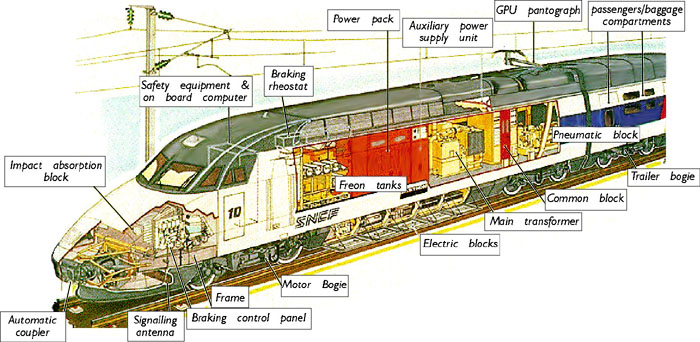
We follow the power chain from pantograph to wheels, in the specific case of the TGV Atlantique 24000 series power car. The TGV 24000 does not contain any particularly exotic components, and in principle shares many of its features with most modern electric (and even diesel-electric) locomotives. The drawing below shows a cutaway view of the 24000, and is followed by a more detailed description. There are two power cars per trainset; each develops 4400 kW (5900 hp) and weighs just 68 tonnes (150,000 lb).
From what I can gather, the TGV only takes power from the catenary for around 10% of the time, the rest is spent free-wheeling. Braking is regenerative, so when slowing down power is fed back into the overhead, and thus into the grid.
The control electronics are impressive, both in size and power...
__________________
"Experience is a combination of the mistakes we have made, and those which we have seen made by others..." simeonlapinbleu.googlepages.com/home
I thought that wildly optomistic for a 300 Kph vehicle, I there was such a large difference in the power required for acceleration and that required for running flywheels or some such energy storage system would be appropriate