Previous in Forum: distribution network engineer   Next in Forum: Oxidization over flex wire - solution
Close
Close
Close
19 comments
Rate Comments: Nested
Anonymous Poster

Weight of Material at water

12/06/2008 1:10 AM

Dear All,

Please explain when a weighted material drop from a certain height in the air reaches the ground quick & it breaks down in to pieces when it hits the ground.But the same material dropped down at water even at higher water depth it does not breaks.

Whats the reason behind that?

Reply
Interested in this topic? By joining CR4 you can "subscribe" to
this discussion and receive notification when new comments are added.

Good Answers:

These comments received enough positive votes to make them "good answers".

"Almost" Good Answers:

Check out these comments that don't yet have enough votes to be "official" good answers and, if you agree with them, vote them!
Guru
Popular Science - Biology - New Member Hobbies - Musician - New Member APIX Pilot Plant Design Project - Member - New Member Hobbies - CNC - New Member Fans of Old Computers - ZX-81 - New Member

Join Date: Jan 2007
Location: Centurion, South Africa
Posts: 3921
Good Answers: 97
#1

Re: Weight of Material at water

12/06/2008 3:35 AM

The surface of the water can deform and will act as a shock absorber. Sand , plasticine, sponge etc will have a similar effect.

At high speed water is also hard and will break some objects. Have a look at a speed boat accident.

A thin walled glass ornament may also break on water.

What object did you use?

__________________
Never do today what you can put of until tomorrow - Student motto
Reply
Anonymous Poster
#2
In reply to #1

Re: Weight of Material at water

12/06/2008 7:25 AM

Dear Sir,

If we considered stone as material.What induces the stone at air fall fast & what phenomenon happen when it is thrown in water.Please explain.

Reply
Guru

Join Date: Jul 2007
Posts: 4448
Good Answers: 143
#3

Re: Weight of Material at water

12/06/2008 8:16 AM

It sounds like you're talking about a stone falling through air as compared to a stone falling through water. Is that correct? If so, the drag will be be significantly different.

__________________
"Well, I've wrestled with reality for 35 years, Doctor, and I'm happy to state I finally won out over it." Elwood P. Dowd
Reply
Guru
Hobbies - Fishing - Old Salt Hobbies - CNC - New Member United States - US - Statue of Liberty - New Member

Join Date: Mar 2007
Location: Rosedale, Maryland USA
Posts: 5197
Good Answers: 266
#4

Re: Weight of Material at water

12/06/2008 10:53 AM

Water is more dense then air so the drag it places on the object keeps it velocity lower. The velocity at which the object impacts the bottom in water is not great enough to shatter the object.

__________________
Life is not a journey to the grave with the intention of arriving in a pretty, pristine body but rather to come sliding in sideways, all used up and exclaiming, "Wow, what a ride!"
Reply
Guru
Popular Science - Biology - New Member Hobbies - Musician - New Member APIX Pilot Plant Design Project - Member - New Member Hobbies - CNC - New Member Fans of Old Computers - ZX-81 - New Member

Join Date: Jan 2007
Location: Centurion, South Africa
Posts: 3921
Good Answers: 97
#5

Re: Weight of Material at water

12/06/2008 1:39 PM

An object falling through air will reach a terminal velocity when the downward force of gravity equal the upward force of drag.

have a look here. http://en.wikipedia.org/wiki/Terminal_velocity

Because water is denser than air the drag in water will be greater and the terminal velocity will be slower.

Also think about the drag changing as the shuttle reenter the atmosphere.

The object will also ¨float" because of the weight of the water displaced must be taken in account.

__________________
Never do today what you can put of until tomorrow - Student motto
Reply
Anonymous Poster
#6
In reply to #5

Re: Weight of Material at water

12/07/2008 5:53 AM

The object is falling thrugh air both times. It hits the ground on one test and breaks and hits water on the second test but does not break.

Reply
2
Guru
United Kingdom - Member - Not a new member!

Join Date: Jun 2008
Location: USA/Europe
Posts: 4547
Good Answers: 68
#7

Re: Weight of Material at water

12/07/2008 6:39 AM

Hello Guest,

Hendrik gave a very good answer.

The water is 'soft' and does act by moving away from the impact which absorbs some of the energy of the object. If the object is fragile and/or moving fast, water acts as a solid at high speed which is why speed boats and aircraft smash in water.

That answers your question but, the Physics of terminal velocity are really interesting, which is why I have pasted this piece below. Including the Maths. Of course Terminal Velocity here is described in air before anything reached earth.

This is a description of 'Terminal Velocity'.

An object reaches terminal velocity when the downward force of gravity equals the upward force of drag. The net for on the object is then zero, and the result is that the velocity of the object remains constant.

In physics, terminal velocity is the velocity at which the drag force of a falling object equals the weight of the object minus the buoyant force, which halts acceleration and causes speed to remain constant. Terminal velocity may refer to the following: Terminal velocity, (a) the final speed (usually an impact speed) achieved by an object at the end of its path (where gravity, applied physical acceleration and dragging effects may all play a part), and (b) in skydiving, the maximum speed achievable for a... Image File history File links Terminal_Velocity. ... Image File history File links Terminal_Velocity. ... This is a discussion of a present category of science. ... In physics, velocity is defined as the rate of change of displacement or the rate of displacement. ... An object falling through a gas or liquid experiences a force in direction opposite to its motion. ... In physics, buoyancy is the upward force on an object produced by the surrounding fluid (i. ...


As an object accelerates (usually downward due to gravity), the drag produced by the passing through a fluid medium, (usually air), increases. At a particular speed, the drag force produced will be equal to the downward force, mostly the weight (mg), of the object. Eventually, it plummets at a constant speed called terminal velocity. Terminal velocity varies directly with the ratio of drag to mass. More drag means slower terminal velocity. Increased mass means higher terminal velocity. An object moving downward at greater than terminal velocity (for example because it was affected by a force downward or it fell from a thinner part of the atmosphere or it changed shape) will slow until it reaches terminal velocity. An object falling through a gas or liquid experiences a force in direction opposite to its motion. ...


For example, the terminal velocity of a skydiver in a normal free-fall position with a closed parachute is about 195 km/h (120 mph or 54 m/s). This velocity is the asymptotic limiting value of the acceleration process, since the effective forces on the body more and more closely balance each other as it is approached. In this example, a speed of 50% of terminal velocity is reached after only about 3 seconds, while it takes 8 seconds to reach 90%, 15 seconds to reach 99% and so on. Skydiver about to land Parachuting, or skydiving, is a recreational activity, competitive sport and method of deployment of military personnel (and occasionally, firefighters). ... Free Fall opens with one of the most stunning first paragraphs I have ever, or am ever likely to, read. ... This article is about the device. ... Kilometre per hour (American spelling: kilometer per hour) is a unit of both speed (scalar) and velocity (vector). ... Miles per hour is a unit of speed, expressing the number of international miles covered per hour. ... Metre per second (U.S. spelling: meter per second) is an SI derived unit of both speed (scalar) and velocity (vector), defined by distance in metres divided by time in seconds. ... An asymptote is a straight line or curve which a curve approaches as one moves along the curve. ...


Higher speeds can be attained if the skydiver pulls in his limbs (see also free-flying). In this case, the terminal velocity increases to about 320 km/h (200 mph or 89 m/s), which is also the maximum speed of the peregrine falcon diving down on its prey. Competition speed skydivers fly in the head down position reach even higher speeds. Current world record is 614 km/h or 382 mph.


An object falling will fall 9.81 meters per second faster every second (9.81 m/s²). The reason an object reaches a terminal velocity is that the drag force resisting motion is directly proportional to the square of its speed. At low speeds the drag is much less than the gravitational force and so the object accelerates. As it speeds up the drag increases, until eventually it equals the weight. Drag also depends on the cross sectional area. This is why things with a large surface area such as parachutes have a lower terminal velocity than small objects like cannon balls. For other uses, see Weight (disambiguation). ... A 3-D view of a beverage-can stove with a cross section in yellow. ... Area is a physical quantity expressing the size of a part of a surface. ...


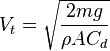
Mathematically, terminal velocity is given by In physics, velocity is defined as the rate of change of displacement or the rate of displacement. ...

see derivation

where Derivations from Terminal velocity. ...

Vt is the terminal velocity, m is the mass of the falling object, g is gravitational acceleration at the Earth's surface, Cd is the drag coefficient, ρ is the density of the fluid the object is falling through, and A is the object's cross-sectional area.

So it can be said that, on Earth, the terminal velocity of an object changes due to the properties of the fluid, mass and the cross sectional area of the object. This article or section is in need of attention from an expert on the subject. ... g (also gee, g-force or g-load) is a non-SI unit of acceleration defined as exactly 9. ... The drag coefficient (Cd, Cx or Cw, depending on the country) is a dimensionless quantity that describes a characteristic amount of aerodynamic drag caused by fluid flow, used in the drag equation. ... For other uses, see Density (disambiguation). ... A fluid is defined as a substance that continually deforms (flows) under an applied shear stress regardless of the magnitude of the applied stress. ...


This equation is derived from the drag equation by setting drag equal to mg, the gravitational force on the object. In physics, the drag equation gives the drag experienced by an object moving through a fluid. ...


Note that the density increases with decreasing altitude, ca. 1% per 80 m (see barometric formula). Therefore, for every 160 m of falling, the "terminal" velocity decreases 1%. After reaching the local terminal velocity, while continuing the fall, speed decreases to change with the local terminal velocity. The barometric formula, sometimes called the exponential atmosphere or isothermal atmosphere, is a formula used to model how the pressure (or density) of the air changes with altitude.

============================================

Take care, and study well.............

The Laws of Physics is the reason and answer to every movement and (reaction) of anyone or anything, whether apparently 'moving' or 'still'.

__________________
Take it easy, bb. >"HEAR & you FORGET<>SEE & you REMEMBER<>DO & you UNDERSTAND"<=$=|O|=$=>"Common Sense is Genius dressed in its Working Clothes"<>[Ralph Waldo Emerson]
Reply Good Answer (Score 2)
Guru

Join Date: Jul 2008
Location: SoCal USA
Posts: 556
Good Answers: 23
#12
In reply to #7

Re: Weight of Material at water

12/09/2008 1:51 AM

Not to be picky, I humbly submit two comments to a wonderfully detailed response.

1. Your comment was that water was 'soft . . .which absorbs some of the energy of the object' . Please note that both the water and the dirt 'absorb' all of the inertial energy since the object stops falling and comes to rest. The main difference is how fast this occurs.

2. The question seemed to me to indicate that the dropping involved was by hand, or at least close enough to the ground that the issue of terminal velocity is probably not realistic to consider, though I was impressed with it.

I posted a response with greater detail further along in this thread.

Respectfully, CJ

__________________
I do not 'know it all', but i will admit that I would like to. CJM
Reply
Guru
United Kingdom - Member - Not a new member!

Join Date: Jun 2008
Location: USA/Europe
Posts: 4547
Good Answers: 68
#14
In reply to #12

Re: Weight of Material at water

12/09/2008 3:33 AM

Hello CJMcGill:

I thought you post was pretty clear and for that I commend you.

And, yes, I was being picky!

It is an interesting subject though?

I read somewhere, not on here I don't think, a question like this:

If a fly hits a train windscreen when the train is moving at a 100 Kl hour would it stop the train far a nano second. And it is worth a thought for sure.

By the way, what went though the fly's mind as it hit the screen?

Take care.............

__________________
Take it easy, bb. >"HEAR & you FORGET<>SEE & you REMEMBER<>DO & you UNDERSTAND"<=$=|O|=$=>"Common Sense is Genius dressed in its Working Clothes"<>[Ralph Waldo Emerson]
Reply
Guru

Join Date: Jul 2008
Location: SoCal USA
Posts: 556
Good Answers: 23
#16
In reply to #14

Re: Weight of Material at water

12/09/2008 3:50 AM

Answer; his bee-hind.

And yes, though very miniscule there would be a calculable lessening of the speed of the train, but not a stopping for a moment.

__________________
I do not 'know it all', but i will admit that I would like to. CJM
Reply
Guru
United Kingdom - Member - Not a new member!

Join Date: Jun 2008
Location: USA/Europe
Posts: 4547
Good Answers: 68
#17
In reply to #16

Re: Weight of Material at water

12/09/2008 4:17 AM

Hello CJMcGill:

Answer; his bee-hind.

And yes, though very miniscule there would be a calculable lessening of the speed of the train, but not a stopping for a moment.

YES! Spot on Sir!..................And it was decided that the windscreen would flex and pretty much take all the 'force'. Though of course, it was theoretical and not something you could measure?

Thanks for the reply.

Take care.....................

__________________
Take it easy, bb. >"HEAR & you FORGET<>SEE & you REMEMBER<>DO & you UNDERSTAND"<=$=|O|=$=>"Common Sense is Genius dressed in its Working Clothes"<>[Ralph Waldo Emerson]
Reply
Power-User

Join Date: May 2007
Location: Los Angeles area, California, USA
Posts: 202
Good Answers: 9
#8

Re: Weight of Material at water

12/07/2008 5:09 PM

TIC

Subliminal surface tension.

MR. GUY

__________________
If you are looking for a positive answer..it's YUP......
Reply Off Topic (Score 5)
Guru

Join Date: Aug 2006
Posts: 4484
Good Answers: 246
#9

Re: Weight of Material at water

12/07/2008 7:08 PM

Let's call a pillow very soft, in it's ability to slow and object gently. We'll call water moderately soft. Lets' call dry sand moderate, packed dirt moderately hard and concrete hard.

Some objects (such as a large spindly glass structure) will break on contact with a pillow. Some objects, such as a boat dropped from 50', will break upon contact with water. Some objects, such as a bb dropped from 100' will not break even when dropped on concrete. So there is a balancing act between material strength, dropping speed, and surface material.

The terminal speed of a rock is quite high in air, and quite low in water. Therefore, at the surface, the rock must slow very quickly. This slowing is called an acceleration. F=MA, meaning that Force = Mass x Acceleration. The force will therefore be high if the acceleration is high (for a given mass). If the force is high enough, and the falling item weak enough, the falling item will break. Airplanes, when they hit the water, break apart. Rocks so not.

__________________
There is more to life than just eating mice.
Reply
Anonymous Poster
#10

Re: elasticity of collisions

12/08/2008 1:02 AM

Assuming the "weighted material" you speak of is a chunk of solid or liquid, perhaps the term that these answers are trying to find is elasticity. The collision (of solid or liquid) with water could be termed, elastic...in that, because because water molecules are very widely spaced, in perpetual motion, and free to move, then kinetic energy transferred from the falling object at impact is accordingly transferred to the water over a large volume and a relatively large time span.

Conversely, the constituent particles at the surface of solid ground are tightly bound and/or (in the case of soil) so closely arranged that friction prevents their motion to a degree sufficient to allow kinetic energy transfer except over a (relatively) very small range from the point of impact.

UG

You have, then, a situation in which, because the kinetic energy cannot be fully transferred to the ground (as was the case with impacted water), the kinetic energy that would have been transferred (say, in an elastic collision with water) instead dissipates within the falling, solid (or liquid) body...such dissipation which becomes sufficient to break the chemical bonds which had held the solid body together up until the time of collision. Thus, the inelastic collision results in shattering of the solid falling object.

Reply
Guru

Join Date: Jul 2008
Location: SoCal USA
Posts: 556
Good Answers: 23
#11

Re: Weight of Material at water

12/09/2008 1:26 AM

Dear Guest, At great length the physics of falling objects has been detailed, and very well I might add.

So to be concise, the critical difference is the rate of change.

More specifically your question requires the physics at point of impact. It is said about automobile accidents 'speed does not kill, it is the difference in speed (the sudden stop) that kills".

It has been duly noted how drag differs in air and water. When the falling object is subjected to a drastic and sudden change in the drag co-efficient, such as at the point of contact with water, soil, concrete, or even a vacuum or denser layer of gas, then inertial energy is exchanged.

The issue is the ability of the object to withstand receiving or dispersing energy, in this example the same or more energy (higher drop over water), in the time given for it to occur. Since the surface tension of the water is less than the surface tension of dirt, the time over which the gravitational inertia transfers is different. The distance traveled after contact with each surface is different. Depending on several factors the object will probably travel further past the surface of the water after contact than solid ground.

Calculating the difference in time and distance, though apparently small, from the point of contact to the point the energy change is complete, times the mass, will give the critical detail you are seeking.

This principle also can be illustrated by throwing an egg or water balloon by hand. If the time for the energy transfer from hand to egg is greater than the egg can withstand, things will get messy. On the other hand, a bus full of people that is slowed to a stop over a proper length of time by the brakes can withstand it better than if slowed more quickly, say by a tree.

__________________
I do not 'know it all', but i will admit that I would like to. CJM
Reply
Guru
United Kingdom - Member - Not a new member!

Join Date: Jun 2008
Location: USA/Europe
Posts: 4547
Good Answers: 68
#13
In reply to #11

Re: Weight of Material at water

12/09/2008 2:02 AM

Hello CJMcGill:

I understand what you are saying,. I was also expecting you to make a point which I have not noticed if it was made.

If an object is fragile which means it deforms less than the speed taken to slow it to a stop, it will break.

It matters not what surface a plastic ball falls onto, it will mostly absorb that contact for deformation.

The only thing to deform, where a hard object in dropped into water, is the water, thus absorbing some of the energy.

No insult implied to you OK.

Take care...................

__________________
Take it easy, bb. >"HEAR & you FORGET<>SEE & you REMEMBER<>DO & you UNDERSTAND"<=$=|O|=$=>"Common Sense is Genius dressed in its Working Clothes"<>[Ralph Waldo Emerson]
Reply
Guru

Join Date: Jul 2008
Location: SoCal USA
Posts: 556
Good Answers: 23
#15
In reply to #13

Re: Weight of Material at water

12/09/2008 3:46 AM

No insult taken, thanks.

Again however you say the water absorbs some of the energy. In fact it absorbs all of the given energy or the object would continue in motion.

Energy is not created or lost, just transformed, transferred etc. The water tension applies equal and opposite energy to the direction of travel of the object in order to stop it. 'Absorbing' the energy means there will be waves through the water, reflected waves of energy into the object, heat, light etc, all equalling the inertial energy that had the object in motion in order to stop it's motion. The 'strength' of the object is determined by the ammount of energy required to break it. Therefore determining the level of reflected energy required to break the object will be measured in terms of mass X speed. The mass does not significantly change but the speed (which involves time, mps, kps etc.) is the variable. At some speed even the plastic ball will break when hitting water.

The parameters of guest's question reveal that the energy reflected when hitting ground was greater than the energy when hitting water, enough to make the difference in breaking or not breaking. The variable in his equation is not the mass or speed of the object in motion, but the time variable of the stopping distance. This time variable is affected by the density of the stopping material, the viscosity etc, but either way the variable in the energy formula is time. Dirt stops an object much more quickly. Same formula, different time element, different result.

It all comes down to the rate of change. The delta, and the strength of the object.

__________________
I do not 'know it all', but i will admit that I would like to. CJM
Reply
Anonymous Poster
#18
In reply to #15

Re: Weight of Material at water

12/11/2008 7:54 PM

What he's trying strenuously to say, is that it breaks down to being a matter of the properties (at atomic level) of the colliding bodies...all else being secondary. To essay an explanation based primarily on dynamics such as absorption is, in effect, to answer the (OP guest's) question by begging the question--a fallacious line of reasoning.

That is to say, what Guest essentially asks is, why is the energy release in a collision between solid and water (likely to be) absorbed (with "damage" only to the water), whereas the energy release (and absorption!!) in a collision between solid and solid will result in damage (in loss of structural integrity) to at least one of the colliding solids. Such a question can only be rationally addressed with primary reference to colliding body properties, both physical and chemical. As a simple example...

Due to its own properties and those of water, Titanic was able on the one hand to collide at high speed with water over both instantaneous and extended time frames with no damage to its own, solid self. One the other hand, with only a change in the properties of water, the collision energy absorbed by the ship was sufficient to damage it severely in a very short period of time. (Curiously, when the collision resulted in least disintegration of the ship, the disruption to the water was greatest; when "damage to water" was greatest, disruption of ship integrity was least...amounting only to "normal" wear and tear on the hull and hull paint.)

PS: Note to admin/Mark: the word, disintegration, is missing from the spell check vocabulary.

Reply Score 1 for Good Answer
Guru

Join Date: Mar 2007
Posts: 2550
Good Answers: 103
#19

Re: Weight of Material at water

12/24/2008 9:07 AM

without going into terminal velocity0 if we look like this ?

The material hits the water surface-

the impulse is till the surface of water (held by surface tension) breaks - in the micro seconds that it breaks - if the force exerted is more than the cohesive force of the material - it will break on hitting even water -

If it is not, as soon as the surface breaks, it gets the archemedis float and the velocity gradually reduces with no more chance of breakage.

In case of hard surface or even dust, the surface will not break, only displace or compress and the impulse transmitted back will likely to be very high compared to liquid and then the chances of breakage will automatically be higher (some times of course we do not break our legs by falling on sand ) and air crafts degenerate - do not powder by hitting the sea

__________________
Fantastic ideas for a Fantastic World, I make the illogical logical.They put me in cars,they put me in yer tv.They put me in stereos and those little radios you stick in your ears.They even put me in watches, they have teeny gremlins for your watches
Reply
Reply to Forum Thread 19 comments

Good Answers:

These comments received enough positive votes to make them "good answers".

"Almost" Good Answers:

Check out these comments that don't yet have enough votes to be "official" good answers and, if you agree with them, vote them!
Copy to Clipboard

Users who posted comments:

Anonymous Poster (4); babybear (4); Blink (1); CJMcGill (4); Hendrik (2); Mr. Guy (1); ozzb (1); sb (1); TVP45 (1)

Previous in Forum: distribution network engineer   Next in Forum: Oxidization over flex wire - solution

Advertisement