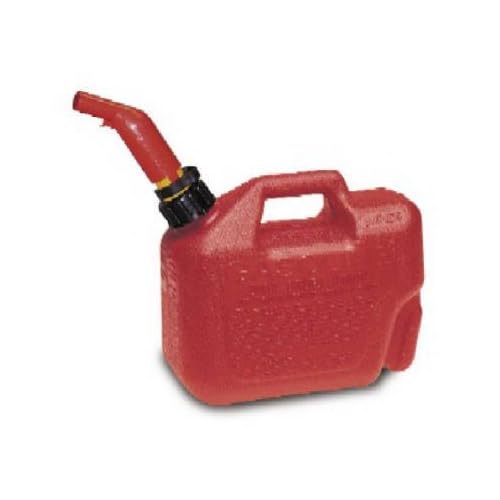
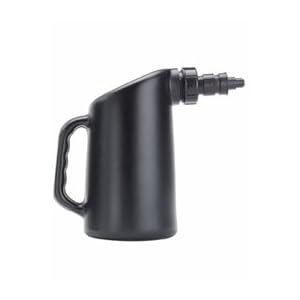
Actually, it's pretty hard to beat the old Mk1Mod0 eyeball. The kind of automatic system you suggest, similar to that found on gas pumps, would probably drive up the cost of a gas can rather significantly. Better I think just to pour slowly and carefully, and watch what you're doing.
For my lawn mower (has a 4 inch vertical filling pipe) I made a floating device from a PVC pipe that I have cut - in the length direction and removed about 1/3rd.
Some more at the top to still be able to pour into it. At the bottom I have a large cork in the pipe, cut under an angle to make the gas flow out easy.
A mark in the pipe tells me to stop pouring. I used a thin walled connection pipe for sinks (white)
I can make a drawing if you are interested.
The Jerry-can used in WWII had a small spout / air breather at the filling cap (I think it still does) which overflowed first when almost full. Maybe the simple design can be copied?
__________________
Never do today what you can put of until tomorrow - Student motto
I think what LynLynch is trying to show is what I thought of this morning. The filler spout on this type of gas can is the vent. You dip the filler spout into the opening of your tank to be filled and when the fuel reaches the level of the vent flow stops because the vent is full of fuel.
This can be done with hoses too for slightly larger filler tanks, just make sure your only vent is at the filler spout outlet and sticking low enough into your receiving tank to hit fuel before reaching your full level.
Oh...and your issue tank cannot be collapsible or overly flexible or have leaks that would allow venting.
Drew
__________________
Question: What is going on with the American's Government? Response: Who is John Galt?
I purchased one several years ago at a big box store exactly as you described. It was a replacement item and the instructions didn't mention not to open the small vent opening on the can. To do so defeated the function of the auto-stop feature and makes a big puddle of gasoline when the receiving tank was full.
__________________
Any day on the green side of the grass is a GREAT DAY!, --- me +++++++++. I believe creativity is an inherent part of everyone. --- Kermit T. Frog
It will work every time that venting is only allowed below where you want fuel level to stop...unless there is an air leak, or your tube is not long enough or your tank is too flexible and collapses after venting is stopped by liquid.
Or there is always what I did trying to top off a small tank...lift the spout out of the filler hole and continue filling after it overflows thereby washing my lawnmower in gasoline!
Drew
__________________
Question: What is going on with the American's Government? Response: Who is John Galt?
I use it to fill my lawn equipment. The tube on the can is plenty long and the tank is ridged. The the red tank above does not have a true vapor recovery system i.e. a gasoline pump.
The way the system I was explaining is supposed to work is that as fuel leaves your issuing can, it is replaced by air. If the only place it can draw that air is inside the tank you are filling and below the level you want to stop before, as the fuel reaches the air inlet (issue tank) it will be drawn up instead of air. Quickly an equilibrium will be reached and fuel will stop flowing from the issue tank. Then if the spout is angled properly, you can tip the issue can over leaving the spout below the fuel level (receiving tank) until the issue tank is low enough to stop flowing when the vent is raised above the level of the fuel in the receiving tank.
This same system can work with a flexible hose (with a flexible vent line terminating at the same place). It just takes a clip to set the depth of the issue hose or 3 hands to juggle the tank and hoses.
Drew
__________________
Question: What is going on with the American's Government? Response: Who is John Galt?
The red "can" up above is what I said doesn't offer spill protection. It claims to but it doesn't. That's all I'm saying. I just tried it again this weekend it over-filled the tank the spout was depressed to allow flow and then was fully inserted into the tank.
Does it possibly have a vacuum leak somewhere? Usually if the seal on the cap does not face a smooth surface because of unevenly shaved plastic it will suck air there and continue to allow flow.
You could upload pictures of your tank so I can be sure I am talking about the same design. The design I am describing is a simple sealed tank where air has to go in to replace the fuel as it leaves. Once the air inlet for the tank is below the level of the fuel in the tank you pour into it cannot drain any more fuel because there is no air to replace it. The inertia of the moving fuel and siphoning will move a little more after the air is cut off, but because the air inlet is below the fuel level it will draw up just as much fuel as siphons out preventing overflow.
Drew
__________________
Question: What is going on with the American's Government? Response: Who is John Galt?
__________________
"Did you get my e-mail?" - "The biggest problem in communication is the illusion that it has taken place" - George Bernard Shaw, 1856
I was at the Wal place just last week and a funnel caught my eye. It has a float, hanging down from the spout end, with a plastic tail that extends up through the spout, terminating with a large ring. When the fuel level reaches the float, it rises and the ring in the bell of the funnel rises up. very simple and cheap, about $3.