Previous in Forum: Brake Screw?!?   Next in Forum: Drum Safety Valve's
Close
Close
Close
50 comments
Rate Comments: Nested
Associate

Join Date: Oct 2010
Posts: 26

Domestic Water Heater in Main Water Supply

12/04/2010 8:26 AM

With this freezing weather many people have frozen water pipes. Is a product available to internally heat pipes to prevent this annual problem?

Ok a well built modern house should not have any problems ,But there millions of old houses that may only " Freeze up" once every few years and suffer,I can visualise a thermostatically controlled power supply and a heater element type of small diameter probe thats installed " Inside" the main supply to the house, that would provide just enough temperature to keep from freezing and only when needed.The heater "Probe" could be any lenght and flexible enough to follow bends that occur in many pipe installations, In my own case the black plastic pipe is approx. 20 mm inside diameter,

Register to Reply
Interested in this topic? By joining CR4 you can "subscribe" to
this discussion and receive notification when new comments are added.

Good Answers:

These comments received enough positive votes to make them "good answers".

"Almost" Good Answers:

Check out these comments that don't yet have enough votes to be "official" good answers and, if you agree with them, vote them!
Guru
Engineering Fields - Electrical Engineering - Been there, done that. Engineering Fields - Control Engineering - New Member

Join Date: Dec 2008
Location: Long Island NY
Posts: 15604
Good Answers: 982
#1

Re: Domestic water heater in main water supply

12/04/2010 9:54 AM

Yes, there are heater tapes that can be wrapped around the exposed pipes to heat them above freezing. Some of these heaters come with a small thermostat control. Many people use these heaters successfully but I must add a warning.

Many times the installation of these heaters is not practical. The part that will freeze is in an outer wall far from the exposed pipes. Sometimes the pipe that will freeze is PVC or another not thermally conductive material so heating the pipe in one location will not transfer to the water in the freezing region. Also by installing this band-aid to solve only one part of a bigger problem you can just be postponing the inevitable freeze or worse, these heaters have started fires. The only sound long term solution is to open the wall and do a modern insulation job. This will prevent the pipes from freezing and reduce the heating bill.

Now heater tapes and other pipe heaters can be a good fix but IMHO should be considered only a temporary fix. Another purely temporary fix is to have the water constantly moving. A small drip down the drain can prevent freezing.

__________________
"Don't disturb my circles." translation of Archimedes last words
Register to Reply Score 1 for Good Answer
Associate

Join Date: Oct 2010
Posts: 26
#2
In reply to #1

Re: Domestic water heater in main water supply

12/04/2010 10:24 AM

Thanks for your input ,and yes I know about " External" heater tapes wrapped around pipes ,and im sure that have there place as a band aid, What im interested in is an internal type of solution ,and straight away there would be vastly less danger of any fire hazard,In many cases its just not feasable to hack out pipes from Walls OR EVEN IN POURED CONCRETE FLOORS AND PATHWAYS.

Once again in my case I have a pipe that is under ground and less than 30 feet long ,that has frozen solid just 2 times in the last 11 years,Ok I should just install another pipe and insulate it, still im thinking it would be easier to install an internal heat element in the pipe ,its only going to switch on a few times every few years.Many people worldwide must also have the same need for a non drastic solution.Also I am aware of the water trickle from a tap trick,but if you have many people in a house someone is bound to turn it off, and tut tut the person that left the tap dripping!!!! Regards Tom

Register to Reply
Power-User

Join Date: Jun 2010
Location: St Louis MO USA
Posts: 224
Good Answers: 7
#4
In reply to #2

Re: Domestic water heater in main water supply

12/04/2010 4:15 PM

Hmmmmm Heat tape as a band aid.... interesting remark. You may be asking for a solution to a non problem. If you add energy to the water in the form of heat or chemical (salt) you will have others problems to deal with. I'm just sayin...The right way to solve your problem is to bury it deeper and insulate correctly. Please feel free to ignore my bad answers.

__________________
klearzen
Register to Reply
Associate

Join Date: Oct 2010
Posts: 26
#6
In reply to #4

Re: Domestic water heater in main water supply

12/04/2010 5:15 PM

Hi I certainly wont ignore your input ,the reason I posted was to get Information and opinions,and your opinion is valued,But I would like to clarify that my earlier comment about heat wrapping being a" band aid " was only in my own case.

What if I also told you that I was "dipping my toe in the water" here to see what solutions are available in the wider world, Reading my local Yellow pages does not produce much help at a local level, maybe there is a niche in the market that I should explore .

So far I have had excellent leads to research,I might add before all this actual or percieved " climate change" occured, "my neck of the woods" rarely experienced such extreme cold snaps ,Im told that the Gulf stream runs nearby and that helps with the normally mild winters we usually have.

Regards Tom.

Register to Reply
Guru

Join Date: Oct 2008
Location: I'm outa here
Posts: 1924
Good Answers: 196
#10
In reply to #2

Re: Domestic water heater in main water supply

12/05/2010 12:19 AM

You may have a solution if you are willing to piece together and tune some hardware yourself rather than buy a complete already developed product. Is it possible to establish a pumping loop of which the troublesome buried pipe is one leg? A few gallons per hour may be enough to keep the pipe from freezing. This could be done with a small Grunfos circulating pump, a normal closed solenoid valve, a relay, a couple of thermostats, one for air temperature and one for water temperature with appropriate ranges, a 24 hour clock timer and whatever small diameter tubing and fittings are suitable for the flow involved. Remember that whatever static pressure is in your water system will be the same everywhere if no faucets are open. So a small differential pressure created by a circ pump will create flow through whatever complete circuit is available. Conceivably even a garden hose laying on the ground could complete a circuit if it was prevented from freezing by a lot of foam insulation. And be protected better than the problem pipe surrounded by frozen ground.

If we knew more about your actual application we could maybe with our collected wisdom be more specific. A cold water pipe up a poorly insulated building wall to a bathroom is going to be easier to develop a loop circuit for than a single pipe leading to a remote building with no parallel hot water line.

The nice thing about a hydraulic loop approach is that it can deliver warm water to any pipe needing it, be completely hands off with no water wastage and is tunable for just the amount of heat flow needed with adjustment of a water valve........Hmmmmm. Maybe we do need a microprocesser to make this thing completely hands off. Sounds like a product now.

Still it's worth looking at rather than risk the use of electricity and heaters. Maybe combine the circulating pump feature with that little inline heater that was in lynlynch's first link (reply#3).

Ed Weldon

Register to Reply
Power-User

Join Date: Mar 2009
Location: O'er looking the silvery Tay
Posts: 255
Good Answers: 18
#13
In reply to #2

Re: Domestic water heater in main water supply

12/05/2010 6:23 AM

Hi technicaltom,

I live in a 180 year old property and despite its 'primative' building standards,judged by todays standards, it resists the effects of the cold without resort to highfalutin' gizmos inside or outside the water services.

Firstly the cold water supply is buried 3 feet below ground level, a standard used in these northern climes since the late 19th century, it works. I wonder if your supply is suffering from a reduced coverage due to 'landscaping' and therefore is much too near to the surface. Also a pipe buried in ground which gets covered in snow which remains undisturbed will be less likely to freeze than one under a cleared driveway.

Interestingly some years ago I came across an outfit which specialised in thawing sevice pipes by passing a heavy current ,at a low p.d, between the street service cock and the domestic service valve.The heating effect usually got things flowing quite quickly.

Once inside the property the presence of ventillator air bricks in solumn voids or lofts where water services without flow exist present a special risk. The problem,unless it hasn't happened already is that you can't get at it until the burst happens.

Returning to your query, a foolproof solution is to get the service pipe relaid to a greater depth, try to avoid any electrical heating devices as they will either go o/c and/or get forgotten and hence fall into disrepair with the inevitable consequences later on!

A simple interim measure is the trickle flow to waste, not down an external stack which will only freeze up and give you even greater grief! A combination of a solenoid controlled from a frost stat connected to a 1/4" bore valve which is set to pass a couple of gallons per hour should suffice as this will keep the incoming main warm from the street supply. I know how little flow is needed as I have a spring fed bird bath in the garden which has a tiny water jet with 2/3 gph which has not frozen in 15 years.

Good luck and wrap up warm,

Massey.

__________________
If it ain't broke,leave it well alone .........until it comes looking for you!
Register to Reply Score 1 for Good Answer
Power-User
Hobbies - CNC - New Member Canada - Member - Finaly got around to it.

Join Date: Feb 2008
Location: Canada
Posts: 499
Good Answers: 12
#46
In reply to #2

Re: Domestic water heater in main water supply

12/07/2010 2:02 PM

Depending on the diameter of the pipe, you may be able to insert an internal heater.

Raychem makes a self regulating heat trace that can be inserted into a water line. They make a prefabbed system or you can just use the trace cable. The first is a fixed length that requires an entrance to the pipe via a tee and a compression fitting.

The other system that I just used was a cut too length, section of self regulating tape. this entered and exited at either end of the pipe, via tee's and compression fittings. The ends must be out of the water.

The great thing about the cut to length Raychem tape, is that it is an irradiated plastic that conducts as it gets colder. Therefore it is totally self regulating and requires no controls.

Register to Reply
Guru
Technical Fields - Technical Writing - New Member Engineering Fields - Piping Design Engineering - New Member

Join Date: May 2009
Location: Richland, WA, USA
Posts: 21017
Good Answers: 795
#5

Re: Domestic Water Heater in Main Water Supply

12/04/2010 5:06 PM

The heat trace should be listed for use in wet locations, and should be protected with a GFCI (ground fault circuit interrupter).

__________________
In vino veritas; in cervisia carmen; in aqua E. coli.
Register to Reply
Guru

Join Date: Oct 2008
Posts: 42355
Good Answers: 1693
#7
In reply to #5

Re: Domestic Water Heater in Main Water Supply

12/04/2010 9:03 PM

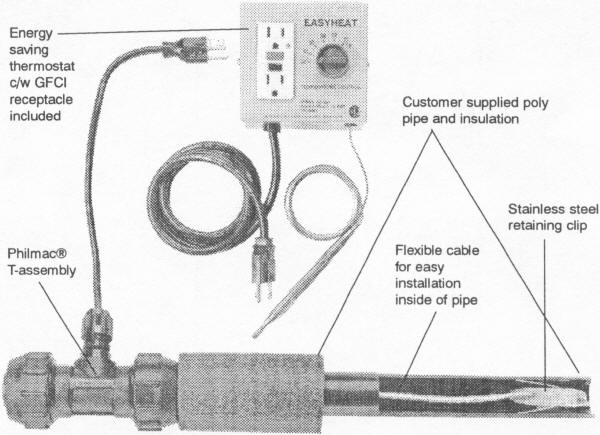
This one has a GFCI.

Register to Reply Score 1 for Good Answer
Guru
Technical Fields - Technical Writing - New Member Engineering Fields - Piping Design Engineering - New Member

Join Date: May 2009
Location: Richland, WA, USA
Posts: 21017
Good Answers: 795
#8
In reply to #7

Re: Domestic Water Heater in Main Water Supply

12/04/2010 9:27 PM

I noticed that, and I should have mentioned how a GFCI appeared in your first link. In any case, it's good to emphasize it. (Before I came here, my plant once had a door frame fire from damaged heat tracing. Shocking somebody would be worse.)

__________________
In vino veritas; in cervisia carmen; in aqua E. coli.
Register to Reply
Anonymous Poster
#9

Re: Domestic Water Heater in Main Water Supply

12/04/2010 10:33 PM

Run you pipes inside the house... that and some metal polish = most fancy.

Register to Reply
Anonymous Poster
#11

Re: Domestic Water Heater in Main Water Supply

12/05/2010 12:23 AM

Well...just a casual observation but it appears that Lynlynch is the only one that read and initially understood the question. That's why I usually pay attention to what he has to say.

Just so no one knows who to throw the darts at, I shall post this anonymously.

Register to Reply Off Topic (Score 5)
Anonymous Poster
#12

Re: Domestic Water Heater in Main Water Supply

12/05/2010 4:51 AM

A simple solution is to flush your toilet several times during the night if you or your wife get up at least a couple of times.This will refresh the water in the lines and prevent freezing. Once again, the KISS SYSTEM (keep it simple stupid), prevails.

HTRN

Register to Reply
Guru

Join Date: Oct 2008
Posts: 42355
Good Answers: 1693
#15
In reply to #12

Re: Domestic Water Heater in Main Water Supply

12/05/2010 9:23 AM

What if it's a hot water line that freezes during the night?

Register to Reply
Guru
Popular Science - Weaponology - New Member Safety - ESD - New Member Hobbies - Fishing - New Member

Join Date: Sep 2006
Location: Near Frankfurt am Main, Germany. 50.390866N, 8.884827E
Posts: 17996
Good Answers: 200
#16
In reply to #15

Re: Domestic Water Heater in Main Water Supply

12/05/2010 9:40 AM

Then they must also wash their hands using the hot water.....simple

__________________
"What others say about you reveals more about them, than it does you." Anon.
Register to Reply
Guru
Popular Science - Weaponology - New Member Safety - ESD - New Member Hobbies - Fishing - New Member

Join Date: Sep 2006
Location: Near Frankfurt am Main, Germany. 50.390866N, 8.884827E
Posts: 17996
Good Answers: 200
#14

Re: Domestic Water Heater in Main Water Supply

12/05/2010 9:12 AM

Only a properly insulated house is the way to go if we are talking about "in-house" piping. The whole house and its contents (pipes as well!) stays warmer with less heating costs in winter, and stays cooler in summer......eg. a much nicer house to live in.

Insulation must not be expensive, just done well.....

If we are talking about external piping then it generally needs to be around 1 meter or deeper (3 feet or more, already mentioned, also it depends on where you live) to resist frost.......

I have seen farmers who left outside taps dripping to stop freezing, the small amount of water movement was enough where the pipes ran mostly underground anyway......it was cheaper to waste water than use heating.....

__________________
"What others say about you reveals more about them, than it does you." Anon.
Register to Reply
Guru
Popular Science - Weaponology - New Member Fans of Old Computers - PDP 11 - New Member Technical Fields - Architecture - New Member Hobbies - HAM Radio - New Member

Join Date: Oct 2009
Location: Maine, USA
Posts: 2168
Good Answers: 71
#17

Re: Domestic Water Heater in Main Water Supply

12/05/2010 10:02 AM

I've been interested in this type of device for some time now. I have a building that has poly water lines to it but they cannot be set any more than about 6 inches below the soil due to the prevailing ledge all around the area. We are in central Maine, USA. Temp today is 32F and expected to get to around 20degF this next week, in the negative digits soon enough! The Easy Heat inline device looks very promising as it can be purchased in lengths from 10 to 270 ft!

The big drawback is the cost of the product. It's nearly $300 for 10ft and $900 for 270ft. If I had a business that needed this on a continuous basis I might be able to afford it as it would be a "capital expense". To purchase and install this device to be used once or twice over several years is unreasonable. At that cost the OP is probably better off to dig up the offensive pipe and either lower it down to 3 ft or so below grade, or insulate it. My situation will require that I set things up such that the outbuilding will "self-drain" when the faucets are shut off, not a choise for the OP since he is looking at the feed line.

We have many camps in the area that have pipes that are prone to freeze and part of my "maintenance service" will drain the systems for the owners at season end and also refill the systems anytime they request, even in winter. The price they pay is not close to the cost of the inline system, but I may recommend it to a couple of customers that can afford it and seem to want the camp available more often than others. Thanks for the pointer!

So now I'm wondering about a similar device that could be made WITHOUT running wires down the pipe. How about a system that could run a hot water inside a very small loop pipe inserted in the main feed line? It would need to be small enough not to interfere with the flow a lot, but I could envision a fairly simple connection to the main feed and another to a hot water source. Anyone want to invent that?

__________________
Tom - "Hoping my ship will come in before the dock rots!"
Register to Reply
Guru

Join Date: Oct 2008
Posts: 42355
Good Answers: 1693
#18
In reply to #17

Re: Domestic Water Heater in Main Water Supply

12/05/2010 10:21 AM

"Anyone want to invent that?" No.

Putting aside the initial cost of such a system, and the reduced flow caused by the internal plumbing, do you propose to let the hot water run all night, or install a recirculating pump that adds even more cost and complexity to the system?

Back on the farm in Arkansas, we used to let the water drip all night long from the faucet furtherest from the pump house on the coldest nights. (Hot and cold) It was totally manual back then. But it worked.

Cheers.

Register to Reply
Guru
Engineering Fields - Electrical Engineering - Been there, done that. Engineering Fields - Control Engineering - New Member

Join Date: Dec 2008
Location: Long Island NY
Posts: 15604
Good Answers: 982
#19
In reply to #17

Re: Domestic Water Heater in Main Water Supply

12/05/2010 10:31 AM

If you are not willing to invent a solution for yourself, why would somebody else do it for you?

__________________
"Don't disturb my circles." translation of Archimedes last words
Register to Reply
Guru
Popular Science - Weaponology - New Member Fans of Old Computers - PDP 11 - New Member Technical Fields - Architecture - New Member Hobbies - HAM Radio - New Member

Join Date: Oct 2009
Location: Maine, USA
Posts: 2168
Good Answers: 71
#20
In reply to #19

Re: Domestic Water Heater in Main Water Supply

12/05/2010 10:44 AM

I don't need the solution...just a suggestion in the wind if someone thinks it's worth any effort...if not then please ignore it.

__________________
Tom - "Hoping my ship will come in before the dock rots!"
Register to Reply
Guru
Engineering Fields - Electrical Engineering - Been there, done that. Engineering Fields - Control Engineering - New Member

Join Date: Dec 2008
Location: Long Island NY
Posts: 15604
Good Answers: 982
#21
In reply to #20

Re: Domestic Water Heater in Main Water Supply

12/05/2010 11:09 AM

Well what about the idea of a temporary feed line into these cabins. The feed line would be run outside on the ground or suspended above (tree branches) to the cabin that happened to be occupied in the middle of winter. I would make the feed line itself be at least three poly tube lines inside one larger insulated flexible pipe. One poly tube would be the cold water line. The other two would be hot water that had the small differential pressure pump mentioned earlier. This way hot water would constantly circulate or flow through this multiple hose line. If you wanted to be real sophisticated about this, you could put some form of flow meter on the two circuits to detect a blockage or break and automatically respond to a plausible failure by closing a solenoid valve.

__________________
"Don't disturb my circles." translation of Archimedes last words
Register to Reply
Guru

Join Date: Oct 2008
Location: I'm outa here
Posts: 1924
Good Answers: 196
#22
In reply to #17

Re: Domestic Water Heater in Main Water Supply

12/05/2010 11:24 AM

Tom -- I get to wondering why some of our members are more interested in editorializing than helping you solve your particular problem.

Reorganizing my previous comments, it seems to me that my approach of a pumping loop may work for remote outbuildings fed by a single water line. It ought to be reasonably easy to push a 3/8" copper tube through a 50 foot run of 3/4" plastic pipe especially if you use the grey electrical conduit with those broad sweeping 90 degree elbows. At the delivery end you put in a cross fitting to allow you to bring the 3/8" hot water tube out through a well sealed hole in a pipe plug, through a solenoid valve and right back into the main cold water line. This becomes one end of the loop. When you lay the pipe you put a run of UF cable in the ground next to it (or inside its own conduit if conditions warrant better protection from gophers and such.)

Now all the control functions for the little circ pump can reside in the main building where the hot water heater is located. If this is a remote camp with bottled gas but no electricity a bit of searching might turn up a suitable 12 volt pump that can be powered off a solar panel under a south facing eave to catch a low winter sun and a backup battery for night time use or prolonged storm periods. Ideally a pump powered by the propane would be an answer to the power and battery limitations. But I know of no such simple off the shelf product.

Ed Weldon

Register to Reply
Guru
Popular Science - Weaponology - New Member Fans of Old Computers - PDP 11 - New Member Technical Fields - Architecture - New Member Hobbies - HAM Radio - New Member

Join Date: Oct 2009
Location: Maine, USA
Posts: 2168
Good Answers: 71
#24
In reply to #22

Re: Domestic Water Heater in Main Water Supply

12/05/2010 1:33 PM

Yes Ed, that's the idea. I think you could use smaller copper or even small plastic to run the hot water/circulator source. The outer pipe would need to be large enough to let you run the smaller pipe through the plastic fittings as well. The entrance for the smaller lines could be through PCV couplings with a cap with holes drilled and sealed.

Now...how do you circulate the hot water? Attaching to a standard hot water tank with a hot out and cold in won't work because the standard tank is static pressure until someone opens a faucet. So maybe it needs to be something like an auto fill tank (like a toilet tank) with a heating coil and small pump in it?

I appreciate your jumping in with actual suggestions rather than editorial comments.

This is how things get "invented" around here anyway...good discussions.

I've done some "temporary" feed lines in the past using regular garden hoses!

__________________
Tom - "Hoping my ship will come in before the dock rots!"
Register to Reply
Guru
Belgium - Member - New Member APIX Pilot Plant Design Project - Member - New Member

Join Date: Aug 2006
Location: Glabbeek, Belgium
Posts: 1480
Good Answers: 28
#25
In reply to #24

Re: Domestic Water Heater in Main Water Supply

12/05/2010 1:41 PM

but how do you get the heat at the end?

the backflow will cool the flow in the tube.

over a few meter it will work, but not that far.

Slide in an electrical heater, which does heat till the tip.

__________________
"Here we are now, entertain us"
Register to Reply
Guru

Join Date: Oct 2008
Location: I'm outa here
Posts: 1924
Good Answers: 196
#31
In reply to #24

Re: Domestic Water Heater in Main Water Supply

12/05/2010 3:33 PM

Tom - Somewhere in my first comment is an admittedly poor attempt to describe the use of a low head circulating pump to move the water in the loop. These things are made by Grunfos and others for circulating hot water in residential heating systems, fuel heated, heat pump and solar. They are high reliability long life pumps with stainless steel liquid ends and cost in the neighborhood of $200-$300. Easy to find in an internet search. They run on 120VAC but draw so little current that they could easily run off a small inverter attached to a 12 volt storage battery that can be kept charged by any number of available power sources. They are centrifugal types which means that they can pump reliably at very low flow rates well below their rated flow rates. Also, unlike many other types of small pumps with plastic components these pumps are designed to operate at hot water temperatures near the boiling point particularly if there is sufficient static pressure in the water (as with a domestic water supply) to keep them from forming steam bubbles in their suction inlets. So if your freezing conditions are so severe that you have to run your hot water heater at it's maximum temperature you will be able to do so especially if the front end of your internal pipe heating pipe is copper instead of plastic such as polyethylene with it's maximum service temperature around 140F.

Ed Weldon

Register to Reply
Guru
Belgium - Member - New Member APIX Pilot Plant Design Project - Member - New Member

Join Date: Aug 2006
Location: Glabbeek, Belgium
Posts: 1480
Good Answers: 28
#23

Re: Domestic Water Heater in Main Water Supply

12/05/2010 11:27 AM

each year this question pops up: how to protect from frozen pipes and how to thaw an already frozen line.

Many options pass by and some have difficulties to stay on track.

As it is potable water which is discussed, adding additives will not solve anything.

Circulation systems are great but always have dead legs. In hot water distribution these harbour legionella, in frost protections they burst.

Most water lines are plastic based, running a current through it is not really and option.

insulation and trace heating are the best option.

Be sure to choose for self regulating heaters as they keep the ultimate temperature achieved low. ($ & € on the electricity bill)

this product can be inserted in water lines:

http://www.tycothermal.com/belgium/english/heat_tracing/applications/commercial/frost_protection_systems_for_pipes/productDetails.aspx?pceg=8134

and it has potable water approvals, for sweden at least.

succes

__________________
"Here we are now, entertain us"
Register to Reply Score 1 for Good Answer
Guru
Popular Science - Weaponology - New Member Fans of Old Computers - PDP 11 - New Member Technical Fields - Architecture - New Member Hobbies - HAM Radio - New Member

Join Date: Oct 2009
Location: Maine, USA
Posts: 2168
Good Answers: 71
#26

Re: Domestic Water Heater in Main Water Supply

12/05/2010 1:41 PM

I don't think it works for most camps since they are usually shut down such that there's no heat inside the camp at all. The "double pipe" method might work for an outside feed line from a residence that has heat and electric all year long.

__________________
Tom - "Hoping my ship will come in before the dock rots!"
Register to Reply
Guru
Belgium - Member - New Member APIX Pilot Plant Design Project - Member - New Member

Join Date: Aug 2006
Location: Glabbeek, Belgium
Posts: 1480
Good Answers: 28
#27
In reply to #26

Re: Domestic Water Heater in Main Water Supply

12/05/2010 1:44 PM

if you cut the heat and electricity and don't drain your water lines before winter, you are stupid and no engineer should help.

__________________
"Here we are now, entertain us"
Register to Reply
Guru
Popular Science - Weaponology - New Member Fans of Old Computers - PDP 11 - New Member Technical Fields - Architecture - New Member Hobbies - HAM Radio - New Member

Join Date: Oct 2009
Location: Maine, USA
Posts: 2168
Good Answers: 71
#28
In reply to #27

Re: Domestic Water Heater in Main Water Supply

12/05/2010 1:52 PM

Please read the entire post before you start calling names!

__________________
Tom - "Hoping my ship will come in before the dock rots!"
Register to Reply
Guru
Belgium - Member - New Member APIX Pilot Plant Design Project - Member - New Member

Join Date: Aug 2006
Location: Glabbeek, Belgium
Posts: 1480
Good Answers: 28
#29
In reply to #28

Re: Domestic Water Heater in Main Water Supply

12/05/2010 2:01 PM

What I suggest is that you become honest with yourself and the customers: quality has it's price.

I can guide you towards solutions which cost way less than professional heat tracing material, but failure is always possible and then you are way further from home.

I do work for a heat tracing company and regularly we loose jobs because a good looking and talking consultant claims he can do it cheaper. cutting out side installations like frost protection. Later it has to be installed anyhow, driving the cost up.

__________________
"Here we are now, entertain us"
Register to Reply
Guru

Join Date: Oct 2008
Posts: 42355
Good Answers: 1693
#30

Re: Domestic Water Heater in Main Water Supply

12/05/2010 2:08 PM

Whatever happened to the OP, technicaltom?

Hopefully, he got what he needed and got out before it got ugly.

Once again, the original question has become an orphan.

Cheers.

Register to Reply
Associate

Join Date: Oct 2010
Posts: 26
#32
In reply to #30

Re: Domestic Water Heater in Main Water Supply

12/05/2010 3:42 PM

Hi I am still here,and have enjoyed the journey so far,And dont worry about me and ugly, I am on a few forums elsewhere that do get "UGLY",Before i posted I had been kicking about several ideas,the " Pipe inside a Pipe" really caught my imagination as it is something I could do myself,with the tools and equiptment i already have. The stumbling block I could see was the need for thermostatic control and electric power supply.Then the Electric "Probe" type internal heater I mentioned in the original post, that also needs electric +thermostatic conrtol seemed easier, So now thanks to all the great ideas posted, im leaning towards a pipe in a pipe solution and utilising hot water from the house supply,Just a few more details about my water situation, The water comes from a 30 metre deep well just in front of the house, the submerisible pump sends the water to an out house where the pressure tank and control box is situated .The clothes washing machine+dryer is in the same out outhouse,there is a 50 litre electric water heater in trhe outhouse as well.I could write a chapter why digging out is nor practical, but one line should suffice,a previous owner had acess to free concrete.Regards TOM

Register to Reply Score 1 for Good Answer
Guru
Technical Fields - Technical Writing - New Member Engineering Fields - Piping Design Engineering - New Member

Join Date: May 2009
Location: Richland, WA, USA
Posts: 21017
Good Answers: 795
#33

Re: Domestic Water Heater in Main Water Supply

12/05/2010 3:59 PM

Well, just get about 50 hay bales and pile them on the ground above the pipeline, thereby insulating it.

__________________
In vino veritas; in cervisia carmen; in aqua E. coli.
Register to Reply Score 1 for Good Answer
Guru

Join Date: Oct 2008
Location: I'm outa here
Posts: 1924
Good Answers: 196
#34
In reply to #33

Re: Domestic Water Heater in Main Water Supply

12/05/2010 4:19 PM

Tornado -- Your comment has a distinct "Been there; done that." ring to it. ....EW

Register to Reply
Guru
Popular Science - Weaponology - New Member Fans of Old Computers - PDP 11 - New Member Technical Fields - Architecture - New Member Hobbies - HAM Radio - New Member

Join Date: Oct 2009
Location: Maine, USA
Posts: 2168
Good Answers: 71
#35

Re: Domestic Water Heater in Main Water Supply

12/05/2010 5:22 PM

Ed, Thanks for all the info...IF I ever get time to play with this idea I'll certainly follow up on your suggestions. Glad the OP likes the idea...let us know how it turns out.

As far as insulating above ground, I've had good luck with hay bales but if you lay a sheet of 2" foam type insulation on the ground and put the hay over that, it works even better. You can also insulate in the ground by using foam over the pipe and then covering with the soil...but if you are digging it up your already into a different solution!

__________________
Tom - "Hoping my ship will come in before the dock rots!"
Register to Reply
Guru

Join Date: Oct 2008
Location: I'm outa here
Posts: 1924
Good Answers: 196
#36
In reply to #35

Re: Domestic Water Heater in Main Water Supply

12/05/2010 6:14 PM

Tom -- I don't know how much this little snippet of info will help but I'll pass it along anyway. Note the latent heat of fusion(freezing to ice) of water is 144 times the heat removal needed to lower its temperature by one degree Fahrenheit. (80 times per degree Celsius)

This relationship is important to your problem. This suggests a form of protection for freezes of short duration in which liquid water on the outside of something to be protected freezes first and delays the freezing of what's inside. It also suggests that flooding the item to be protected with readily available volumes of cold water is better than using limited amounts of hot water that may be only 60 degrees warmer.

Also note that in some cases the presence of rotting organic material in the vicinity of the pipe can be a useful heat source as well as providing insulation. ... Ed Weldon

Register to Reply
Guru
Popular Science - Weaponology - New Member Fans of Old Computers - PDP 11 - New Member Technical Fields - Architecture - New Member Hobbies - HAM Radio - New Member

Join Date: Oct 2009
Location: Maine, USA
Posts: 2168
Good Answers: 71
#37
In reply to #36

Re: Domestic Water Heater in Main Water Supply

12/05/2010 6:53 PM

Thanks again...that is useful info and explains why they spray the fruit in Florida when it gets below 32 degrees!

You mentioned decomposing materials which brings up another idea that I've never tried but always thought had merit. A poor mans heat pump...

Anyone that lives in the north and has a septic tank knows that it's warm enough to keep the snow melted off the top ALL winter. So I thought a system of pipes wrapped around the outside or even the inside of the tank might be able to capture some amount of heat. A simple system of an air mover to circulate the air in the pipe from your basement through the pipes and back should be able to raise the ambient temp some what. I know they do this to capture the earth's heat from depths of 10ft below ground level as the temp there tends to be a steady ~50 deg F. The parts I don't know about are the thermal losses involved through types, sizes and lengths of pipe. Might be an interesting thing to try. My current resident has the tank too far from the house for it to be practical, plus the ledge lends to additional issues laying new lines of pipe!

__________________
Tom - "Hoping my ship will come in before the dock rots!"
Register to Reply
Guru
Popular Science - Weaponology - New Member Safety - ESD - New Member Hobbies - Fishing - New Member

Join Date: Sep 2006
Location: Near Frankfurt am Main, Germany. 50.390866N, 8.884827E
Posts: 17996
Good Answers: 200
#44
In reply to #35

Re: Domestic Water Heater in Main Water Supply

12/06/2010 4:21 AM

I think it was the op who said two things:- 1) A lot of (free) concrete. 2) that he can dig down a small amount, make a shallow trench.

If the above is true, then surely a small trench, fully lined with good insulating material, and then cover the trench above. This might reduce the amount of straw.....

It would at least make the pile smaller......so to say.....

__________________
"What others say about you reveals more about them, than it does you." Anon.
Register to Reply Score 1 for Good Answer
Anonymous Poster
#38

Re: Domestic Water Heater in Main Water Supply

12/05/2010 7:13 PM

After you review all the "technical" proposals consider going out to a horse/dairy farm

& trucking several loads of fresh manure to spread 1' to 2' deep over the pipe run when you expect a hard winter.

In the spring put the composted material on your lawn or garden.

Register to Reply Score 1 for Good Answer
Guru
Hobbies - DIY Welding - New Member

Join Date: Apr 2008
Location: Bristol, Tennessee
Posts: 1177
Good Answers: 58
#39

Re: Domestic Water Heater in Main Water Supply

12/05/2010 7:31 PM

This one is out there, folks, so have patience. I've dealt with frozen pipes, even in new construction when the pipe was in an outside wall, a big mistake.

Anyway, the idea is to put a small bladder type pressure tank on the furthest ends of the plumbing line, one on hot, one on cold. Since this is a well situation it's easy to put a very slow drip going back to the well. As the pump cycles, water will flow through the pipes to the ends, and then back again as the pressure drops. You can control the drip to control the times the pump cycles per day.

This idea uses electricity for the pump, but maybe less than heat tapes.

To work in a city water situation, you would have to monitor the pressure from the city. If you find that the pressure varies on a regular basis, you don't have to drip any, but you will have to pay for the water used, 'cause city meters don't read backwards. Some systems have a check, and this idea won't work on them.

__________________
mike k
Register to Reply Score 1 for Good Answer
Guru

Join Date: Oct 2008
Location: I'm outa here
Posts: 1924
Good Answers: 196
#40
In reply to #39

Re: Domestic Water Heater in Main Water Supply

12/05/2010 8:02 PM

mike k -- GA on this one. Very interesting new information. Might take some tuning and PM attention that not everyone will be up to doing. Do you have experience on that angle to share with us? ...............Ed Weldon

Register to Reply
Guru
Belgium - Member - New Member APIX Pilot Plant Design Project - Member - New Member

Join Date: Aug 2006
Location: Glabbeek, Belgium
Posts: 1480
Good Answers: 28
#42
In reply to #39

Re: Domestic Water Heater in Main Water Supply

12/06/2010 2:38 AM

Not such a bad idea if heat is cheap and water expensive.

Ice will have the tendency to grow on the outer wall is the amount of water cycled is not sufficient: you need to be sure that you can heat up the full length of the line.

The temperature of the returning water can give you some info on the cycle frequency needed (the colder the water comes back, the more frequent you need to cycle)

__________________
"Here we are now, entertain us"
Register to Reply
Power-User

Join Date: May 2007
Location: Ronan, Montana
Posts: 174
Good Answers: 10
#41

Re: Domestic Water Heater in Main Water Supply

12/06/2010 1:12 AM

Put a "Y" fitting in the line. Through the branch that's open insert a heated cable to the desired length such as one used to heat the eves of a house to prevent ice buildup. Of course the wire will have to be run through a cap and rubber seal to prevent it from leaking. Protect it with a ground fault breaker. Plug it in when needed.

Make sure the covering won't "unpot" your water. It's cheap.

Randy

__________________
"don't be so open minded that your brain falls out" unknown
Register to Reply
Guru
Belgium - Member - New Member APIX Pilot Plant Design Project - Member - New Member

Join Date: Aug 2006
Location: Glabbeek, Belgium
Posts: 1480
Good Answers: 28
#43
In reply to #41

Re: Domestic Water Heater in Main Water Supply

12/06/2010 2:41 AM

Why the need to stipulate the use of a GFI?

Anyhow IEC rules on trace heating impose it. (and if not applicable, the manufacturer will)

The cable used on roofs can't be used in pipe: the rubber is not compatible with potable water.

__________________
"Here we are now, entertain us"
Register to Reply
Power-User

Join Date: May 2007
Location: Ronan, Montana
Posts: 174
Good Answers: 10
#45

Re: Domestic Water Heater in Main Water Supply

12/06/2010 11:13 PM

I figured there would be a commercially available internal solution as I suggested in my homemade solution in post #41. Here's some links:

http://www.do-it-yourself-pumps.com/heated-in-pipe-freeze-protection.htm

http://www.purenorthwater.com/node/36

http://www.heattracingdirect.com/

I would think that an internal electric trace heater has to be the cheapest and most efficient way to go. No digging or anything but opening the line where it's accessable and installing the trace heater.

Randy

__________________
"don't be so open minded that your brain falls out" unknown
Register to Reply
Guru

Join Date: Dec 2010
Posts: 1686
Good Answers: 116
#47

Re: Domestic Water Heater in Main Water Supply

12/11/2010 8:58 AM

I know they are strictly "off-topic" but the solutions to the PROBLEM I rate are the manure, the straw and the buried insulation over the pipe - I think they came from guys who get severe cold every winter. Never rely on "High-tech" more than you must! When it comes to home piped water and sewage stay with the simple, fail-proof methods, preferably those that last a lifetime. Buried water-filled insulation is no insulation - you need polystyrene or polyurethane with closed pores/bubbles into which water cannot seep. You could just pile 2 feet of soil over the pipe and make it a plant bed feature - not really more work than moving the soil off the concrete, putting on insulation, returning the soil!

Register to Reply
Guru

Join Date: Oct 2008
Location: I'm outa here
Posts: 1924
Good Answers: 196
#48
In reply to #47

Re: Domestic Water Heater in Main Water Supply

12/11/2010 12:18 PM

67 -- Nothing off topic about your solutions. The best solution to any problem is one that fixes the problem for good and never needs attention again. Although, it is probably a good idea to take a picture or two of what you did and put it in your "house" file so 30 years from now you'll be reminded of what was done. Many years ago soon after we bought our house a rare snowstorm left a light dusting of snow behind the house with two circular rings of grass showing. Sure glad I took a photo of that perfect location record of our septic tanks.

Howsomever, if you wife's treasured rose bushes are growing over the pipe major excavation is probably not the best solution.

About "High Tech" ...... I've never been sure about what that really means. In this case what would be more high tech? An electric heater with a digital readout stuck in the end of the pipe of some kind or a set of carefully worked out heat transfer calculations to determine the right amount and placement of organic and insulating material around the buried pipe? Would it be high tech if you used a calculator instead of a slide rule to do the calculations? Or would you need to use a 2 dimensional field solution in a computer using someone else's software to qualify?

Ed Weldon

Register to Reply
Guru

Join Date: Dec 2010
Posts: 1686
Good Answers: 116
#49
In reply to #48

Re: Domestic Water Heater in Main Water Supply

12/12/2010 11:00 AM

Well ED.. I thought electric heaters and pumps were "high tech", compared to digging deeper with a spade! Very interesting to hear your experience with the "crop marks", a good thing to keep in mind. Since we only get really cold winters about every 10 years here in Britain, the electric heater will probably have rotted in 10 years time! Considering all the details that have come out, running a little water back to the well through a temporary plastic pipe covered with clip-on pipe insulation looks good. But it ALL depends on foreseeing the freeze and checking the electric gizmos, installing the temporary circulating pipe etc in good time!

Register to Reply
Guru
Hobbies - RC Aircraft - New Member Hobbies - Automotive Performance - New Member Hobbies - DIY Welding - New Member

Join Date: Jul 2007
Location: Fort Lauderdale Florida
Posts: 5708
Good Answers: 123
#50

Re: Domestic Water Heater in Main Water Supply

12/12/2010 11:22 PM

If you want to prevent freezing pipes from being a problem for you, and your neighbors for miles around, dig up the concrete, bury the well insulated pipe in a well drained trench, and install an expensive monitoring system.

Doing this will prevent the temperature from dropping for the next 30 to 50 years. Ask all of the Floridians that purchased stand-by generators after The series of hurricanes we had a few years ago.

__________________
Bob
Register to Reply
Register to Reply 50 comments

Good Answers:

These comments received enough positive votes to make them "good answers".

"Almost" Good Answers:

Check out these comments that don't yet have enough votes to be "official" good answers and, if you agree with them, vote them!
Copy to Clipboard

Users who posted comments:

67model (2); Andy Germany (3); Anonymous Poster (4); bob c (1); Ed Weldon (7); Gwen.Stouthuysen (6); Icarus (1); klearzen (1); lyn (5); Massey 726 (1); mike k (1); Randyl (2); redfred (3); technicaltom (3); Tom_Consulting (7); Tornado (3)

Previous in Forum: Brake Screw?!?   Next in Forum: Drum Safety Valve's

Advertisement