Hi everybody,
this is my first message on this forum! I hope we'll have nice and useful "conversations" all together :)
My problem consists in powering a stepping micromotor wirelessly, so without any cable. The motor shaft is fixed to a small gear which controls a rack-and-pinion mechanism. In the picture below, the yellow region is the section of the available conical volume which should contain the motor and its powering system:

I would like to exploit the principle of the transformer in order to power the micromotor by induction. A small coil could be connected to the micromotor and stay close to him, while an external coil, bigger and "more powerful", could guide the induction process.
In this second image we have the position of the mechanism: the gear, in red, is positioned perpendicularly to the motor shaft (in grey) while the green part is able to move laterally, on the plane of the screen. I quickly drew the motor and the small coil below this mechanism, to give an idea of the system's structure:
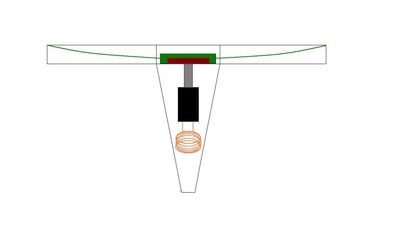
The motor does not have to work continuously, on the contrary it should turn very slowly and in a very accurately controlled way. We should know, for example, that it has rotated of N degrees and thus the green part has translated laterally of M millimeters. This positioning process can take some minutes, we are not in a hurry. So the powering of the motor can be limited to these moments in which it rotates of a few degrees and immediately after it is "turned off".
Honestly I have no idea about the practical feasibility of the system, since my studies didn't cover it; yet, a priori I think that the energy transfer principle could work. My doubts are mainly these:
- how to dimension the two coils in order to make the motor work, and how long this induction requires (is it immediate?);
- I think the induction produces some sort of heating... could it be dangerous? If I reduce to the minimum the dimension of the small internal coil, will this heating be important or negligible?
- I think that, for controlling the number of steps that the motor performs, we are forced to add some electronical components (like a microprocessor). Does anybody have any more precise idea about this? In terms of volume, do these components occupy a big space? Can they be positioned not exactly next to the motor or do they have to be permanently connected to it?
I hope my explanation was clear enough, I tried to simplify the problem in order to present only its useful details. In any case it won't be a problem to better explain the problem, I'll do my best!
Thank you in advance for your answers, bye bye :)


 Wireless Powering of a Stepping Motor


 Re: wireless powering of a stepping motor


"Almost" Good Answers: