|
 There has been a general disregard on CR4 for NASA's
Curiosity rover that is currently exploring the Martian topography. How could
this be largely ignored by an engineering community? Allow me to play alarmist. There has been a general disregard on CR4 for NASA's
Curiosity rover that is currently exploring the Martian topography. How could
this be largely ignored by an engineering community? Allow me to play alarmist.
Conspiracy theory! Little green men! Jodie Foster in Contact!
AHHHHH!
Ok. While only a few of us actually believe this is
possible, Curiosity has indeed stumbled upon some interesting finds on the red
planet. Last week, speculation presided over the origin of metallic specks in
the Martian soil. While
scientists believe  these shiny objects are indigenous to Mars, they aren't
jumping to the conclusion of alien life as the source. It's suspected that soil or mineral forming processes are the cause. Though
if it was Mork, I'd somehow
be okay with that. these shiny objects are indigenous to Mars, they aren't
jumping to the conclusion of alien life as the source. It's suspected that soil or mineral forming processes are the cause. Though
if it was Mork, I'd somehow
be okay with that.
The objective of Curiosity is to find out if life on Mars
was ever sustainable, even at microbial levels. This is just one example of the
three-pronged search for extraterrestrial intelligence, or SETI.
The Search
In October 1978, 20-year-old Victorian Fred Valentich was
piloting a single-engine aircraft over Australia's Bass Straight. Nearly 50
minutes into his flight, he requested information on nearby aircraft. None were
reported or detected, though Valentich had visual confirmation of an aircraft
tailing him and "playing some sort of game." After a series of exchanges in
which Valentich changed his identification of the craft from a military jet to
"not an aircraft," 17 seconds of metal-on-metal scraping were recorded by
flight controllers. Frederick Valentich and his airplane were never seen or
heard from again, and no credible (including skeptical) leads have surfaced.
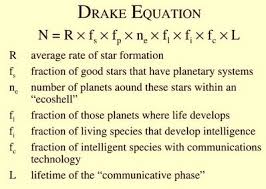 I'll be the first to admit this seems far-fetched, but in
1960 leading astronomers, chemists, and businessmen met to outline the
probability of intelligent life. Astronomer Frank Drake proposed this
equation, meant to establish a working number of how many extraterrestrial
civilizations located in the Milky Way that could communicate with Earth. He
arrived at 10,000. I'll be the first to admit this seems far-fetched, but in
1960 leading astronomers, chemists, and businessmen met to outline the
probability of intelligent life. Astronomer Frank Drake proposed this
equation, meant to establish a working number of how many extraterrestrial
civilizations located in the Milky Way that could communicate with Earth. He
arrived at 10,000.
There are obvious flaws in this equation, but it serves to
underscore the point that alien life isn't possible, but rather probable.
"So then where are all these civilizations?"
That becomes the obvious question. Enrico Fermi, an Italian
physicist, proposed that this is the result of one of three causes: intelligent
life is much rare than we believe; our current detection methods are
incomplete; or our observations are incomplete. The latter two are considered
the most likely amongst leading SETI proponents. Some believe that
extraterrestrial societies avoid Earth intentionally, allowing it to develop
naturally and withholding contact until it passes some technological or ethical
threshold.
The Future SETI
 In his novel A Brief
History of Time world-renown physicist Steven Hawking suggests broadcasting
the position of Earth is reckless, and science-fiction films typically depict
extraterrestrials as menacing overlords. These films also depict humans
repelling intergalactic travelers, but a species with interstellar travel
capabilities would likely conquer Earth with minimal effort. Remarkably,
experts largely reason that alien beings would be benevolent, and much could be
gained by both sides from cooperation. Technologically advanced people would be
expected to be morally advanced as well, and many of the Earth's most
successful societies have been benevolent as a whole. Finally, if
extraterrestrials are making a concerted effort to avoid meddling in
terrestrial affairs, it shows evidence of some galactic union. Malevolent alien
invaders could very well be policed by other celestial forces, essentially
turning things in the exact plot of Transformers. In his novel A Brief
History of Time world-renown physicist Steven Hawking suggests broadcasting
the position of Earth is reckless, and science-fiction films typically depict
extraterrestrials as menacing overlords. These films also depict humans
repelling intergalactic travelers, but a species with interstellar travel
capabilities would likely conquer Earth with minimal effort. Remarkably,
experts largely reason that alien beings would be benevolent, and much could be
gained by both sides from cooperation. Technologically advanced people would be
expected to be morally advanced as well, and many of the Earth's most
successful societies have been benevolent as a whole. Finally, if
extraterrestrials are making a concerted effort to avoid meddling in
terrestrial affairs, it shows evidence of some galactic union. Malevolent alien
invaders could very well be policed by other celestial forces, essentially
turning things in the exact plot of Transformers.
Currently, SETI initiatives rely on exploration rovers (such
as Curiosity), radio astronomy, and discovering new, possibly habitable
planets. Exploration rovers remain in their first generation of development and
the discovery of Earth-like planets is not enough to assume life is present. As
such, active SETI, or the broadcasting of messages to extraterrestrials,
remains the best hope for communication. Attempts at 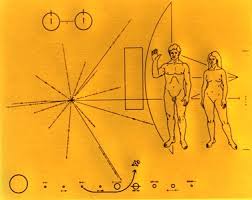 such were gold plaques and records attached
to the Pioneer and Voyager spacecrafts, but are unlikely to reach an
intelligent civilization in the Earth's lifetime. Exceptionally simple radio
transmission is the most practical medium for contact aliens, with the first
message "Mir, Lenin, and CCCP" directed at Venus. Gee, wonder who sent that one? The next interstellar transmission
was the Arecibo message sent to Messier 13, a star cluster 24,000 light years
away. (Remember: light year is a distance, not time.) This message contained
numerals, atomic numbers, the make-up of DNA, and some other essential
information. Radio transmission remains the heart of SETI, and it will likely
be our first contact with extraterrestrial beings. such were gold plaques and records attached
to the Pioneer and Voyager spacecrafts, but are unlikely to reach an
intelligent civilization in the Earth's lifetime. Exceptionally simple radio
transmission is the most practical medium for contact aliens, with the first
message "Mir, Lenin, and CCCP" directed at Venus. Gee, wonder who sent that one? The next interstellar transmission
was the Arecibo message sent to Messier 13, a star cluster 24,000 light years
away. (Remember: light year is a distance, not time.) This message contained
numerals, atomic numbers, the make-up of DNA, and some other essential
information. Radio transmission remains the heart of SETI, and it will likely
be our first contact with extraterrestrial beings.
Post-Detection
It's true. I'm not afraid to comment on topics provoking
skepticism and supernaturalism. Yet, we're not talking about things that go
bump in the night or bats that turn in to fanged humanoids.
 These are legitimate scientific enterprises that I hope
someday, just maybe in my life, I get
to see some payoff from. I'd say $2.6 billion in tax dollars, for Curiosity
alone, assures me that something significant will be discovered thanks to NASA's
ambitious rover program, even if it's not Martians. These are legitimate scientific enterprises that I hope
someday, just maybe in my life, I get
to see some payoff from. I'd say $2.6 billion in tax dollars, for Curiosity
alone, assures me that something significant will be discovered thanks to NASA's
ambitious rover program, even if it's not Martians.
Though, if by chance it is, you'd be happy to know that many
organizations already have little dockets in place known as post-detection
protocols. And in 'Merica, it's called Superman.
Resources
Image credits: PC Mag; ZD Net; G Static; Wikipedia; Zuko; Deadline
Wikipedia - Active SETI; Post-detection policy; Cultural impace of extraterrestrial contact; Fermi paradox; Drake equation; Zoo hypothesis
Bell Jar News - NASA's Curiosity rover discovers strange, bright object
IETI - Contact: Long-term Implications for Humanity
| 

 2
2


 Re: The Search for Extraterrestrial Intelligence


Good Answers: