|
It's been a long-held assumption that dolphins are amongst the smartest animals on Earth. I say 'assumption' not because I intend to degrade the dolphin's intelligence, but because their genuine cognitive abilities are still in debate. Some reports speculate that dolphins are more intelligent than humans, and bottlenose dolphins 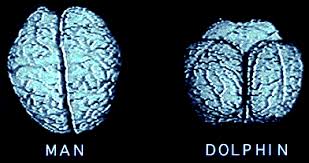 have exhibited the ability to watch television, recognize themselves in a mirror and understand numbers. However, much of the same research also suggests that a dolphin's intellect may be heavily based on mimicry. And while a well-developed neocortex – found in both humans and dolphins – is considered a good indicator of an animal's problem solving abilities, it is by far from animal law. have exhibited the ability to watch television, recognize themselves in a mirror and understand numbers. However, much of the same research also suggests that a dolphin's intellect may be heavily based on mimicry. And while a well-developed neocortex – found in both humans and dolphins – is considered a good indicator of an animal's problem solving abilities, it is by far from animal law.
While a dolphin's exact level of cognition is up in the air, it's clear that dolphins are at least amongst the most intelligent non-primate animals. They display spectacles of  complex play and understanding of the physical laws of their marine environment, as seen in the dolphin blowing bubble rings at right. How could I compose a blog post about dolphin intelligence without mentioning Flipper? Though Flipper is indeed fictitious, his role was satisfied by several dolphins whose unique abilities were combined to fulfill the character (except for the voice, which is actually a kookaburra). Though Flipper was a pet, his general duties included patrolling Coral Key Park and Marine Reserve, splashing people who made puns and saving (low intelligence) characters from sharks. complex play and understanding of the physical laws of their marine environment, as seen in the dolphin blowing bubble rings at right. How could I compose a blog post about dolphin intelligence without mentioning Flipper? Though Flipper is indeed fictitious, his role was satisfied by several dolphins whose unique abilities were combined to fulfill the character (except for the voice, which is actually a kookaburra). Though Flipper was a pet, his general duties included patrolling Coral Key Park and Marine Reserve, splashing people who made puns and saving (low intelligence) characters from sharks.
As you may already know, the U.S. Navy has been harnessing the intellect of dolphins since 1960. The U.S. Navy Marine Mammal Program in San Diego, Calif., trains dolphins and sea lions to provide ship and harbor protection, mine detection, and equipment recovery. Dolphins are valued for their echolocation, and sea lions for their excellent underwater hearing and low-light vision. This program was declassified in the 1990s when the Soviet version of the marine mammal program was closed, and it consists of five teams of porpoises and accompanying trainers:
- MK4 and MK7, whose dolphins identify and mark sea mines.
- MK8, whose dolphins find safe ship routes in enemy territory.
- MK6, who use both dolphins and sea lions to protect harbors from human swimmers.
- MK5, who locate lost equipment by the use of sea lions.
The U.S Navy claims it has never trained these animals for the purpose of attack and that its standard of care for the animals is extremely high. This is in contrast to the Soviet program, which suffered from funding problems for its killer dolphins before finally being sold to Iran in 2000.
 Like many things in the 21st century, the dolphins' and sea lions' jobs are being replaced with machinery. Entering 2017, the USNMMP will begin to phase out the program in favor of less expensive aquatic drones. The primary replacement of the program will be the Kingfish UUV, which will hunt sea mines, conduct search operations, patrol harbors, and destroy wayward ordinance. Like many things in the 21st century, the dolphins' and sea lions' jobs are being replaced with machinery. Entering 2017, the USNMMP will begin to phase out the program in favor of less expensive aquatic drones. The primary replacement of the program will be the Kingfish UUV, which will hunt sea mines, conduct search operations, patrol harbors, and destroy wayward ordinance.
The Navy likens its use of porpoises to the tactical dogs carried by the Army, but there is no current plan to replace K9s in military use despite many years of development. In every instance so far, the biological nose of a dog has beat technological imitations. And recently dolphins training off the California coast accidentally found a neat piece of history – one that was likely to have been overlooked by a UUV.
One dolphin found a Howell torpedo, which for its time was a revolutionary weapon. It was the first torpedo which could follow a route without leaving a wake. Its  11-feet-long brass construction was powered by a 132-pound flywheel which was spun to 10,000 RPM before launch. It had a 400 yard range and traveled at 25 knots. Only 50 of them were made by 1889 before another manufacturer improved upon the design. The one found last week is only the second remaining production model. 11-feet-long brass construction was powered by a 132-pound flywheel which was spun to 10,000 RPM before launch. It had a 400 yard range and traveled at 25 knots. Only 50 of them were made by 1889 before another manufacturer improved upon the design. The one found last week is only the second remaining production model.
The Navy admits that dolphins will still serve after 2017, as their abilities cannot be completely pantomimed by robots. Dolphin guards will likely remain stationed at submarine bases in Georgia and Washington. The main issue is the expense of keeping the dolphins. To keep them healthy and trained, a team of vets and handlers is needed almost round-the-clock. A long series of specialty enclosures, hoists and other equipment means  further operational expenses. Estimates place the current budget of the program at $20 million annually. further operational expenses. Estimates place the current budget of the program at $20 million annually.
I remain skeptical that the dolphin program will be completely erased by the end of the decade. I feel that there are certain functions accomplished by sentient creatures that just cannot be repeated by drones or other machinery. All technology aside, there is just something cool about dolphins helping protect the American people
Resources
(Images credits: All About Dolphins; X Air Forces; Wikimedia; Tumblr)
L.A. Times - Navy dolphins discover rare...
Wikipedia - U.S. Navy Marine Mammal Program
| 


 Re: Porpoises with Purpose


