|
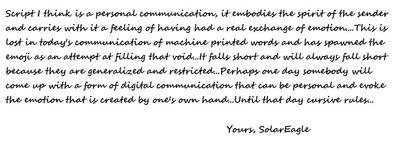
 Do you write in cursive or manuscript? Do you write in a mixture of the two? Do you write in cursive or manuscript? Do you write in a mixture of the two?
Whether or not to teach cursive in elementary schools has been a debate in the recent news with strong opinions on both sides.
Cursive emerged from Renaissance Italy, perhaps partly because lifting a delicate quill off and on the paper was apt to damage it and spatter ink. By the 19th century, cursive handwriting was considered a mark of a good education. In many countries today, including the U.S. and Canada, children are generally taught to write both cursive and manuscript. In France, children are taught to write cursive in kindergarten but in Mexico, only manuscript is taught. Image Credit
Interestingly, research consistently failed to find any real advantage of cursive over other forms of handwriting. It’s admittedly difficult to study because it’s hard to find children whose educational situation differs only in the style of handwriting.
Many will argue that cursive is faster than manuscript, helps with spelling, and helps with dyslexia. Another very popular argument is that without learning to write in cursive, student will not be able to read it and therefore won’t be able to read historical documents. But many students struggle with the fine motor skills of writing cursive and making the connection between reading and writing since books are written in script.
An article in Nautilus, “Cursive Handwriting and Other Education Myths”, breaks down numerous studies that disprove the merits of cursive handwriting. The author argues for students to be able to develop their own handwriting style which will encourage writing speed as well as increase legibility.
What do you think? Are there merits to students learning cursive? Should teachers not waste the time and just teach manuscript?
| 

 8
8


 Re: Cursive vs. Manuscript






Good Answers:
"Almost" Good Answers: