The Engineer's Notebook Blog

The Engineer's Notebook

The Engineer's Notebook is a shared blog for entries that don't fit into a specific CR4 blog. Topics may range from grammar to physics and could be research or or an individual's thoughts - like you'd jot down in a well-used notebook.

Previous in Blog: Do We Need Better Hurricane Ratings?   Next in Blog: Blowing Up the Balloons at the Macy’s Thanksgiving Day Parade
Close
Close
Close
28 comments
Rate Comments: Nested

Bananapocalypse?

Posted November 14, 2016 1:00 PM by BestInShow
Pathfinder Tags: bananas extinction panama disease

In this post, I originally intended to focus on the evils of monoculture, seen through the lens of the Cavendish banana. Over the past few years, articles about the banana’s impending demise from disease turn up sporadically, so I thought I could use this as another way to preach from my soapbox about sustainable agriculture. However, after digging deeper into both monocultures and bananas, I unearthed information that turned this post from mostly a soapbox to a report on advances in plant and fungal genetics, with a short detour through the definition of monoculture and a few words about the dangers thereof.

Are bananas grown as a monoculture?

The simplest definition of monoculture is the practice of growing a single crop in a field during one growing season. Polyculture is growing more than one crop in the same field at the same time, such as interplanting corn and beans. That’s it. Many farmers rotate crops; they plant a different crop in a given field each year in a regular sequence. Many people, myself included, think of a monoculture as the same crop—often the same species or variety—in the same field year after year.
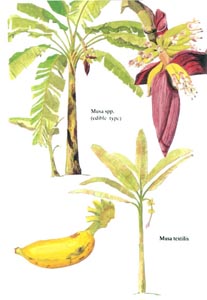
Commercially-grown bananas, however, meet my conception of a monoculture in spades. Not only is the same crop grown in the same fields every year, but growers also produce new Dwarf Cavendish banana plants, the most widely-grown of several Cavendish clones, vegetatively. These bananas are parthenocarpic (seedless). Vegetative reproduction ensures that each plant is a clone of every other plant; they have identical genotypes. So yes, bananas are a monoculture.

And this is bad because…

Remember the Irish potato famine? Most of the potatoes planted in Ireland were of one variety. This lack of genetic variation exacerbated the blight’s severity. When a pathogen attacks a vulnerable plant variety, all plants of that variety are at risk. The Understanding Evolution website points out that “…evolutionary theory tells us that relying on crops with low genetic variation can lead to disaster.”

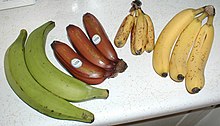
Now commercial growers overwhelmingly rely on one cloned variety of banana, grown as a monoculture, for export. Ironically, Central and South American banana producers switched to Cavendish from the Gros Michel, or Big Mike, banana in the 1950s-’60s when Big Mike succumbed to the first wave of Panama disease, a form of Fusarium wilt. Cavendish plants aren’t susceptible to this strain of Fusarium, and their fruits are well-suited to large-scale commercial enterprises. Picked green, these bananas take several weeks to ripen, allowing for longer shipping and storage times. Unfortunately, Cavendish isn’t as tasty as Gros Michel, but consumers don’t appear to mind.

Given what we know about the Irish potato famine and the decline of Gros Michel, you’d think that banana growers would try to tap into some of the genetic diversity available in wild bananas. With 47 percent of the world banana crop devoted to Cavendish monoculture, banana producers and aficionados are poised on the precipice should another blight arise.

…here comes Tropical Race 4

And that’s exactly what’s happening. A new form of Fusarium fungus, called Tropical Race 4, has emerged in Asia and is decimating banana plantations. The disease is easily transmitted by soil and water and perhaps by air. The disease spores migrate so easily that this year’s International Banana Congress moved to Costa Rica from Miami out of concern that attendees might spread the disease. Plantations infected with TR4 will take years to recover, if indeed they can recover. Fortunately, TR4 hasn’t yet hit Central and South America, so there’s time to work on a solution.
Unfortunately, breeding new disease-resistant banana varieties has traditionally taken decades. The British started in the early 1920s attempting to breed a Panama disease-resistant Gros Michel banana. The challenge of breeding tasty, seedless
bananas, though, is complicated by banana triploidy and tetraploidy. Natural mutations have created sterile triploid and tetraploid varieties. Hybridizers typically cross diploid plants (which have seeds) with triploid plants, sort through the progeny, and select likely candidates for more study. This process is long, painstaking, and complicated. No useful new hybrids or cultivars have emerged in 60 years. Over the last few years, multiple organizations have joined the hunt, but no new plants, yet.

Genetics to the rescue

Earlier this year (2016), a trio of researchers from the University of California at Davis, the University of Queensland, and the University of Wageningen announced a stunning discovery. Using pieces of the genetic code for both the Cavendish banana and two of the three most serious banana-attacking fungi, Ioannis Stergiopoulos (UC Davis), André Drenth (Queensland), and Gert Kema (Wageningen) demonstrated how the fungus appropriates the banana’s metabolic pathways and uses its nutrients. Stergiopoulos characterized this discovery’s significance: “This parallel change in metabolism of the pathogen and the host plant has been overlooked until now and may represent a ‘molecular fingerprint’ of the adaption process.” Fungi adapt their metabolism to match that of the host plant, enabling the fungi’s efficient and swift conquest of the host. Understanding this mechanism should lead to development both of more resistant plants and more effective fungicides.

This research looked at the Sigatoka complex of three fungal diseases caused by three species of the Pseudocercospora fungus, not Panama disease caused by TR4. However, as Steriopoulos pointed out, researchers can parlay this understanding of the importance of the metabolic takeover process into solutions for other fungal diseases, not just of bananas but also other crops.

Consequences of a Bananapocalypse

Bananas are the world’s favorite fruit and probably our oldest fruit. The 100 million bananas eaten yearly make this the world’s fourth most important food crop. In the
United States and Europe, bananas are a sweet treat. In much of the world, though, the fruit is a diet staple, providing up to 30 percent of daily calories consumed. In addition to providing calories, banana crops are critical economic assets to growers and to the countries that produce them. If the Cavendish banana goes extinct, banana lovers won’t be the only ones affected; millions of people in developing nations will suffer as well. This promising genetic research could save much more than just a popular fruit.

Resources

"Experts Race to Stop Bananapocalypse from Hitting Latin American Producers." The Guardian 21 April 2016. Retrieved November 9, 2016.

"Fungi Could Wipe Out Bananas in 5 to 10 Years." Futurity 15 August 2016. Retrieved November 7, 2016.

"Panama Disease." Retrieved November 10, 2016.

"With the Familiar Cavendish Banana in Danger, Can Science Help It Survive?" The Conversation 23 October 2016. Retrieved November 7, 2016.

Images credits:

Banana plant and fruit. Tun Institute of Learning

Banana varieties. Wikimedia Commons.

Australian banana plantation ca. 1907. Wikimedia Commons.

Reply

Interested in this topic? By joining CR4 you can "subscribe" to
this discussion and receive notification when new comments are added.
Guru
Hobbies - CNC - New Member Hobbies - DIY Welding - New Member Engineering Fields - Electromechanical Engineering - New Member

Join Date: Aug 2007
Posts: 23647
Good Answers: 420
#1

Re: Bananapocalypse?

11/14/2016 1:15 PM

Good article. all it takes is a virus and one species of crop would be wiped out, and it will be devastating.

__________________
“ When people get what they want, they are often surprised when they get what they deserve " - James Wood
Reply
Guru
United States - Member - New Member Popular Science - Cosmology - New Member Technical Fields - Education - New Member

Join Date: Jan 2014
Location: Albany, NY
Posts: 1187
Good Answers: 24
#2
In reply to #1

Re: Bananapocalypse?

11/14/2016 1:50 PM

Thanks! The same kind of disaster could happen to other crops, too. You'd think banana growers would have learned from the potato famine not to depend on one variety. I guess the tremendous difficulty involved in developing acceptable new hybrids has kept the banana universe limited. I was intrigued by this new research, which could help not only bananas but other fungus-susceptible crops as well.

Reply
Guru
Hobbies - CNC - New Member Hobbies - DIY Welding - New Member Engineering Fields - Electromechanical Engineering - New Member

Join Date: Aug 2007
Posts: 23647
Good Answers: 420
#3
In reply to #2

Re: Bananapocalypse?

11/14/2016 1:59 PM

You'd think banana growers would have learned from the potato famine not to depend on one variety.

The problem with that is, it was a potato crop failure... the Irish were still dying of starvation yet they were actually exporting food during the famine due to the political and land ownership issues. These issues are were the reason why for monocrops

Of course I do understand about having various strains of potato itself to fight disease.

__________________
“ When people get what they want, they are often surprised when they get what they deserve " - James Wood
Reply
Guru
United States - Member - New Member Popular Science - Cosmology - New Member Technical Fields - Education - New Member

Join Date: Jan 2014
Location: Albany, NY
Posts: 1187
Good Answers: 24
#4
In reply to #3

Re: Bananapocalypse?

11/14/2016 2:12 PM

I didn't know that! That's dreadful.

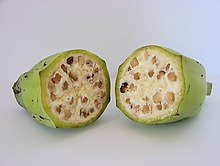
Sort of similar with bananas. According the sources I read, farmers who grow Cavendish fruit for export generally feed their families indigenous bananas. These species bananas are perfectly fine except that they have gigunda seeds. You can eat around the seeds, obviously, but banana customers in the US, Europe, Australia, and elsewhere don't want to be bothered with them. See picture below.

Reply
Guru
Hobbies - CNC - New Member Hobbies - DIY Welding - New Member Engineering Fields - Electromechanical Engineering - New Member

Join Date: Aug 2007
Posts: 23647
Good Answers: 420
#5
In reply to #4

Re: Bananapocalypse?

11/14/2016 2:18 PM

I like seedless bananas.... watermelon too.

I thought from the reports of over 10 years ago, that bananas would be extinct by now.

__________________
“ When people get what they want, they are often surprised when they get what they deserve " - James Wood
Reply
Guru
United States - Member - New Member Popular Science - Cosmology - New Member Technical Fields - Education - New Member

Join Date: Jan 2014
Location: Albany, NY
Posts: 1187
Good Answers: 24
#6
In reply to #5

Re: Bananapocalypse?

11/14/2016 2:36 PM

I read an article published in 2002 or 2004, thereabouts, that said in 10 years we'd be banana-less. Perhaps the interesting question is why we still have bananas, despite the lack of new disease-resistant varieties. This latest plague started in Asia in the 1990's and hasn't yet spread to Central and South America. I suppose banana growers are successfully slowing down the disease's march around the globe.

Reply
Guru
Safety - Hazmat - New Member United States - US - Statue of Liberty - New Member Engineering Fields - Chemical Engineering - Old Hand

Join Date: Mar 2011
Location: Lubbock, Texas
Posts: 14331
Good Answers: 162
#8
In reply to #6

Re: Bananapocalypse?

11/14/2016 4:43 PM

If there was only a drought resistant breed of coffee. The coffee farmers seem to be having difficulties staying in business due to lack of water.

__________________
If it ain't broke, don't fix it. Just build a better one.
Reply
Guru

Join Date: Apr 2011
Posts: 8006
Good Answers: 286
#9
In reply to #1

Re: Bananapocalypse?

11/14/2016 5:39 PM

A virus could do it, but it would probably have to rely on a pervasive mobile vector for rapid and wides spread, since most plants don't get out and about much.

A fungus on the other hand, like the one discussed above, can be adept at spreading without relying on a 3rd party.

We have experienced first hand the pitfalls of monoculture reliance. We needn't even look beyond bananas. The Gran Michele banana, the predecessor to our current Cavendish was taken out by a different type of fusarium wilt fungus.

We survived the demise of the Grand Michele, and we will survive the loss of the Cavendish.

__________________
Eternal vigilance is the price of knowledge. - George Santayana
Reply
Guru
Hobbies - CNC - New Member Hobbies - DIY Welding - New Member Engineering Fields - Electromechanical Engineering - New Member

Join Date: Aug 2007
Posts: 23647
Good Answers: 420
#10
In reply to #9

Re: Bananapocalypse?

11/14/2016 5:50 PM

Your post rings a memory, I recall a fungus in grape vineyards that needs to be monitored for infestation quite closely

__________________
“ When people get what they want, they are often surprised when they get what they deserve " - James Wood
Reply
Guru
United States - Member - New Member Popular Science - Cosmology - New Member Technical Fields - Education - New Member

Join Date: Jan 2014
Location: Albany, NY
Posts: 1187
Good Answers: 24
#12
In reply to #10

Re: Bananapocalypse?

11/15/2016 8:33 AM
Reply
Guru
Hobbies - CNC - New Member Hobbies - DIY Welding - New Member Engineering Fields - Electromechanical Engineering - New Member

Join Date: Aug 2007
Posts: 23647
Good Answers: 420
#14
In reply to #12

Re: Bananapocalypse?

11/15/2016 9:18 AM

I can't remember, when TC mention the type of banana Gran Michele, that name is was shook my memories because it sounded similar to the disease.

Black Rot in grapes is similar to Cherries that have was is called Brown Rot, and when that happens, that that's a death sentence the following spring it wouldn't have any leaves and the tree is dead within a year.

__________________
“ When people get what they want, they are often surprised when they get what they deserve " - James Wood
Reply
Guru

Join Date: Apr 2011
Posts: 8006
Good Answers: 286
#18
In reply to #10

Re: Bananapocalypse?

11/15/2016 12:55 PM

Fusarium is pretty much ubiquitous. If you sample soil outside with plants growing, it is pretty much a given you will find fusarium or their spores. A number of fusarium species release toxins, making them problematic for plants and sometimes even for animals like ourselves. Fungicides don't seem to be effective.

Damage comes down to how well the particular species of fusarium, the resistance of the plant (or animal), the growing conditions and possible modes of transfer. Fusarium wilt is very common in gardens. Choosing fusarium resistant strains is critical in my area. Odly enough, being careful to avoid contaminating foliage with soil while digging or watering also seems to limit fusarium impact.

The biggest grape blight I can think of was the French Wine Blight, but that was a case of aphids.

I need to make a correction; the name of the banana cultivar previously wiped out by fusarium is 'Gros Michel' not what I had incorrectly recalled above.

__________________
Eternal vigilance is the price of knowledge. - George Santayana
Reply
Guru
Hobbies - CNC - New Member Hobbies - DIY Welding - New Member Engineering Fields - Electromechanical Engineering - New Member

Join Date: Aug 2007
Posts: 23647
Good Answers: 420
#19
In reply to #18

Re: Bananapocalypse?

11/15/2016 1:17 PM

The biggest grape blight I can think of was the French Wine Blight, but that was a case of aphids.

Aphids,... that could have been it. That's why I had trouble finding it.

Its interesting about the toxins left in the soil.

This is going off subject, Our neighbor worked for a nursery, and they would sterilize the soil (seeds) by gassing it with Methyl Bromide.

__________________
“ When people get what they want, they are often surprised when they get what they deserve " - James Wood
Reply
Guru

Join Date: Apr 2011
Posts: 8006
Good Answers: 286
#24
In reply to #19

Re: Bananapocalypse?

11/15/2016 9:56 PM

Sterilizing soil is an alternative, though I suspect it isn't cheap. I'm sure high temperature steam could be used too.

Seems like reintroducing a heavy supply of beneficial microorganisms after sterilization would be a good idea, as many improve yields and can compete with the bad guys.....maybe it's just me, but leaving sterile field seems like an open invitation for requiring sterilization again next year.

.

BTW, didn't mean to suggest toxins were left in the soil and that damaged the plants. Fusarium is in the soil. Disturbing the soil, digging deep, leaving loose soil that might be blown around or splashed on plants by rain or heavy sprinklers gives the fungus an easy path to the plant.

I've had some success using planting barriers using minimal disruption of the surface (just small intermittent holes) with seedlings placed in the center of a small amount of potting media.

__________________
Eternal vigilance is the price of knowledge. - George Santayana
Reply
Guru
Safety - Hazmat - New Member United States - US - Statue of Liberty - New Member Engineering Fields - Chemical Engineering - Old Hand

Join Date: Mar 2011
Location: Lubbock, Texas
Posts: 14331
Good Answers: 162
#26
In reply to #19

Re: Bananapocalypse?

11/17/2016 11:39 AM

EPA put methyl bromide, and methylene bromide on the hit list over ten years ago, right?

__________________
If it ain't broke, don't fix it. Just build a better one.
Reply
Guru
Hobbies - CNC - New Member Hobbies - DIY Welding - New Member Engineering Fields - Electromechanical Engineering - New Member

Join Date: Aug 2007
Posts: 23647
Good Answers: 420
#28
In reply to #26

Re: Bananapocalypse?

11/17/2016 12:20 PM

possible, considering my neighbor were I got the info from, hasn't worked at a nursery for over 30 years.

__________________
“ When people get what they want, they are often surprised when they get what they deserve " - James Wood
Reply
Guru
Safety - Hazmat - New Member United States - US - Statue of Liberty - New Member Engineering Fields - Chemical Engineering - Old Hand

Join Date: Mar 2011
Location: Lubbock, Texas
Posts: 14331
Good Answers: 162
#25
In reply to #10

Re: Bananapocalypse?

11/17/2016 11:35 AM

Powdery mildew is one nemesis of vineyard owners /grape producers worldwide. It is more likely to be a problem in areas where there are cooler, wetter springs with much overcast. Areas like West Texas only occasionally have issues with this fungus.

The real problem with powdery mildew is a minimal infestation of 5% can result in white wines tasting less like watermelons, or apples, and more like cooked apricots or tomato paste. Obviously that is not good for putting that wine on the shelves.

__________________
If it ain't broke, don't fix it. Just build a better one.
Reply
Guru
Hobbies - CNC - New Member Hobbies - DIY Welding - New Member Engineering Fields - Electromechanical Engineering - New Member

Join Date: Aug 2007
Posts: 23647
Good Answers: 420
#27
In reply to #25

Re: Bananapocalypse?

11/17/2016 12:19 PM

I'm not a big fan of a Dry Riesling wine.

Which I did a quick search the Riesling grapes are prone to Botrytis (aka Noble rot)

__________________
“ When people get what they want, they are often surprised when they get what they deserve " - James Wood
Reply
Guru

Join Date: Mar 2007
Location: by the beach in Florida
Posts: 33392
Good Answers: 1817
#7

Re: Bananapocalypse?

11/14/2016 3:22 PM
__________________
All living things seek to control their own destiny....this is the purpose of life
Reply
Guru

Join Date: Nov 2010
Location: Virginia, Georgia, Idaho
Posts: 1079
Good Answers: 30
#11

Re: Bananapocalypse?

11/15/2016 8:26 AM

There are far more than 100 million bananas eaten each year.

__________________
PFR Pressure busts pipes. Maybe you need better pipes.
Reply
Guru
United States - Member - New Member Popular Science - Cosmology - New Member Technical Fields - Education - New Member

Join Date: Jan 2014
Location: Albany, NY
Posts: 1187
Good Answers: 24
#13
In reply to #11

Re: Bananapocalypse?

11/15/2016 8:52 AM

You're right. That should probably be 100 million tons eaten, not individual bananas. Maybe 2-3 bananas in a pound ... that's a lot of bananas.

Reply
Guru

Join Date: Mar 2007
Location: by the beach in Florida
Posts: 33392
Good Answers: 1817
#15

Re: Bananapocalypse?

11/15/2016 9:30 AM

I think probably any crop and every farmer faces the threat of things that can destroy their crop, whether it's weather, or insects, or fungus, or a vast variety of conditions that can and do influence crop yields every year....We here in florida are battling any number of threats, perhaps most famously, citrus greening, a bacterial infestation carried by insects, specifically the Asian citrus psyllid, that ruins fruit and kills the trees...Florida's citrus industry is a $10 billion (with a "B") dollar industry that has been plagued by this pest for 10 years now, resulting in last years crop yield the smallest in 50 years...

..."When citrus greening first emerged, researchers and growers pinned their hopes on finding a cure. They began looking for an effective treatment or a new variety of disease-resistant trees. But a cure has proved elusive. So now, the industry has focused on strategies to keep infected trees healthy and productive as long as possible. Growers are using costly treatments like extra fertilizer and pesticide. Some also have also begun using heat to control the disease, subjecting trees to periodic steam baths.

At his 35-acre research facility in Vero Beach, Bob Adair has had promising results with something he calls metalized reflective mulch. "It's a monomolecular layer of aluminum," he says, "a very, very thin coating of aluminum, very shiny. Looks much like aluminum foil."

Underneath a row of grapefruit trees, the ground is covered by a silvery plastic sheet. It acts like a mirror, reflecting the light and heat of the intense Florida sunshine. "As we stand here," Adair says, "you can probably feel the heat. And what we're looking at are trees that are growing 50 percent faster than trees that were planted with the grower's standard, which is bare ground."

Even more important, on trees with the metalized mulch, Adair is seeing fewer Asian psyllids, the insects that carry citrus greening disease. "So we have a healthy tree, a bigger tree with more fruit," he says. He believes it could be a valuable tool for growers, helping keep their groves productive while the search continues for a cure."...

http://www.npr.org/sections/thesalt/2015/11/27/457424528/how-long-can-floridas-citrus-industry-survive

__________________
All living things seek to control their own destiny....this is the purpose of life
Reply
Guru

Join Date: Mar 2007
Location: by the beach in Florida
Posts: 33392
Good Answers: 1817
#17
In reply to #15

Re: Bananapocalypse?

11/15/2016 11:30 AM
__________________
All living things seek to control their own destiny....this is the purpose of life
Reply
Guru
United States - Member - New Member Popular Science - Cosmology - New Member Technical Fields - Education - New Member

Join Date: Jan 2014
Location: Albany, NY
Posts: 1187
Good Answers: 24
#20
In reply to #15

Re: Bananapocalypse?

11/15/2016 1:58 PM

This is a case where the unexpected consequences turned out to be good. I wonder what the cost of this stuff is.

Reply
Guru

Join Date: Mar 2007
Location: by the beach in Florida
Posts: 33392
Good Answers: 1817
#21
In reply to #20

Re: Bananapocalypse?

11/15/2016 3:56 PM

They sell it for about $.10 sq ft retail...I imagine in bulk < half that...

http://www.groworganic.com/brite-n-up-silver-mulch-0-5-mil-30-x100-roll.html

...each tree probably requires one of these rolls 250 sq ft....

__________________
All living things seek to control their own destiny....this is the purpose of life
Reply
Guru
United States - Member - New Member Popular Science - Cosmology - New Member Technical Fields - Education - New Member

Join Date: Jan 2014
Location: Albany, NY
Posts: 1187
Good Answers: 24
#22
In reply to #21

Re: Bananapocalypse?

11/15/2016 4:25 PM

So $25 or less per tree. I wonder if the increase in yield covers the cost? Of course at least some gets passed along to the consumer but even consumers have their limits.

I gave a half a thought to trying this in our tiny vegetable garden. We only get eastern and southeastern sun in the morning and not much else until after 3:00 p.m. Maybe if my plants had sun reflectors.

Reply
Guru

Join Date: Mar 2007
Location: by the beach in Florida
Posts: 33392
Good Answers: 1817
#23
In reply to #22

Re: Bananapocalypse?

11/15/2016 6:09 PM

Probably be good for tomatoes....

It certainly is effective against certain types of problems in certain types of crops in certain locations....a disease resistant strain of the crop for your location would be wise as well....

http://tswvramp.org/management/

http://www.guardandgrow.com/

__________________
All living things seek to control their own destiny....this is the purpose of life
Reply
Guru

Join Date: Jun 2008
Posts: 859
Good Answers: 33
#16

Re: Bananapocalypse?

11/15/2016 11:27 AM

See how GMO science saved the papaya in Hawaii....Lots of reference material out there...

Reply
Reply to Blog Entry 28 comments
Copy to Clipboard

Users who posted comments:

BestInShow (7); C-Mac (1); James Stewart (3); PFR (1); phoenix911 (8); SolarEagle (5); truth is not a compromise (3)

Previous in Blog: Do We Need Better Hurricane Ratings?   Next in Blog: Blowing Up the Balloons at the Macy’s Thanksgiving Day Parade

Advertisement