Challenge Questions Blog

Challenge Questions

Stop in and exercise your brain. Talk about this month's Challenge from Specs & Techs or similar puzzles.

So do you have a Challenge Question that could stump the community? Then submit the question with the "correct" answer and we'll post it. If it's really good, we may even roll it up to Specs & Techs. You'll be famous!

Answers to Challenge Questions appear by the last Tuesday of the month.

Previous in Blog: Electric Bill Enigma: Newsletter Challenge (February 2018)   Next in Blog: Pollination Puzzle: Newsletter Challenge (April 2018)
Close
Close
Close
7 comments
Rate Comments: Nested

Core Conundrum: Newsletter Challenge (March 2018)
Posted February 28, 2018 5:01 PM
Pathfinder Tags: challenge question planet core

This month's Challenge Question: Specs & Techs from IEEE Engineering360:

A scientist claims she can determine the size and density of an extraterrestrial planet’s core by landing a spacecraft on its surface, using only radio equipment on the lander and corresponding equipment at tracking stations on Earth. How is this possible?

And the answer is:

A planet’s rotational motions, namely the precession rate of its spin axis and the nutation of its spin axis, depend on its interior structure. For this reason, a planet’s core size and density can be determined by estimations of its precession and nutation. The precession is the long-term drift of the planet’s rotation axis in space, while the nutation describes the periodic motions of this axis as observed from space.

The precession and nutation values can be ascertained based on measurements of the relative velocity of the lander and tracking stations on Earth. The relative velocity can be found by measuring the Doppler shift of radio transmissions sent from the tracking station to the lander and re-transmitted back to Earth.

NASA’s Mars InSight lander mission will carry out this very task through its Rotation and Interior Structure Experiment (RISE). The lander will be equipped with an X-Band radio transponder that will provide the radio link necessary for Doppler tracking of the lander’s location. From this information, Mars’ precession and nutation values can be calculated and the size and density of its core can be determined.

For more on the InSight mission, see this article.

Reply

Interested in this topic? By joining CR4 you can "subscribe" to
this discussion and receive notification when new comments are added.
Guru

Join Date: Mar 2007
Location: by the beach in Florida
Posts: 33392
Good Answers: 1817
#1

Re: Core Conundrum: Newsletter Challenge (March 2018)

02/28/2018 5:32 PM

You could measure the weight of the lander on the planet and calculate the resulting MoI (moment of inertia)difference by the effect on the gravitational acceleration anomaly as a function of latitude with line-of-sight rf signal...

__________________
All living things seek to control their own destiny....this is the purpose of life
Reply
Guru

Join Date: Apr 2010
Location: About 4000 miles from the center of the earth (+/-100 mi)
Posts: 9910
Good Answers: 1141
#2

Re: Core Conundrum: Newsletter Challenge (March 2018)

02/28/2018 6:49 PM

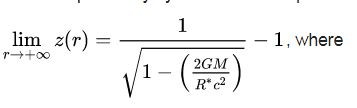
The signal from the spacecraft received from inside the planet's gravitational field will be shifted down in frequency (gravitational redshift).

The more often used exact equation for gravitational redshift applies to the case outside a non-rotating, uncharged mass which is spherically symmetric. The equation is:

  • G is the gravitational constant,
  • M is the mass of the object creating the gravitational field,
  • R is the radial coordinate of the point of emission (which is analogous to the classical distance from the center of the object, but is actually a Schwarzschild coordinate),
  • r is the radial coordinate of the observer (in the formula, this observer is at an infinitely large distance), and
  • c is the speed of light.

https://en.wikipedia.org/wiki/Gravitational_redshift

Reply
Guru
Engineering Fields - Optical Engineering - Member Engineering Fields - Engineering Physics - Member Engineering Fields - Systems Engineering - Member

Join Date: Apr 2010
Location: Trantor
Posts: 5363
Good Answers: 647
#3

Re: Core Conundrum: Newsletter Challenge (March 2018)

03/01/2018 8:46 PM

1. Assuming that the core is metallic and

2. That the rock outside of the core is non-metallic and

3. Assuming the planet rotates on its axis with the axis not oriented toward the Earth and

4. That the radio equipment on the spacecraft can emit a broad range of frequencies and

5. That the receiving stations on Earth can detect the radio signals from the spacecraft over a wide db signal range.

Then, the size and makeup of the core can be determined by measuring the change in signal intensity over a range of wavelengths, as the spacecraft rotates around the core as the planet itself rotates. The (metallic) core blocks signals that are passed by non-metallic rock.

__________________
Whiskey, women -- and astrophysics. Because sometimes a problem can't be solved with just whiskey and women.
Reply
Member
Ingeniería en Español - Nuevo Miembro - New Member

Join Date: Apr 2017
Posts: 8
#4

Re: Core Conundrum: Newsletter Challenge (March 2018)

03/02/2018 1:01 AM

1.-Approach the exoplanet in a low orbit coplanar with Earth. The radio signal emitted by the spacecraft will vanish around half of the total time. Same for signals emitted from Earth detected in spacecraft. Knowing the spacecraft velocity the diameter of exoplanet can be determined, hence its size (assumed spherical).

2.-At landing, either measuring the necessary thrust exerted to land smoothly or the redshift the planet mass can be deduced.

Reply
Guru

Join Date: Mar 2011
Location: Sebastopol, California
Posts: 1205
Good Answers: 54
#5

Re: Core Conundrum: Newsletter Challenge (March 2018)

03/02/2018 9:33 AM

By broadcasting Down into the planet assuming there is a surface to land on. As the planet rotates and/or orbits it's sun, the signal characteristics will change. By setting a base line with a starting frequency and a full orbit/rotation or two, the transmitter can then sweep up and down it's bandwidth over several rotations, and the variance can be measured and evaluated by radio telescope.

__________________
Most people are mostly good most of the time.
Reply
Power-User

Join Date: May 2017
Location: Houston the Emerald City that would be Oz, TX serving art collectors and patrons worldwide
Posts: 224
Good Answers: 8
#6

Re: Core Conundrum: Newsletter Challenge (March 2018)

03/02/2018 10:08 AM

Using the "Red Shift" methodology elucidated in prior posts you can determine the gravitational field. THEN you can take that field and by using integrated gravity blocks, (think 3d pixels) and various material densities can "stack" and arrange them in a computer model to (extraterrestrial) geophysically map the subsurface. We did this back in the mid-1970's with salt domes on the Texas Gulf Coast. (Oh the joys of FortranIV, forklift sized card decks, paper outputs, and waiting all night for the monster Univac to run your model only to find out that on that a one character typo on card 1039 caused the program to loop and the operators to kick you out of process).

__________________
To get anywhere fast the first thing you do is go off in the wrong direction.
Reply
Guru

Join Date: May 2016
Posts: 1746
Good Answers: 87
#7

Re: Core Conundrum: Newsletter Challenge (March 2018)

03/02/2018 11:00 AM

To make this work, you need to make a lot of assumptions.

Is it a rocky? Is there a metallic core? Gaseous? Is it platinum or solid rubber lovingly crafted by those Magrathean planetary engineers? Any of them could generate the same gravity field and be indistinguishable from a gravity field alone.

Reply
Reply to Blog Entry 7 comments
Copy to Clipboard

Users who posted comments:

Alexvs (1); Deefburger (1); Jpfalt (1); Rixter (1); SolarEagle (1); Stephen Archer (1); Usbport (1)

Previous in Blog: Electric Bill Enigma: Newsletter Challenge (February 2018)   Next in Blog: Pollination Puzzle: Newsletter Challenge (April 2018)

Advertisement
