Challenge Questions Blog

Challenge Questions

Stop in and exercise your brain. Talk about this month's Challenge from Specs & Techs or similar puzzles.

So do you have a Challenge Question that could stump the community? Then submit the question with the "correct" answer and we'll post it. If it's really good, we may even roll it up to Specs & Techs. You'll be famous!

Answers to Challenge Questions appear by the last Tuesday of the month.

Previous in Blog: The Ol' Bulb Drop: Newsletter Challenge (January 2019)   Next in Blog: Spring Stumper: Newsletter Challenge (March 2019)
Close
Close
Close
25 comments
Rate Comments: Nested

Onerous Odds: Newsletter Challenge (February 2019)

Posted January 31, 2019 5:01 PM
Pathfinder Tags: challenge question odds

This month's IEEE GlobalSpec newsletter challenge is:

When played separately, the probability of losing each of two different coin-toss games is higher than the probability of winning the games. Wily Will, however, claims to have concocted a scheme in which he’ll play each of the pair of games in an alternating sequence to beat the odds. Is it possible Wily Will can come out ahead by combining two losing games?

And the answer is:

Yes, Wily Will can come out ahead by playing each of the two losing games in an alternating sequence.

He can achieve this triumph because he has mastered Parrondo’s paradox. This apparent paradox states that two losing games can be turned into a winning game by combining the two.

Consider the following two coin toss games. In game 1, a weighted coin is tossed with a probability of winning of 49.5%. The player starts with $100. He gains $1 for every winning toss and loses $1 for every losing toss. Over many rounds, the player will lose all of his money since the chance of losing a round is higher than the probability of winning.

In game 2, one of two weighted coins is tossed, based on the player’s capital. If the player’s capital is a multiple of 3, a weighted coin with a probability of winning of less than 9.5% is tossed. Otherwise, a weighted coin with a probability of winning of 74.5% is tossed. Like game 1, the player starts with $100, gains $1 for every winning toss and loses $1 for every losing toss. And like game 1, the player will lose all of his money over many rounds.

When played independently, the player will lose money in either of the games. But Wily Will plans to apply Parrondo’s paradox to come out ahead by playing the games one after the other in a sequence. He’ll play two rounds of game 1 followed by two round of game 2 in a continuous cycle. This approach establishes a link between the two games so that the probability of winning game 2 is no longer independent of the probability of winning game 1. The compound game establishes a dependence of game 2 on the result of game 1 so that the player can enter game 2 in a favorable state that makes him more likely to win.

Further Reading

Harmer, G. P.; Abbott, D. Parrondo's paradox. Statist. Sci. 14 (1999), no. 2, 206--213. doi:10.1214/ss/1009212247. https://projecteuclid.org/euclid.ss/1009212247

Reply

Interested in this topic? By joining CR4 you can "subscribe" to
this discussion and receive notification when new comments are added.

Good Answers:

These comments received enough positive votes to make them "good answers".
Guru

Join Date: Mar 2007
Location: by the beach in Florida
Posts: 33392
Good Answers: 1817
#1

Re: Onerous Odds: Newsletter Challenge (February 2019)
01/31/2019 5:26 PM

If this was true Vegas would go broke in a week....

__________________
All living things seek to control their own destiny....this is the purpose of life
Reply
Guru

Join Date: Apr 2010
Location: About 4000 miles from the center of the earth (+/-100 mi)
Posts: 9910
Good Answers: 1141
#2

Re: Onerous Odds: Newsletter Challenge (February 2019)

01/31/2019 5:32 PM

Will can play two grandmaster chess players. His odds of winning against each would be low, but he plays both simultaneously, playing white against one and black against the other. White always moves first.

Grandmaster1 playing white makes his move. Will then copies Grandmaster1's move in the other game against Grandmaster2. When Grandmaster2 makes his move, Will makes that move against Grandmaster1, and so on.

The result will be that Will either beats 1 of the Grandmasters or ties both of them. This is much better than he could do against either.

Reply
Guru

Join Date: Apr 2010
Location: About 4000 miles from the center of the earth (+/-100 mi)
Posts: 9910
Good Answers: 1141
#3
In reply to #2

Re: Onerous Odds: Newsletter Challenge (February 2019)

01/31/2019 6:38 PM

Misread the question. I wonder if there are coin toss games with rules such that Will can use the same principle as in #2.

Reply
Guru

Join Date: Mar 2007
Location: by the beach in Florida
Posts: 33392
Good Answers: 1817
#4
In reply to #3

Re: Onerous Odds: Newsletter Challenge (February 2019)

01/31/2019 7:40 PM
__________________
All living things seek to control their own destiny....this is the purpose of life
Reply
Guru

Join Date: Apr 2010
Location: About 4000 miles from the center of the earth (+/-100 mi)
Posts: 9910
Good Answers: 1141
#5
In reply to #4

Re: Onerous Odds: Newsletter Challenge (February 2019)

02/01/2019 7:19 AM

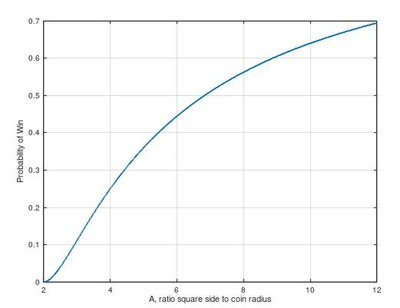
OK, I think I might be getting on board now. You're throwing coins at a grid, and if they don't cross a line you win. So it all boils down to the ratio of the area of a coin to the area of a square in the grid. Scaling everything up or down will produce the same odds.

Analysis:

Assume the radius of the coin is 1. You win if the center of the coin falls inside a small square inside of the big square. The boundaries of the small square are distance 1 (the radius of the coin) from the outside square. If the outside square has side A and area A2, the inside square will have side (A-2) and area (A-2)2. The probability of winning is r = ((A-2)/A)2 , the ratio of the area of the small square to big square's area. Putting r=.5 for an even game gives A = 4 + 2*sqrt(2). If A < 6.8284... it is a losing game.

A plot showing the probability of win as a function of A when the coin radius is 1:

"When played separately, the probability of losing each of two different coin-toss games is higher than the probability of winning the games. Wily Will, however, claims to have concocted a scheme in which he’ll play each of the pair of games in an alternating sequence to beat the odds. Is it possible Wily Will can come out ahead by combining two losing games?"

The probability of winning is just a function of the relative size of the coin and the squares. My WAG is that Wily Willy is swapping in a slightly smaller fake coin. Playing two games at once provides enough distraction to the observers for him to switch coins.

Reply
Guru

Join Date: Mar 2007
Location: by the beach in Florida
Posts: 33392
Good Answers: 1817
#10
In reply to #5

Re: Onerous Odds: Newsletter Challenge (February 2019)

02/01/2019 12:28 PM

Well he could sneak in ahead of time and put magnets under the winning squares, then use steel pennies for toss...

...but I don't think cheating counts here...

__________________
All living things seek to control their own destiny....this is the purpose of life
Reply
Guru

Join Date: Oct 2014
Location: Hemet, Land of milk and honey.
Posts: 2365
Good Answers: 36
#13
In reply to #3

Re: Onerous Odds: Newsletter Challenge (February 2019)

02/02/2019 10:47 AM

Rixter, I believe the game refers to :

Dynamical bias in the coin toss / Stanford statistics

Reply
Guru
Engineering Fields - Electrical Engineering - Been there, done that. Engineering Fields - Control Engineering - New Member

Join Date: Dec 2008
Location: Long Island NY
Posts: 15600
Good Answers: 981
#6

Re: Onerous Odds: Newsletter Challenge (February 2019)

02/01/2019 9:06 AM

I did a quick Google search and found there are several different types of coin-toss games. Without knowing which two types of games Wily Wil plays I don't see how it is possible to develop a strategy to beat similarly unknown odds. Swapping coin sizes from game to game was suggested but using illegal objects in a game to win is often a disqualification.

I challenge GlobalSpec to know what I'm holding.

__________________
"Don't disturb my circles." translation of Archimedes last words
Reply
Guru

Join Date: Apr 2010
Location: About 4000 miles from the center of the earth (+/-100 mi)
Posts: 9910
Good Answers: 1141
#7
In reply to #6

Re: Onerous Odds: Newsletter Challenge (February 2019)

02/01/2019 10:30 AM

Maybe it has something to do with a small machine with electrical problems...

Reply
Guru
Engineering Fields - Electrical Engineering - Been there, done that. Engineering Fields - Control Engineering - New Member

Join Date: Dec 2008
Location: Long Island NY
Posts: 15600
Good Answers: 981
#8
In reply to #7

Re: Onerous Odds: Newsletter Challenge (February 2019)

02/01/2019 11:19 AM

Who fixes small machines anymore?

__________________
"Don't disturb my circles." translation of Archimedes last words
Reply Off Topic (Score 5)
Guru

Join Date: May 2011
Location: Northern California
Posts: 805
Good Answers: 81
#20
In reply to #6

Re: Onerous Odds: Newsletter Challenge (February 2019)

02/04/2019 10:15 AM

I challenge GlobalSpec to know what I'm holding.

My guess: A computer mouse or a mobile phone!

__________________
"Why do things that only happen to stupid people keep happening to me?" Homer Simpson
Reply
Guru
Engineering Fields - Electrical Engineering - Been there, done that. Engineering Fields - Control Engineering - New Member

Join Date: Dec 2008
Location: Long Island NY
Posts: 15600
Good Answers: 981
#21
In reply to #20

Re: Onerous Odds: Newsletter Challenge (February 2019)

02/04/2019 10:17 AM

That's in one hand,

__________________
"Don't disturb my circles." translation of Archimedes last words
Reply Off Topic (Score 5)
Guru
Engineering Fields - Electrical Engineering - Been there, done that. Engineering Fields - Control Engineering - New Member

Join Date: Dec 2008
Location: Long Island NY
Posts: 15600
Good Answers: 981
#9

Re: Onerous Odds: Newsletter Challenge (February 2019)

02/01/2019 11:31 AM

Assuming this is a heads or tails coin toss game with 50/50 odds of correctly guessing the result then I think I see what Wily may have misled himself about. Wily is using a poor definition of a "win" by counting a tie as a win. 3/4 of the time Wily wins at least one of the two games. (Well he did win one of the two games but...)

Since the sparse information in this poser does not preclude this scenario, I declare this poser as solved. Feel free to submit other scenarios and declare yourself a winner. Wily Wil certainly did.

__________________
"Don't disturb my circles." translation of Archimedes last words
Reply
Guru
Technical Fields - Technical Writing - New Member Engineering Fields - Piping Design Engineering - New Member

Join Date: May 2009
Location: Richland, WA, USA
Posts: 21017
Good Answers: 795
#11

Re: Onerous Odds: Newsletter Challenge (February 2019)

02/01/2019 10:49 PM

If Wily Will's opponent adopts the same strategy as Wily Will...then who wins?

__________________
In vino veritas; in cervisia carmen; in aqua E. coli.
Reply
Power-User

Join Date: Dec 2016
Posts: 205
Good Answers: 3
#12

Re: Onerous Odds: Newsletter Challenge (February 2019)

02/02/2019 1:07 AM

In Australia we have a game called two-up. Some mining towns like Broken Hill, Kalgoorlie and Mt. Isa are rightly infamous for these "schools".
Essentially played with two pennies (they haven't been legal currency since 1966 and as a point of trivia have a diameter of exactly 25.4mm a.k.a one inch) the object is to go odds, one head and one tail, and evens two of either.

I went with two mates that would bet on flys racing up a wall who reckoned they had it "sussed" (figured to normal people). One was going to bet odds and the other evens and divvy up their dosh (split the money) after the game down the pub.
Wonderful plan ....

These same two went to Jupiters Casino on the Gold Coast Queensland and figured that roulette could be taken betting one on odds and one on evens using the same arbitrary plan...
Wonderful plan ....

These same clowns discovered Red and Black. So or daring clowns tried their diabolical plan on the red and black on the roulette...

Wonderful plan ....
Guess what the result was?
If you selected - Mick can you spot us a few dollars the bloody casino cheated us.
Spills, one of the clowns, sprang to mind with this question.
There is a difference between theory and reality.

Reply
Power-User

Join Date: Dec 2016
Posts: 205
Good Answers: 3
#14

Re: Onerous Odds: Newsletter Challenge (February 2019)

02/02/2019 11:23 PM

Ah ha I get it.
You folk from South Canada chuck coins as opposed to tossing them skyward.

Reply
Guru
Australia - Member - New Member

Join Date: Feb 2008
Location: Australia
Posts: 2181
Good Answers: 255
#15

Re: Onerous Odds: Newsletter Challenge (February 2019)

02/03/2019 5:47 AM

If Wily Willy is "the house", then of course he will win.

If Wily Willy has enough funds to bet the second game to recover losses in the first and the stake in the second and so on until he does win, then he will win PROVIDED he quits immediately after a win, or returns to the initial stake amount to start the next series of games.

The "trick" is to vary the amount staked since there is always the possibility of a "win".

If the games are truly independent, then (as a competitor) there will be no benefit in the second game having resulted from the first (and vice versa).

It would be as though he played every alternate game in each competition. Equal bets each time would give him an average loss equal to the loss probability for the number of bets placed.

__________________
Just an Engineer from the land down under.
Reply
Guru

Join Date: Mar 2007
Location: Etherville
Posts: 12362
Good Answers: 115
#16

Re: Onerous Odds: Newsletter Challenge (February 2019)

02/03/2019 8:19 AM

Sounds similar to a previous question about tossing a coin to decide who pays for a meal. To gain advantage, the opponent must be lured into always tossing first.

__________________
For sale - Signature space. Apply on self addressed postcard..
Reply
2
Guru

Join Date: Apr 2010
Location: About 4000 miles from the center of the earth (+/-100 mi)
Posts: 9910
Good Answers: 1141
#17

Re: Onerous Odds: Newsletter Challenge (February 2019)

02/03/2019 10:12 AM

The Puzzle:

When played separately, the probability of losing each of two different coin-toss games is higher than the probability of winning the games. Wily Will, however, claims to have concocted a scheme in which he’ll play each of the pair of games in an alternating sequence to beat the odds. Is it possible Wily Will can come out ahead by combining two losing games?

Parrondo's paradox

From Wikipedia, the free encyclopedia Jump to navigationJump to search

Parrondo's paradox, a paradox in game theory, has been described as: A combination of losing strategies becomes a winning strategy[1]. It is named after its creator, Juan Parrondo, who discovered the paradox in 1996. A more explanatory description is:

There exist pairs of games, each with a higher probability of losing than winning, for which it is possible to construct a winning strategy by playing the games alternately.

A simplified example[edit]

For a simpler example of how and why the paradox works, again consider two games Game A and Game B, this time with the following rules:

  1. In Game A, you simply lose $1 every time you play.
  2. In Game B, you count how much money you have left. If it is an even number, you win $3. Otherwise you lose $5.

Say you begin with $100 in your pocket. If you start playing Game A exclusively, you will obviously lose all your money in 100 rounds. Similarly, if you decide to play Game B exclusively, you will also lose all your money in 100 rounds.

However, consider playing the games alternatively, starting with Game B, followed by A, then by B, and so on (BABABA...). It should be easy to see that you will steadily earn a total of $2 for every two games.

Thus, even though each game is a losing proposition if played alone, because the results of Game B are affected by Game A, the sequence in which the games are played can affect how often Game B earns you money, and subsequently the result is different from the case where either game is played by itself.

https://en.wikipedia.org/wiki/Parrondo%27s_paradox#A_simplified_example

Reply Good Answer (Score 2)
Guru
Engineering Fields - Electrical Engineering - Been there, done that. Engineering Fields - Control Engineering - New Member

Join Date: Dec 2008
Location: Long Island NY
Posts: 15600
Good Answers: 981
#18
In reply to #17

Re: Onerous Odds: Newsletter Challenge (February 2019)

02/03/2019 11:50 AM

GA I think Parrondo's paradox is precisely where this challenge is headed. However, when physicist Derek Abbott states that one must study a set of Parrondo games for several months to see that this is not a paradox then I still have my doubts. It still seems the unkown type of coin toss game(s) are critical. Wily Will may still go broke.

__________________
"Don't disturb my circles." translation of Archimedes last words
Reply
Guru

Join Date: Mar 2007
Location: by the beach in Florida
Posts: 33392
Good Answers: 1817
#19
In reply to #17

Re: Onerous Odds: Newsletter Challenge (February 2019)

02/03/2019 2:45 PM

So the question is, can you design 2 games that can be gamed....I find the whole subject gamy...

__________________
All living things seek to control their own destiny....this is the purpose of life
Reply
Guru

Join Date: Apr 2010
Location: About 4000 miles from the center of the earth (+/-100 mi)
Posts: 9910
Good Answers: 1141
#22
In reply to #17

Re: Onerous Odds: Newsletter Challenge (February 2019)

02/04/2019 12:06 PM

Here is an example of Parrando's Paradox applied to a coin tossing game...

Weird Paradox Says 2 Losses Equals a Win. And It Could Lead to Fast Quantum Computers.

By Marcus Woo, Live Science Contributor | July 24, 2018 11:59am ET

https://www.livescience.com/63142-parrondos-paradox-quantum-computing.html

Reply
Guru
Engineering Fields - Electrical Engineering - Been there, done that. Engineering Fields - Control Engineering - New Member

Join Date: Dec 2008
Location: Long Island NY
Posts: 15600
Good Answers: 981
#23
In reply to #22

Re: Onerous Odds: Newsletter Challenge (February 2019)

02/04/2019 1:02 PM

Yes, when one can find two games that can affect the odds of one or the other game (my understanding of a Parrando game) then one certainly can improve your odds of winning by playing both games, even to the point of making it likely to win consistently. However, I've apparently not been clear in my apprehension.

Identifying two seemingly independent games that actually affect each other's odds is difficult to correctly deduce. Particularly any random games used in gambling. A consistent winner will and has induced the house to change the game(s) into making them independent or that the payout is still less than the improved odds. At the same time, a perceived but false coupling of games can induce more games played with the player expecting things to turn around at any time.

__________________
"Don't disturb my circles." translation of Archimedes last words
Reply
Guru

Join Date: Apr 2010
Location: About 4000 miles from the center of the earth (+/-100 mi)
Posts: 9910
Good Answers: 1141
#24
In reply to #23

Re: Onerous Odds: Newsletter Challenge (February 2019)

02/05/2019 2:19 PM

The trick is that the payoff in game B depends on how much money you have, which, of course, is influenced by game A. In this case (#17), game A still operates at a loss, but its action helps game B enough that together they operate at a gain.

Reply
Power-User
Hobbies - Musician - New Member Technical Fields - Technical Writing - New Member

Join Date: Nov 2012
Posts: 431
Good Answers: 6
#25

Re: Onerous Odds: Newsletter Challenge (February 2019)

02/07/2019 9:40 AM

The answer is now posted -- thanks to everyone for participating.

__________________
Nobody realizes that some people expend tremendous energy merely to be normal. -Camus
Reply
Reply to Blog Entry 25 comments

Good Answers:

These comments received enough positive votes to make them "good answers".
Copy to Clipboard

Users who posted comments:

Hannes (1); jhowdy (1); Just an Engineer (1); Kris (1); redfred (6); Rixter (7); Sapling (2); SolarEagle (4); tonyhemet (1); Tornado (1)

Previous in Blog: The Ol' Bulb Drop: Newsletter Challenge (January 2019)   Next in Blog: Spring Stumper: Newsletter Challenge (March 2019)

Advertisement
