Previous in Forum: Paint Will Not Dry   Next in Forum: RS1200
Close
Close
Close
42 comments
Rate Comments: Nested
Power-User

Join Date: Dec 2006
Location: ON Canada
Posts: 185
Good Answers: 1

Fluid Flow Question

01/13/2019 5:11 PM

This question for an invention.

Let's say you have 10 compressible rubber hoses and 10 weights of one pound. Which scenario would allow the fluid to flow more freely.

Scenario 1: Each host has 1 weight on it, causing them to compress a little.

Scenario 2: 5 of the hoses have 2 weights on them causing them to compress more, and the other 5 have no weights.

The fluid is flowing from one pumping source to one destination. The flow is splitting into the 10 hoses, and flowing parallel.

Thanks,

Register to Reply
Pathfinder Tags: fluid flow
Interested in this topic? By joining CR4 you can "subscribe" to
this discussion and receive notification when new comments are added.

Good Answers:

These comments received enough positive votes to make them "good answers".

"Almost" Good Answers:

Check out these comments that don't yet have enough votes to be "official" good answers and, if you agree with them, vote them!
Guru

Join Date: Mar 2007
Location: by the beach in Florida
Posts: 33392
Good Answers: 1817
#1

Re: Fluid flow question

01/13/2019 5:45 PM

You must convert to henweighs and eggflows....

__________________
All living things seek to control their own destiny....this is the purpose of life
Register to Reply Score 1 for Off Topic
Guru

Join Date: Dec 2005
Posts: 1602
Good Answers: 19
#34
In reply to #1

Re: Fluid flow question

01/20/2019 11:01 PM

No, you convert measurements to the Furlong/Stone/Fortnight system. Then you call a tax accountant to crunch the numbers you make up.

__________________
Eventually, one needs to realize that it is far less important to be the smartest person in the room than it is to sit next to that person and make friends.
Register to Reply Score 1 for Off Topic
Guru

Join Date: Oct 2008
Posts: 42355
Good Answers: 1693
#2

Re: Fluid flow question

01/13/2019 6:06 PM

Get some hose and some weights and model the experiment.

That's better than asking strangers who don't care.

Register to Reply
Guru

Join Date: Mar 2007
Location: by the beach in Florida
Posts: 33392
Good Answers: 1817
#3

Re: Fluid flow question

01/13/2019 6:22 PM

Depending on the supply pressure, you might just increase velocity rather than restrict flow....

__________________
All living things seek to control their own destiny....this is the purpose of life
Register to Reply
Guru

Join Date: Oct 2008
Posts: 42355
Good Answers: 1693
#6
In reply to #3

Re: Fluid flow question

01/13/2019 8:19 PM

No.

This might be true if, as your photo demonstrates, the restriction is at the outlet of the 10 tubes, which it is not.

Otherwise, the velocity will only increase at the obstruction and after that it will be reduced slightly, depending on the amount of obstruction.

Register to Reply
Guru

Join Date: Apr 2010
Location: About 4000 miles from the center of the earth (+/-100 mi)
Posts: 9910
Good Answers: 1141
#4

Re: Fluid flow question

01/13/2019 7:59 PM

Given a fixed fluid pressure, the flow rate should be proportional to the total cross sectional area of the hoses. So it depends on whether a weight of 2 pounds reduces the cross section more or less than twice as much as a 1 pound weight.

Register to Reply
Guru

Join Date: Apr 2010
Location: About 4000 miles from the center of the earth (+/-100 mi)
Posts: 9910
Good Answers: 1141
#15
In reply to #4

Re: Fluid flow question

01/14/2019 6:27 PM

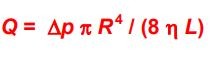
Actually, through a circular pipe with a given pressure, the flow rate is proportional to the fourth power of the radius, ala the Poiseuille's law.

http://www.physics.usyd.edu.au/teach_res/jp/fluids/viscosity.pdf

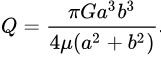
If you place enough weight on a hose, it will deform into an elliptical shape and will have the same circumference but less cross sectional area. This will result in less flow rate for the same pressure. The pressure to flow rate for an elliptical cross section is:

where G is the pressure gradient (a constant, ΔP/L), a and b are the axes of the ellipse, and μ is the viscosity.

https://en.wikipedia.org/wiki/Hagen%E2%80%93Poiseuille_equation

How much the hose is deformed for a given weight depends on the pressure inside the hose and the characteristics of the hose itself. It also depends on the physical size of the weight which will determine the external pressure on the hose. The external pressure will have to exceed the internal pressure before there is any deformation at all, so deformation is not necessarily proportional to weight.

Bottom line: There is not enough information for a meaningful answer.

.

Register to Reply Score 1 for Good Answer
Guru

Join Date: Jul 2005
Location: Stoke-on-Trent, UK
Posts: 4496
Good Answers: 137
#20
In reply to #15

Re: Fluid flow question

01/15/2019 6:32 AM

Poiseuille's law only applies to laminar flow, which needs Reynold's number < 2400. This rarely occurs in practice with non-viscous liquids like water and common pipe sizes. Eg for dia 25mm and velocity 1m/s, Reynolds number is ~ 25000.

In turbulent flow Δh = 4*f*L/D*V2/(2*g). V goes as 1/D2, so Δh roughly as 1/D5 for given flow. Not exact as varying D changes the Reynolds number, which might change friction factor f a little, but by much for moderate change of D.

__________________
Give masochists a fair crack of the whip
Register to Reply
Guru
Technical Fields - Technical Writing - New Member Engineering Fields - Piping Design Engineering - New Member

Join Date: May 2009
Location: Richland, WA, USA
Posts: 21017
Good Answers: 795
#5

Re: Fluid Flow Question

01/13/2019 8:15 PM

For freest flow, omit all the weights. Why are they there anyway?

__________________
In vino veritas; in cervisia carmen; in aqua E. coli.
Register to Reply Score 1 for Off Topic
Power-User

Join Date: Dec 2006
Location: ON Canada
Posts: 185
Good Answers: 1
#9
In reply to #5

Re: Fluid Flow Question

01/13/2019 10:22 PM

I'll explain more when I fill the provisional patent.

Register to Reply
Guru
United Kingdom - Member - Indeterminate Engineering Fields - Control Engineering - New Member

Join Date: Jan 2007
Location: In the bothy, 7 chains down the line from Dodman's Lane level crossing, in the nation formerly known as Great Britain. Kettle's on.
Posts: 32175
Good Answers: 839
#25
In reply to #9

Re: Fluid Flow Question

01/16/2019 4:50 AM

Ah. So this thing, whatever it is, forms a patent application with a view to protecting its commercial application. Well, without any offer of a contribution being received here from the application, <unsubscribes>.

__________________
"Did you get my e-mail?" - "The biggest problem in communication is the illusion that it has taken place" - George Bernard Shaw, 1856
Register to Reply
Guru

Join Date: Oct 2008
Posts: 42355
Good Answers: 1693
#7

Re: Fluid Flow Question

01/13/2019 8:48 PM

Are you using a PD pump, or centrifugal? Are you lifting the water?

Rubber hardness will play into this also. Fluid pressure may just push the weight up and reduce restriction.

More details, please.

Register to Reply Score 1 for Off Topic
Power-User

Join Date: Dec 2006
Location: ON Canada
Posts: 185
Good Answers: 1
#8
In reply to #7

Re: Fluid Flow Question

01/13/2019 10:20 PM

Lets say there's no pumping source the water is just flowing down from 7 feet, and when it encounters the weighted area it's at 3 psi. The hose flattens out on the ground, it's a soft rubber, the hose can be compressed almost like a water balloon.

Register to Reply
Guru

Join Date: Oct 2008
Posts: 42355
Good Answers: 1693
#10
In reply to #8

Re: Fluid Flow Question

01/13/2019 10:45 PM

You said, "The fluid is flowing from one pumping source to one destination."

"Soft rubber?"

There's no way to understand what you are trying to do with so many undefined, unanswered questions remaining.

Like I said, get some hose and experiment.

Register to Reply
Guru

Join Date: Jul 2016
Posts: 1366
Good Answers: 105
#22
In reply to #8

Re: Fluid Flow Question

01/15/2019 6:25 PM

You could use Bernoulli nozzle equations with various estimated restrictions to model the hose restriction(s). To simplify, assume no friction loss in the pipe down to the nozzles/restrictions, then enter 3 sets of restrictions, approximating the various cross sectional area of the hose, open, 1lb weight, 2lb weight.

As the velocity goes up in the larger (more open) nozzles, the 5 with no restriction, the pressure drop will increase as well, so you need to model all flow paths. The Q of each branch can be added arithmetically to get your total flow.

The flow coefficients would be best modeled using smooth edged entrance, use 1.0. To simplify, I think you can use the simpler form d1 / d2 less than 0.3

Differential head at orifice would be your 7 feet, consisting of nozzle loss plus exit loss. From the nozzle differential you need to subtract your exit velocity head loss, which will be highest for your un-restricted pipes, velocity head in feet of liquid is (V squared) / 2g in English terms,(velocity in fps) squared / (2 x 32.174 fps/s). Velocity head for your restricted pipes will be lower, so you will see an increase in net pressure across your nozzle. The solution may take several iterations, as we all know with hydraulic modeling like this.

The exit velocity head also has a coefficient, maybe 0.82 from the chart below, though other sources say the factor is 1.0

Below from Cameron Hydraulic Data, 17th Edition (Ingersoll Rand), page 2-8.

Formulae on Page 3-118 show a solution for gradual contractions & enlargement in pipe, which probably is a more rigorous solution, to calculate resistance coefficient k, also used with k x ((Vsquared)/2g), where g=32.174 f/s/s

Register to Reply
Guru

Join Date: Mar 2007
Location: by the beach in Florida
Posts: 33392
Good Answers: 1817
#11

Re: Fluid Flow Question

01/13/2019 10:56 PM

Rainwater catch barrel with distributed drip irrigation for garden...

__________________
All living things seek to control their own destiny....this is the purpose of life
Register to Reply Score 1 for Off Topic
Guru
United Kingdom - Member - Indeterminate Engineering Fields - Control Engineering - New Member

Join Date: Jan 2007
Location: In the bothy, 7 chains down the line from Dodman's Lane level crossing, in the nation formerly known as Great Britain. Kettle's on.
Posts: 32175
Good Answers: 839
#12

Re: Fluid Flow Question

01/14/2019 8:36 AM

Without numerical information all that can be said is that it depends entirely on the design of the pump, the sizes and shapes of the weights and the character of the hoses:

  • If it were a positive displacement pump, it would make absolutely no difference whatsoever, because the pump would lift the weight(s) until the rated flow were achieved. However, were one or more weights to fall off, then most of the flow would take place through the hoses where that had happened and little-to-nothing through the others, though it would depend upon the lengths and diameters of the hoses as to the back-pressure presented to the manifold as to what happened to those where the weights had not fallen off.
  • In scenario 2 it is most likely that all the flow would be split between the 5 hoses that have no weight applied to them and little-to-nothing through the other 5.
  • If the hoses were of different diameters and lengths then the flow would take place preferentially through the shorter and larger ones.

Where is this thread going, please?

__________________
"Did you get my e-mail?" - "The biggest problem in communication is the illusion that it has taken place" - George Bernard Shaw, 1856
Register to Reply
Guru
Engineering Fields - Civil Engineering - Member

Join Date: Mar 2011
Location: ''but, don't we get PAID to ask questions?...''
Posts: 1661
Good Answers: 17
#13
In reply to #12

Re: Fluid Flow Question

01/14/2019 1:01 PM

Without clear and complete diagram, it would depend entirely on the volume of your henweigh...

__________________
''illigitimi non carborundum...''(i.e.: don't let the fatherless (self-deluding,sabotaging, long-term-memory-impaired, knee-jerking, cheap-shotting, mono-syllabic, self-annointed, shadow-lurking, back-biting, off-topic-inquisitors) grind you down...)
Register to Reply
2
Power-User

Join Date: Dec 2006
Location: ON Canada
Posts: 185
Good Answers: 1
#42
In reply to #12

Re: Fluid Flow Question

01/23/2019 9:21 PM

I got some latex hose and will do the experiment.

I thought it would be a simple effect, didn't mean to make it so complicated. I'd like to thank everyone for their contribution. I will post the results.

Register to Reply Good Answer (Score 2)
Guru

Join Date: Dec 2007
Location: Haverhill, MA
Posts: 1149
Good Answers: 151
#14

Re: Fluid Flow Question

01/14/2019 5:03 PM

Think of this in an electrical circuit analogy. Your pump ( a pressure source) as EMF, your hoses as conductors, and your weights as resistors.

__________________
The older I am, the better I used to be
Register to Reply Score 1 for Good Answer
Guru

Join Date: Oct 2008
Posts: 42355
Good Answers: 1693
#16
In reply to #14

Re: Fluid Flow Question

01/14/2019 8:54 PM

As Rixter said, the conductors are undefined. And even variable.

Register to Reply Score 1 for Off Topic
Guru
Safety - Hazmat - New Member Engineering Fields - Retired Engineers / Mentors - New Member Engineering Fields - Piping Design Engineering - New Member Hobbies - DIY Welding - New Member Fans of Old Computers - PDP 11 - New Member

Join Date: Feb 2007
Location: Stronger Than The Storm
Posts: 2394
Good Answers: 203
#17

Re: Fluid Flow Question

01/14/2019 10:22 PM

One extremely important factor is the hydraulic friction of the internal surface of the hoses and the corresponding lengths of the hoses. Also important is the pressure supplied by the fluid source. If this whole arrangement is supplied at a higher pressure vs. a lower pressure the weights will have more negative effect on those 5 hoses than the positive difference on the straight hoses.

Example: a fire truck is supplying 10ea 1-1/2" hoses, appropriate valves with solid bore nozzles on each one at the open ends. Partially close 5 ea of the valves so that each nozzle is now restricted by 20% (80% open). Each of the partially closed valves/hoses will restrict more flow than the unclosed valves/hoses gain.

Another complicating factor is that as the flow decreases in the partially closed valves/hoses the flow speed reduces and the hydraulic resistance to flow decreases. This causes the reduction in flow to be less than 20% through those hoses. Likewise the hoses with no restrictions will not have a 20% increase in flow since the fluid velocity has increased therefore increasing the effect of the hydraulic resistance.

Hydraulic resistance is the effect of the internal lining of the hose, bends and loops just like the elbows, "T"'s, unions, couplings, etc. do in a home or other facility with piping.

Good Luck, Old Salt

__________________
Any day on the green side of the grass is a GREAT DAY!, --- me +++++++++. I believe creativity is an inherent part of everyone. --- Kermit T. Frog
Register to Reply Score 1 for Good Answer
Guru

Join Date: Mar 2012
Location: Out of your mind! Not in sight!
Posts: 4424
Good Answers: 108
#18

Re: Fluid Flow Question

01/14/2019 11:11 PM

Define: More freely!

You already know that the flow rate will not change.

If you put in 10 liters per minute on one side it should come out (at some given time, expansion of rubber hoses allowed) at 10 liters per minute.

If you restrict on hose the other ones will carry more flow with the outlet flow being equal again to the inlet flow. If you restrict all hoses the same the flow will be the same for all hoses, but the effort to put the flow through (higher pressure) will increase.

Define: More freely!

__________________
Common Sense Dictates
Register to Reply
Guru
Safety - Hazmat - New Member Engineering Fields - Retired Engineers / Mentors - New Member Engineering Fields - Piping Design Engineering - New Member Hobbies - DIY Welding - New Member Fans of Old Computers - PDP 11 - New Member

Join Date: Feb 2007
Location: Stronger Than The Storm
Posts: 2394
Good Answers: 203
#19
In reply to #18

Re: Fluid Flow Question

01/15/2019 12:00 AM

Scenario 2: 5 of the hoses have 2 weights on them causing them to compress more, and the other 5 have no weights.

Unfortunately life and hydraulic flow of water through hoses and restrictions are not linear or equal. The reduction in flow of the 5 hoses with 2 weights on each will not be matched by the increase in flow of the 5 hoses with no weights. As the flow increases in these the hydraulic resistance will increase and slow down the speed of the water more than simply directly proportional to the flow lost with the 5 weighted hoses.

For example: 50 ft of 3/4" (garden hose) flowing 10 gpm has a friction loss of 6 PSI. Increase that flow by 50% to 15 gpm and the friction loss increases by 100% to 12 psi. Double the initial flow to 20 gpm and the friction loss increases by 366% to 22 psi. The flows used as examples are much higher than the conditions stated in the original question but the same things happens for all flow rates, hose sizes, constrictions, etc., just different numbers.

Good Luck, Old Salt

__________________
Any day on the green side of the grass is a GREAT DAY!, --- me +++++++++. I believe creativity is an inherent part of everyone. --- Kermit T. Frog
Register to Reply Score 1 for Good Answer
Guru

Join Date: Mar 2012
Location: Out of your mind! Not in sight!
Posts: 4424
Good Answers: 108
#27
In reply to #19

Re: Fluid Flow Question

01/17/2019 12:24 AM

Old salt, while the flow for individual hoses might be different, the flow in will be equal to flow out. No matter what!

If it will be the same as before is another question and hence I ask OP to define "more freely".

__________________
Common Sense Dictates
Register to Reply
Guru
Safety - Hazmat - New Member Engineering Fields - Retired Engineers / Mentors - New Member Engineering Fields - Piping Design Engineering - New Member Hobbies - DIY Welding - New Member Fans of Old Computers - PDP 11 - New Member

Join Date: Feb 2007
Location: Stronger Than The Storm
Posts: 2394
Good Answers: 203
#28
In reply to #27

Re: Fluid Flow Question

01/17/2019 6:37 PM

NO! The flow going in being the flow out of the system with 10 hoses is not the question if they are combined back to one container (example) as stated "The fluid is flowing from one pumping source to one destination". The QUESTION IS-- "Which scenario would allow the fluid to flow more freely." This wants to know which system (5 hoses partially blocked or 10 flowing freely) will flow the fastest as measured by quantity/time. The comparison is not the difference between the volume what goes in vs. what comes out. The comparison is which system will flow the water in the shortest time and why does it. There is no statement within the question that asks if there is a variation between each individual system's in and out volume. All that it is asking for is: "would allow the fluid to flow more freely" i.e. which arrangement will have the higher or lower flow rate (volume/time or quantity/time).

In life there are certain paraphrases relevant to this example:

What goes in must come out. It doesn't matter how you got there just so you got there. It ain't over till it's over (Yogi Berra) It ain't over till the fat lady sings Where's the meat? When you come to a fork in the road, take it. (Yogi again) You can observe a lot by watching. Yogi again, very applicable to questions on CR4! If you ask me anything I don’t know, I’m not going to answer, Yogi Should be considered when posting on CR4

Please refer to the examples in #19. Each arrangement has its unique flow in-out but the different arrangements don't have the same flow in-out identical to each other.

Old Salt

__________________
Any day on the green side of the grass is a GREAT DAY!, --- me +++++++++. I believe creativity is an inherent part of everyone. --- Kermit T. Frog
Register to Reply
Guru

Join Date: Mar 2012
Location: Out of your mind! Not in sight!
Posts: 4424
Good Answers: 108
#29
In reply to #28

Re: Fluid Flow Question

01/18/2019 2:06 AM

Not sure what you mean.

With the PD pump the flow stays exactly the same for the system.

With any other pump it might be slightly different based on pump curve and pressure losses, but dont expect much.

But one thing for sure the system flow in will be the system flow out not looking at transient behavior of bulging hoses or weights being lifted.

The qualitative answer to which hose will flow fastest is the one with the least pressure loss aka no weight on.

System flow in and out stays the same.

__________________
Common Sense Dictates
Register to Reply Off Topic (Score 3)
Guru

Join Date: Oct 2008
Posts: 42355
Good Answers: 1693
#21
In reply to #18

Re: Fluid Flow Question

01/15/2019 9:56 AM

"If you restrict one hose the other ones will carry more flow with the outlet flow being equal again to the inlet flow," is only correct if you are using a PD pump. This is gravity flow so restricting the flow of one hose does not increase the flow of the others.

Register to Reply Score 1 for Good Answer
Guru

Join Date: Mar 2012
Location: Out of your mind! Not in sight!
Posts: 4424
Good Answers: 108
#26
In reply to #21

Re: Fluid Flow Question

01/17/2019 12:21 AM

OP mentioned first a pumping source. Just seen the later gravity fed idea.

One thing for sure flow in will be flow out.

If there is less flow for different scenarios is now a different question based on pressure losses.

__________________
Common Sense Dictates
Register to Reply
Guru
Engineering Fields - Optical Engineering - Member Engineering Fields - Engineering Physics - Member Engineering Fields - Systems Engineering - Member

Join Date: Apr 2010
Location: Trantor
Posts: 5363
Good Answers: 647
#23

Re: Fluid Flow Question

01/15/2019 7:18 PM

This is for an invention?

Be aware that if you share important information about an invention in the public domain you risk not being able to patent the invention.

But if you’re looking for help with your patent claims, my fees are reasonable...

__________________
Whiskey, women -- and astrophysics. Because sometimes a problem can't be solved with just whiskey and women.
Register to Reply
Guru
Popular Science - Weaponology - New Member United Kingdom - Member - New Member

Join Date: May 2007
Location: Harlow England
Posts: 16512
Good Answers: 670
#24

Re: Fluid Flow Question

01/16/2019 4:31 AM

Do the experiment.
Fluids rarely behave as one expects/predicts.
There are too many variables, how consistent is the hose wall thickness, it's materal properties and the interior surface finish.

My experience from peristaltic pumps says...
DO THE TESTING!
Del

__________________
health warning: These posts may contain traces of nut.
Register to Reply
Guru

Join Date: Oct 2006
Location: 44.56024"N 15.307971E
Posts: 8277
Good Answers: 270
#30

Re: Fluid Flow Question

01/18/2019 1:47 PM

There are too many Murphy's law factors to consider.

A pin-hole sized leak will eventually empty a fuel tank.

A 1 1/2 inch kitchen sink drain will clog up easily and never drain.

Go figure!

__________________
"A man never stands so tall as when he stoops to help a child." "Never argue with a stupid person.They will drag you down to their level and beat you with experience" "To create an apple pie from scratch, first you must create a universe"
Register to Reply
Guru

Join Date: Oct 2006
Location: 44.56024"N 15.307971E
Posts: 8277
Good Answers: 270
#31

Re: Fluid Flow Question

01/18/2019 2:08 PM

What type of manifold are you using?

Where on the manifold are you introducing the flow?

The further from the input source,the less flow you will have,regardless of weight.

If you have circular manifold,with the input in the center it will be more equally distributed.

What material is the hose made of..rubber... canvas(like fire hose),what shape is the weight? Is the weight spread over a large area or is it wedge shaped,sharp or blunt?What is the temperature of the fluid?What is the ambient temperature?What effect does the fluid temperature have on the hose;does it become softer with an increase in temperature;If the fluid is warmer or colder than the hose,how long will it take the hose to equalize it's temperature with the liquid inside;what effect does the ambient temperature have on the heat exchange between the inside and outside of the hose?What color is the hose;What effect does the color have on the temperature of the sun shining on it or is it cloudy;is it raining of fair;what is the barometric pressure,is it windy or calm;what effect does the wind velocity have on the hose temperature;are all of the hoses oriented in the same direction,windward of leeward;Have you allowed for elevation differences of the hoses;are they level at all points?

Provide this info and perhaps I can help you.

__________________
"A man never stands so tall as when he stoops to help a child." "Never argue with a stupid person.They will drag you down to their level and beat you with experience" "To create an apple pie from scratch, first you must create a universe"
Register to Reply Score 1 for Off Topic
Guru
Safety - Hazmat - New Member Engineering Fields - Retired Engineers / Mentors - New Member Engineering Fields - Piping Design Engineering - New Member Hobbies - DIY Welding - New Member Fans of Old Computers - PDP 11 - New Member

Join Date: Feb 2007
Location: Stronger Than The Storm
Posts: 2394
Good Answers: 203
#32
In reply to #31

Re: Fluid Flow Question

01/20/2019 11:26 AM

All the things, potential differences, between the two scenarios that you have asked for are irrelevant to the question. The only difference between the scenarios is the location of the weights on the tubes. If he/she wanted anything else it they would/should have stated it/them. All the questions asked/stated in #31 have no effect on this question because they are irreverent. They are constant between the two scenarios.

If some things seem too complicated make them simpler. For example, instead of a PD pump or any other type, use a bucket of water with the same amount of water in it for both scenarios. Put a drain hose from it's bottom to the manifold. Use the same bucket for each scenario. Same quantity of water, same pressure, same gravity, and no other variations present. How simpler can it get than gravity?

Don't make the question more complicated by asking for irrelevant variables.

Keep It Simple St_pid!

Only introduce variables when they are part of the question.

Old Salt

__________________
Any day on the green side of the grass is a GREAT DAY!, --- me +++++++++. I believe creativity is an inherent part of everyone. --- Kermit T. Frog
Register to Reply
Guru

Join Date: Oct 2006
Location: 44.56024"N 15.307971E
Posts: 8277
Good Answers: 270
#37
In reply to #32

Re: Fluid Flow Question

01/21/2019 8:00 AM

My remarks:(31) were meant to be sarcasm.

__________________
"A man never stands so tall as when he stoops to help a child." "Never argue with a stupid person.They will drag you down to their level and beat you with experience" "To create an apple pie from scratch, first you must create a universe"
Register to Reply Score 1 for Off Topic
Guru
Technical Fields - Technical Writing - New Member Engineering Fields - Piping Design Engineering - New Member

Join Date: May 2009
Location: Richland, WA, USA
Posts: 21017
Good Answers: 795
#33

Re: Fluid Flow Question

01/20/2019 6:46 PM

Lab type hose clamps (that squeeze the hose to make it flatter) are probably a better bet than weights.

__________________
In vino veritas; in cervisia carmen; in aqua E. coli.
Register to Reply
Guru
Safety - Hazmat - New Member Engineering Fields - Retired Engineers / Mentors - New Member Engineering Fields - Piping Design Engineering - New Member Hobbies - DIY Welding - New Member Fans of Old Computers - PDP 11 - New Member

Join Date: Feb 2007
Location: Stronger Than The Storm
Posts: 2394
Good Answers: 203
#35
In reply to #33

Re: Fluid Flow Question

01/20/2019 11:38 PM

'As you suggested, I had considered what would happen it the threaded type were used instead of the weights. The tensioned ones that clamp from one side would be very hard to get 10 that were identical in tension. They are good for flow or no flow but not for in-between flows. The screw type, with upper and lower parallel pieces that do the actual squeezing, with a threaded bolt like screw moving the upper one closer to the bottom one would certainly be easier to control but there could also be variations between them.

If they were to be used I would probably use a rod parallel to the tube to limit the compression of the each "nutted" hose. The thickness of the rod or other type of limiting spacer would be determined by the desired reduction in diameter. For example: if I had 3/4" o.d., 1/8" wall thickness latex rubber hose and wanted to reduce the flow through some of the hoses evenly I could take a lab clamp and place the hose through the clamp. If the I want to squeeze it to reduce flow I would calculate 3/4" (o.d.) -- amount of squeeze (3/16" in this example). In this example it would be 3/4" - 3/16" = 9/16". For this I would probably look for a piece of 9/16" o.d. rod in my junk box(s). This placed parallel to the hose will limit the closing of the clamp to a set known dimension. To reduce the flow even more I would use a smaller diameter rod. This would allow even more constriction to flow.

I made no mention of this in my replies since the original question made no mention of anything else but the nuts. The use of clamps would just introduce another deviation from the original question.

Yes, your lab hose clamps would do a better job. They are what I would do if I were to conduct this comparison in a lab.

Good Luck. Old Salt

'

__________________
Any day on the green side of the grass is a GREAT DAY!, --- me +++++++++. I believe creativity is an inherent part of everyone. --- Kermit T. Frog
Register to Reply Score 1 for Off Topic
Guru

Join Date: Oct 2006
Location: 44.56024"N 15.307971E
Posts: 8277
Good Answers: 270
#36
In reply to #35

Re: Fluid Flow Question

01/21/2019 7:57 AM

"All the things, potential differences, between the two scenarios that you have asked for are irrelevant to the question. The only difference between the scenarios is the location of the weights on the tubes. If he/she wanted anything else it they would/should have stated it/them"...Old Salt

__________________
"A man never stands so tall as when he stoops to help a child." "Never argue with a stupid person.They will drag you down to their level and beat you with experience" "To create an apple pie from scratch, first you must create a universe"
Register to Reply Score 1 for Off Topic
Guru

Join Date: May 2016
Posts: 1746
Good Answers: 87
#38

Re: Fluid Flow Question

01/21/2019 10:45 AM

This could be engineered to go either way or equally for both, depending on how you design the hose and weight geometries. Kind of like the joke about the accountant who, when asked, What's two plus two? responded "What would you like it to be?"

Register to Reply
Commentator

Join Date: May 2017
Posts: 70
Good Answers: 1
#39

Re: Fluid Flow Question

01/21/2019 1:13 PM

It is a kindergarten question which response is done by voltage in parallel equation. Note, the resistances (tensions due to weights or deformations) are the ones making higher or lower the flow.

Register to Reply
Guru
Safety - Hazmat - New Member Engineering Fields - Retired Engineers / Mentors - New Member Engineering Fields - Piping Design Engineering - New Member Hobbies - DIY Welding - New Member Fans of Old Computers - PDP 11 - New Member

Join Date: Feb 2007
Location: Stronger Than The Storm
Posts: 2394
Good Answers: 203
#40
In reply to #39

Re: Fluid Flow Question

01/21/2019 4:02 PM

In many cases electricity and fluid hydraulics are identical or very similar in their properties. Likewise is some cases they are completely opposite.

In hydraulics, increase the size of the pipe and the fluid flows faster. In electricity, increase the size of the resistance and the flow decreases.

In hydraulics, a drip pan can be used to collect any leakage. In electronics, have you ever heard of drip pan for a Grid Leak?

In hydraulics, hinges can be used to change the direction of flow from a hose or universal position fitting. In electronics, have you ever heard of hinges for a swinging choke?

Good Luck, Old Salt

__________________
Any day on the green side of the grass is a GREAT DAY!, --- me +++++++++. I believe creativity is an inherent part of everyone. --- Kermit T. Frog
Register to Reply
Commentator

Join Date: May 2017
Posts: 70
Good Answers: 1
#41
In reply to #40

Re: Fluid Flow Question

01/21/2019 6:27 PM

Hello Salt,

Thank you four addendum. Regarding leakages and draftings, I say: yes, your analogy is done in circuits as well using capacitors, resistors, or diodes.

Regards

Register to Reply
Register to Reply 42 comments

Good Answers:

These comments received enough positive votes to make them "good answers".

"Almost" Good Answers:

Check out these comments that don't yet have enough votes to be "official" good answers and, if you agree with them, vote them!
Copy to Clipboard

Users who posted comments:

buzneg (3); Codemaster (1); gringogreg (1); HiTekRedNek (4); IdeaSmith (4); Jose1 (2); Jpfalt (1); lyn (6); MR. Guest (1); old salt (6); PWSlack (2); Ried (1); Rixter (2); rwilliams (1); SolarEagle (3); Tornado (2); Usbport (1); user-deleted-1105 (1)

Previous in Forum: Paint Will Not Dry   Next in Forum: RS1200

Advertisement