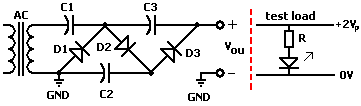
Can we use 1000micro farad of 50v in ac tripler circuit? I tried to make a tripler ckt as per the diagram below but couldn't get the required result. I have provided 12volts using a transformer.
The ac signal passes through C1 and D1 clamps the most negative part of the signal to ground, so the whole of the ac signal is above ground.(+ve)
Now this signal goes through C3 which has D3 stopping the most negative part of the waveform going below the positive peak of the input signal as rectified and filtered by D2 & C2, this means the output voltage is now the ac peak to peak voltage plus itself.
As I can't see the original circuit I've had to guess at the component references but the way it works is straightforward.
Hope that helps!! - John.
__________________
A little knowledge is a dangerous thing - Googling is far worse!
I think the problem is the diode in your load which is basically a voltage clamp. Before you add the load you would have 12 X 3. = 36, but when you add the load you would have 12 X 3 / 2 = 18v
__________________
Perfection is a subjective and abstract concept.
I am going to go with asking the really obvious question - "what oscillator circuit are you using to power the transformer"?
If you are just connecting a 12V DC battery up to the transformer you are not going to get anything out. You need an alternating voltage (AC) created by a transistor flip-flop circuit, 555 timer chip or one of the many other charge-pump oscillator chips designed especially for this application (many, such as the MAX1044 switched-capacitor voltage converter do not even need a transformer).
Try goggling "MAX1044" or "Voltage tripler". Other sites on the web with voltage tripler circuits include
Since you are already using a transformer, why don't you just use one with three times as many turns on the secondary, and get rid of all the caps etc.?
__________________
Teaching is a great experience, but there is no better teacher than experience.
The sad reality of a charge pump circuit, which this is, (you might think of it as successive charge pumps) is that you can't usually get a lot of power out of it due to limits in the ESR of the capacitors and the fact that you are chaining successive charge pumps. Think of a bucket brigade except that as you go along the buckets get smaller fast.
It is far more efficient to use a step up transformer.
__________________
The hardest thing to overcome, is not knowing that you don't know.
If you didn't have any load, you would see about 3X the peak input voltage. However, under load, the actual voltage you see may be significantly lower. The higher the output current being drawn (i.e., the lower the value of load resistor), the lower the output voltage will be and the greater the output ripple.
The formula for output voltage versus load current can be estimated as follows:
Vout = Vmax - Vdrop
where Vmax = 2*Vpk*n
and Vdrop = I*(4n^3+3n^2-n)/6*f*C
where:
n = number of stages - in the case of a tripler, n = 1.5
f = operating frequency
C = stage caacitance (in farads)
I = load (amps)
Solving for 60 Hz and a 12 volt RMS transformer:
Vmax = 50.9 V.
Vdrop = I*52.08
So, Vout = 50.9 - I*52.08
From the above, you can see that if I=0, you''ll see the full tripled voltage output. However, if your load current is 0.5A, your output voltage will only be about 24.9 volts. Note that since your electrolytic capacitors also have equivalent series resistance (ESR) and there are also diode drops, your actual output voltage may be even lower at a given current...
__________________
Stoneridge Engineering - Wreaking Havoc with Electrons for over 40 Years!
Good Answers: