The Building & Design Blog is the place for conversation and discussion about building projects, tools and equipment, materials and hardware, and environment & energy. Here, you'll find everything from application ideas, to news and industry trends, to hot topics and cutting edge innovations.
A month ago when I wrote about structures grown from mushrooms, I imagined I’d found myself the strangest potential future for grown buildings. I was so very wrong.
In 2008, Mitchell Joachim, co-founder of Terreform, a nonprofit organization for philanthropic architecture, urban, and ecological design, imagined and designed a house made of meat.
Luckily, such a building does not consist of Joachim huddling in a Tauntaun carcass in a land far far away (or even in the above field, surrounded by cows). Instead, this “house” would be victimless, a 3D printed structure of extruded pig cells. For the small-scale prototype (right), the pig cells covered a polyethylene terephthalate (PET or PETE) scaffold. Sodium benzoate was used as a preservative to kill yeast, bacteria, and fungi, while the remainder of the model matrix was composed of an amalgam of thickening agents, salts, gelatins, and cochineal—presumably to dye the structure naturally.
Actual details regarding the proposal are hard to come by, but Joachim envisioned the concept would move from what he admits was a “very expensive fitted cured pork or articulated swine leather with an extensive shelf life” to a complex organic home where “tissues, skin, and bone replace insulation, siding, and studs.”
A “window detail” provided with the project proposal on Terreform’s site articulates the placement of everything from muscle fibers, to derma papilla, to … sphincter cavities. Those particular cavities would act as fenestration, creating doors and windows capable of opening and closing.
TED journalist Patrick D’Arcy indicates that Joachim understands many Terreform projects probably won’t be realized. Instead, Joachim explains, “[t]he more interesting the idea is, the more provocative the idea, the more it resonates historically—it becomes an important piece of the puzzle, eventually leading towards the solution.”
In the same article, Joachim indicates the meat house idea is less about building a house out of meat, rather about designing new technologies and materials for large-scale construction. That being said, aren’t there less extreme ways to promote new technology than living in a house made of jerky? Even Terreform’s earlier grown Fab Tree Hab is a much easier concept to wrap one’s brain around.
While this idea may never come to fruition, imagining Joachim and his team growing pig carcass after victimless pig carcass in their lab certainly puts other seemingly radical construction techniques into perspective. Perhaps with that mindset, we really will be able to change architecture at the cellular level.
This crazy little pre-fab ‘builds itself’ at the touch of a button, in less than ten minutes. Termed a “dynamic property asset” by its creators at Ten Fold Engineering, this mobile structure is aimed at a variety of industries, with applications from mobile homes, offices, and clinics, to shops, exhibitions, restaurants, and schools.
“Ten Fold” seems an appropriate name for the U.K.-based company when you watch the origami-like structures unfold from a compact box. It reminds me of creating folded paper building templates for elementary schoolers.
These designs, of which there are many presented on the site, are patent pending. However, the concept is intriguing despite its proclaimed simplicity, and the videos that provide proof of concept tests for the individual joints are impressive to watch (at least in my humble opinion).
The systems operate without complex drive systems and use very little power, instead relying on their “‘family’ of pin-jointed linkages that preform specific useful movements repeatedly, precisely and reversibly … with each element counterbalancing the other.”
Ten Fold Engineering minimized manufacturing costs by designing linkages that can perform multiple movements depending on the position of the fixed bar. Another aspect of uniformity multiplies the cost-saving benefits, as each standard design uses just three different bar-lengths throughout the structure.
Without an on-site power requirement, the fully deployable units can be “built” anywhere, making them uniquely suited for emergency services or remote locations. Of course, as Ten Fold Engineering reminds us in their graphic above, the opportunities for these structures do not end there.
At a starting price of £100,000, they may not be perfect for your next camping trip, but given a few years, you may be able to get an affordable Ten Fold Pop Up mansion.
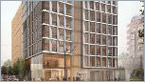
The 90,000 sq ft structure will rank as one of the tallest timber high-rises to be built in North America. The building will be constructed primarily of cross-laminated timber components, in conjunction with glue-laminated beams and columns.
Editor's Note: This news brief was brought to you by the Building & Design eNewsletter. Subscribe today to have content like this delivered to your inbox.
To say that the construction industry has changed due to technological advances is an understatement. Once expensive and time-consuming, construction projects are now happening much more quickly and for a lot less money.
Editor's Note: This news brief was brought to you by the Building & Design eNewsletter. Subscribe today to have content like this delivered to your inbox.
The silver birch (Betula pendula) is one of the major trees for forest products in the Northern Hemisphere, according to biologist Victor Albert, who just co-led a Finnish-funded project that hoped to illuminate the evolutionary history of the birch. Birch is among the more widely used woods for veneer and plywood worldwide. Silver birch, which was the focus of the study, is used in everything from plywood and interior trim to boxes and turned objects. According to Albert, “[o]thers, like spruce, pine and poplar, all have genome sequences, but birch did not—until now.”
The research team, including Jaakko Kangasjärvi, Ykä Helariutta, Petri Auvinen and Jarkko Salojärvi of the University of Helsinki in Finland, discovered gene mutations that could prove quite valuable to multiple industries.
Together they sequenced about 80 individuals of Betula pendula, more commonly known as the silver birch. The silver birch is native to Europe and southwest Asia, so the team sampled populations of the species “up and down Finland, down to Germany, over to Norway and Ireland, and all the way up to Siberia.”
Thanks to the 80 genomes sequenced, the researchers were able to identify genetic mutations that could potentially benefit multiple industries. To do this, the researchers searched for distinctive stretches of DNA within the genomes called “selective sweeps” that identify genetic regions that are critical to the survival and development of the species.
The team found sweeps that influence tree growth—important for increasing production—in addition to selective sweeps associated with environmental conditions. “The selective sweeps we identified may be the basis for local adaptation for different populations of birch,” Salojärvi stresses. “Trees in Siberia are under different selective pressure from trees in Finland, so genes are being tweaked in different ways in these two places to allow these plants to better adjust to their environment.”
The researchers hope that, as Helariutta said, “[a]n understanding of these natural adaptations can facilitate genetic engineering and artificial selection,” making their research “very useful for forest biotechnology.”