|
 |
Relativity and Cosmology
This is a Blog on relativity and cosmology for engineers and the like. My website "Relativity-4-Engineers" has more in-depth stuff.
You can comment directly on this Blog if the comment/question is relevant. to the topic Comments/questions of a general nature should preferably be posted to the FAQ section of this Blog (http://cr4.globalspec.com/blogentry/316/Relativity-Cosmology-FAQ).
A complete index to the Relativity and Cosmology Blog can be viewed here: http://cr4.globalspec.com/blog/browse/22/Relativity-and-Cosmology"
Regards, Jorrie
|
Posted October 04, 2020 6:10 AM
by Jorrie
|
|
When I first heard that there is no easy exact formula for the circumference of the standard ellipse, I found it hard to believe. I had already learned that a planet traces out an ellipse with the Sun at one of the foci. And that the orbital period is proportional to the three-halves power of the semi-major axis of the orbit,
where:
- a: semi-major axis,
- b: semi-minor axis.
This is Kepler's third law of planetary motion. It gives this easy equation for the period of the orbit:
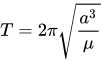
where
This ignores relativistic effects, of course, so the orbit is and exact ellipse.
If the elliptical period is so simple, then why is the circumference of the orbit a problem? After all, Kepler's second orbital law also states that the planet sweeps out a constant area per unit time, as observed in Sun-centered coordinates.
This is the consequence of the constancy (conservation) of angular momentum around an orbit, so for each position on the ellipse perimeter, it is trivial to calculate the orbital velocity. So we have velocity and we have time - the distance that the planet travel should also be trivial. Or not?
The precise value for the perimeter length (circumference) is given by the following infinite series: (Wikipedia Ellipse Circumference)
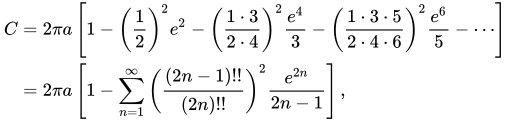
where !! is the double factorial.
This series converges, but by expanding in terms of
h = ( a − b ) 2 / ( a + b ) 2 ,
James Ivory and Bessel derived an expression that converges much more rapidly:
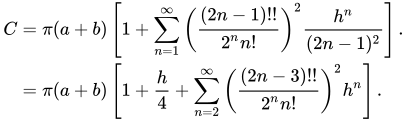
I leave you with the puzzle: why is the period and the velocity of the elliptical orbit trivial, but the precise perimeter length so complex?
|
|
|
|
Posted August 24, 2020 7:15 AM
by Jorrie
|
|
In my prior Blog post on the Einstein equivalence principle, I have not identified important values, like the mass of the black hole, real distances and the actual times that would have been recorded by Alice and Bob.
For a BH to have an event horizon radius of 0.5 lyr, it must have an ultra large mass, something like half the mass of the Milky Way. Its Schwarzschild radius must be of order the radius of the Oort Cloud (where the long period comets are thought to come from). It must be similar to this observed BH: The monster black hole in galaxy cluster Abell 85 is roughly the size of our solar system, but packs the mass of 40 billion suns.
 Figure 1: Annotated SpaceProperTime Diagram Figure 1: Annotated SpaceProperTime Diagram
Alice is parked at a distance of half a lyr from the event horizon, which itself is half a lyr from the singularity, both distances measured as Schwarzschild radial coordinates.[a]
An interesting tidbit: Alice and Bob will feel only 0.35g of acceleration - the more massive a BH is, the lower the g-forces required to hover at a given factor outside the horizon radius.
The original plan was for Bob to free-fall from rest to meet his fate at the singularity. Alice did however convince him that the result will almost certainly be death at the singularity, so they decided to rather drop a well-censored probe into the BH and try to get as much information off the freefall as possible.
Bob equipped both the ship and the probe with a wide-band, variable frequency transceiver and then frequency locked each receiver to the other side's transmitter so that they can track the changes in received carrier frequencies. Bob will ask "Omni-eye" to track the frequency changes and report it to them instantaneously. With that, he gently drops the probe over the side. Let's call this time To.
Immediately Bob notices a redshift in the probe frequency that he receives, which he knows must come from the velocity redshift and a gravitational redshift combined. The probe is both moving away from him and entering regions of lower gravitational potential.
Bob also checks Omni's report on the corresponding frequency that the probe has received. It shows a blueshift, despite the fact that the distance between the ship and probe is continuously increasing. Bob knows that the probe 'sees' their signal blueshifted, but that the velocity redshift diminishes it somewhat, even though the probe's relative speed is still very low. The relative speed between probe and ship increases rather rapidly, but so does the gravitational blueshift. Which one of the latter two will win out?
It so happens that at the event horizon, both red- and blueshift factors are supposedly approaching infinity, so the question is, which one changes faster? We can obviously just wait until Omni-eye tells us the experimental result, but it is fun to try and predict that in advance. The secret lies in the fact that warping of space and time are rather different in this case. Below are two views of the above SpaceProperTime Diagram, rotated so that we look at the curve along selected axes. You can try this with the HSPT.js app that I have posted before.
  If we just look outside the BH (blue dots), one can see more severe space warping on the left (into the hyper-plane) than one can see time warping on the right. Now the space-warp determines the blueshift and the time-warp determines redshift that the probe observes. It is clear which one wins. If we just look outside the BH (blue dots), one can see more severe space warping on the left (into the hyper-plane) than one can see time warping on the right. Now the space-warp determines the blueshift and the time-warp determines redshift that the probe observes. It is clear which one wins.
At the moment that the probe passes the event horizon (yellow dots), space warp is about double the effect of the time warp. The result is that the probe observes Bob's carrier frequency with a 2:1 blueshift ratio. Interestingly, for a quiescent black hole, this will be our probe's only means for detecting the moment of passing the event horizon, at To+1.8 yrs, as annotated on Fig. 1.
For Bob in the spaceship, that moment is not readily detectable due to the double redshift (gravitational and velocity). The probe's signal will be gradually redshifted into non-detectability, without any neatly defined moment of passing the horizon. But fortunately, Omni can to tell Bob that the time is To+2.3 yrs. Omni can also give running commentary on the probe's progress on its way to the singularity.
The probe's frequency will still show a diminishing partial cancelling of the gravitational blueshift by velocity redshift. Eventually the blueshift will overwhelm the redshift and the probe's received frequency will rise exponentially to a death-scream, possibly being fried by the intense infalling energy, while at the same time being pulled apart vertically by the unbounded tidal gravity near the singularity. The last probe report will be at To+2.2 yrs probe time. Bob's ship clock will read 3.4 yrs when he receives the final 'instantaneous' report from Omni.
Bob is now very thankful to Alice for convincing him not to jump in himself...
|
|
|
|
Posted August 17, 2020 3:00 AM
by Jorrie
|
|
 One day after Alice's arrival at Deep-2, she and Dot sat down for the change of shift briefing - recall that Dot must soon return for Home leave. While having a cuppa and a slice of Deep grown space-sponge, Alice pressed a few buttons to allow her ship's clocks to sync to Dot's time zone (one hour and a bit ahead of her clocks). Dot watched, smiled and remarked: One day after Alice's arrival at Deep-2, she and Dot sat down for the change of shift briefing - recall that Dot must soon return for Home leave. While having a cuppa and a slice of Deep grown space-sponge, Alice pressed a few buttons to allow her ship's clocks to sync to Dot's time zone (one hour and a bit ahead of her clocks). Dot watched, smiled and remarked:
"Do you still remember how much we at first struggled in Prof Zok's class, trying to figure out this time adjustment through the old-style relativity of simultaneity and synchronization offsets?
"Yea, how horrible it was with all those accelerations thrown into the mix! Fortunately in the next year he did show us how space-propertime works and it became much more intuitive. And how easily it leads into general relativity!"
This imaginary dialogue might serve as gentle introduction into how gravity works and how space-propertime diagrams can be used to illustrate it.
Take the simplest case that we had before, where Alice just accelerated away from inertial Bob at 1g for exactly one year on her clock. From the SPT principle (or equations), we have found that Alice would reach a point 0.54 lyr distant in Bob's frame, with Bob's clock reading 1.18 years. What will this scenario "look like" if we choose Alice's (accelerating) frame as reference?

Essentially we must straighten Alice's worldline, as her frame is now the reference. This dictates that we must slant all the horizontal lines of constant propertime downward from Alice's position, in such a way that they all converge at 1 lyr to the left on the original distance axis, as pictured on the right.
To Alice's it will initially appear as if Bob accelerates at 1g to the left.[a] Bob is inertial and feels no acceleration (it is a coordinate acceleration, vs. Alice's proper acceleration). Alice feels the proper 1g acceleration, but in her own frame, she is not moving, of course.
This process will curve and compress Bob's worldline from Alice's perspective, so it will not retain it's length, but will appears to be contracted. Bob's worldline will still end at the slanted line of 1.18 yr, as before. Coordinate acceleration can obviously not change Bob's propertime readings.
Can it really be this simple? You bet it can. It embodies what is called the 'Einstein equivalence principle'. That point where all the propertime lines converge is an event horizon. At 1 lyr behind her, from Alice's perspective, the universe 'disappears' into a 'coordinate singularity'[b]. For as long as she keeps up her 1g acceleration, no signal emitted farther than 1 lyr behind her can ever reach her. She will in fact be outrunning light, without going faster then light at any time. A case of a "rocket propelled tortoise against a light-speed hare".
If Alice stops accelerating an start to coast, that light will eventually catch up with her. From Alice's perspective, while accelerating, it looks roughly the same as if Bob was free-falling towards a massive black hole. But this is not quite the full story of gravity yet. It essentially shows only 'time-curvature' and does not have any 'space-curvature' as yet.
There is another issue to solve: Bob's worldline is no longer 'growing at the speed of light', as we had it before. To reinstate this intuitiveness, we can picture an extra (fictitious) spatial dimension, into which Bob's worldline can do some extra curving. We can then essentially have a "5-velocity vector". This way we restore the prior simplicity and Bob's worldline can again extend at the speed of light. This way we have proper curved spacetime, as shown below (copied from Relativity 4 Engineers).

The extra dimension is labeled "hyperspace", allowing Bob's blue worldline in Alice's frame above to curve along two dimensions. Hence allowing it to retain the "growing at the speed of light" property.
There are various ways of picturing this, but my choice eventually fell on a simple 'community edition' of a Javascript 3D graphics utility, Vis.js, into which I could embed the required .js code for calculating and plotting the curve. It sports some animation and user rotation features for the graphic, which I found very valuable for interpreting and understanding the process. Click this link: 3D-Hyper-Space-Proper-Time-Diagram.
 It should open a separate window, so it is best viewed side by side with this description. It starts with the three axes: light-year (space), year (time) and 'hyper' (for hyper-space), with two blue dots symmetrically placed around the origin (0,0,0). The right-hand one represents Bob's and Alice's starting positions, 1 ly from the origin and the left-hand one is just a mirror image of Bob's position on the other side of the mass M. This is for easier scaling within the restrictions of the utility and besides, the symmetry looks prettier and is handy when trying to view the scenario from different directions. It should open a separate window, so it is best viewed side by side with this description. It starts with the three axes: light-year (space), year (time) and 'hyper' (for hyper-space), with two blue dots symmetrically placed around the origin (0,0,0). The right-hand one represents Bob's and Alice's starting positions, 1 ly from the origin and the left-hand one is just a mirror image of Bob's position on the other side of the mass M. This is for easier scaling within the restrictions of the utility and besides, the symmetry looks prettier and is handy when trying to view the scenario from different directions.
I have made Bob free-fall all the way to almost at the central circularity, while Alice uses her continuous propulsion system to hold station at r=1 lyr Schwarzschild radial coordinate from the singularity at r=0.
First just click 'Play' and watch Bob's worldline (and his mirror image) falls into the central singularity of the black hole (BH). The dot separation is constant on the diagram and where Bob falls through the event horizon, the dot colors change to gold. The red dots are Alice's worldline, as she sits at constant distance from the BH and just "moves through time at speed c".
Once the simulation starts over, click 'stop' to pause and click/drag on the picture to position the eye for different perspectives. Once paused you can also step forward and backwards, or drag the slider for any desired frame. You effectively have a "God's eye view" from anywhere outside space and time.
By rotating to various vantage points, one can convince yourself that the worldline increment per step is indeed the same for Alice and Bob, all the way until Bob reaches the dreaded central singularity. He may never actually reach it, but to answer that requires a theory of quantum gravity, which mankind has not quite found.
In a follow-on post, I will say something about the numerics around this simulation, e.g. what the mass and size of the BH must be, at what distance Alice sits from the horizon and how long it takes Bob to meet his demise, if that is what will happen.
-J
Notes
[a] Bob's acceleration as observed in Alice's frame will gradually decrease to near zero as he 'falls' closer to the coordinate singularity of the event horizon.
[b] A coordinate singularity means that the choice of coordinates creates an event horizon and an apparent black hole, which can be removed by a change of coordinates.
|
|
|
|
Posted August 11, 2020 12:00 AM
by Jorrie
|
|
 This is a fanciful little scenario for 'flexing the muscles' of acceleration in space-propertime a little and so giving a better intuitive feel for this representation of relativity. Remember, this is not some 'new theory', just an alternative view of standard Einstein Special Relativity. This is a fanciful little scenario for 'flexing the muscles' of acceleration in space-propertime a little and so giving a better intuitive feel for this representation of relativity. Remember, this is not some 'new theory', just an alternative view of standard Einstein Special Relativity.
Deep Space Astronauts, Alice, Bob, Charlie and Joe are having dinner in their base station (Deep-1), when a 'DeepNote' from their colleague Dot popped up on the Deep-Hologram in the dining hall. Dot is stationed on Deep-2, at a constant 1.66 light years from Deep-1. Dot's 10 year service award for Deep-space service is coming up in the not too far future.
Alice, Charlie and Joe are all due to depart soon in order to relieve Dot and other more distant colleagues, for their scheduled returns to Earth. After dinner, the friends decided to surprise Dot by simultaneous arrival, flyby's and messaging at her 10 year service award function. Here is the broad plan that they came up with (overview graphic one the right, with a more readable one copied below).
Bob will stay at Deep-1, Alice will use her trusted old 1g continuous acceleration spaceship, thrusting halfway to Deep-2, then reversing the thrust for 1g deceleration, in order to come to rest at Dot's station for attending the award function personally. Joe will use the brand new near-instant boost warp-drive, departing simultaneously with Alice, accelerating momentarily to a constant speed that allows him to fly past Deep-2 just when Alice arrives there.
Charlie will use the modern 3g continuous deep space drive to play a relativistic "tortoise and hare" game with Joe - departing somewhat later than the other two and then continuously accelerate at 3g. His departure must be timed so that he will pass Deep-2 exactly when the other two arrive there. The three travelers will be monetarily colocate with Dot at the function.
Not to be totally outdone, 'stay-at-home-Bob' will send congrats using the Deep-hologram system, but also timed so that his message will reach Dot simultaneously with the travelers.
 The friends ask Quant-1 (Deep-1's quantum computer) for a proposal on departure times. Here is what Quant-1 came up with. The friends ask Quant-1 (Deep-1's quantum computer) for a proposal on departure times. Here is what Quant-1 came up with.
1. Alice (red curve) is to set off tomorrow at t=T0 on her Deep-synchronized ship clock, accelerating at 1g until t=T0+1.22 yr on her clock and then reverse the thrust. Her maximum speed will be 0.836c relative to Deep-1/2 and she will decelerate until she parks at halt at Deep-2, at T0+2.44 yr on her clock. It will be T0+3.08 yr Dot-time.
2. Joe (gold) is to set off at the same time as Alice, near-instantly warp to a relative speed of 0.534c and fly past Deep-2 at 2.6 yr, also at 3.08 Dot time, as planned. Interestingly, Joe will initially outrun Alice, as she is still accelerating, but somewhere Alice will pass Joe again and then he will catch op again at the moment Alice stops at Deep-2.
3. Charlie (the green hare) is to relax and train in the centrifuge for the upcoming 3g ordeal, until T0+1.12 year when he must set off at a constant 3g acceleration, until he flashes past Deep-2 at T0+1.94 yr on-board (also at T0+3.08 yr Dot time), having reached the incredible speed of 0.986c and still accelerating.
4. 'Bob-the-reference' must send his hologram-message at T0+1.42 yr, exactly 1.66 years before his friends will reach Deep-2. This is how long the signal will take to get there, because sadly, instant quantum data transfer still doesn't work.
Note that everyone arrives at Deep2 at the same coordinate time, as can be seen from their identical space-propertime path lenghts (yes, they are really the same).
Also note that right-hand thick purple vertical line is not only Dot's worldline, but represent the event when her friends arrive. This is an important point: in space-propertime, events are vertical lines, not single points like in a Minkowski diagram. This is the price one pays for the otherwise superb clarity of the uniform scale of space propertime worldlines.
Once this is well digested (?), I will move on to show how space-propertime couples to gravity through Einstein's equivalence principle and other factors.
-J
|
|
|
|
Posted August 07, 2020 5:00 AM
by Jorrie
|
|
 I have introduced the idea of Epstein Space-Propertime Diagrams (ESPD) in my previous Blog post. To refresh, here is the ESPD's structural relationship between two relatively moving inertial frames. In this post I will extend the principle to accelerated motion. I have introduced the idea of Epstein Space-Propertime Diagrams (ESPD) in my previous Blog post. To refresh, here is the ESPD's structural relationship between two relatively moving inertial frames. In this post I will extend the principle to accelerated motion.
Fig. 1 The case with no acceleration copied on the right
Three important features of the EPSD are:
1. Relative movement at a constant speed is equivalent to an Euclidean rotation around the origin by an angle: Φ = asin (v/c) e.g. the red Euclidean coordinate system relative to the blue one (where v/c is the relative velocity as a fraction of the speed of light). When v=c, the angle is pi/2, in contrast to the Minkowski diagram, where the angle would have been pi/4 (using atan Φ instead of asin Φ).
2. In flat spacetime (i.e. no gravity, spatial contraction or expansion), accelerated wordlines extend by a unity arc length per time unit, loosely stated as 'at the speed of light' around a 'curvature center'. This is a tad misleading, because it clashes with the standard meaning of speed and velocity, which are measured through space alone. The correct statement is that the magnitude of the 4-velocity (a vector through 3 spatial plus one time dimensions) remains constant.
3. This implies that while the acceleration lasts, the whole structure of the accelerated frame continually rotates around a shifting 'origin' over time. This is best pictured by a radius of curvature of individual worldlines around a shifting center of curvature. Fig. 2 depicts only one worldline going through the original origin for a small Δt.

Fig. 2: Initial acceleration from rest.
Note that in space-propertime diagramming, the coordinate time (Δt) is given by the arc, not by the vertical axis, which is propertime (Δtau) of course.
The initial center of curvature lies along the x-axis and the acceleration can be viewed as a centripetal force experienced by a hypothetical object moving at the speed of light around the center of curvature at radius R. This would cause centripetal acceleration of c/R2 in the +x direction.
Constant proper acceleration (as observed by in the accelerating frame) is equivalent to a continuous small rotation of the worldline around a shifting center of curvature, while the extension of the worldline is a unit four-vector per time unit . This gives the curved (parabolic) worldline segment Δt as indicated in Fig. 3.
Fig. 3 Continued constant proper acceleration
In most spacetime diagramming, geometric units like seconds and light-seconds, or year (yr) and lightyear (lyr) are used, so that c=1 lyr/yr and can be eliminated for simplicity.
The equation (lifted from the eBook) for the radius of curvature embodies the constant acceleration (x-dot-dot) and the relativistic factor cos Φ = √(1-v2). It shows how the relative speed can never exceed 1, because the radius of curvature will tend to infinity and the worldline to horizontal, i.e. the speed of light.
The constant proper acceleration is measured by an on-board accelerometer, so in the reference coordinate system, observed acceleration will tend to zero as Φ tends to pi/2.
This is in line with the standard relativity concept of momentum and energy tending to infinity as the relative speed tends to the speed of light. Not to distract from the natural flow of the idea, I will discuss energy and momentum in space-propertime at a later stage.
Here is a pseudo-code algorithm (lifted from the eBook) for calculating such an acceleration curve from the Fig. 3 point of view:

It is largely self-explanatory, but just a few comments may be in order, I hope. The first 2 lines of code after the 'output' line simply rotates the present center of curvature to temporarily sit at a more convenient spot for calculation. The simpler calculation is performed and then the values are rotated back so that the new (x, tau) coordinate sits in the the correct place. One can't use precisely zero acceleration, but I stick in a value of 1E-12, being close enough to zero for all practical purposes.
I will now turn to a more practical-sounding example involving Alice and Bob, two space fairing friends, obtained from the algorithm above.
On the right is a plot for Alice accelerating away from Bob at 1 lyr/y2, which is (interestingly) very close to 1g of proper acceleration, as we know it.
After one year on Alice's clock, with her accelerometer showing a constant 1g, she reaches a speed of 0.76c relative to the inertial Bob. Her distance from Bob is x=0.54 lyr, as shown. Bob's clock reads 1.18 yr at the same time, according to his definition of simultaneity (a horizontal line). Note that the blue vector and the red arc are of equal length.
The initial radius of curvature R = 1 lyr, but increases to R~2.4 lyr after the one year of onboard acceleration. In Bob's frame the acceleration drops from the initial 1g to 1/2.4~0.42g, due to the squared relativistic factor.
The Epstein diagrams are good for gaining insight in the workings, but relativists have derived exact solutions for calculating the curves analytically. The relevant equation are (using a for proper acceleration, t for coordinate time and T for propertime):
Edit: I have noticed that these equations were not simplified all the way, so I followed Einstein's advice...
x = (COSH(at)-1)/a , T=SINH(at)/a and v = TANH(at)
The hyperbolic trig functions show that the underlying spacetime structure is still hyperbolic in nature.
In a next Blog post I will use the analytical equations to plot more scenarios for Alice and Bob (and friends), which can be hugely informative.
-J
|
|
|
|
Show all Blog Entries in this Blog
|
|
|
Search this Blog
|
|
|
Relativity and Cosmology:
|
|
|
|
|
|


