|
Although Einstein predicted in 1915 that gravity will bend light and Eddington confirmed it in 1919, it took until the 1930s before the phenomenon of gravitational lensing was properly understood and calculated. In this mini-series gravitational lensing will be shown in a few easy to follow equations.
Einstein did (in 1915) calculate the bending of light around a star like our Sun, using the relativistic null geodesic equation for light,(1) as approximated for a low gravitational field. Figure 1 shows graphically how the Sun bends light when observed during a total solar eclipse (highly exaggerated for clarity).
Fig. 1: 
The magnitude of the angle of deflection is approximated by:

where M is the deflector mass in kg and R is the distance from the center of the mass in meter, assuming that the mass is spherically symmetric. If we plug in the mass of the Sun (M ~ 2x1030 kg) and the distance of closest approach equal to the radius of the Sun (R ~ 7x10⁸ m), we get Einstein's original result for "Sun grazing" rays being deflected by 1.75 arc seconds.
This is exactly twice the value that Newton's dynamics predicts, which can be obtained by calculating the hyperbolic (Kepler) orbit of a particle grazing the Sun at speed c. The reason for this difference is that Newton's theory is compatible with the equivalence principle (half the effect), but not with curved space, the other half.
Figure 2 below shows the geometry for using this deflection in gravitational lensing. The astronomer observes the light coming from the distant source as ring of light (the Einstein ring) around the deflector. This happens because the gravitating mass bends light less and less the farther from it, which is opposite to a convex lens, which bends light more farther from its center.
Fig. 2 
The magnitudes of the angles are approximated by:

where φ is as defined before, α0 is the angle between the deflector and the image(s), Ds is the distance to the source and Dd the distance to the deflector. Eq. 2 is a purely geometrical approximation where the angles are all very small (arc-seconds). The figure is again exaggerated for clarity.
The ring of light appears many times brighter than the source, because the intensity per area of the observed ring is the same as that of the source without the lens, but the ring's surface area is much larger. The dotted circle in the center of the image represents the un-lensed surface of the source, as observed.
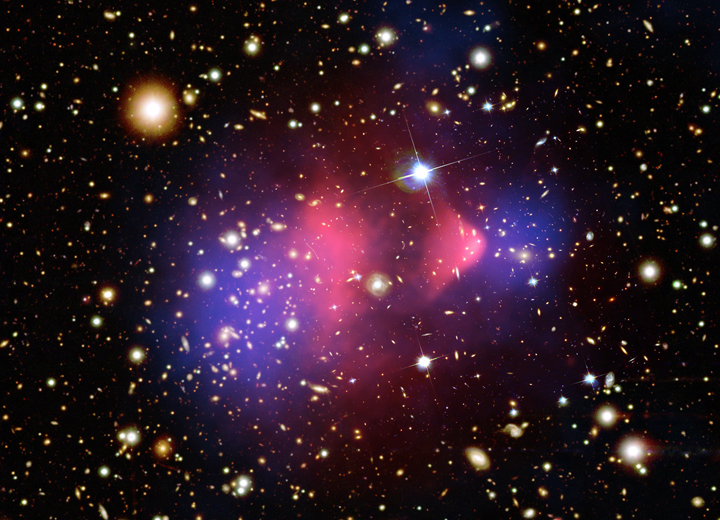
We cannot observe such Einstein rings around the Sun during a total solar eclipse, because the deflection is too small for our distance from it. It can however be seen around galaxies and clusters of galaxies at large distances. This effect makes it possible to observe distant galaxies having a chance alignment with a foreground one, with magnification, allowing useful measurements at distances where it would not have been possible.
One of the most useful applications of the Einstein ring is that it gives astronomers a tool for "weighing" a distant galaxy. They can measure angle α0 and distances Ds and Dd, the latter pair by means of their respective redshifts. Using equations (1) and (2), the mass M of the deflector lens follows easily:

Let's put in some values, say: α0 = 1 arcsec, Dd = 1 billion ly and Ds is double that. I find: M = 1.5x1041 kg, or 75 billion solar masses. This may sound outrageously large, but it's actually less than half the estimated mass of our own Galaxy.
In case you want to check my calcs, here's values from the spreadsheet: G=6.67E-11, c=3.00E+08m/s, alpha_0=1 arcsec=4.85E-06rad, Ds=2Gly=1.89E+25m, Dd=1Gly=9.47E+24m, M=1.50E+41kg. One solar mass=2E+30kg.
Many such Einstein rings have been observed, although not as perfect as in this idealization. The approximation used holds only for the case where the source is closely lined up with the lensing deflector. It is much more likely that the source will not be well lined up with the deflector. This situation will be discussed in part II of this mini-series.
Notes:
(1) For information on the orbital equation for light, see Tests of Relativity on the website Relativity 4 Engineers.
(2) The equations are all converted to "engineer-friendly" form from standard texts on relativity. Special credit to George K. Francis et al. (http://new.math.uiuc.edu/superball/pb.pdf)
-J
| 



 Re: Gravitational Lensing & Einstein Rings