|

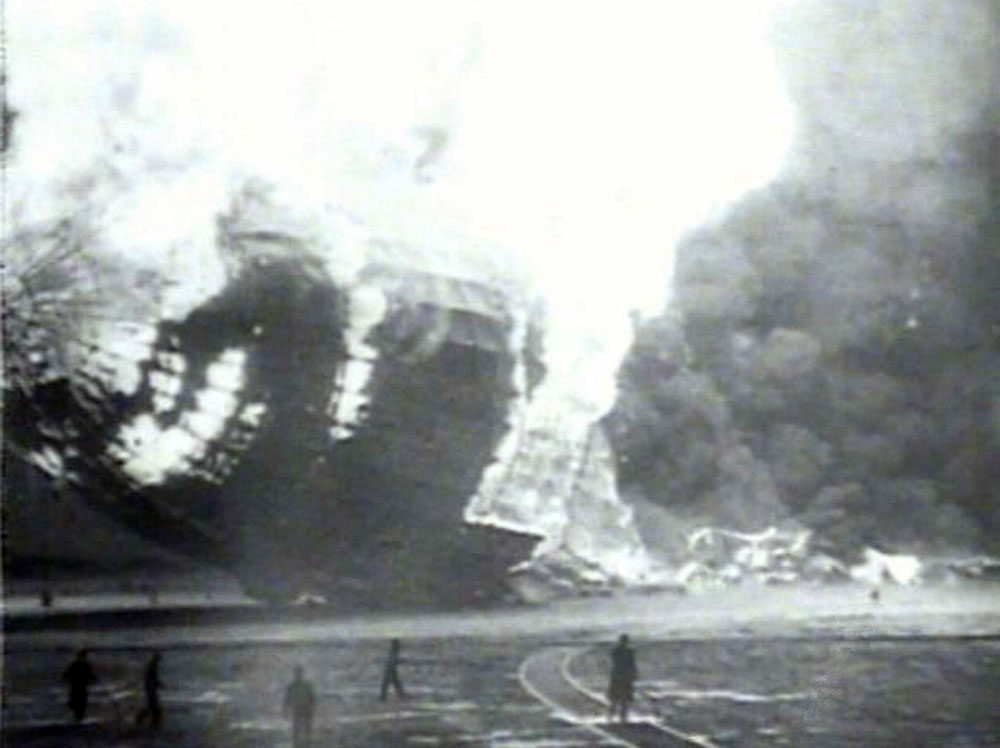
"Oh, the humanity!" said Herbert Morrison as he gave eyewitness radio coverage of the flaming
German airship. Nothing regarding the
Hindenburg disaster has burned more vividly into history, except for the
perhaps the hydrogen itself.
And although Morrison's chilling words had no real intention
beyond shock and fear, I'd like to think they described the evolution of the
incident quite well. After all, the myths and theories surrounding the event's
cause are a prime example of how scientific inquiry can be noticeably shaped by
a person's motives.
The Incident
On May 6, 1937 at around 7:00pm, a German airship named the Hindenburg began its landing at
Lakehurst Naval Air Station, the first of several scheduled trips for the 1937
season. The ship had made several successful transatlantic flights in the past
year, and plans were being formulated for a joint U.S. - Germany airship operation.
Sometime during the landing procedure, the Hindenburg caught
fire. Where the initial fire began is uncertain, but it quickly spread across
the tail and burst through the nose of the craft. Within 40 seconds (the exact
number of seconds has been disputed) the airship was completely engulfed and
destroyed. The disaster killed 13 passengers (of 36) and 22 crew members (of
61).
The Cause
Static electricity has been designated one of the most
likely causes of the ignition. The airship had just passed through a
thunderstorm where it would have built up charge. Poor electrical bonding
between fabric panels could have caused an undesirable discharge when the
grounding ropes were dropped. Some argue that this is unlikely, since a special
coating was used on the ship to prevent electric sparks.
 Other theories about the source of ignition include
lightning and engine failure. Still others suspect the whole incident was
really German sabotage in disguise. Other theories about the source of ignition include
lightning and engine failure. Still others suspect the whole incident was
really German sabotage in disguise.
The primary (and initial) fuel for the fire was either
hydrogen gas or the covering of the airship's shell. Most argue that the
abundant (some billions of BTUs worth) and extremely volatile hydrogen gas was
the main culprit. A sharp turning maneuver carried out during the landing could
have caused one of the bracing wires to break, in turn slashing one of the gas
cells.
But others (including many hydrogen fuel advocates) have
been quick to argue that the fabric or
paint could have caused the fire to start and/or been the main source of the
explosion.
The Effect
The Hindenburg was (and still is) the largest aircraft ever
constructed, at 804 feet (more than two American football fields). Prior to the
incident, the hydrogen airship was an established form of air travel, despite
the numerous
non-military accidents associated with the technology. The Hindenburg
tragedy, which gained much more attention than other failures, marked the end
of hydrogen as a flotation gas. Less than four years later, the last of the
zeppelins had been dismantled (in part to use the aluminum for the German war
machine).
Lessons Learned?
The Hindenburg disaster was public proof that hydrogen airships
were not safe. The resulting policy changes quickly smothered any chances engineers
had to learn from mistakes. In this case, the best learning that took place was
in pulling the plug.
But even a quick Google search will show that theories surrounding
the Hindenburg have been used to advocate both for and against hydrogen fuel.
Many hydrogen advocates have argued that because hydrogen is lighter than air
and burns up, it was not responsible for any deaths. Some go further to say
that poor fabric design or rocket fuel-like paint were the real culprits. On
the flip-side, others attempt to use the Hindenburg as evidence that all uses of hydrogen are completely unsafe.
While I understand the intent behind both sides, it's easy
to see how these biased perspectives are stretching truth to draw conclusions.
To the hydrogen advocates:
Even if the hydrogen was not the initial cause of the fire,
it is clear from the video
recording that the fire burned from the inside out, and that the hydrogen
was its primary fuel. This is supported by the fact that the painted fabric was
wet and that some of it did not burn at all. And since almost all who died were
killed in the fire, it is impossible for hydrogen to be completely innocent. If
the zeppelin had used helium, it would (at the very least) have slowed the rate
of the burning fabric if not preventing it from catching fire.
To the hydrogen assailants:
The fact that hydrogen was an unsafe lifting gas during the
1930's does not mean that it would make an unsafe fuel in the present day.
Though the properties of hydrogen are the same between the lifting agent and
the fuel, the applications and technologies used are far different. Who is to
say that a hydrogen airship with present day technology would not be nearly as
safe as one that uses helium?
In short, I have no problem discussing the many mysteries
and theories behind the Hindenburg, and there are many (see sources below). But
it would be nice if the politics surrounding it could be left to the
politicians.
Sources:
Airships.net
- Myths about the Hindenburg Crash
Aviation
- The Hindenburg Disaster
Disaster of the
Hindenburg
The
Hindenburg and Humanity
The Mystery
of the Hindenburg Disaster
What
Destroyed the Hindenburg? Theories and Myths
| 


 Re: The Hindenburg Legend - Myths and Bias


