|
Soccer, football, association football, fútbol.
Considering the same game is played by over 250 million people in 200
countries, it's truly a case of "a rose
by any other name."

International
soccer culminates at the World Cup, held every four years and most recently in
2010, hosted by South Africa. For one month, the world stopped at the sight of
an Adidas soccer ball. And also rioted at the sound of the vuvuzela. And
also listened to pop musician Shakira do her best "Fozzy Bear" impression.
Between the song, the crowd, the games, and the
international participation, the World Cup is nothing short of electric.
But, there is a new part of the football game that is
getting some energy: the ball. And I don't mean in the figurative sense.
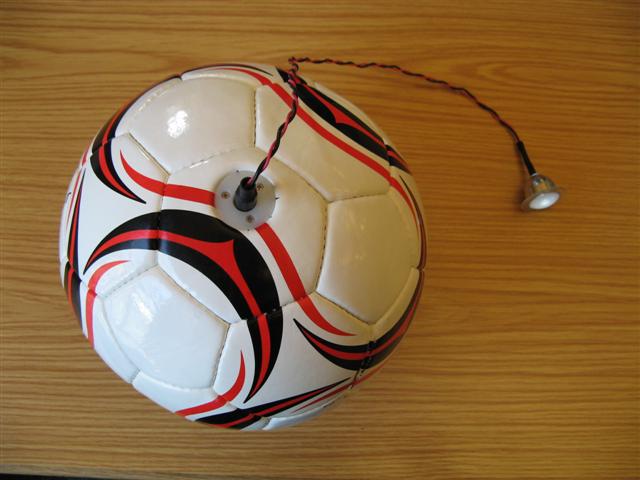
Introducing the
"sOccket."
 ...via PM ...via PM
This typical looking soccer ball actually has a small
electric alternator in it. Original designs had an inductive coil mechanism, which
is the charging method for a shake-to-charge flashlight. More recent designs
incorporate a gyroscope mechanism, which allows the ball to capture energy with
any movement. Its operational range is
2.71 to 3.61 volts, but can generate as much as 24 volts.
sOccket co-creator Jessice Matthews offers an in-depth look at the prototypes design.
The
ball is very durable, and is pretty close to the official weight of a size 5
soccer ball. The ball can store 3 hours of LED lighting with 30 minutes of
play, and can even run a water purifier. is very durable, and is pretty close to the official weight of a size 5
soccer ball. The ball can store 3 hours of LED lighting with 30 minutes of
play, and can even run a water purifier.
...via sOccket
While this seems impractical for developed, western nations,
soccer's popularity isn't limited to those who can just watch games on TV. Many
people in poor, aboriginal villages throughout Africa, South and Latin America,
the Caribbean, and Asia enjoy a casual game of soccer, but it's more likely to
be a version of kick the can or kick the knotted plastic bags. It's also these areas that have limited
access to electricity and clean water.
Unfortunately
though, the sOccket's business model relies strictly on charity for its
distribution, so the folks at sOccket are going to depend on philanthropies and
good-willed corporations to distribute these soccer balls to needy areas.
Credit giant American Express is among the first to jump on this truly
brilliant idea (and they sponsored a really cool commercial to tell you all about it, of course).
The hope is to eventually begin a buy-one, give-one program,
so individuals have incentive to purchase the ball.
The ball's energy generating technology is expected to last
a few years, while the ball itself is expected to last much longer as the
sOccket isn't made of typical latex and rubber, but rather weather-resistant
foam. What the creators hope for most of
all is to inspire youths in rural areas to educate themselves so they can
contribute with other innovations. If
even a fractional number of young, poor soccer players are inspired by this
product, then the sOccket's true benefits are immeasurable. Bill Clinton,
former U.S. president, said "It's quite extraordinary really. Kick a ball, turn
on a light. It's an off-grid solution."

Though Billy really doesn't know anything about soccer. Just cheap, sustainable energy. And burgers. And jazz. And, well, you see where I'm going......via ISI Photos
Not convinced that this will catch on? Two countries where
the sOcckets implementation will surely transform life-- El Salvador and Honduras--went
to war in 1969, fueled by a World Cup soccer game. I think that speaks for itself.
I agree that this idea is incredible. Do I expect it to be more than a blip on most North American's radars? No. Let's face it: soccer will never have the marketing of American football. (Or, if you're Canadian, the beer.)
But
it is fun to watch David Beckham and Reggie Bush duke it out over their
respective sports.
Resources
Popular Mechanics - sOccket
sOccket.com
Discovery News - sOccket
| 


 Re: The (Real) Electric Soccer Ball.


