|
Scientific and engineering progress sometimes seems limited only by time, money, and motivation. Let's face it; if enough people want it done we can build something as enormous and expensive as the Large Hadron Collider (LHC), which spans through 27 km of tunnels and cost around $4.4 billion. Fun stuff.
Of course, if we're talking money, few organizations have more at their fingertips than our nations' militaries. And this abundance of resources, coupled with patriotic and wartime motivations, often amounts to an overabundance of enterprise and invention (i.e. military + money + zeal = big and expensive guns). Luckily for us, we can enjoy learning about most epic of undertakings in military engineering, even if they were flat-out failures.
In this edition, we look at three "visionary" mid-1900's aircraft designs that, simply put, didn't work.
#1 - The Kalinin K7
 The Kalinin K-7 was a Russian designed experimental heavy bomber built in the early 1930s under the principle of "bigger is better". With wings spanning 132.5 meters (a 747 is ~68.5m), this "flying fortress" was one of the largest (if not the largest) planes to ever leave the ground. It used a total of 20 engines which powered over 14 propellers. Inside the wings of the plane was enough room to seat 120 passengers and a crew of 11. It featured as many as 12 gunner positions and could carry up to 16 tons of bombs, 112 fully equipped paratroopers, or 8.5 tons of parachutable supplies depending on the range of travel required. The Kalinin K-7 was a Russian designed experimental heavy bomber built in the early 1930s under the principle of "bigger is better". With wings spanning 132.5 meters (a 747 is ~68.5m), this "flying fortress" was one of the largest (if not the largest) planes to ever leave the ground. It used a total of 20 engines which powered over 14 propellers. Inside the wings of the plane was enough room to seat 120 passengers and a crew of 11. It featured as many as 12 gunner positions and could carry up to 16 tons of bombs, 112 fully equipped paratroopers, or 8.5 tons of parachutable supplies depending on the range of travel required.
(Credit: Gizmodo)
In its test flights, the K-7 reached a top speed of 140 mph and an elevation of 13,000 ft. Unfortunately, a crash in 1933 during one of its test flights killed 15 people as well as the plane's chances of ever reaching completion. The crash was investigated by a committee of aviation experts, and it was concluded that the aircraft failed due to surface vibrational issues due to improper weight balancing.

(Credit: Gizmag)
For more reading:
Pilotfriend
Fiddler's Green
Gizmodo
Gizmag
#2 - The XF-85 Goblin
 Alongside one of the biggest planes to ever grace the skies, let's look at one of the smallest. The XF-85 Goblin was a "parasite" fighter designed by the US in 1948 to protect bombers that had to venture beyond the range of their escorts. With only a 14'10" length and 21' wingspan, it was made to be transported and released from the B-36 bomber through its payload doors; after eliminating the threat with its four .50 caliber machine guns, it would then reattach to a trapeze connection, fold its wings, and be lifted back into the bomb bay. It had no landing gear, save for a steel skid and some small wheel runners for emergencies. Alongside one of the biggest planes to ever grace the skies, let's look at one of the smallest. The XF-85 Goblin was a "parasite" fighter designed by the US in 1948 to protect bombers that had to venture beyond the range of their escorts. With only a 14'10" length and 21' wingspan, it was made to be transported and released from the B-36 bomber through its payload doors; after eliminating the threat with its four .50 caliber machine guns, it would then reattach to a trapeze connection, fold its wings, and be lifted back into the bomb bay. It had no landing gear, save for a steel skid and some small wheel runners for emergencies.
(Credit: U.S. Air Force -->)
Parasite fighters had been used in other forms, such as on dirigible airships (bringing to mind the airship escape scene from Indiana Jones: The Last Crusade, with Dr. Jones' brilliant aerial defense). However, none had ever been launched in this unusual fashion. A B-29 superfortress (shown right) was used for test launches, since a B-36 prototype did not exist. Although the Goblin flew and handled well, the turbulence around the "mothership" made it incredibly hard to recover using the trapeze system in place. Eventually the project was scrapped in favor of a more promising solution to bomber escorting: aerial refueling.
#3 Focke Wulf Triebflugel
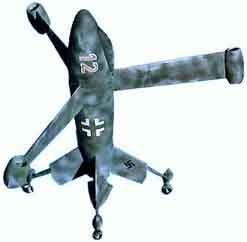 Perhaps one of the most creative and ridiculous aircraft designs was the Focke Wulf Triebflugel. It was based off the principle of the helicopter, in that it used three large spinning rotors. Beyond this, the Focke-Wulf is very much its own creation. The rotors were designed to spin around the fuselage, and were powered by small jets on the tips which would be jumpstarted by rockets. Using ramjets made it possible to reach altitudes of 59,000 ft. It also could use a variety of cheap fuels, which would be important for expanding the costly German war machine. Perhaps one of the most creative and ridiculous aircraft designs was the Focke Wulf Triebflugel. It was based off the principle of the helicopter, in that it used three large spinning rotors. Beyond this, the Focke-Wulf is very much its own creation. The rotors were designed to spin around the fuselage, and were powered by small jets on the tips which would be jumpstarted by rockets. Using ramjets made it possible to reach altitudes of 59,000 ft. It also could use a variety of cheap fuels, which would be important for expanding the costly German war machine.
(Credit: Fiddler's Green -->)
This 30' rotating wing fighter was devised in 1942 as a convenient point defense fighter that needed only a small area for takeoff. Unfortunately, designers failed to think about the practicality of landing such a machine. The spinning rotors and jet exhaust made rear visibility nearly impossible, which was essential for the vertical/backwards landing it was designed for. Ejection of the pilot from the plane was also problematic for obvious reasons. The project was terminated in 1944, mostly because it had been in the development stage for far too long.

(Credit: greyfalcon.us)
For more reading:
Fiddler's Green
Rocket Dungeon
| 


 Re: Failred Military Designs - Aircraft


