|
So many industrial products and process find alternative
uses in the arts.
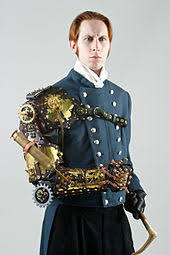 Paint isn't just a surface coating, but a means of visual
expression and interpretation. Modern art sculptors have been using welding and
brazing techniques for decades to create obtuse structures. Steampunk has
become a clothing and aesthetic style that idolizes 19th Century steam-powered
machinery. Paint isn't just a surface coating, but a means of visual
expression and interpretation. Modern art sculptors have been using welding and
brazing techniques for decades to create obtuse structures. Steampunk has
become a clothing and aesthetic style that idolizes 19th Century steam-powered
machinery.
And, in what is perhaps the performing art's introduction to
industrial machinery, scissor lifts now participate in ballet. No really, have
a look.
While as, um--beautiful, as that was, it's likely that the
composer was 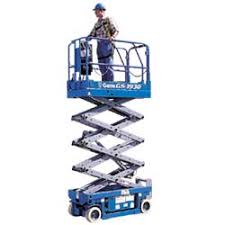 simply living out a childhood fantasy of playing on scissor lifts.
They do look like giant toys after all. It's unlikely though that the composer
understood the industrious nature of his playthings. simply living out a childhood fantasy of playing on scissor lifts.
They do look like giant toys after all. It's unlikely though that the composer
understood the industrious nature of his playthings.
Scissor lifts owe their mechanical capability to the
pantograph. A pantograph is a series of linked parallelograms with
hinged intersections that allow the operator to elongate
the mechanism while still maintaining the integrity of the geometric
figure. The structural components of the pantograph serve as
opposing line segments within adjacent parallelograms; geometric
changes are therefore uniform across the mechanism. True vertical lift
is accomplished by using components of equal length.
When two pantographs are arranged so as to actuate from
a single drive they extend correspondingly and loads can be balanced between
them. A calculator exists for 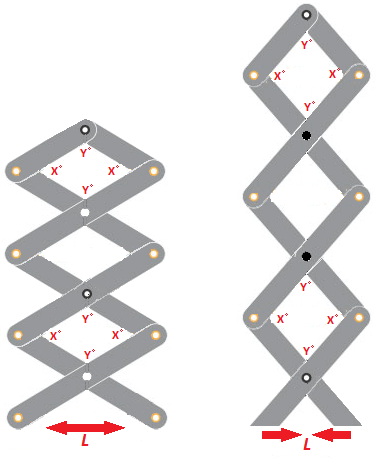 computing the linear input force
required according to where the drive supplies power to the scissor
mechanism, be it upon the base
or a center
pin . computing the linear input force
required according to where the drive supplies power to the scissor
mechanism, be it upon the base
or a center
pin .
Motor-driven propulsion is a
valuable attribute in many situations requiring scissor lifts. This allows
workers to position the lift on an as-needed basis which is particularly useful
in maintenance and construction applications. 'Slab' lifts are restricted to
paved, smooth surfaces; rough terrain lifts rely on robust tires and four-wheel
drive to traverse off-road conditions.
To improve lift agility,
manufacturers rely on a sharp turning radius and a short wheelbase. Parking
brakes ensure lift location, and tires and casters come in non-marking,
off-road, anti-slip, press-on, and urethane varieties. Economical and legal
reasons prohibit scissor lifts from road travel; they are hauled or towed
between job sites. However, some scissor lifts may be flatbed or
railcar-mounted for specialty applications. Many mobilized lifts utilize outriggers
for further foundational stability.
Furthermore, the control, maneuverability, and power
source of a scissor lift is critical to its utility, other
characteristics better describe the vertical capabilities of the
lift.
- Stroke:
this is the range of height safely attained by use of a scissor lift. This
is directly correlated with the number
of scissor intersections and the length of the
components used in the pantograph.
- Size:
this is the dimensions of the work platform elevated by the lift. Many lifts
feature an extendable platform to increase the area's square volume.
- Capacity:
the maximum burden that the lift is designed to safely support, be it
personnel or freight.
- Tilt:
in cargo-lifting situations it may be helpful to have a lift table that can
pitch its load to an angle to make the load more accessible.
You can see IHS GlobalSpec's complete scissor lift selection
guide here.
 Also, if you have a scissor lift, remember that
you should not operate it with your judgment impaired or on the road, like this idiot [language]. Also, if you have a scissor lift, remember that
you should not operate it with your judgment impaired or on the road, like this idiot [language].
(Image credits: Wikipedia; Taylor Rental; IHS GlobalSpec; Craig Boyce)
| 


 Re: Scissor Lifts Make Great Toys


