|
Fractals are geometric objects (lines, shapes, objects) that are self similar with respect to scale. Take a look at the example below;
A fractal

looks the same

over all ranges

of scale

This is called "self-similarity"

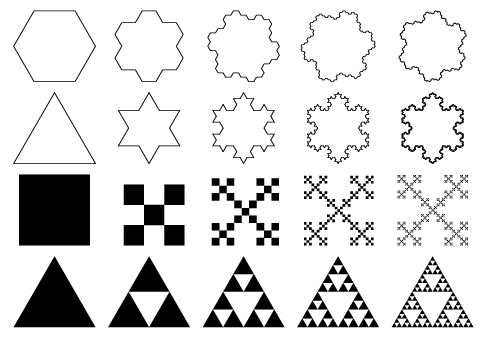
Take a look at the shapes below. In each of the examples, fractals are being created through iteration (doing the same thing over and over again to the shapes). No fractals are in the diagram below since you would have to iterate forever to get it to be a true fractal, but the shapes are at least approaching the fractal shape from left to right.
Euclidean shapes and objects have dimensions of integer value. A square has a dimension of 2, just like a circle does. A cube has a dimension of 3, just like a sphere does. A line has dimension 1, a point dimension 0, a hypersphere has 4 dimensions or more. Here "Euclidean" for the layperson is pretty much the same as "traditional" (Euclid is widely considered the father of the geometry). Here are some examples of three dimensional objects;

Here are some examples of 2 dimensional objects;

Fractals have dimensions too, but their dimensions are not integer, but are a type of geometry and can be categorized by their dimension. Fractal dimensions though are never 1, 2, 3, 4, etc. but somewhere in between, like 1.33333333333 or 2.78 or .31, etc. So what does a dimension of 2.78 mean? To answer that all important question in this discussion, we need to understand how we define "Dimension".
For a long time, dimension was simply the number of things needed to describe the geometric object. For instance, to describe a line, you need only provide it's length. To describe a square you need to say its length and width (2). For a cube you need to provide length, width, and height. This definition doesn't work for fractals and another, more general explanation is necessary. This more general explanation is provided by Hausdorff dimension.
This method for calculating dimension examines what happens to an object when you slice it up. Lets look at some simple Euclidean objects to reassure ourselves that the method is giving us our expected outcome. I have taken the following examples below from Exploring Fractals by Mary Ann Connors.
Mathematical Interpretation of Dimension via Self-similarity

Notice that the line segment above is self-similar. It can be separated into 4 = 41 "miniature" pieces. Each is 1/4 the size of the original. Each looks exactly like the original figure when magnified by a factor of 4 (magnification or scaling factor).

The square above can be separated in to miniature pieces with each side = 1/4 the size of the original square. However, we need 16 = 42 pieces to make up the original square figure.

The cube above can be separated into 64 = 43 pieces with each edge 1/4 the size of the original cube.
In these simple cases the exponent gives the dimension:
4 = 41 (Dimension = 1) 16 = 42 (Dimension = 2) 64 = 43 (Dimension = 3) Therefore, N (the number of miniature pieces in the final figure) is equal to S (the scaling factor) raised to the power D (dimension).
N = SD
This formula is the key to finding the dimensions of fractals. It's reassuring that it provides the correct dimensions for our know Euclidean shapes above. Lets try calculating the dimension of our original fractal (Sierpinski Triangle) using the method above;
Notice that the lower left portion of the triangle is exactly the same as the entire triangle when magnified by a factor of two. It is self-similar.
Now we compute the dimension of the Sierpinski Triangle: Notice the second triangle is composed of 3 miniature triangles exactly like the original. The length of any side of one of the miniature triangles could be multiplied by 2 to produce the entire triangle (S = 2). The resulting figures consists of 3 separate identical miniature pieces. (N = 3).
What is D?
 or or


 (not an integer!) (not an integer!)
So a Sierpinski Triangle has a dimension of approximate1.585! Notice its dimension is in between that of a line and a Euclidean shape, but it's not quite either.
Let's try another fractal. We'll take this fractal that looks like a dotted line.

Please note that the diagram above shows you how to make the fractal. To make it you follow the following steps. Take your line and split it into three equal parts. Delete the second part. Repeat for the two remaining line segments. Do this forever. The result is a line of infinitely small line segments that form a distinct pattern. This particular type of fractal is called a Cantor Dust Fractal. Two calculate the dimension, we use the same procedure as before;
Noting that there are 2 line segments for every line segment from the earlier step N=2 and each line segment is 1/3 of the original line segment, S=3 , we get the equation;
2=3D
Log 2 = D Log 3
D = Log 2/Log 3
D = .6309...
So a Cantor Dust Fractal has dimension of approximately .63, in between the dimension of a point (D=0) and a line (D=1).
Let's look at a larger fractal;

The fractal above is called a Menger Sponge Fractal. If you look closely you can see that the large cube can be thought to be made up of 20 identical smaller cubes and 7 empty spaces where cubes have been "deleted" or removed. The scaling factor is 3. So N=20 and S=3. Setting up the dimension equation;
N = SD
20 = 3D
Log 20 = D Log 3
D = Log 20 / Log 3
D = 2.7268...
So a Menger Sponge fractal has dimension of ~2.73. This is in-between the dimensions of a square (D=2) and a cube (D=3).
Now that we've calculated some fractal dimensions, I'd like to point out some nice features. Fractal dimension is intuitive. What I mean to say is that the dimension of a fractal such as Cantor Dust, Sierpinski Triangle, or a Menger Sponge is close to the Euclidean shape it kind-of looks like. It makes sense that Cantor Dust is somewhere in-between a point and a line. It makes sense that a Menger Sponge is not quite three dimensional. So fractals aren't the exotic objects they seem to be at first glance, but simply an expansion of geometry to fractional dimensions.
There is a great analogy to this in our counting systems. For a long time we didn't have fractions and decimals, etc. We only used what's referred to as "Integers" (1,2,3,4,5,.....). Eventually over time we added numbers like 1.221 or 1.4342. We came to find out that integers are the exception, not the rule. Most numbers are ugly decimal things. In the same way, for a long time now we have believed that geometry consisted only of Euclidean objects such as squares, triangles, cubes, pyramids, etc. Now with fractals we realize that Euclidean objects are the exception, not the rule. There is an infinite number of fractal shapes, each with their own unique fractional dimension.
In Part II, I'll discuss what we can do with this recently acquired knowledge of geometry and what it may mean for the future.
| 




 Re: Fractals - Part I


