Previous in Forum: Air Cooling   Next in Forum: The Growth of Human Hair
Close
Close
Close
13 comments
Rating: Comments: Nested
Power-User

Join Date: Feb 2005
Posts: 255
Good Answers: 2

Autumnal Equinox Sunrise/Sunset

09/22/2006 1:31 PM

Tonight at 12:03 eastern is the Autumnal Equinox. (already!) I can buy the equal daylight/nighttime property of the equinox because it is easily modeled with a basketball and a light. I am having trouble accepting the sunset directly in the west (rise in the east) claim that I hear/see in the media. I know that near the North Pole, the sun is pretty low in the sky right now and soon it will be 24 hrs of night, so it must be setting it the south west, right? Intuitively, I feel that the sun rises directly in the east and sets directly in the west only at the equator on the equinox...

Register to Reply
Interested in this topic? By joining CR4 you can "subscribe" to
this discussion and receive notification when new comments are added.
The Engineer
Engineering Fields - Engineering Physics - Physics... United States - Member - NY Popular Science - Genetics - Organic Chemistry... Popular Science - Cosmology - New Member Ingeniería en Español - Nuevo Miembro - New Member

Join Date: Feb 2005
Location: Albany, New York
Posts: 5060
Good Answers: 129
#1

Re: Autumnal Equinox Sunrise/Sunset

09/22/2006 2:14 PM

"Intuitively, I feel that the sun rises directly in the east and sets directly in the west only at the equator on the equinox..."

I could be wrong, but I think you're right. I think you're explanation pretty much sums it up, but I may be mission something ;)

Register to Reply
Guru
Engineering Fields - Aerospace Engineering - Retired South Africa - Member - The Rainbow-nation Engineering Fields - Engineering Physics - Relativity & Cosmology Popular Science - Cosmology - The Big Picture!

Join Date: May 2006
Location: Pretoria, South Africa
Posts: 3804
Good Answers: 69
#2
In reply to #1

Re: Autumnal Equinox Sunrise/Sunset

09/22/2006 2:48 PM

My take on this is that you are both wrong. The equinoxes have the peculiar effect that all places on Earth, even the Poles, have 12 hours of potential sunshine on that day, if we ignore weather factors. I think that translates to a sunrise due east and a sunset due west. But maybe I'm also wrong - perhaps a geologist can settle this?

__________________
"Perplexity is the beginning of knowledge." -- Kahlil Gibran
Register to Reply
Guru
Popular Science - Evolution - New Member Popular Science - Weaponology - New Member

Join Date: May 2006
Location: The 'Space Coast', USA
Posts: 11119
Good Answers: 918
#3
In reply to #2

Re: Autumnal Equinox Sunrise/Sunset

09/22/2006 3:14 PM

Jorrie, I believe you are right.

In order for the duration of day and night to be equal the sunrise must be due east and the sunset due west. This is independent of where the observer is on the globe.

However, as you advance in latitude (north or south) the maximum elevation of the Sun will be lower in the sky than it will be at the equator, which would be directly overhead.

Register to Reply
The Engineer
Engineering Fields - Engineering Physics - Physics... United States - Member - NY Popular Science - Genetics - Organic Chemistry... Popular Science - Cosmology - New Member Ingeniería en Español - Nuevo Miembro - New Member

Join Date: Feb 2005
Location: Albany, New York
Posts: 5060
Good Answers: 129
#4
In reply to #2

Re: Autumnal Equinox Sunrise/Sunset
09/22/2006 3:25 PM

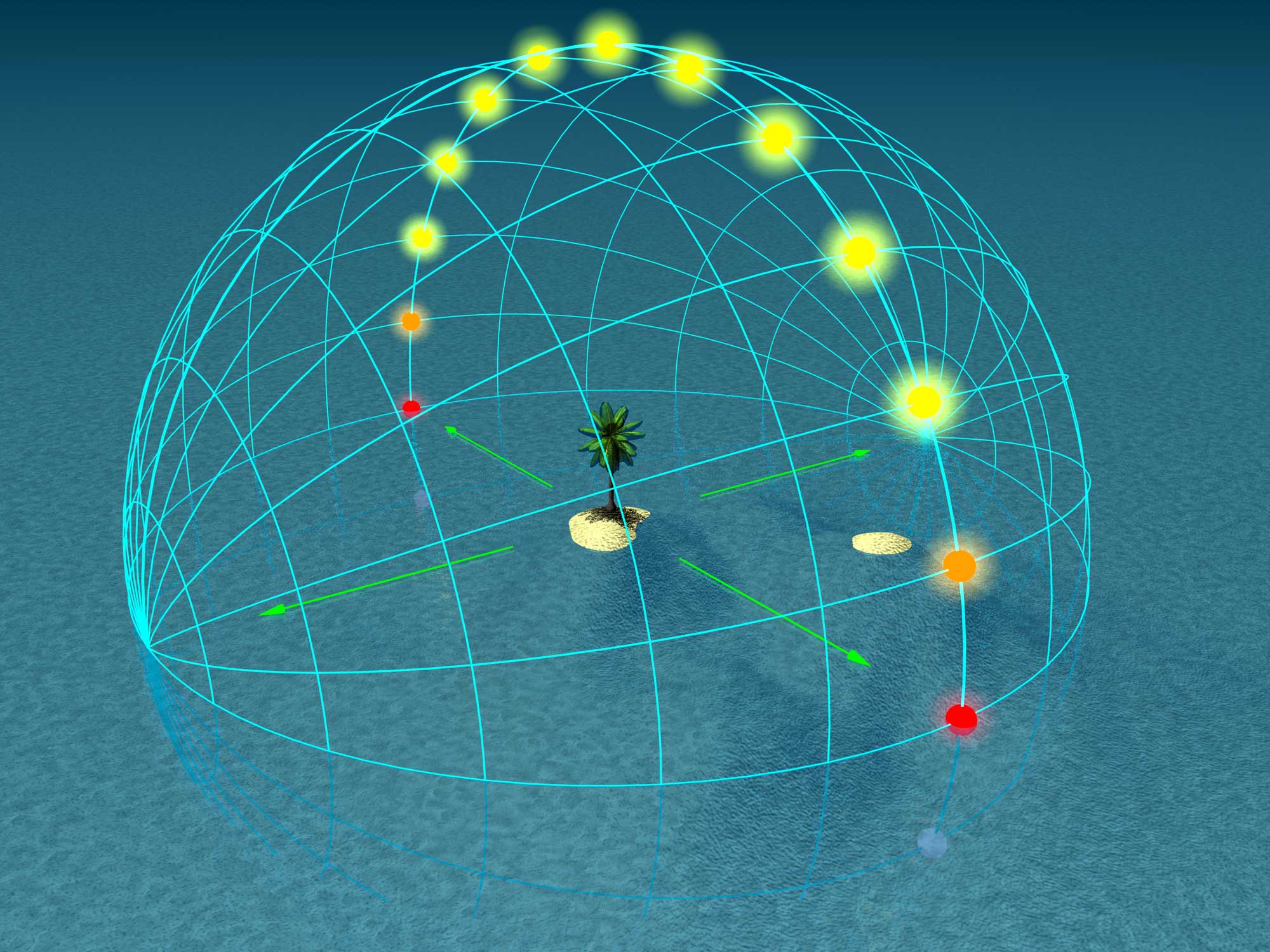
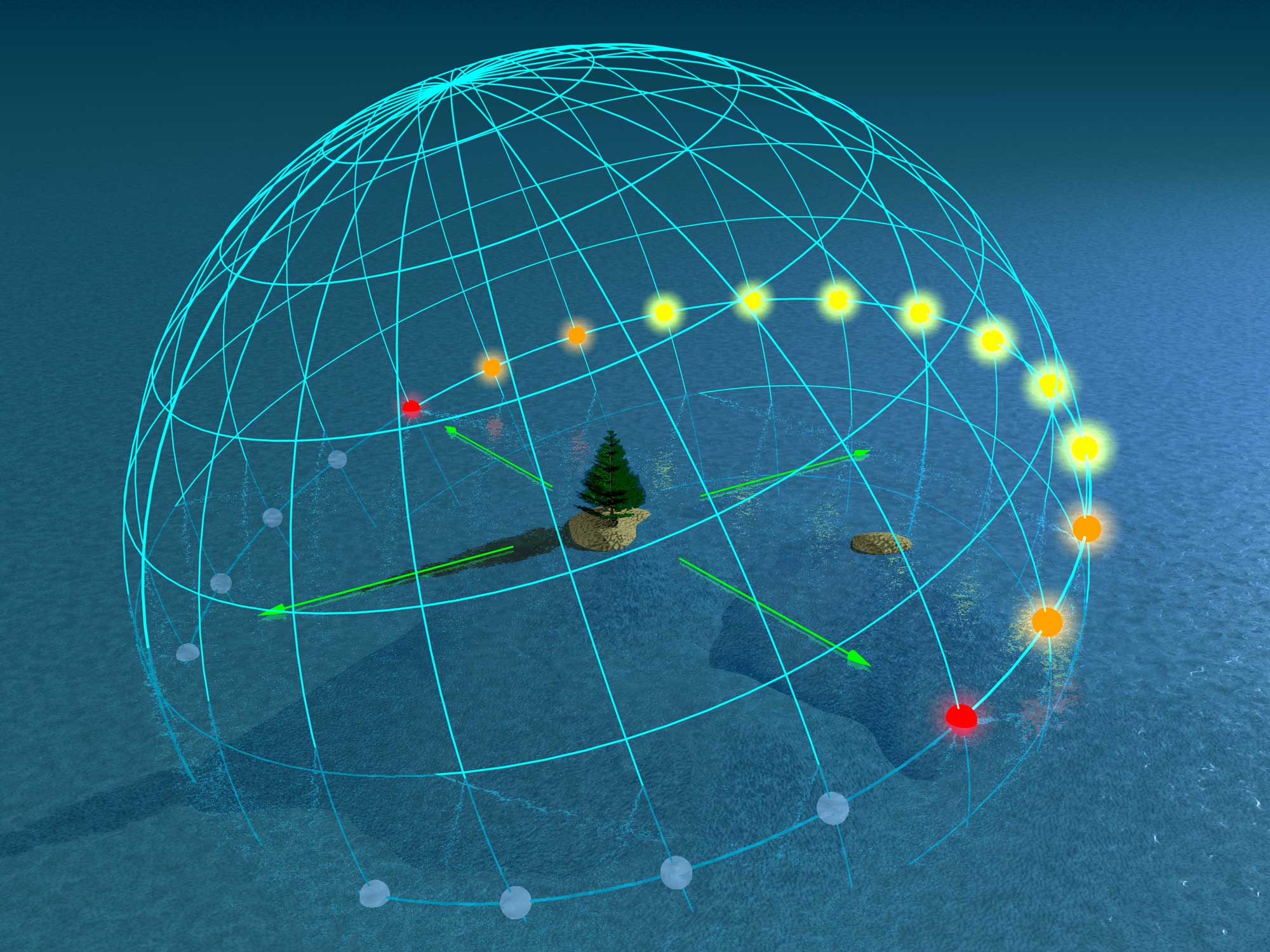
According to Wikipedia, I think you're right Jorrie. There is a great article with pictures. Here are day arcs at different latitudes, each sun represents an hour of the day. Notice no matter the latitude, the sun always rises due East and sets due West.

At the equator.

At Latitude 50 degrees

At Latitude 70 degrees

Register to Reply
Member

Join Date: Mar 2006
Posts: 9
#5

Re: Autumnal Equinox Sunrise/Sunset

09/23/2006 1:51 AM

I'm not an expert, but if I'm not mistaken east and west are directions relitive to the magentic poles of the earth not the direction to the sun. Since the magnetic poles do not change yearly but thier direction relitive to the sun does, does it not make sense that in the northern hemisphere, in summer, the sun rises in the NE and sets in the SW and in winter, rises in the SE and sets in the NW? 47 years and I haven't taken the time to notice ...

Register to Reply
Guru
Engineering Fields - Aerospace Engineering - Retired South Africa - Member - The Rainbow-nation Engineering Fields - Engineering Physics - Relativity & Cosmology Popular Science - Cosmology - The Big Picture!

Join Date: May 2006
Location: Pretoria, South Africa
Posts: 3804
Good Answers: 69
#6
In reply to #5

Re: Autumnal Equinox Sunrise/Sunset
09/23/2006 2:24 AM

SmokieDobe, no, the directions are not referenced to the magnetic Poles, but to the true geographical poles, i.e., the spin axis of the Earth. When you navigate with a compass, you add or subtract a deviation to the magnetic north to obtain true north. Maps are also working with true north.

__________________
"Perplexity is the beginning of knowledge." -- Kahlil Gibran
Register to Reply
Member

Join Date: Mar 2006
Posts: 9
#7

Re: Autumnal Equinox Sunrise/Sunset

09/23/2006 10:22 AM

Jorrie,

Thank you for clearing that up. You of course are correct. But at this point in time (the last few decades for discussion) aren't they close enough to parallel for my comment to be valid? We aren't trying to navigate here ... or are we? My comment also assumed a flat, level plane for refferance to Earths orbit around the center of the Sun. I am thinking about a sunrise and a sunset from a casual point of view, not discecting it.

Register to Reply
Power-User

Join Date: Feb 2006
Location: Detroit Downriver
Posts: 119
#8

Re: Autumnal Equinox Sunrise/Sunset

09/25/2006 9:23 AM

Correct me if I'm wrong, but the equinox is that part of the cycle where the Sun is directly over the equator and the equator is at the center of the axis of rotation. Therefore, all points on the earth would pass equally through 12 hours of daylight and 12 hours of darkness.

Because one is viewing the sunset from a fixed perspective on the surface of the globe and cannot see through dirt, the person standing in northern lattitudes would perceive the sunset to be to the south of due west.

__________________
The legacy of the digital age is that of segregation through differing formats. - HerbVic
Register to Reply
Guru
Engineering Fields - Aerospace Engineering - Retired South Africa - Member - The Rainbow-nation Engineering Fields - Engineering Physics - Relativity & Cosmology Popular Science - Cosmology - The Big Picture!

Join Date: May 2006
Location: Pretoria, South Africa
Posts: 3804
Good Answers: 69
#9
In reply to #8

Re: Autumnal Equinox Sunrise/Sunset

09/25/2006 10:09 AM

You are correct about the sun being directly above the equator at the equinoxes. However, the sun rises/sets just about bang-on due east/west on the equinoxes, without you having to see through dirt!

You would agree that at the equator the east/west rise/set statement is true. Now all the parallels will, like the equator, point directly at the sun at sunrise/sunset (well as near as it doesn't matter!). The sun is far enough away so that a few thousand miles off the equator makes no difference in the sun's bearing at rise/set.

Another way to view it: during the northern summer, the sun sets north of due west and in winter it sets south of due west. So when does the sunset cross the due west? Obviously...

With all this said, none of it is actually precise! The day did not equal the night on Sep 22 and the sun did not rise/set precisely east/west. This is due to two factors.

1) The definition of sunrise is when the upper limb of the sun becomes visible, which is a few minutes before the center of the sun rises.

2) Atmospheric refraction makes the sun 'rise' a few minutes before it should actually be visible.

On both counts the opposite happens at sunset. Real day-night equaling happens more or less today (25th) in the Northern hemisphere.

__________________
"Perplexity is the beginning of knowledge." -- Kahlil Gibran
Register to Reply
Power-User

Join Date: Feb 2006
Location: Detroit Downriver
Posts: 119
#10
In reply to #9

Re: Autumnal Equinox Sunrise/Sunset

09/25/2006 3:36 PM

Thanks Jorrie! I see it now. Dirt doesn't enter into it. At all. And, the atmospheric refraction effect is another wrinkle I hadn't thought of.

Great discussion! I guess the only 2 places on Earth where the Sun wouldn't set due West is at the north and south center of axis of rotation in which all directions lead south or north respectively. There, during the Fall Equinox, the Sun would appear to be perpetually setting as it skirted the horizon. And of course the closer one is to the pole, the greater the bias toward more lighted time due to atmospheric refraction.

__________________
The legacy of the digital age is that of segregation through differing formats. - HerbVic
Register to Reply
Guru

Join Date: Aug 2006
Posts: 4484
Good Answers: 246
#12
In reply to #10

Re: Autumnal Equinox Sunrise/Sunset

09/26/2006 11:11 AM

Dirt doesn't enter into it?? You must be a flatlander. Here, the sun appears to set an hour early because of dirt, in the form of mountains... Ok, Ok, I know what you mean.

__________________
There is more to life than just eating mice.
Register to Reply
Power-User

Join Date: Feb 2005
Posts: 255
Good Answers: 2
#11

Re: Autumnal Equinox Sunrise/Sunset

09/25/2006 4:03 PM

I found two sites to help illustrate visually the path of the sun in the sky on any day at any location. Sol Path is a shareware program. I encourage users to support shareware authors as they see fit. The second is a plotting program from the University of Oregon, it's free. Sun Chart

Register to Reply
Anonymous Poster
#13

Re: Autumnal Equinox Sunrise/Sunset

10/16/2006 12:19 PM

Greetings --

An approach from geometry may be helpful.

Assuming the earth to be spherical, a shadow cast by a locally vertical linear object lies along a great circle that includes the point where the sun is at the zenith. Thus, at sunrise or sunset, the line of vision -- from the observer to the point on the horizon where the sun in situated -- lies on such a great circle.

At the equinox, the point where the sun it at the zenith lies on the equator, and the great circle demarcating night and day is a (north-south) meridian. By symmetry, all of the great circles emenating from the zenith point intersect this meridian at right angles, in an east-west direction. Thus, an obsever sighting along any great circle ar sunrise or sunset is sighting along the east-west direction.

It is at first a bit counerintuitive that a great circle -- from the meridian near the north pole to the equatorial zenith point -- lies locally in the east-west direction. This is because we are accustomed to visualizing the earth with the north pole on top, thus obfuscating the symmetry that emmenates from the zenith point.

Regards,

AMB

Register to Reply
Register to Reply 13 comments
Copy to Clipboard

Users who posted comments:

Anonymous Hero (1); Anonymous Poster (1); Bayes (2); Blink (1); HerbVic (2); Jorrie (3); Paddy O'Flanigan (1); SmokieDobe (2)

Previous in Forum: Air Cooling   Next in Forum: The Growth of Human Hair
You might be interested in: Playfield Equipment, Trackballs, DSP Boards

Advertisement