Previous in Forum: Thermoacoustics and inlet fogging on a gas turbine   Next in Forum: Thomas Friedman on Energy
Close
Close
Close
40 comments
Rate Comments: Nested
Power-User

Join Date: Dec 2006
Location: ON Canada
Posts: 185
Good Answers: 1

Temperature Difference to kW

09/05/2008 7:31 PM

1 degree Celcius of temperature difference = how many kW's? (energy wise, assume 100% efficient)

I have some questions for combustion engineer's and therodynamic's engineers, if there are any here willing.

Register to Reply
Interested in this topic? By joining CR4 you can "subscribe" to
this discussion and receive notification when new comments are added.

Good Answers:

These comments received enough positive votes to make them "good answers".

"Almost" Good Answers:

Check out these comments that don't yet have enough votes to be "official" good answers and, if you agree with them, vote them!
Guru

Join Date: Jul 2007
Posts: 4448
Good Answers: 143
#1

Re: temperature difference to kW?

09/05/2008 7:50 PM

You can't equate temperature rise to kW except in very specific particulars. Can you provide some, please?

__________________
"Well, I've wrestled with reality for 35 years, Doctor, and I'm happy to state I finally won out over it." Elwood P. Dowd
Register to Reply
Guru
New Zealand - Member - Interested in everything- see my Profile please APIX Pilot Plant Design Project - Member - Member Engineering Fields - Electrical Engineering - Member Engineering Fields - Power Engineering - Member Engineering Fields - Civil Engineering - Member Hobbies - Musician - Autoharp and Harmonica Hobbies - Hunting - Member Hobbies - Fishing - Member

Join Date: Nov 2007
Location: Christchurch, (The Garden City), South Island, New Zealand
Posts: 4395
Good Answers: 230
#2

Re: temperature difference to kW?

09/05/2008 7:57 PM

Hello buzneg

You have asked a question which is impossible in its present form.

Please reply, with

Kind Regards....

__________________
"The number of inventions increases faster than the need for them at the time" - SparkY
Register to Reply
Power-User

Join Date: Nov 2007
Location: South Florida
Posts: 394
Good Answers: 8
#12
In reply to #2

Re: temperature difference to kW?

09/07/2008 7:54 AM

Hey, Sparky,

I really like the way you request additional information.

/Ari (Orpheuse)

__________________
Orpheuse
Register to Reply Off Topic (Score 5)
Guru
Engineering Fields - Marine Engineering - New Member

Join Date: May 2007
Location: Australia.
Posts: 1642
Good Answers: 81
#3

Re: temperature difference to kW?

09/05/2008 8:23 PM

1 Ltr of water varied by 1 deg C = 1 watt. Different liquids and materials have there own heat coefficients. Not an expert, just some thoughts.

Regards JD.

Register to Reply
Power-User

Join Date: Sep 2007
Location: Sheboygan, WI USA
Posts: 372
Good Answers: 13
#4

Re: Temperature Difference to kW

09/06/2008 10:57 PM

By definition it requires 1 BTU to raise 1 kG of water 1 degree C

1 BTU = 778 ft-lbs

1 BTU/hr = 0.2931 watts

1 BTU/minute = 17.57 watts

__________________
"I believe we are masters of our lives - we hold all the cards and it is up to us to use them right." Vesna Vulova - survived 33,000ft fall
Register to Reply
3
Guru

Join Date: Aug 2006
Posts: 4484
Good Answers: 246
#10
In reply to #4

Re: Temperature Difference to kW

09/07/2008 12:13 AM

The concept is right, but your numbers are wrong.

1 BTU is the amount of heat required to raise the temperature of 1 pound of water 1 degree F. (1 kg x 1 degree C would be 3.96 BTU.)

3412 BTU = 1 kWh

One gallon of gasoline (petrol) is about 118,000 BTU.

The mass of the one liter of H2 produced by a typical "HHO" scam device in one minute: .000089 kg = .089 grams = 89 milligrams.

The energy content of 89 milligrams of H2: 133,000 BTU x .000089 = 11.8 BTU.

The amount of gasoline equal to 11.8 BTU = 11.8/118,000 = .0001 gallon = .08 teaspoons = 6.4 drops

The amount of gasoline consumed in producing 89 milligrams of H2, if the electrolysis were 100% efficient: .00005 gallons = about 30 drops.

Net fuel loss per minute in generating "HHO": about 24 drops.

The loss per minute if the "HHO" device generated 10 liters per minute: about 240 drops, or three teaspoons.

The loss generated by a 10 liter per minute HHO device in teaspoons per hour: 180 teaspoons per hour.

The above, in gallons per hour: .23 gph

Horsepower loss represented by .23 gph, typically: about 3

Good estimate of reasonable best spark ignition engine efficiency: 25% Good estimate of typical alternator efficiency: 67%. Combined efficiency: 16.75%

Engine power increase from injecting H2 into intake air stream of modern spark ignition engine: none. Power is reduced because the H2 displaces air, which is needed for combustion of fuel.

Number of legitimate lab dyno tests that have shown fuel efficiency improvements from "HHO" injection: zero.

Dollar amount of "HHO" scam devices (Hydro 4000) sold by one small company after WPTV (in West Palm Beach Florida) promoted the devices for them: $1,000,000 in just two months.

I hope that gives you a sense for the thermodynamics involved in your line of "work", Buzneg.

__________________
There is more to life than just eating mice.
Register to Reply Good Answer (Score 3)
Guru

Join Date: Jul 2006
Location: "Dancing over the abyss."
Posts: 4884
Good Answers: 243
#16
In reply to #10

Re: Temperature Difference to kW

09/07/2008 7:14 PM

Just the facts.

GA. milo

__________________
People say between two opposed opinions the truth lies in the middle. Not at all! Between them lies the problem, what is unseeable,eternally active life, contemplated in repose. Goethe
Register to Reply
Guru

Join Date: Aug 2006
Posts: 4484
Good Answers: 246
#22
In reply to #16

Re: Temperature Difference to kW

09/08/2008 2:52 AM

Thanks.

I'm hoping these facts will help reorient buzneg, one of our resident HHO scammers. I notice that he has discontinued his BR (big rig) system and his smaller system, to be replaced, he says, by "better" systems. He doesn't define "better." A reasonable assumption would be "more efficient at removing money from customer pockets."

In that respect, magnacoaster (another CR4 guy) will be hard to beat. He hopes to remove remarkably large quantities of the green stuff from people's pockets. In his scam, he claims:

  • With a total of 12 volts at 1 amp input there was a total of 250 volts 10 amps of output power.

2500 watts output from 12 watts input is well beyond merely impressive. The home use 12,000 watt unit is only $15,000, but I bet that Richard would be willing to give CR4 people a discount even from that very reasonable price -- we are kind of a "family" here. We will have to act fast, because the units have been released for sale now, and there will almost certainly be a rush. Richard is projecting sales of more than 1,000,000 Vorktex units a year. The revenue from this would be $15 x 109... which is enough to pay some really large legal fees.

If buz hopes to make it into the CR4 scam hall of fame, he needs to get that next model out pretty darn quick.

__________________
There is more to life than just eating mice.
Register to Reply Score 1 for Good Answer
Guru
New Zealand - Member - Interested in everything- see my Profile please APIX Pilot Plant Design Project - Member - Member Engineering Fields - Electrical Engineering - Member Engineering Fields - Power Engineering - Member Engineering Fields - Civil Engineering - Member Hobbies - Musician - Autoharp and Harmonica Hobbies - Hunting - Member Hobbies - Fishing - Member

Join Date: Nov 2007
Location: Christchurch, (The Garden City), South Island, New Zealand
Posts: 4395
Good Answers: 230
#23
In reply to #22

Re: Temperature Difference to kW

09/08/2008 4:25 AM

Hello Blink

That'll be helpful in a few billion years when the sun starts to decline output.

A couple of those units (they will be far more improved by then), will be able to replace our ageing star.

Kind Regards....

__________________
"The number of inventions increases faster than the need for them at the time" - SparkY
Register to Reply Off Topic (Score 5)
Anonymous Poster
#39
In reply to #22

Re: Temperature Difference to kW

10/18/2010 5:05 PM

Thanks for your answer. What I'm looking for is the number of KW useage for a 11 degree the temperature change in an average 1,600 sq ft house. Any takers?

Register to Reply
Guru

Join Date: Dec 2007
Location: Cypress Calif
Posts: 741
Good Answers: 23
#18
In reply to #10

Re: Temperature Difference to kW

09/07/2008 8:08 PM

Learn something new every day, I would've expected alternators to be in the 80% range for efficiency. I doubt that alternator efficiency has a significant impact on overall fuel economy, in the current generation of automobiles.

I've been hearing rumors for years of increasing the standard voltage used in automobiles in order to operate peripheral accessories such as power steering etc. in order to reduce parasitic losses. I'm sure there are other losses involved in running a power steering pump, but it would seem the frictional losses would not be much more than 5% with a belt, is there really that much to be gained?

__________________
"The reasonable man adapts himself to the world; the unreasonable one persists in trying to adapt the world to himself. Therefore all progress depends on the unreasonable man" George Shaw
Register to Reply Off Topic (Score 5)
Associate

Join Date: Jan 2007
Location: Los Angeles, California
Posts: 35
Good Answers: 3
#5

Re: Temperature Difference to kW

09/06/2008 11:16 PM

Actually, one British Thermal Unit (BTU) is the amount of heat required to change the temperature of one pound of water by one degree Fahrenheit.

However, the problem with the original question is that it does not describe the quantity or type of substance that will undergo the temperature change. The question need to be re-stated into something like: How many units of energy (kW) are required ton change the temperature of XX amount (weight) of yy (substance) by zz (degrees). It would also help they could supply the specific heat (SH) of the substance.

Register to Reply
Guru
New Zealand - Member - Interested in everything- see my Profile please APIX Pilot Plant Design Project - Member - Member Engineering Fields - Electrical Engineering - Member Engineering Fields - Power Engineering - Member Engineering Fields - Civil Engineering - Member Hobbies - Musician - Autoharp and Harmonica Hobbies - Hunting - Member Hobbies - Fishing - Member

Join Date: Nov 2007
Location: Christchurch, (The Garden City), South Island, New Zealand
Posts: 4395
Good Answers: 230
#6
In reply to #5

Re: Temperature Difference to kW

09/06/2008 11:19 PM

Hello Gadget Guy and others above

I agree with your incisive analyses.

we are still a'waiting the response from the original Topic Poster: buzneg

Kind Regards....

__________________
"The number of inventions increases faster than the need for them at the time" - SparkY
Register to Reply
Power-User

Join Date: Sep 2007
Location: Sheboygan, WI USA
Posts: 372
Good Answers: 13
#7
In reply to #5

Re: Temperature Difference to kW

09/06/2008 11:22 PM

Thanks for the correction, I don't have that Thermodynamics reference book handy and I took the course about 20 years ago, but thought it would be in IU.

Would also need to know the ambient temp, any insulation or coatings, whether the material or liquid will go thru a phase change, ...

__________________
"I believe we are masters of our lives - we hold all the cards and it is up to us to use them right." Vesna Vulova - survived 33,000ft fall
Register to Reply
Guru
New Zealand - Member - Interested in everything- see my Profile please APIX Pilot Plant Design Project - Member - Member Engineering Fields - Electrical Engineering - Member Engineering Fields - Power Engineering - Member Engineering Fields - Civil Engineering - Member Hobbies - Musician - Autoharp and Harmonica Hobbies - Hunting - Member Hobbies - Fishing - Member

Join Date: Nov 2007
Location: Christchurch, (The Garden City), South Island, New Zealand
Posts: 4395
Good Answers: 230
#8
In reply to #7

Re: Temperature Difference to kW

09/06/2008 11:26 PM

Hello CoronaCameraMan

Those details will be needed, of course.

There appears to be increasing numbers of Posts of this nature, and no feedback from the Topic Poster afterwards, with many Members doing their best to assist.

Kind Regards....

__________________
"The number of inventions increases faster than the need for them at the time" - SparkY
Register to Reply
Power-User

Join Date: Nov 2007
Location: South Florida
Posts: 394
Good Answers: 8
#17
In reply to #8

Re: Temperature Difference to kW

09/07/2008 7:31 PM

I noticed it as well. I believe the original poster is long gone. What I would like to see is a filter on the Guest account. I feel we should allow a Guest full access 5 times. After that, they must register of they will not be able to post, they will be able to read but not post.

That should take care of the problem of our habitual Guests. "Guests are like fish, after 3 days they start to stink".

/Ari (Orpheuse)

__________________
Orpheuse
Register to Reply
Guru

Join Date: Jul 2006
Location: "Dancing over the abyss."
Posts: 4884
Good Answers: 243
#19
In reply to #17

Re: Temperature Difference to kW

09/07/2008 8:47 PM

You said: ""Guests are like fish, after 3 days they start to stink"."

FISH: First In Still Here

Best regards.

milo

__________________
People say between two opposed opinions the truth lies in the middle. Not at all! Between them lies the problem, what is unseeable,eternally active life, contemplated in repose. Goethe
Register to Reply
Guru
New Zealand - Member - Interested in everything- see my Profile please APIX Pilot Plant Design Project - Member - Member Engineering Fields - Electrical Engineering - Member Engineering Fields - Power Engineering - Member Engineering Fields - Civil Engineering - Member Hobbies - Musician - Autoharp and Harmonica Hobbies - Hunting - Member Hobbies - Fishing - Member

Join Date: Nov 2007
Location: Christchurch, (The Garden City), South Island, New Zealand
Posts: 4395
Good Answers: 230
#20
In reply to #19

Piscatorial Advice Wanted - Thank You.

09/07/2008 9:10 PM

Hello Milo

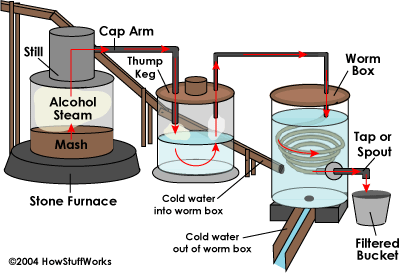
I have placed a picture of my Still at left.

I have not yet tried any fish-flavoured ethanol, and presume the appeal of it would be limited to those of a piscaphilitic nature.

Please advise where the fish should be placed, to obtain maximum flavour transfer.

Kind Regards....

__________________
"The number of inventions increases faster than the need for them at the time" - SparkY
Register to Reply Off Topic (Score 5)
Guru

Join Date: Jul 2006
Location: "Dancing over the abyss."
Posts: 4884
Good Answers: 243
#21
In reply to #20

Re: Piscatorial Advice Wanted - Thank You.

09/07/2008 9:56 PM

Into the filtered bucket and a chunk in the bottle like the worm in the tequila bottle:

You did say maximum flavor transfer...

milo

__________________
People say between two opposed opinions the truth lies in the middle. Not at all! Between them lies the problem, what is unseeable,eternally active life, contemplated in repose. Goethe
Register to Reply Off Topic (Score 5)
Participant

Join Date: Sep 2008
Posts: 1
#9

Re: Temperature Difference to kW

09/06/2008 11:44 PM

For water, the relationship between kW, flow rate (V in l/s) and temperature rise (T2-T1) is

q (kW) = 4.2 x V x (T2-T1)

and for air, where the flow rate V is in m3/s

q (kW) - 1.2 x V x (T2-T1)

I am not sure exactly what the question related to, but hopefully this will help.

Regards,

John D

Register to Reply
Power-User

Join Date: Apr 2008
Posts: 365
#11

Re: Temperature Difference to kW

09/07/2008 4:38 AM

Co2 has a rise and fall in pressure each + - 1 degee Celsius, the pressure difference each 9 bar 1 litre a second produces 720 watts, 80% efficient.

Co2 31.1 to 32.1 is 19.852 Kw. 1 litre flow per second turbine 60 RPM.

Register to Reply
Guru
Engineering Fields - Electrical Engineering - Analog and Digital Circuit Design Engineering Fields - Electromechanical Engineering - Transformers, Motors & Drives, EM Launchers Engineering Fields - Engineering Physics - Applied Electrical, Optical, and Mechanical

Join Date: Jan 2008
Location: NY
Posts: 1207
Good Answers: 119
#13

Re: Temperature Difference to kW

09/07/2008 8:11 AM

Original question lacks sufficient detail to answer. As for proposed water heating example...

1 gram H2O raised 1 deg C = 1 calorie = 4.1868 Joules = 4.1868 W-s

1 liter H2O raised 1 deg C = 1000 calories = 4186.8 Joules = 4.1868 kW-s

...please note units. :)

Register to Reply
Guru
Hobbies - HAM Radio - CE3AM....4X4SW....CE3NSW

Join Date: Aug 2006
Location: Santiago Chile.
Posts: 845
Good Answers: 7
#14

Re: Temperature Difference to kW

09/07/2008 10:19 AM
  • If my efforts to answer your question will be in direct proportion to the amount of thinking you put into your question, than my answer will look like this:

Wangito.

__________________
Never trade luck for skill.
Register to Reply
Participant

Join Date: Sep 2008
Location: Cartagena Colombia
Posts: 1
#15

Re: Temperature Difference to kW

09/07/2008 2:56 PM

Temperatura difference to Kw.

Your question is very interesting and has many ways to answer it. BTU (British Thermal Unit) is the amount of energy required to raise the temperatura of 1 pound of wáter 1 degree farenheit.

Temperature is a thermodynamic property of a substance which depends on energy content. Heat energy entering a substance will increase the temperatura of that substance.

To cause a rise in temperatura as you ask heat energy is needed. But we need to talk about what is the object that will suffer the temperatura rise, because different substances will require a different amount of energy to produce a given temperature increase.

So to heat oil 1 oF it is different to increase the same temperatura difference of water.

A very usefull formula to understand this concept is:

Q = m c ΔT whre Q is the required amount of energy to change the temperatura of an object with mass m. The units are a Little bit complicated: Btu/lbm-oR. BTU is the brittish termal unit, lbm is pound mass and oR is temperatura in Rankine degrees.

1 Kw = 3412 BTU/ hr=860421 cal/hr

Register to Reply
Power-User

Join Date: Dec 2006
Location: ON Canada
Posts: 185
Good Answers: 1
#24

Re: Temperature Difference to kW

09/11/2008 8:36 PM

Let's say heat supply is 25oz of water at 140 degree's F, per minute, and the ambient temperature is 77 degree's.

http://www.youtube.com/watch?v=uJGpbvvJA2I

assume 100% efficiency to kW

and then 15% efficiency to kW (like solar panels)

Register to Reply
Power-User

Join Date: Apr 2008
Posts: 365
#25
In reply to #24

Re: Temperature Difference to kW

09/12/2008 1:30 AM

Hello Buzneg,

Heating water is as fossil as burning Coal.

Heat 1 litre Co2 vapour to 75 degrees C and you get 10,000 bar pressure. Cool it to 31 degrees C and you get 9,9926 bar pressure. 9.926 bar working force.

I litre vapour pressures 1 litre liquid all flowing 1 litre per second 80% hydro turbine 720 watts each 9 bar pressure. 794 Kw 1 litre turbine 60 RPM

Cheers

Peter

Register to Reply
Guru

Join Date: Aug 2006
Posts: 4484
Good Answers: 246
#27
In reply to #25

Re: Temperature Difference to kW

09/12/2008 1:49 PM

Heat 1 litre Co2 vapour to 75 degrees C and you get 10,000 bar pressure.

This is nonsensical. CO2 gas follows ordinary gas laws. Thus, heating one liter of CO2 at STP would, first, not change its pressure; it would simply cause it to expand. Suppose the one liter of gas is in a closed container a 273 K. Then, the pressure would go from one bar to (75 + 273)/273 Bar: 1.27 Bar.

__________________
There is more to life than just eating mice.
Register to Reply Score 1 for Good Answer
Power-User

Join Date: Apr 2008
Posts: 365
#32
In reply to #27

Re: Temperature Difference to kW

09/13/2008 4:26 AM

Ken.

Gas web site Co2 temperature to pressure, and also Wikipedia. Critical and Supercritical Co2 pressure and temperature.

Web, Cryogenic cooling using Co2 as refrgerant 74 bar pressure 31.1 C liquid.

Supercritical Co2 vapour 75 C 10,000 bar pressure.

Co2 is known not to obey laws like other gasses do.

Cheers

Peter

Register to Reply
Guru

Join Date: Aug 2006
Posts: 4484
Good Answers: 246
#33
In reply to #32

Re: Temperature Difference to kW

09/13/2008 7:38 PM

Apparently, you misread or misinterpreted what you read. At the temperatures you quoted, CO2 acts like any other gas.

Supercritical Co2 vapour 75 C 10,000 bar pressure.

This has no meaning. It is simply words strung together. CO2 vapor at 75C does not, simply by being at 75C, have a pressure of 10,000 Bar.

__________________
There is more to life than just eating mice.
Register to Reply
Guru
Engineering Fields - Electrical Engineering - Analog and Digital Circuit Design Engineering Fields - Electromechanical Engineering - Transformers, Motors & Drives, EM Launchers Engineering Fields - Engineering Physics - Applied Electrical, Optical, and Mechanical

Join Date: Jan 2008
Location: NY
Posts: 1207
Good Answers: 119
#26
In reply to #24

Re: Temperature Difference to kW

09/12/2008 11:02 AM

Cute video with toy steam engines.

Solar flux at sea level in direct sun can be as high as 1000 Watts/square-meter.
ref "http://en.wikipedia.org/wiki/Insolation"

Direct capture to heat should be pretty efficient where conversion to electric through photovoltaics will have a much lower efficiency. This is why solar water heating for domestic hot water use can be VERY efficient in SOME areas.

The following calculations answer your specific question and confirm the approximate solar flux heating seen in the video.

25 ounces H2O/min. = 708.74 grams/min.
delta Temp. = (140 degF-77 deg F) =63 deg F = 17.222 deg C


708.74 (g / min.) x 17.222 (deg C) x 1/60 (min./sec.) = 203.43 (calories/sec.)

203.43 (calories/sec.) x 4.1868 (Joules/calorie) = 851.73 (Joules/sec.) = 851.73 (Watts)

851.73 (W) x 1/1000 (kW/W) = 0.852 (kW)


NOTE: Heat of vaporization calculation (for producing steam) requires additional terms.
:)

Register to Reply
Power-User

Join Date: Dec 2006
Location: ON Canada
Posts: 185
Good Answers: 1
#28
In reply to #26

Re: Temperature Difference to kW

09/12/2008 7:31 PM

thx. There's something funny with temper conversions though, I'm getting different delta temps by coverting the temps at different points.

140F=60C

77F=25C

140F-77F=63F=17.22C

60C-25C=35C=95F

which is it 17.22C or 35C?

I've double checked all these with an online calculator.

Register to Reply
Guru

Join Date: Jul 2007
Posts: 4448
Good Answers: 143
#29
In reply to #28

Re: Temperature Difference to kW

09/12/2008 7:52 PM

Buzneg,

You need to differentiate between degrees Fahrenheit and Fahrenheit degrees. One is a temperature (which includes a y intercept in the conversion), the other is a delta temperature. So, a temperature of 63. °F = 17. °C, but a temperature change of 63. F° = a temperature change of 35. C°.

I'm not sure this nomenclature is still legit. If not, someone will correct me. But, I've used it for decades and it works to keep the two straight.

__________________
"Well, I've wrestled with reality for 35 years, Doctor, and I'm happy to state I finally won out over it." Elwood P. Dowd
Register to Reply Score 1 for Good Answer
Guru
Engineering Fields - Electrical Engineering - Analog and Digital Circuit Design Engineering Fields - Electromechanical Engineering - Transformers, Motors & Drives, EM Launchers Engineering Fields - Engineering Physics - Applied Electrical, Optical, and Mechanical

Join Date: Jan 2008
Location: NY
Posts: 1207
Good Answers: 119
#30
In reply to #28

Re: Temperature Difference to kW

09/12/2008 11:46 PM

Sorry about that :(
CORRECTIONS for my temp conversion error:

25 ounces H2O/min. = 708.74 grams/min.
delta Temp. = (140 degF-77 deg F) = (60 degC-25 degC) = 35 deg C


708.74 (g / min.) x 35 (deg C) x 1/60 (min./sec.) = 413.43 (calories/sec.)

413.43 (calories/sec.) x 4.1868 (Joules/calorie) = 1730.9 (Joules/sec.) = 1730.9 (Watts)

1730.9 (W) x 1/1000 (kW/W) = 1.731 (kW)


NOTE1: Heat of vaporization calculation (for producing steam) requires additional terms.

NOTE2: The corrected numbers above make the video seem a little too good to be true. I'd question the numbers claimed on the video. Filling 2 small bottles with hot water did not accurately measure the input energy. It measured the heat energy stored in the pipe PLUS the input energy. Also keep in mind that ground water can be as cold as 35 degF. This is a very important factor when trying to use solar for domestic hot water needs.

Register to Reply
Guru

Join Date: Aug 2006
Posts: 4484
Good Answers: 246
#31
In reply to #30

Re: Temperature Difference to kW

09/13/2008 1:34 AM

The corrected numbers above make the video seem a little too good to be true.

It seems that way. I imagine his temperature estimate was high (150 f water would be painful to hold), and perhaps his Fresnel lens was larger than a square meter. But whatever the details, he is not too far off -- a large Fresnel lens can focus meaningful amounts of energy, although of the lens is one square meter and the location is southern California, then perhaps 1kW would be reasonable.

__________________
There is more to life than just eating mice.
Register to Reply
Power-User

Join Date: Dec 2006
Location: ON Canada
Posts: 185
Good Answers: 1
#34
In reply to #30

Re: Temperature Difference to kW

09/20/2008 6:56 PM

will the heat of vapourization have much of an effect on this number? What would be a safe number to assume? 1kW?

Register to Reply
Power-User

Join Date: Dec 2006
Location: ON Canada
Posts: 185
Good Answers: 1
#35
In reply to #34

Re: Temperature Difference to kW

09/20/2008 7:00 PM

I square meter of sunlight is guessed to be 1kW, and this lens is 0.76m square, I'm pritty sure, it says on his website.

Register to Reply
Power-User

Join Date: Dec 2006
Location: ON Canada
Posts: 185
Good Answers: 1
#37
In reply to #35

Re: Temperature Difference to kW

09/20/2008 9:33 PM

correction the fresnal in that video is 1m square, not .76

Register to Reply
Anonymous Poster
#36
In reply to #34

Re: Temperature Difference to kW

09/20/2008 8:09 PM

I would use 1000 Watts/square-meter in general calculations using IDEAL conditions. Your specific location on the planet and your local weather patterns will greatly affect this number.

ref... http://en.wikipedia.org/wiki/Heat_of_vaporization

2270 J/g (or 2270 kJ/kG ... same thing)

The calculation has 2 parts. First you need the energy to bring the water up to the boiling point, then you add the energy needed to turn the boiling water to steam.

Water Example:
Start temp 25 deg C
bring to boil at 100 deg C
dT= 75 deg C

1g x (4.1868J/g-C x 75C + 2270J/g) = 1g x (314.01J + 2270J) = 2584J

NOTE that the energy required to vaporize this quantity of water is ~7 times the energy needed to bring it to the boiling point!

Assuming that 1000 watts/square-meter of solar flux is reasonable, you could theoretically convert 1 gram (1 cc) of water to steam about every 2.6 seconds.

At that rate you would boil the kettle dry in about 45 minutes (sounds about right;-)

Register to Reply
Active Contributor
Engineering Fields - Mechanical Engineering - Hotel Maintenance Engineering Fields - Energy Engineering - New Member Hobbies - Automotive Performance - Improving MPG ?

Join Date: Mar 2009
Location: Portugal
Posts: 16
Good Answers: 2
#38

Re: Temperature Difference to kW

05/06/2009 3:18 PM

Hi all.

Let me just remind some basic concepts:

(Units in formulas are written between square brackets)

1. Temperature T is a SI base unit which represents the molecular vibration of a substance. It is related to its Internal Energy. Temperature will vary when there is a Internal Energy (Heat) exchange. The SI unit for Temperature is Kelvin (K). 1K is numerically equivalent to 1ºC, but the scale starts at different points: 0ºC=273,15K. Another unit for T is Fahrenheit.

2. kW is a unit for Power, which may be defined as the amount of Energy transfered by Time unit, P=E/t. The Watt (W) is the unit accepted by SI for Power. Another unit for P is British Thermal Unit per Hour.

[W]=[J/s]

3. The formula ΔE=m.c.ΔT relates the Internal Energy variation with the Mass, Specific Heat and Temperature Variation for a given fluid or body. Other units for E are Calorie and British Thermal Unit.

ΔE in [J]

m in [kg]

c in [J/(kg.K)]

ΔT in [K]

4. Finally, P=m.c.ΔT/t, with the units [kg.(J/kg.K).K]/[s] = [J]/[s] = [W]

For water at normal state, c≈1000 cal/(kg.K)≈4,2 kJ/(kg.K). So, to heat 1 litre≈1kg of water from 20ºC to 100 ºC in 60 seconds, we would need a power of:

P≈1*4,2*(100-20)/60≈5,6kW

Assume no thermal losses...

Hope this is of any help.

See you all soon,

RGO

International System of Units

Metric System

Imperial System

Register to Reply
Guru
United Kingdom - Member - Indeterminate Engineering Fields - Control Engineering - New Member

Join Date: Jan 2007
Location: In the bothy, 7 chains down the line from Dodman's Lane level crossing, in the nation formerly known as Great Britain. Kettle's on.
Posts: 32175
Good Answers: 839
#40

Re: Temperature Difference to kW

02/21/2024 10:55 AM

Any <...questions for combustion engineer's and therodynamic's engineers...> should be addressed, in the first instance, to the Royal Apostropher. .

__________________
"Did you get my e-mail?" - "The biggest problem in communication is the illusion that it has taken place" - George Bernard Shaw, 1856
Register to Reply
Register to Reply 40 comments

Good Answers:

These comments received enough positive votes to make them "good answers".

"Almost" Good Answers:

Check out these comments that don't yet have enough votes to be "official" good answers and, if you agree with them, vote them!
Copy to Clipboard

Users who posted comments:

Anonymous Poster (2); Blink (5); buzneg (5); CoronaCameraMan (2); DaS Energy (3); etorres (1); Gadget Guy (1); jdretired (1); JohnD (1); Milo (3); mjb1962853 (3); Orpheuse (2); PWSlack (1); RGO (1); Sparkstation (5); TVP45 (2); wangito (1); YWROADRUNNER (1)

Previous in Forum: Thermoacoustics and inlet fogging on a gas turbine   Next in Forum: Thomas Friedman on Energy

Advertisement