Previous in Forum: how to install virtual box from command line   Next in Forum: Are we loosing good members?
Close
Close
Close
17 comments
Rate Comments: Nested
Active Contributor

Join Date: Jan 2009
Location: mid atlantic usa
Posts: 11

why is co2 such a concern?

03/11/2009 8:52 AM

CO2 is plant food, is it not? Our food may be plant or animal that consumes plant, seems like the life cycle of organisms depends on CO2, so why the push to regulate and eradicate same?

Regards

__________________
God is good all the time, all the time God is good.
Register to Reply
Interested in this topic? By joining CR4 you can "subscribe" to
this discussion and receive notification when new comments are added.

Good Answers:

These comments received enough positive votes to make them "good answers".

"Almost" Good Answers:

Check out these comments that don't yet have enough votes to be "official" good answers and, if you agree with them, vote them!
Anonymous Poster
#1

Re: why is co2 such a concern?

03/11/2009 8:53 AM

New to the global warming debate, eh?

Register to Reply
Power-User

Join Date: Aug 2007
Location: United States
Posts: 169
Good Answers: 1
#2

Re: why is co2 such a concern?

03/11/2009 12:41 PM

Not enough plants to absorb CO2. If trees are planted that improve absorbsion of CO2, a possibility of producing more methane which is a worst greenhouse gas. Catch 22?

Register to Reply
Active Contributor

Join Date: Jan 2009
Location: mid atlantic usa
Posts: 11
#3

Re: why is co2 such a concern?

03/11/2009 8:30 PM

Methane is a fuel, is it not? We can convert it to generate electric power through combustion , with CO2 & H2O as byproducts.. So another set of cycles is started, one being the water cycle, the other being plant food. The two together are supplementing the food chain. With me so far? Or are the great bureaucracies of this country and planet too far above this simplification of resource allocation? Want to be less dependent on foreign oil? Capture and burn methane. This entity called Global Warming confuses my feeble mind.

__________________
God is good all the time, all the time God is good.
Register to Reply Off Topic (Score 5)
Power-User

Join Date: Aug 2007
Location: United States
Posts: 169
Good Answers: 1
#8
In reply to #3

Re: why is co2 such a concern?

03/12/2009 2:08 PM

I think some major sources of methane would be difficult to capture, such as cow farts.

Register to Reply
Guru

Join Date: Oct 2008
Posts: 42355
Good Answers: 1693
#4

Re: why is co2 such a concern?

03/11/2009 8:50 PM

Were you on the Bush "environmental" team???

Too much of a good thing can fry you.

Natural cycle, or not, too much CO2 will adversely affect us all.

Register to Reply
Active Contributor

Join Date: Jan 2009
Location: mid atlantic usa
Posts: 11
#5

Re: why is co2 such a concern?

03/11/2009 9:16 PM

since I am a newbie and cannot seem to wrap my mind around the adverse effects of "too much" CO2, I'd really appreciate some scientific qualification and quantification from any expert out there.

Thanks

__________________
God is good all the time, all the time God is good.
Register to Reply
Guru
Popular Science - Biology - life lover Hobbies - Musician - music lover Safety - Hazmat - better safe than sorry United Arab Emirates - Member - desert trek Technical Fields - Procurement - procurement

Join Date: Sep 2008
Location: Dubai, UAE
Posts: 744
Good Answers: 58
#6

Re: why is co2 such a concern?

03/12/2009 4:43 AM

for a newbie on this matter, you'll like this site.

HTH!

__________________
Now the darkness only stays the night-time, in the morning it will fade away. -- George Harrison (All Things Must Pass)
Register to Reply
Guru
Popular Science - Cosmology - New Member Technical Fields - Technical Writing - New Member Engineering Fields - Energy Engineering - New Member Engineering Fields - Electrical Engineering - New Member Engineering Fields - Control Engineering - New Member Engineering Fields - Electromechanical Engineering - Old Member, New Association

Join Date: Apr 2008
Location: Lexington, KY
Posts: 1639
Good Answers: 73
#7

Re: why is co2 such a concern?

03/12/2009 1:38 PM

Perhaps the problem is one of perspective. The co2 that traps the heat is well above the reach of any plant life. And the volume of air in between must be substantially thinned out first before the partial pressure of co2 at ground level starts to drop.

The effects we are seeing now only came about in the last 100 years. And during that 100 years the annual rate of production of co2 due to human activity has been accelerating. It is expected to continue to accelerate as the demand for machine based transportation and electricity continues to grow with population and modernization. Consequently, if we wait to react until we feel the full effect, it will be like trying to stop a freight train with your bare hands.

Those plants that we need so desperately to remove co2 may not tolerate elevated temperatures very well. Then what? And, the process of photosynthesis is fairly slow compared to the rate at which we can produce co2. Are we producing co2 faster than the existing plants can use it up? Yes, no question about that. How much can we stand before conditions really get bad? No one knows, but it will surely be a long and hard road to recovery. There may have to be some massive population reduction or extinction before significant co2 reduction can begin. That would not be my preference.

__________________
A great troubleshooting tip...."When you eliminate the impossible, whatever remains, however improbable, must be the truth." Sir Arthur Conan Doyle
Register to Reply
Anonymous Poster
#9
In reply to #7

Re: why is co2 such a concern?

03/12/2009 2:33 PM

CO2 is heavier than the major constituents of the atmosphere, N2 and O2. Why would it be at a higher altitude where plants couldn't use it? Wouldn't it tend to sink lower, or at least commingle with O2 and N2 at ground or sea-level?

Register to Reply
Power-User

Join Date: Aug 2007
Location: United States
Posts: 169
Good Answers: 1
#10
In reply to #9

Re: why is co2 such a concern?

03/12/2009 9:34 PM

It would seem with that reasoning there would not be any plant growth in the highest mountains.

Perhaps this will explain.

Register to Reply
3
Guru
Canada - Member - Toronto, Ontario (South Parkdale On The Lakeshore) Engineering Fields - Marine Engineering - Great Lakes School Of Marine Technology (Owen Sound and Port Colbourne) Technical Fields - Architecture - Private Practice 1976-1990 Technical Fields - Education - Toronto Teachers' College 1971 Technical Fields - Marketing/Advertising - Founding Member Hobbies - Hunting - Founding Member Hobbies - Target Shooting - Founding Member

Join Date: Mar 2006
Location: Toronto Ontario Canada
Posts: 1265
Good Answers: 14
#11

Re: why is co2 such a concern?

03/13/2009 7:31 AM

Hi, fisher!

You wrote, "so why the push to regulate and eradicate [Carbon dioxide (CO2)]?"

Three main reasons.

The first reason is this:

The temperature of the earth stays temperate (cool) due to its ability to reflect the sun's rays back into space.

A greenhouse is a glass house that traps the heat from the sun inside by allowing it to pour in through its glass walls, but that uses those same glass walls to reflect the heat back inside when it tries to bounce off the contents of the greenhouse (tables, plants, earth) in order to escape back out into space again. This kind of one-way trapping of the sun inside the greenhouse helps keep the greenhouse warm.

CO2 is a greenhouse gas. Its presence acts like the glass on a glass greenhouse, allowing the sun's heat through, but resisting its normal reflection back into space.

Normally, plants and other natural phenomena eat up the natural amounts of CO2 produced on the earth. If it doesn't get eaten up, it will last typically for about a year before it dissipates or gets absorbed into the earth and stops greenhousing the sun's rays.

Currently, the earth and its human inhabitants (through mainly fossil fuel emissions) are producing CO2 at a very slightly faster rate than the natural CO2-eating system of the earth can get rid of it. It's sort of like a strong stream of water running into a bathtub with a slightly smaller drain than the size of the stream. The more sunshine that can't be reflected back into space after pouring in through the CO2, the warmer the earth's atmosphere gets. We call this "the greenhouse effect".

Although the burning of fossil fuels contributes something less than 3% of the naturally occurring additional CO2 to the atmosphere, something that geological physicists, climatologists and meteorologists deem nothing more than "noise" in the overall increases of CO2 from natural causes due to (in reverse, kind of) the natural warming of the planet at this time in history, nobody disputes that the rate of rise in temperature is more rapid than all the times it has happened before; and there is a widely accepted theory that the additional greenhouse gases produced by our burning of fossil fuels may be accelerating it, even if they are not directly causing it. It is causing our weather to change dramatically because our ice caps are melting and the warmer air in moist climates over the ocean produces more violent weather. We call this effect of changing weather "climate change".

Three ways of getting rid of the temperature problems caused by the greenhouse gases, of which CO2 is a major player (methane is another one), are to increase the amount of plankton in the oceans, reduce the amount of human-caused CO2 creation by 80%; and/or to artificially cool the surface of the earth for a year or more by shading it from the sun to a comfortable, but cool, temperature using very small amounts of reflective material. It's estimated that one kilogram of, for example, finely ground white or yellow material released into the stratosphere and allowed to spread by wind could harmlessly reduce the amount of CO2 temperature-raising capability equal to 80 tonnes of CO2 just by reflecting the sun's newest heat supply back into space artificially. Some scientists have proposed sulphur for this purpose; but that's a very bad idea because sulphur mixes in the moist air to become sulphuric acid and acid rain, which kills anything it falls on.

It's late, and I'm too tired to write about the other two consequences of increased CO2 in the atmosphere. I'm going to bed. Meanwhile, you have one of the major controversies around CO2 to think about. Stay tuned.

Mark

Register to Reply Good Answer (Score 3)
2
Guru
Hobbies - DIY Welding - New Member

Join Date: Oct 2008
Location: Cairns, Qld, Australia
Posts: 968
Good Answers: 65
#15
In reply to #11

Re: why is co2 such a concern?

03/29/2009 8:49 AM

Hi MarkTheHandyman:

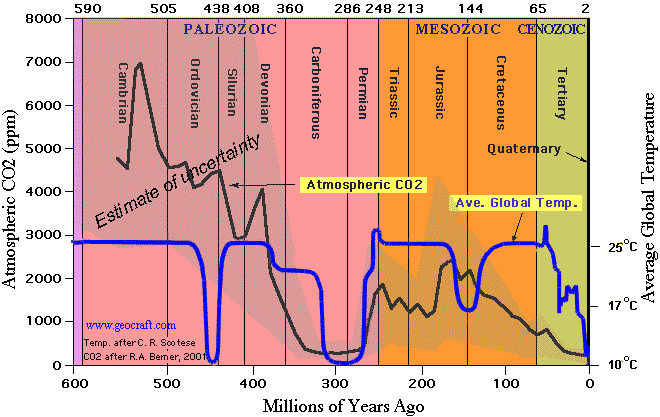
If CO2 is such a good greenhouse gas (it's actually a pretty lousy one), perhaps you can explain some of the features of the graph below.

Note that in the Cambrian, CO2 rises from 5,000 ppm (over 10x present) to about 7,000 ppm. During this time, temperature stays constant.

In the Ordovician, CO2 falls but not much while temperature is firstly static and then falls.

And so it goes on with little linkage between CO2 and temp.

The Carboniferous is the only age in which CO2 is lower than now. In all other ages it is higher than now.

Geologically, our current temperature is about the lowest ever.

Suddenly, we get a scare about rising CO2 and temperature. Apparently the physics of atmospheric science has changed since those times.

If you look more closely at more modern temperatures and historical evidence we find the medieval warm period when grain was grown in Greenland, vineyards operated in Southern Scotland and Newfoundland was called "Vinland" because of the native grapes which grew there.

Computer models either deny this period existed or put it as fairly small, yet history shows us it had to be warmer than now, without anthropogenic effects to blame for it. (Incidently there is evidence that about the same time warmer than "normal" conditions also existed in Sinjiang in the (present) Takla Makan desert.)

Anthropogenic global warming exists in computer models and projections, none of which satisfactorily fit the known historical evidence.

Coming more recently, there was a warm period in the 1930's which was similar to now and the temperature rose ahead of the CO2 rise, whereas previously it was lagging it.

Much of the historical evidence for CO2 levels comes from ice cores. If an ice core is opened without being kept under pressure (and most of them are), CO2 escapes from the gas bubbles in the ice (it was held under pressure there until the examination was commenced) and an erroneously low reading is obtained for CO2. Ice cores tested under pressure, showed CO2 in the 1700's as around 350ppm (I can't find the reference at the moment but will post it when I do. The writer was a Polish expert in ice cores). This is similar to the levels causing concern now and yet temp was slowly rising from a mini ice age.

I could go on, but as far as I can see, the evidence for anthropogenic global warming is weak and only holds if you are selective as to which evidence you quote.

I fully expect that within 20 years we will be concerned about the imminent ice age!

Global Temperature and Atmospheric CO2 over Geologic Time

Late Carboniferous to Early Permian time (315 mya -- 270 mya) is the only time period in the last 600 million years when both atmospheric CO2 and temperatures were as low as they are today (Quaternary Period ).

Register to Reply Good Answer (Score 2)
Power-User

Join Date: Aug 2007
Location: United States
Posts: 169
Good Answers: 1
#16
In reply to #15

Re: why is co2 such a concern?

03/29/2009 9:03 AM

Did you want to live like dinosaurs? If oceans covered much of the earth who cared at the time. It is not what about happened in the past, any global warming would be about our future. The earth would survive and probably other species as well. Something as cyclical as an ice age would make it extremely difficult for northern societies and put enormous requirements on resources. There are too many humans now just to relocate. Technology would not have been developed to save us, because once again we are making our survival political.

Register to Reply
2
Guru
Hobbies - DIY Welding - New Member

Join Date: Oct 2008
Location: Cairns, Qld, Australia
Posts: 968
Good Answers: 65
#17
In reply to #16

Re: why is co2 such a concern?

03/30/2009 5:02 AM

Hi vrbarnett:

My point was that the anthropogenic warming fraternity must account for these anomalies before their models can be believed.

It is obvious from history (both geological and written) that what is occurring now is not unusual, so why the concern?

If it is not unusual, where is the evidence that it is anthropogenic?

If climate models cannot account for these past events, why do we have such confidence in extrapolations based on them?

Register to Reply Good Answer (Score 2)
Guru
Canada - Member - Toronto, Ontario (South Parkdale On The Lakeshore) Engineering Fields - Marine Engineering - Great Lakes School Of Marine Technology (Owen Sound and Port Colbourne) Technical Fields - Architecture - Private Practice 1976-1990 Technical Fields - Education - Toronto Teachers' College 1971 Technical Fields - Marketing/Advertising - Founding Member Hobbies - Hunting - Founding Member Hobbies - Target Shooting - Founding Member

Join Date: Mar 2006
Location: Toronto Ontario Canada
Posts: 1265
Good Answers: 14
#12

Re: why is co2 such a concern?

03/13/2009 8:47 PM

Hi, fisher!

re your question, "why the push to regulate and eradicate [CO2]?

Here's reason two for concerns surrounding over-production of CO2 inside the earth's atmosphere.

It turns out that some of the excess CO2 that doesn't get eaten up by the natural CO2 consumers in the biosphere mixes with seawater to produce Carbonic Acid (H2CO3) and a chemical called Carbonate (CO3).

50% of the uneaten amount of the 3% of the earth's current excess CO2 ...produced in a very small way by burning of fossil fuels... is reported to have become dissolved in the oceans over a surprising number of years of recent human history.

This leads us to think that the human-produced excess CO2 is more attracted to ocean-mixing than normally produced excess CO2.

The additional amount of CO3 (carbonate) now in the oceans makes them less able to absorb the extra CO3 that used to be contributed by limestone (CaCO3) areas on the ocean floor here and there around the world. The additional CO3 also means super-saturation of that chemical by the oceans...in some areas, they can't absorb any more.

At the same time, the H2CO3 (carbonic acid) lowers the PH of the oceans in general, which means oceans are becoming more acidic.

Wikipedia explains this in more detail (although it's not necessary to know the details, just the results):

"When CO2 dissolves, it reacts with water to form a balance of ionic and non-ionic chemical species : dissolved free carbon dioxide (CO2 (aq)), carbonic acid (H2CO3), bicarbonate (HCO3-) and carbonate (CO32-). The ratio of these species depends on factors such as seawater temperature and alkalinity (see the article on the ocean's solubility pump for more detail)."

As you may well imagine, it's not possible to lower the amount of alkalinity (or raise the amount of acidity, depending upon which way you look at it) of the oceans without having some sort of effect on sea life.

We already know from experience that fly ash [sulphur-containing air pollution --from high smoke stacks-- mixes with rain and becomes sulphuric acid,] and the resulting "acid rain" has caused thousands of entire freshwater lakes in North America and elsewhere to have no (zero, none!) fish life any more because the fish were not able to live in the higher acid environment; as well as burning the foliage off millions of trees throughout North America.

Raising the acidity in the oceans is having two negative effects.

The most noticeable is that it becomes more difficult for shellfish to make and keep their shells, which suffer a little when the amount of carbonate rises in seawater.

The second is that the amount of available oxygen for the fish to breathe is lessened. There are already "dead zones" in the ocean where fish refuse to live because the available oxygen is too low to sustain them. And when you think about the possibility that we might have something to do with them, mankind-caused dead zones in the oceans is a very scary thing.

Our oceans are under attack in a variety of ways already. Over-fishing has depleted some fish stocks to the point where they are off-limits for fishermen until they can bounce back, and perhaps also "IF" they are able to bounce back. Bottom dragging is a variety of fishing characterized by dragging fish nets across the bottom of the ocean to catch more fish; and is messing up the life-sustaining eco systems along the ocean's bottom and killing other species that can't be used for food but get caught by the nets anyway.

Several species of animals, birds, and fish, etc. that are ocean-aquatic dwellers have been doomed to extinction by these attacks. Even knowing this, several countries still have fishermen who follow these damaging fishing practices because there are too many mouths to feed with a very small agricultural production capability at home and a tradition of living off the sea.

This is putting the oceans under attack as well; and marine biologists, oceanographers, and food economists and ecologists around the world warn that with the extinction of ocean species due to carbonic acidification of the oceans, human extinction may follow rapidly.

That's another good reason to be concerned about the excess production of CO2, don't you think?

The third reason will follow soon. (Or, just tell me you can't take any more, and I'll stop! )

Mark

Register to Reply Score 1 for Good Answer
Power-User
Australia - Member - New Member Hobbies - Target Shooting - New Member Popular Science - Weaponology - New Member

Join Date: Dec 2007
Location: Sydney Australia
Posts: 480
Good Answers: 35
#13

Re: why is co2 such a concern?

03/14/2009 11:16 PM

Fisher,

It's not just about the CO2, there are many other gases released by our industrial processes that harm the atmosphere and the environment.

All these gases have been given a CO2 equivelant to make it easier for people to get thier heads around the problem.

From memory, for some of the CFC's, 1 tonne of CFC = 22 tonnes of CO2 = 20 Cars

Trees wont help with some of the gases.

Regards,
Sapper

__________________
It's all about the Boom! - MythBusters
Register to Reply
Active Contributor

Join Date: Jan 2009
Location: mid atlantic usa
Posts: 11
#14

Re: why is co2 such a concern?
03/26/2009 8:13 AM

I thank all of you for your contributions to the discussion on this hot topic.

Sincerely

Dan

__________________
God is good all the time, all the time God is good.
Register to Reply
Register to Reply 17 comments

Good Answers:

These comments received enough positive votes to make them "good answers".

"Almost" Good Answers:

Check out these comments that don't yet have enough votes to be "official" good answers and, if you agree with them, vote them!
Copy to Clipboard

Users who posted comments:

Anonymous Poster (2); fisher (3); langyaw (1); lyn (1); MarkTheHandyman (2); NotUrOrdinaryJoe (1); Sapper (1); sceptic (2); vrbarnett (4)

Previous in Forum: how to install virtual box from command line   Next in Forum: Are we loosing good members?

Advertisement