Previous in Forum: Why Are People Like This?   Next in Forum: vegetable wastes
Close
Close
Close
Page 1 of 2: « First 1 2 Next > Last »
Rate Comments: Nested
The Engineer
Engineering Fields - Engineering Physics - Physics... United States - Member - NY Popular Science - Genetics - Organic Chemistry... Popular Science - Cosmology - New Member Ingeniería en Español - Nuevo Miembro - New Member

Join Date: Feb 2005
Location: Albany, New York
Posts: 5060
Good Answers: 129

Arctic Sea Ice May Be Gone in 30 Years

04/03/2009 10:46 AM

Here's the story:

WASHINGTON – Arctic sea ice is melting so fast most of it could be gone in 30 years. A new analysis of changing conditions in the region, using complex computer models of weather and climate, says conditions that had been forecast by the end of the century could occur much sooner.

A change in the amount of ice is important because the white surface reflects sunlight back into space. When ice is replaced by dark ocean water that sunlight can be absorbed, warming the water and increasing the warming of the planet.

The finding adds to concern about climate change caused by human activities such as burning fossil fuels, a problem that has begun receiving more attention in the Obama administration and is part of the G20 discussions under way in London.

"Due to the recent loss of sea ice, the 2005-2008 autumn central Arctic surface air temperatures were greater than 5 degrees Celsius (9 degrees Fahrenheit) above" what would be expected, the new study reports.

That amount of temperature increase had been expected by the year 2070.

The new report by Muyin Wang of the Joint Institute for the Study of Atmosphere and Ocean and James E. Overland of the National Oceanic and Atmospheric Administration's Pacific Marine Environmental Laboratory, appears in Friday's edition of the journal Geophysical Research Letters.

Article Found here

Register to Reply
Interested in this topic? By joining CR4 you can "subscribe" to
this discussion and receive notification when new comments are added.

Good Answers:

These comments received enough positive votes to make them "good answers".

"Almost" Good Answers:

Check out these comments that don't yet have enough votes to be "official" good answers and, if you agree with them, vote them!
Anonymous Poster
#1

Re: Arctic Sea Ice May Be Gone in 30 Years

04/03/2009 1:38 PM

Aaaaaand cue the throngs of negative responses comprised from some combination of:

  • it's because the sun is getting warmer.
  • the Earth has been hotter before.
  • the climate models are all wrong.
  • but this winter it was colder and/or there was more snow in (insert town here).
  • Al Gore is elitist and also he's fat and he drives a big airplane and he's gay.
  • you just want to destroy America.
Register to Reply
Guru
Engineering Fields - Systems Engineering - New Member Popular Science - Weaponology - New Member

Join Date: Jun 2006
Location: Borrego Springs
Posts: 2636
Good Answers: 62
#2
In reply to #1

Re: Arctic Sea Ice May Be Gone in 30 Years

04/03/2009 5:10 PM

Are we developing a reputation?

Actually after a couple of the resources posted in discussions, I was ready to start a thread on what to do rather than whether...whatever.

I suppose part of it is bowing to the inevitable, since clearly something is going to be done, I'd just as soon contribute to it being targeted, reasonable, and effective.

But part of it is due to the science filling in some of the voids. The argument is now better backed by facts.

So chalk up one victory.

But some of the things suggested are still silly.

And some of the things suggested are *feel goods* that are not even designed to address the problem.

But Al Gore is still a ponce

__________________
"If you want to get somewhere else, you must run at least twice as fast as that!"
Register to Reply Off Topic (Score 5)
The Engineer
Engineering Fields - Engineering Physics - Physics... United States - Member - NY Popular Science - Genetics - Organic Chemistry... Popular Science - Cosmology - New Member Ingeniería en Español - Nuevo Miembro - New Member

Join Date: Feb 2005
Location: Albany, New York
Posts: 5060
Good Answers: 129
#3
In reply to #2

Re: Arctic Sea Ice May Be Gone in 30 Years

04/03/2009 5:55 PM

Al Gore is a good guy who worked tirelessly for 25 years to raise awareness on Global Climate change, he's no ponce.

Besides that, I agree with everything else you said. We do need to have a discussion about how to tackle this problem and I agree that many of the suggested "solutions" are "feel goods" that solve little (I'm talking about cap and trade and ethanol here especially).

You know, it was T. Boone Pickens (who is a ponce), who should be credited with raising awareness of one of the more practical solutions being implemented now, which is a modernization of the national power grid. That modernization opens the door for more efficient energy sharing which can greatly reduce CO2 emissions.

Register to Reply Off Topic (Score 5)
Anonymous Poster
#4
In reply to #3

Re: Arctic Sea Ice May Be Gone in 30 Years

04/03/2009 7:29 PM

Funny thing - Pickens is a businessman and Gore is a politician. Advances the argument that solutions to the "crisis" should come from the private sector, not the government.

Register to Reply Off Topic (Score 5)
Guru
Engineering Fields - Systems Engineering - New Member Popular Science - Weaponology - New Member

Join Date: Jun 2006
Location: Borrego Springs
Posts: 2636
Good Answers: 62
#5
In reply to #3

Re: Arctic Sea Ice May Be Gone in 30 Years

04/03/2009 8:50 PM

Roger, I like ya enough that our different taste in ponce designation won't ruffle my opinion.

And I doubt Al and Pickens give a hoot for our respective opinions.

__________________
"If you want to get somewhere else, you must run at least twice as fast as that!"
Register to Reply Off Topic (Score 5)
The Engineer
Engineering Fields - Engineering Physics - Physics... United States - Member - NY Popular Science - Genetics - Organic Chemistry... Popular Science - Cosmology - New Member Ingeniería en Español - Nuevo Miembro - New Member

Join Date: Feb 2005
Location: Albany, New York
Posts: 5060
Good Answers: 129
#16
In reply to #5

Re: Arctic Sea Ice May Be Gone in 30 Years

04/04/2009 12:05 PM

Agreed.

Register to Reply Off Topic (Score 5)
Guru

Join Date: Oct 2007
Location: Transcendia
Posts: 2963
Good Answers: 93
#6

Re: Arctic Sea Ice May Be Gone in 30 Years

04/03/2009 9:32 PM

Al Gore, retired and made a movie. Bush is writing a book.

Obama is working on getting rid of atomic bombs.

The Vatican is about to announce that they have initiated a space program to colonize and terraform Mars and Venus, so no one will ever feel compelled to use a condom, for anything other than keeping sand out of their rifle barrel.

It is predicted that though the climate has gotten progressively hotter due to human activity, we are in for all, to stay about the same as it has become, due to a real cycle.

If Volcanos go off real big, and Solar Cycle output is low here for a bit, we will have about what we have reliably for the next 5 to 7 years, according to my reads.

(I was kidding about the Vatican.)

No point.

Just a climate weather report 5 to 7 year prediction, with no volcanic or nuclear winter skews, not possible to reliably predict.

__________________
You don't get wise because you got old, you get old because you were wise.
Register to Reply
Guru
Canada - Member - If there is a way to screw someting up, there is someone to do so! Safety - Hazmat - New Member

Join Date: Mar 2007
Location: Iqaluit, NU. Canada
Posts: 1854
Good Answers: 140
#7

Re: Arctic Sea Ice May Be Gone in 30 Years

04/03/2009 9:42 PM

Well... all I can say, from one who lives in the Arctic, yup! Its melting all right. Why is it melting? There are many theories and supposed reasons as to why. What we need to do is actually answer the "why" and we need to answer it real soon.

Oh... it sure is not gonna take 30 years either!

Here is what happens when we get late ice off of the Greenland sheet.

http://outdoors.webshots.com/album/568881014bQIFTk

__________________
Joe Contractor to Electrical Inspector, "What do you mean you are going to make me follow the code?".
Register to Reply
Anonymous Poster
#8

Re: Arctic Sea Ice May Be Gone in 30 Years

04/03/2009 11:43 PM

it may double in 30 years as fae as we know.

Register to Reply Score 2 for Off Topic
Power-User

Join Date: Nov 2006
Location: San Francisco Bay area
Posts: 212
Good Answers: 15
#9

Re: Arctic Sea Ice May Be Gone in 30 Years

04/03/2009 11:51 PM

Hello,

There is a fabulous documentary which I saw on Public TV during the week called "Extreme Ice". If anybody had a doubt as to the validity of Al Gore's movie , they should see this documentary.

The photography is stunning as is the story of the reality of ice depletion at the poles.

Regards.

__________________
I like 2 tinker-no, really!
Register to Reply
Power-User

Join Date: Jan 2007
Location: Knoxville, Tn
Posts: 141
Good Answers: 3
#10

Re: Arctic Sea Ice May Be Gone in 30 Years

04/04/2009 12:19 AM

The unexpected huge release of methane from below the ice is accelerating the warming. A two to three degree average increase globally is all it takes.

__________________
Analogies are like something else.
Register to Reply
Guru
Popular Science - Weaponology - bwire Hobbies - Car Customizing - New Member

Join Date: Dec 2007
Location: Upper Mid-west USA
Posts: 7498
Good Answers: 97
#11

Re: Arctic Sea Ice May Be Gone in 30 Years

04/04/2009 1:56 AM

I'm amazed that I have a great seat for the show

__________________
If death came with a warning there would be a whole lot less of it.
Register to Reply Off Topic (Score 5)
Guru
Hobbies - Model Rocketry - New Member

Join Date: Jun 2007
Location: East of Seattle, Washington state Republic of the 50 states of America
Posts: 2045
Good Answers: 36
#12
In reply to #11

Re: Arctic Sea Ice May Be Gone in 30 Years

04/04/2009 2:46 AM

To bad the solar minimum is so low for a while we could watch it under the northern lights. http://science.nasa.gov/headlines/y2009/01apr_deepsolarminimum.htm?list1282116

Planting this year is even later than last years do to a very late spring. Suppose to freeze again to night. Snowing in all the mountains here. Going to need a late fall just to get the long warmth crops to mature. We barely made it last year. It may be warming everywhere else but we are cooling here for now.

__________________
(Larrabee's Law) Half of everything you hear in a classroom is crap. Education is figuring out which half is which.
Register to Reply Off Topic (Score 5)
The Engineer
Engineering Fields - Engineering Physics - Physics... United States - Member - NY Popular Science - Genetics - Organic Chemistry... Popular Science - Cosmology - New Member Ingeniería en Español - Nuevo Miembro - New Member

Join Date: Feb 2005
Location: Albany, New York
Posts: 5060
Good Answers: 129
#19
In reply to #12

Re: Arctic Sea Ice May Be Gone in 30 Years

04/04/2009 12:14 PM

People were wearing shorts in Albany in March this year and it's hit 60 within the two weeks after christmas three years in a row. Unless you're from Albany, there's no way you could know how crazy that is. The U.S. and Canadian climate is changing significantly because of the melting arctic cap. It strongly effects the seasonal patterns of the jet stream. For Albany it means much milder winters on average. I don't know what it means for Washington.

http://www.ciw.edu/news/changing_jet_streams_may_alter_paths_storms_and_hurricanes

Register to Reply Off Topic (Score 5)
Power-User

Join Date: Sep 2006
Location: Houston Texas
Posts: 282
Good Answers: 16
#24
In reply to #19

Re: Arctic Sea Ice May Be Gone in 30 Years

04/04/2009 12:21 PM

And aren't they forecasting snow in Albany for tomorrow? Is that normal?

__________________
Specializing in Dynamic Weighing Systems for Powder and Bulk Solids Handling
Register to Reply Off Topic (Score 5)
The Engineer
Engineering Fields - Engineering Physics - Physics... United States - Member - NY Popular Science - Genetics - Organic Chemistry... Popular Science - Cosmology - New Member Ingeniería en Español - Nuevo Miembro - New Member

Join Date: Feb 2005
Location: Albany, New York
Posts: 5060
Good Answers: 129
#30
In reply to #24

Re: Arctic Sea Ice May Be Gone in 30 Years

04/04/2009 12:41 PM

Yes actually. It normally snows, sometimes as late as May. Albany is a cold, cold place. At least it used to be.

Register to Reply Off Topic (Score 5)
Guru
Hobbies - Model Rocketry - New Member

Join Date: Jun 2007
Location: East of Seattle, Washington state Republic of the 50 states of America
Posts: 2045
Good Answers: 36
#38
In reply to #19

Re: Arctic Sea Ice May Be Gone in 30 Years

04/04/2009 4:05 PM

I don't know what it means for Washington.

So far the last 2 years are about 5 to 100 F cooler year round in Eastern Washington. Last summer was very mild and December was record cold and snow. The grape harvest was almost too late. Heavy snows both winters and spring is weeks late again and looks like we will now have instant late spring heat.

Normally we are the warmest area of Washington but the last few months we have had more Coastal type weather. Today is sunny and in the sixties last week overcast in in the forties for a high.

Brad

__________________
(Larrabee's Law) Half of everything you hear in a classroom is crap. Education is figuring out which half is which.
Register to Reply Off Topic (Score 5)
Guru
Popular Science - Weaponology - bwire Hobbies - Car Customizing - New Member

Join Date: Dec 2007
Location: Upper Mid-west USA
Posts: 7498
Good Answers: 97
#40
In reply to #12

Re: Arctic Sea Ice May Be Gone in 30 Years

04/04/2009 4:27 PM

The quintesimal assumption is a juxtaposition of striation I suppose

__________________
If death came with a warning there would be a whole lot less of it.
Register to Reply Off Topic (Score 5)
2
Guru
Canada - Member - Specialized in power electronics

Join Date: Feb 2008
Location: Montreal, Canada.
Posts: 1372
Good Answers: 80
#13

Re: Arctic Sea Ice May Be Gone in 30 Years

04/04/2009 10:06 AM

1- On the mitigation side.

Technologies to economically transform CO2 into useful material are being developed. This is much more promising than stocking it under ground. So, within a few years the industrial CO2 "problem" will be solved in the western world.

Is Chindia going to reduce its emission? No, unless we develop a technology that makes it advantageous to do so. Once again, don't expect politicians and environmentalists to solve the problem. It is up to us engineers. Develop a viable technology and the problem will be solved.

As for cars emissions, the higher cost of oil and the tighter credit will make people switch to more efficient vehicles and will help make the alternative energies viable over the next 10-20 years.

Now what is next? Other gas have a worst effect than CO2. Their volume is lower than CO@ and they are often produced in nature. One has to look at concentrated sources to eliminate them. But this is a minor effect in the overall scheme.

2- Facing the music.

Even if we eliminate the human sources of CO2 and other gas, it seems that the climate is going to change. This is a natural process. Whether human have an effect on it or not. I will let other people play the blame game.

Most engineers are problem solvers. Undertaking the challenges posed by different climates on the planet has been our task for thousand of years. This is not different.

We will continue to experience water distribution and shortage problems.

The building codes will need to be upgrades to reduce energy consumption and provide better protections from the elements.

Roads and other transportation systems will need to be updated.

Food production will also need to be adapted.

Basically, business as usual for Mr. Engineer, but on an accelerated pace.

Are you up to it?

__________________
Experienced is earned, common sense is taught, both are rare essentials of life.
Register to Reply Good Answer (Score 2)
Guru
Canada - Member - Specialized in power electronics

Join Date: Feb 2008
Location: Montreal, Canada.
Posts: 1372
Good Answers: 80
#27
In reply to #13

Re: Arctic Sea Ice May Be Gone in 30 Years

04/04/2009 12:29 PM

Another factor that is also coupled to climate change, is the destruction of forests all over the world. The Amazon forest comes to mind but it is not the least.

Each time we dry a marsh land, clear cut a forest to harvest the wood or to build a housing development, we are affecting the climate.

Forest and wetlands are sponges that regulate the water. They reduce flooding and regulate the temperature by releasing water vapors. We are reducing this capacity on a daily basis in North America as well as in the rest of the world. We are all guilty of that one and it has a real impact! Maybe more significant than the CO2.

We need to promote wood fiber recycling and tree planting. This is a direct action that everyones can do with better results than changing the light bulbs from incandescent to neon... It will also save the habitats for a large number of creatures. Be nice to Nature and Nature will be nice to you.

Save trees to save the world.

__________________
Experienced is earned, common sense is taught, both are rare essentials of life.
Register to Reply
Power-User

Join Date: Sep 2006
Location: Houston Texas
Posts: 282
Good Answers: 16
#14

Re: Arctic Sea Ice May Be Gone in 30 Years

04/04/2009 11:30 AM

History dictates that the last glacial period ended more than 8,000 years ago. Since that time the ice has been continually receding. Please someone explain to me how mankind caused that to happen.

All living beings will have to continually adapt to the present climate, from the dinosaurs to modern day man, regardless of what the climate will be.

__________________
Specializing in Dynamic Weighing Systems for Powder and Bulk Solids Handling
Register to Reply
Guru
Engineering Fields - Retired Engineers / Mentors - New Member

Join Date: Dec 2006
Location: Brecksville, OH
Posts: 1621
Good Answers: 18
#15

Re: Arctic Sea Ice May Be Gone in 30 Years

04/04/2009 11:38 AM

A recent byline about research into the major factor impacting ocean temperatures (and hence the largest impact on ice melt in the Arctic) is a reduction in dust; a suggestion was that increased dust reduces ocean temperatures. If that is the case, then particulate matter increases from pollution may be a good thing.

I'm not taking any sides on this issue, but maybe, just maybe, we as scientists need to really research (with firm uncontested data) what is happening on the planet that truly impacts Global Warming, before we go off "half-cocked" to change our planet acting as if the sky were falling.

__________________
"Consensus Science got us into this mess, then why can't it get us out?" : Rephrase of Will Rogers Comment
Register to Reply
Anonymous Poster
#17

Re: Arctic Sea Ice May Be Gone in 30 Years

04/04/2009 12:08 PM

and your point is what exactly? This is just another "the world is doomed" thread by roger pink.

Register to Reply
The Engineer
Engineering Fields - Engineering Physics - Physics... United States - Member - NY Popular Science - Genetics - Organic Chemistry... Popular Science - Cosmology - New Member Ingeniería en Español - Nuevo Miembro - New Member

Join Date: Feb 2005
Location: Albany, New York
Posts: 5060
Good Answers: 129
#21
In reply to #17

Re: Arctic Sea Ice May Be Gone in 30 Years

04/04/2009 12:16 PM

I never say the world is doomed. I say that the first step to fixing a problem is to admit we have one. Then debate a solution. Instead, we stick to denial because it's easier.

Also, I didn't write the article.

Register to Reply Score 1 for Good Answer
Anonymous Poster
#35
In reply to #21

Re: Arctic Sea Ice May Be Gone in 30 Years

04/04/2009 2:52 PM

Then debate a solution - The last time you started a debate you quickly showed your true side by lashing out and insulting people who disagreed with you. You do seem to have this issue as a your pet. Show the facts and then base your argument on this instead of hearsay and rumour.

Register to Reply Score 1 for Off Topic
The Engineer
Engineering Fields - Engineering Physics - Physics... United States - Member - NY Popular Science - Genetics - Organic Chemistry... Popular Science - Cosmology - New Member Ingeniería en Español - Nuevo Miembro - New Member

Join Date: Feb 2005
Location: Albany, New York
Posts: 5060
Good Answers: 129
#41
In reply to #35

Re: Arctic Sea Ice May Be Gone in 30 Years

04/04/2009 10:42 PM

That thread, which I posted, was a debate as to whether confrontation, ignoring, or dispelling made up facts point by point is a better approach when addressing issues where there is a scientific consensus but still the misconception of a debate.

I was arguing that confrontation was the best course as an infinite number of made up facts can be constructed and refuting them are unrealistic. I also was arguing that ignoring the problem by not engaging leads creates a vacuum that is filled with psuedo science. In the end the confrontation method didn't work either. You all simply reaffirmed each other and I had little backup from the silent majority.

So now I'm trying a different approach. I won't confront, I'll engage some and not others.

As for showing facts instead of hearsay, that's sort of tough to do to your standards when you consider NASA, APS, and the UN as politically biased and unreliable.

Register to Reply
Guru
Hobbies - Model Rocketry - New Member

Join Date: Jun 2007
Location: East of Seattle, Washington state Republic of the 50 states of America
Posts: 2045
Good Answers: 36
#42
In reply to #41

Re: Arctic Sea Ice May Be Gone in 30 Years

04/04/2009 11:56 PM

Here is some help with the facts of Wang and Overlands report,

"After paring their suite of 23 climate models down to the best half-dozen, two researchers now say with new confidence that summer ice will most likely disappear around 2037. But none of the select models predicts a tipping point--a sudden jump to an ice-free summer Arctic"...

"The new model study recognizes that not all climate models are created equal. For the 2007 Intergovernmental Panel on Climate Change (IPCC) assessment, modelers around the world ran 23 different climate models with and without rising greenhouse gases. The fate they predicted for arctic ice ranged from complete loss in the summer by 2020 to only slight losses by 2100, and almost everywhere in between."...

"To further narrow the possible outcomes, arctic researchers Muyin Wang of the University of Washington, Seattle, and James Overland of the Pacific Marine Environmental Laboratory in Seattle added another constraint: Usable models must reasonably reproduce the ups and downs of sea ice area from summer to winter and back. As they report in a paper in press at Geophysical Research Letters, that shortened the list to six models. "That's a very important improvement," says Wang, because those models should have the most realistic response to the rising heating by the strengthening greenhouse.

Wang and Overland then examined each simulation to see how many years it took summer sea ice to dwindle from its current 4.6 million square kilometers to an essentially ice-free summer Arctic Ocean. The "expected time frame" for ice-free summers is about 30 years. Ice-free conditions aren't likely before the late 2020s,..."

Here is but one link of many

The above is the relevant parts from Science News but you must be a subscriber to read the original articles in whole.

IN ACCORDANCE WITH TITLE 17 U.S.C. SECTION 107, THIS MATERIAL IS DISTRIBUTED WITHOUT PROFIT TO THOSE WHO HAVE EXPRESSED A PRIOR INTEREST IN RECEIVING THE INCLUDED INFORMATION FOR RESEARCH AND EDUCATIONAL PURPOSES.

Brad

__________________
(Larrabee's Law) Half of everything you hear in a classroom is crap. Education is figuring out which half is which.
Register to Reply Score 1 for Good Answer
Anonymous Poster
#43
In reply to #41

Re: Arctic Sea Ice May Be Gone in 30 Years

04/05/2009 1:35 AM

I had little backup from the silent majority. - maybe because there was no silent majority just a vocal majority that actually disagree with your view and more importantly your approach. Had everyone agreed with you, would you then have claimed that the silent majority were in disagreement? I think not. We can all claim the silent majority vote because, just like your "facts", it is open to interpretation.

I'll engage some and not others - so you are taking on the approach of ignoring those with a different viewpoint. How exactly will that achieve anything, you maybe better off standing in front of the mirror and talking to your self.

Register to Reply
The Engineer
Engineering Fields - Engineering Physics - Physics... United States - Member - NY Popular Science - Genetics - Organic Chemistry... Popular Science - Cosmology - New Member Ingeniería en Español - Nuevo Miembro - New Member

Join Date: Feb 2005
Location: Albany, New York
Posts: 5060
Good Answers: 129
#44
In reply to #43

Re: Arctic Sea Ice May Be Gone in 30 Years

04/05/2009 10:07 AM

Its kind of hard to take a lecture from a "guest" seriously. At least I make myself accountable for my statements by signing in. It's easy to be brave when your anonymous.

But to answer your question on viewpoints, I don't agree that all viewpoints are valid and should be considered. If someone started a post tomorrow that there was no gravity, or that the sun would rise in the west, I don't think I'm obligated to "hear them out", post after post.

Now you may feel those are ridiculous examples, but after years and years of study, some things that you may find debatable or in dispute, are equally obvious me because of my understanding of statistics, or game theory, or fundamental physics, or applied quantum mechanics, or thermodynamics, etc.

I'll hear the argument that scientists are biased or lost perspective. I suppose that is a much easier argument than actually doing all the work required to engage them. As for having to talk into a mirror, it won't be necessary, there are plenty of reasonable users here to engage with.

Register to Reply
Anonymous Poster
#45
In reply to #44

Re: Arctic Sea Ice May Be Gone in 30 Years

04/05/2009 10:48 AM

So in addition to "the planet being doomed" your other favourite pass time is writing "seriously" . So if you write "seriously", we should all sit back and be lectured to by an arrogant self opinionated pessimist.

As was said in a previous post "You can't hide the truth just by saying "Seriously?"."

Register to Reply
Guru
Hobbies - Model Rocketry - New Member

Join Date: Jun 2007
Location: East of Seattle, Washington state Republic of the 50 states of America
Posts: 2045
Good Answers: 36
#46
In reply to #45

Re: Arctic Sea Ice May Be Gone in 30 Years

04/05/2009 11:33 AM

But seriously you come off like an officer hiding behind the badge of guest. I do hope I'm responding to the same guest.

Yes it is obvious Roger has a conviction (not a criminal one or a crime) and we debate the cause and effect of global warming. He is improving his tact so you berate him? Odd way to show positive feedback.

To find fault in others first look at oneself for fault.

When admonishing someone for their actions attack the act not the person and not in public.

Brad

__________________
(Larrabee's Law) Half of everything you hear in a classroom is crap. Education is figuring out which half is which.
Register to Reply
The Engineer
Engineering Fields - Engineering Physics - Physics... United States - Member - NY Popular Science - Genetics - Organic Chemistry... Popular Science - Cosmology - New Member Ingeniería en Español - Nuevo Miembro - New Member

Join Date: Feb 2005
Location: Albany, New York
Posts: 5060
Good Answers: 129
#48
In reply to #46

Re: Arctic Sea Ice May Be Gone in 30 Years

04/05/2009 2:59 PM

I really appreciated the underhanded compliment UV. I will stop working on the electronic structure and spin state of oxy and deoxyhemoglobin immediately to spend more time on my tact.

I look forward to the day where someone can say something completely untrue and ridiculous and I'll be able to respond by saying "hmmm.....I never thought of it that way, thank you for your insight". I have a lot of work to do before this day and that.

(Yes, I realized this post is probably a setback)

Register to Reply
The Engineer
Engineering Fields - Engineering Physics - Physics... United States - Member - NY Popular Science - Genetics - Organic Chemistry... Popular Science - Cosmology - New Member Ingeniería en Español - Nuevo Miembro - New Member

Join Date: Feb 2005
Location: Albany, New York
Posts: 5060
Good Answers: 129
#47
In reply to #45

Re: Arctic Sea Ice May Be Gone in 30 Years

04/05/2009 2:20 PM

I just thought it might be a bit absurd to suggest that maps a few thousands of years old have been found in Egypt showing Antarctica without ice when the ice on Antarctica is a mile and a half thick and there is a multitude of scientific data indicating that it's been ice there at least 100,000 years. But that's me. This Egyptian map thing is another one of these made up facts that I argue it is impractical to dispute, since one can literally invent as many facts as one wants and there aren't simply not enough hours in the day to refute them all.

And again, I'm not a pessimist, I post so that we can stop denying there's a problem and start discussing a solution.

Register to Reply
3
Guru
Popular Science - Cosmology - Let's keep knowledge expanding Engineering Fields - Retired Engineers / Mentors - Hobbies - HAM Radio - New Member

Join Date: Dec 2006
Location: North America, Earth
Posts: 4528
Good Answers: 106
#49
In reply to #47

Re: Arctic Sea Ice May Be Gone in 30 Years

04/05/2009 3:14 PM

I appreciate the guest backing me up, but I assure you that I'm not the guest. Too bad he didn't vote me a GA. In another thread it was suggested that CR4 officials have a number assigned to each guest to tell them apart. I like the idea. In yet another they are calling each guest "Edgar" unless they include a name.

"...there is a multitude of scientific data indicating that it's been ice their at least 100,000 years"

Are these the same "scientists" that claim global warming is definitely man caused? BTW I never implied the ice hadn't been there that long.

"This Egyptian map thing is another one of these made up facts that I argue it is impractical to dispute, since one can literally invent as many facts as one wants..."

So any "fact" you don't like is made up, and any you do is absolutely rock solid? I think it's my turn to give the guest a GA. But don't worry, I'm used to being shrugged off because of lack of "credentials".

Seriously, global warming has been discussed over and over and over again on CR4. Why are you beating a dead horse? I care about the environment too, but let's get our "facts" straight.

__________________
“I would rather have questions that can't be answered than answers that can't be questioned.” - Richard Feynman
Register to Reply Good Answer (Score 3)
The Engineer
Engineering Fields - Engineering Physics - Physics... United States - Member - NY Popular Science - Genetics - Organic Chemistry... Popular Science - Cosmology - New Member Ingeniería en Español - Nuevo Miembro - New Member

Join Date: Feb 2005
Location: Albany, New York
Posts: 5060
Good Answers: 129
#50
In reply to #49

Re: Arctic Sea Ice May Be Gone in 30 Years
04/05/2009 4:21 PM

StandardsGuy,

I just want us to be clear. Your claim is that there exists an ancient Egyptian map that shows Antarctica without ice many thousands of years ago and think the fact that I thought that was so ridiculous as to not warrant a serious response evidence of my close mindedness right?

Am I getting this right? Is that what you're claiming?

Roger

Register to Reply
Guru
Popular Science - Cosmology - Let's keep knowledge expanding Engineering Fields - Retired Engineers / Mentors - Hobbies - HAM Radio - New Member

Join Date: Dec 2006
Location: North America, Earth
Posts: 4528
Good Answers: 106
#54
In reply to #50

Re: Arctic Sea Ice May Be Gone in 30 Years
04/05/2009 7:05 PM

"...the fact that I thought that was so ridiculous as to not warrant a serious response evidence of my close mindedness right?"

It was pretty obvious that you were ignoring me. I think that you didn't want to consider it because it might be an inconvenient truth that you could not deal with. If people were able to sail from pole to pole in the past, that would mean that the earth was warmer then, and you would have to answer my question of "should the earth have an ice cap".

__________________
“I would rather have questions that can't be answered than answers that can't be questioned.” - Richard Feynman
Register to Reply
The Engineer
Engineering Fields - Engineering Physics - Physics... United States - Member - NY Popular Science - Genetics - Organic Chemistry... Popular Science - Cosmology - New Member Ingeniería en Español - Nuevo Miembro - New Member

Join Date: Feb 2005
Location: Albany, New York
Posts: 5060
Good Answers: 129
#52
In reply to #49

Re: Arctic Sea Ice May Be Gone in 30 Years
04/05/2009 4:27 PM

And another thing, it has nothing to do with academic credentials. I have more academic credentials than Jorrie, but I shut up and listen when he talks about Relativity. You know why? Because he's obviously put the time in to study and master the subject and knows better than me. This has never been about academic credentials. This is about laziness.

Register to Reply
Guru
Popular Science - Cosmology - Let's keep knowledge expanding Engineering Fields - Retired Engineers / Mentors - Hobbies - HAM Radio - New Member

Join Date: Dec 2006
Location: North America, Earth
Posts: 4528
Good Answers: 106
#55
In reply to #52

Re: Arctic Sea Ice May Be Gone in 30 Years
04/05/2009 7:19 PM

"This has never been about academic credentials. This is about laziness"

So, as you pointed out earlier, since you know something about statistics, game theory, fundamental physics, quantum mechanics, thermodynamics, etc., you think that you are a know-it-all in earth weather patterns? You think because I didn't do as much research as you, the poster of this thread, that I am lazy? Is that what you are saying? It still looks like credentials to me. How do you know how much research I have done? You are back to name calling as a guest has said in the past. You are cornered because 3 people disagree with you, so you lash out with names. This reminds me of my sisters who couldn't find anything wrong with my argument, so they attacked my character. Maybe I should call you "sissy", but I won't.

__________________
“I would rather have questions that can't be answered than answers that can't be questioned.” - Richard Feynman
Register to Reply
The Engineer
Engineering Fields - Engineering Physics - Physics... United States - Member - NY Popular Science - Genetics - Organic Chemistry... Popular Science - Cosmology - New Member Ingeniería en Español - Nuevo Miembro - New Member

Join Date: Feb 2005
Location: Albany, New York
Posts: 5060
Good Answers: 129
#58
In reply to #55

Re: Arctic Sea Ice May Be Gone in 30 Years

04/05/2009 9:37 PM

I'll tell you what, if you want to debate this "ancient egyptian map" I'm game. Except, I don't want to do it buried in this thread. Lets start a new post, where everyone can see, and we will debate it thoroughly.

You've said a lot of things to me, it's time to back it up. Set up the thread and lets see how you handle me in a very public debate on whether or not this "ancient egyptian map" is evidence of an ice-free Antarctica.

I'll see you in that post. I promise to use no personal attacks, only fact after fact after fact.

Register to Reply
Guru
Hobbies - DIY Welding - New Member

Join Date: Oct 2008
Location: Cairns, Qld, Australia
Posts: 968
Good Answers: 65
#60
In reply to #58

Re: Arctic Sea Ice May Be Gone in 30 Years

04/06/2009 1:59 AM

The map referred to is the map by Piri Ries admiral of the Turkish navy. It dates from 1530 or before and shows South America (east and west coasts) and portion of Antarctica.

The Antarctic section reasonably accurately shows the coastline of Antarctica as though it was free of ice.

Only that fragment has survived.

I thought it was found in Istanbul, in the old Sultan's palace, but I could be wrong.

Piri claimed he had based his map on "ancient documents". I have no idea how old that makes his source material, but the map fragment is a fact. I've seen photos of it.

I wish you fellows would stop trying to stir Roger. I value his factual input, even if I frequently disagree with him, and I don't want to see him diverted into dealing with questions of his tact, bedside manner or whatever.

He's a much better sparring partner just as he is.

Register to Reply
The Engineer
Engineering Fields - Engineering Physics - Physics... United States - Member - NY Popular Science - Genetics - Organic Chemistry... Popular Science - Cosmology - New Member Ingeniería en Español - Nuevo Miembro - New Member

Join Date: Feb 2005
Location: Albany, New York
Posts: 5060
Good Answers: 129
#61
In reply to #60

Re: Arctic Sea Ice May Be Gone in 30 Years

04/06/2009 9:41 AM

Sceptic,

Are you sure the map he is referring to is the Piri Ries map? Epke had posted the same thing, but I didn't think it was the map he meant, as he said ancient Egyptian map.

I know around 600 BC the Pharoh Necho II had a fleet circumnavigate Africa (according to Herodotus). I thought maybe the map he was referring to was related to that. (Here's a link, second paragraph in the Ambitious Projects Section) or perhaps he meant some legend of some earlier map. As far as I'm aware, no map or periplus from Necho II's fleets circumnavigation is extant, nor anything earlier. However, if he has a link that mentions this ancient Egyptian map, it would help clear up at least whether we are saying a 1600 AD map or a 600 BC map or something else entirely.

The map you refer to (Piri Ries) is in no way unique. He was simply following the tradition of adding a land mass in the south to "balance the land mass". Aristotle had postulated that a large land mass was needed in the southern hemisphere to compensate for all of the land in the northern hemisphere. After the Renaissance, cartographers started to add this southern continent to their maps, ofter referring to it as "Terra Australis" (Land of the South in Latin).

http://en.wikipedia.org/wiki/Terra_Australis

If you look below, you'll see that in the 1500's they way overestimated how big this southern continent would be (because they were trying to balance land mass, they hadn't actually seen Antarctica) and then as the age of exploration progressed they reduced the size.

Here are some samples of medieval maps:

Here's a real map of the world with a much smaller Antarctica:

Register to Reply
Guru
Hobbies - DIY Welding - New Member

Join Date: Oct 2008
Location: Cairns, Qld, Australia
Posts: 968
Good Answers: 65
#83
In reply to #61

Re: Arctic Sea Ice May Be Gone in 30 Years

04/11/2009 7:29 AM

Most of these maps are based on Ptolemy's Geography from Roman times (I'm going on memory here so I could readily be wrong on the time period). He had a somewhat distorted view of the world away from the Mediterranean, but his work influenced most of the medieval cartographers.

The Piri Reis map and one other , whose name I forget, have some reasonably accurate features.

My earlier statement of 1530 was wrong, it is dated 1513. It also shows east coast of South America and West coast of Africa, not West coast of South America as I previously stated.

http://www.world-mysteries.com/sar_1.htm

"6, July, 1960
Subject: Admiral Piri Reis Map
TO: Prof. Charles H. Hapgood
Keene College
Keene, New Hampshire


Dear Professor Hapgood,
Your request of evaluation of certain unusual features of the Piri Reis map of 1513 by this organization has been reviewed.
The claim that the lower part of the map portrays the Princess Martha Coast of Queen Maud Land, Antarctic, and the Palmer Peninsular, is reasonable. We find that this is the most logical and in all probability the correct interpretation of the map.
The geographical detail shown in the lower part of the map agrees very remarkably with the results of the seismic profile made across the top of the ice-cap by the Swedish-British Antarctic Expedition of 1949.
This indicates the coastline had been mapped before it was covered by the ice-cap.
The ice-cap in this region is now about a mile thick.
We have no idea how the data on this map can be reconciled with the supposed state of geographical knowledge in 1513.

Harold Z. Ohlmeyer Lt. Colonel, USAF Commander"

This is quoted from the above site. (I don't buy everything this site says)

Is it a forgery? If not then somewhere in human history there was a time when there was sufficiently little ice in Antarctica for a cartographer to make a good stab at the shape of this portion of the land.

Depending on the site you look at, the map is taken seriously or dismissed.

I'm not sure what to make of it.

Those rejecting it seem to have an agenda that the Antarctic hasn't been free of ice during human history therefore this map cannot be showing it.

Most of those who accept it have the agenda that there was a secret knowledge among the "ancients" which we have since lost.

As there is some doubt as to exactly what projection was being used, assumptions are made about the projection which show excellent fit, or rotten fit according to the requirements of the interpretation being pushed. Some of the detractors would have you believe these cartographers were incredibly incompetent, while others would have you believe they we only recently managed to acquire this accuracy. I disbelieve both extremes.

If the above letter is genuine, it seems to be an independent assessment by someone who had no particular axe to grind, so probably fairly reliable and it would throw some doubt on our "accepted knowledge".

Register to Reply
Guru
Popular Science - Cosmology - Let's keep knowledge expanding Engineering Fields - Retired Engineers / Mentors - Hobbies - HAM Radio - New Member

Join Date: Dec 2006
Location: North America, Earth
Posts: 4528
Good Answers: 106
#63
In reply to #58

Re: Arctic Sea Ice May Be Gone in 30 Years

04/06/2009 8:08 PM

I have no emotional need to win a debate with you, Roger. The map was just one small piece in the global warming issue which has been beat to death as I said. I don't think it deserves a thread of its own, so at the risk of seeming lazy (to you), I will decline. I have better things to do such as work and "honeydew" projects. I'm off to find another thread, or better yet another forum, where the arrogance doesn't spill out of the CRT and all over the keyboard. bye

__________________
“I would rather have questions that can't be answered than answers that can't be questioned.” - Richard Feynman
Register to Reply
The Engineer
Engineering Fields - Engineering Physics - Physics... United States - Member - NY Popular Science - Genetics - Organic Chemistry... Popular Science - Cosmology - New Member Ingeniería en Español - Nuevo Miembro - New Member

Join Date: Feb 2005
Location: Albany, New York
Posts: 5060
Good Answers: 129
#64
In reply to #63

Re: Arctic Sea Ice May Be Gone in 30 Years

04/06/2009 10:54 PM

Seriously?

Register to Reply Off Topic (Score 6)
Power-User

Join Date: May 2008
Location: Europe
Posts: 285
Good Answers: 9
#67
In reply to #63

Re: Arctic Sea Ice May Be Gone in 30 Years

04/07/2009 7:10 AM

StandardsGuy,

Don't let roger pink get under your skin and drive you away from this forum. Your opinion is just as valuable as roger pinks. I was involved in a separate thread with roger pink and roger pink does not like people disagreeing with him. roger pink calls for a debate but actually is unwilling to debate anything, roger pinks preferred method is name calling in the hope that the other person stops posting. While I don't necessariy disagree with all of roger pinks views, I do have an issue with how he goes about putting those views across. Talking down to people and trying to belittle them is not going to get your point across, no matter how valid a point you may (or may not) have.

Kind Regards

Mr. W.A. Snow

Register to Reply Off Topic (Score 4)
Guru
Popular Science - Weaponology - bwire Hobbies - Car Customizing - New Member

Join Date: Dec 2007
Location: Upper Mid-west USA
Posts: 7498
Good Answers: 97
#56
In reply to #47

Re: Arctic Sea Ice May Be Gone in 30 Years

04/05/2009 7:35 PM

scientific data indicating that it's been ice there at least 100,000 years.

Data based upon an assumption...

__________________
If death came with a warning there would be a whole lot less of it.
Register to Reply
Guru
Popular Science - Weaponology - New Member Netherlands - Member - New Member Fans of Old Computers - Commodore 64 - New Member

Join Date: Sep 2007
Location: Japan
Posts: 2703
Good Answers: 38
#59
In reply to #56

Re: Arctic Sea Ice May Be Gone in 30 Years

04/05/2009 10:26 PM

they can drill the ice and check its content it is a good way to approximate the age of the ice

__________________
From the Movie "The Big Lebowski" Don't pee on the carpet man!
Register to Reply
Guru

Join Date: May 2006
Location: Placerville, CA (38° 45N, 120° 47'W)
Posts: 6215
Good Answers: 248
#51
In reply to #45

Re: Arctic Sea Ice May Be Gone in 30 Years

04/05/2009 4:26 PM

If you want to be taken seriously, sign in and identify yourself. Otherwise...(no I won't say it in public)

In case you haven't been at CR4 very long, Roger Pink is one of, if not the, most respected source(s) of accurate scientific information on this forum. He is hardly arrogant; he just knows what he is talking about!

__________________
Teaching is a great experience, but there is no better teacher than experience.
Register to Reply
The Engineer
Engineering Fields - Engineering Physics - Physics... United States - Member - NY Popular Science - Genetics - Organic Chemistry... Popular Science - Cosmology - New Member Ingeniería en Español - Nuevo Miembro - New Member

Join Date: Feb 2005
Location: Albany, New York
Posts: 5060
Good Answers: 129
#53
In reply to #51

Re: Arctic Sea Ice May Be Gone in 30 Years

04/05/2009 4:29 PM

Thanks dkwarner, but in their defense, I can be overbearing at times. It's not like this is coming out of thin air, though they are going a little over the top with it. I do know what I'm talking about though (except when I don't).

Register to Reply
Anonymous Poster
#22
In reply to #17

Re: Arctic Sea Ice May Be Gone in 30 Years

04/04/2009 12:18 PM

Not quite as simple as "the world is doomed."

The world is doomed unless the High Priesthood of Science is bowed down to and obeyed and worshipped without question.

Register to Reply
The Engineer
Engineering Fields - Engineering Physics - Physics... United States - Member - NY Popular Science - Genetics - Organic Chemistry... Popular Science - Cosmology - New Member Ingeniería en Español - Nuevo Miembro - New Member

Join Date: Feb 2005
Location: Albany, New York
Posts: 5060
Good Answers: 129
#28
In reply to #22

Re: Arctic Sea Ice May Be Gone in 30 Years

04/04/2009 12:36 PM

The fact that you typed that on a computer and posted it on the internet and yet clearly don't see the irony of your statement is awesome.

Register to Reply
Power-User

Join Date: Jan 2008
Location: since 20 Jan 09, the USSA
Posts: 375
Good Answers: 81
#31
In reply to #28

Re: Arctic Sea Ice May Be Gone in 30 Years

04/04/2009 12:44 PM

What is awesome is the false equation of science equalling engineering. The internet and everything that facilitates it is engineering, with the fundamental science behind it the quantum mechanics of p-n junctions, i.e., transistors.

And that science is fundamentally different than that discussed in this thread, because that science demonstrably works.

Register to Reply
Guru
Popular Science - Cosmology - Let's keep knowledge expanding Engineering Fields - Retired Engineers / Mentors - Hobbies - HAM Radio - New Member

Join Date: Dec 2006
Location: North America, Earth
Posts: 4528
Good Answers: 106
#18

Re: Arctic Sea Ice May Be Gone in 30 Years

04/04/2009 12:13 PM

What makes you think the Antarctic is supposed to have ice? Where's your reference point? Some years ago an ancient scroll (map) was found in Cairo Egypt that showed the mountain ranges in Antarctica that are buried under 2 miles of snow now.

__________________
“I would rather have questions that can't be answered than answers that can't be questioned.” - Richard Feynman
Register to Reply
The Engineer
Engineering Fields - Engineering Physics - Physics... United States - Member - NY Popular Science - Genetics - Organic Chemistry... Popular Science - Cosmology - New Member Ingeniería en Español - Nuevo Miembro - New Member

Join Date: Feb 2005
Location: Albany, New York
Posts: 5060
Good Answers: 129
#26
In reply to #18

Re: Arctic Sea Ice May Be Gone in 30 Years

04/04/2009 12:27 PM

1. The article is about the arctic, not antarctica.

2. I didn't write the article, I posted it

3. Ancient Egyptian Scrolls? Seriously? Is this what it's come to?

On a side note, I'm a big history buff. I'm right now I'm reading a book on the periplus of Hanno. Hanno was a carthaginian who sailed as far as the Niger river around 500 BC. If you guys get a chance you should read about him, it's fascinating stuff.

http://en.wikipedia.org/wiki/Hanno_the_Navigator

Register to Reply
Guru
Popular Science - Weaponology - New Member Netherlands - Member - New Member Fans of Old Computers - Commodore 64 - New Member

Join Date: Sep 2007
Location: Japan
Posts: 2703
Good Answers: 38
#57
In reply to #26

Re: Arctic Sea Ice May Be Gone in 30 Years

04/05/2009 9:20 PM

I guess he means this map

http://en.wikipedia.org/wiki/Piri_Reis_map

I heard about a theory that if enough cold water from the north pole would stop the warm water stream in the Atlantic and a new ice age "would" occur

__________________
From the Movie "The Big Lebowski" Don't pee on the carpet man!
Register to Reply
Anonymous Poster
#20

Re: Arctic Sea Ice May Be Gone in 30 Years

04/04/2009 12:16 PM

AlGore is not a ponce. He is a guru of the movement, and since he joined a partnership in a carbon credit partnership, he is having a net worth growth around 100 million dollars per year. He is the smartie, an You and I are the dunces.

--------------------------------------

If in doubt, follow the money trail.

Register to Reply Score 1 for Off Topic
The Engineer
Engineering Fields - Engineering Physics - Physics... United States - Member - NY Popular Science - Genetics - Organic Chemistry... Popular Science - Cosmology - New Member Ingeniería en Español - Nuevo Miembro - New Member

Join Date: Feb 2005
Location: Albany, New York
Posts: 5060
Good Answers: 129
#23
In reply to #20

Re: Arctic Sea Ice May Be Gone in 30 Years

04/04/2009 12:19 PM

Al Gore has always just been a messenger of the scientific community. And we all know what the people do to messengers who bring bad news.

Register to Reply
Anonymous Poster
#32
In reply to #23

Re: Arctic Sea Ice May Be Gone in 30 Years

04/04/2009 1:15 PM

They get fabulously wealthy and win a Nobel Prize peddling bunk?

Register to Reply Score 2 for Off Topic
The Engineer
Engineering Fields - Engineering Physics - Physics... United States - Member - NY Popular Science - Genetics - Organic Chemistry... Popular Science - Cosmology - New Member Ingeniería en Español - Nuevo Miembro - New Member

Join Date: Feb 2005
Location: Albany, New York
Posts: 5060
Good Answers: 129
#36
In reply to #32

Re: Arctic Sea Ice May Be Gone in 30 Years

04/04/2009 2:54 PM

His dedication to "green" causes probably cost him the Presidency.

He was born wealthy and they don't just give Nobel Prizes away for nothing.

Here's his wikipedia page on Al Gore, maybe give it a read if you have a chance (unless you believe wikipedia to be biased somehow)

http://en.wikipedia.org/wiki/Al_Gore

Register to Reply
Power-User

Join Date: Jan 2008
Location: since 20 Jan 09, the USSA
Posts: 375
Good Answers: 81
#39
In reply to #36

Re: Arctic Sea Ice May Be Gone in 30 Years

04/04/2009 4:21 PM

Al Gore may have been born with a silver spoon in his mouth, but he profited enormously from his green cause advocacy.

While many say that his profligate use of energy in his home and also his travel on corporate jets in lieu of commercial transports is the height of hypocrisy, I disagree.

It is not hypocrisy, it is who he and his ilk are at the very core. They are the governing class, they merit this lifestyle, and it burns them up that anyone besides them can do it. Hence the present vilification of the private sector, especially CEOs.

When it was pointed out that all the international traveling of these elites to all these meetings was in itself a source of CO2, the response was that traveling was necessary. So once again you have elites deciding for all the rest of us what is necessary, and what isn't.

Register to Reply Score 2 for Off Topic
Power-User

Join Date: Sep 2006
Location: Houston Texas
Posts: 282
Good Answers: 16
#25
In reply to #20

Re: Arctic Sea Ice May Be Gone in 30 Years

04/04/2009 12:25 PM

What exactly has Al Gore done with his own lifestyle to improve the environment? I will follow his actions, not his words.

http://www.snopes.com/politics/bush/house.asp

__________________
Specializing in Dynamic Weighing Systems for Powder and Bulk Solids Handling
Register to Reply
The Engineer
Engineering Fields - Engineering Physics - Physics... United States - Member - NY Popular Science - Genetics - Organic Chemistry... Popular Science - Cosmology - New Member Ingeniería en Español - Nuevo Miembro - New Member

Join Date: Feb 2005
Location: Albany, New York
Posts: 5060
Good Answers: 129
#29
In reply to #25

Re: Arctic Sea Ice May Be Gone in 30 Years

04/04/2009 12:38 PM

You can dislike anyone you want, we don't have to agree. God Bless America.

Register to Reply
Power-User

Join Date: Sep 2006
Location: Houston Texas
Posts: 282
Good Answers: 16
#33
In reply to #29

Re: Arctic Sea Ice May Be Gone in 30 Years

04/04/2009 1:34 PM

It may surprise you that I am also concerned with the environment, likely just as much as you are. I have children and expect to have grandchildren someday so also want them to inherit a clean earth. Roger while I admire your passion, I also question your philosophy.

Where our opinions diverge involves what efforts will truly "save the planet", and what current issues are simply causes of man vs causes of nature. Some problems (like this ice melting thread) might not be possible to reverse, and attempting to do so will redirect our resources that otherwise could perform some good. My primary effort is to make people examine in detail the science behind the agenda they are pushing, i.e. whether the efforts they are attempting will result in the solutions they want to achieve.

Unfortunately there will always be "inconvenient truths" that are glossed over in our collective quest for utopia. Case in point:

The majority of our electrical power is currently generated from old, dirty coal-fired power plants. This fact cannot be changed, and yes I hate this fact too. Solar, hydro, wind, tidal and geothermal etc are small-scale and cannot offer anywhere near the generating capacity we need in the immediate future.

Yet there are many newer large-scale generation technologies, including "clean" coal and nuclear, that could be built today. While both are superior to existing coal plants, neither are perfect so yes both have substantial environmental footprints. Resultantly either of these technologies are a political nightmare when the activists and bureaucrats get involved, attempting to save the planet and effectively legislating them out of existence. Even wind power is becoming under attack by the NIMBY gangs.

So, what is the net result of cancelling building the clean coal and nuclear plants? Without any viable large-scale replacement technology available the dirty old grandfathered coal-fired plants will keep chugging along, spewing proportionally more pollution into the air. Exactly the opposite effect the green activists were attempting to achieve.

Every action has an equal and opposite reaction. Please everyone examine the repercussions of the actions they seek to forward.

One thing we both do agree with: God Bless America.

__________________
Specializing in Dynamic Weighing Systems for Powder and Bulk Solids Handling
Register to Reply Off Topic (Score 4)
The Engineer
Engineering Fields - Engineering Physics - Physics... United States - Member - NY Popular Science - Genetics - Organic Chemistry... Popular Science - Cosmology - New Member Ingeniería en Español - Nuevo Miembro - New Member

Join Date: Feb 2005
Location: Albany, New York
Posts: 5060
Good Answers: 129
#34
In reply to #33

Re: Arctic Sea Ice May Be Gone in 30 Years

04/04/2009 2:46 PM

I think we should aggressively fund solar and fusion research. I've said this many many times on CR4. I've said many times that I think cap and trade is unrealistic and doesn't really do anything. I've also made it clear that I think biofuels are useless and even immoral (because of their effects on food prices).

As for Al Gore, I don't agree with everything he says and have never indicated I do. I don't assume anyone who bashes him is antienvironment. It's been my experience that the vast majority on both sides take shots at him. I defend him because I've been listening to what he had to say since the late eighties and always admired his passion and the fact that he was willing to champion science in times where it has become politically unpopular. I understand that some people view him as an opportunist, but I simply can't see him that way knowing all that I know about him.

Register to Reply Off Topic (Score 5)
Anonymous Poster
#37
In reply to #29

Re: Arctic Sea Ice May Be Gone in 30 Years

04/04/2009 2:57 PM

if we disagree with you then you are likely to start throwing insults around AGAIN. I am sure that will get people to listen to your point of view.

Register to Reply Score 2 for Off Topic
Guru

Join Date: Oct 2007
Location: Transcendia
Posts: 2963
Good Answers: 93
#62

Re: Arctic Sea Ice May Be Gone in 30 Years

04/06/2009 3:52 PM

Your report in conjunction with the report out of The Week last week, that the Warming was stalled, would imply to me that we had reached a tipping point.

My study of alternative sources of energy leads me to agree that for it to compete with our traditional sources, improvements to the Grid are the key.

Until the Grid can integrate the alternatives, oil and coal will continue to be king.

So my first suggestion is that we encourage investment in a national electric Grid specifically designed to integrate all alternative sources.

For those who do not believe in Global Warming, all I can fall to say to them is what difference does that really make when you consider political realities, and even the reality that oil is getting more and more difficult to find?

In the end you ought not really need to accept Global Warming, to accept the technologies intended by some to mitigate it.

Even Bush was prompted to call for reductions in dependence on foreign oil.

Say for instance a big Volcano goes off, and that event causes a few years of extremely cold weather.

Such an event would mean we needed all the energy we could get, from whatever sources we could harness, meaning either way, hot or cold the Grid needs work.

One does not necessarily need a good reason, or have to feel threatened to do the right thing.

What will be a real drag is if some Saudi Oil Company buys up all the technology for alternative power sources, and we end up having to buy that from them too.

Some powerful interests didn't much mind the addiction to oil, before it got short in Texas, and out of their control in other parts of the world.

The final point of this post is that we would be wise to act in pursuit of energy that is renewable, regardless of Global Warming.

__________________
You don't get wise because you got old, you get old because you were wise.
Register to Reply Score 1 for Good Answer
2
Guru

Join Date: Dec 2006
Location: Germany 49° 26' N, 7° 46' O
Posts: 1950
Good Answers: 109
#65

Re: Arctic Sea Ice May Be Gone in 30 Years

04/07/2009 5:12 AM

Hi,

some facts:

there have been minimum 7 ice-ages in the last 1 million years.

And in-between warm periods - much warmer than today, also warmer than the last "good" period 900 to 1200 years ago - the Viking time when Eric the Red and his companions sailed to "Greenland" and "Vinland".

The ice was not gone completely -but had a considerably smaller extension than now.

The latest very warm period was around 6000 years ago, when human beings in Cyprus invented the first copper handling (from native metallic copper) and then copper smelting from ores.

If the ice-cores that are drilled in central Greenland and Antarctica are examined this cycling pattern is seen in the relation of oxygen 16 to oxygen 18 and in carbon-dioxide entrapped in gas bubbles - most cycles much longer and the very cold periods much longer than the warm periods.

O16/O18 relation is driven by the surface temperature of the ocean - the heavier isotope more difficult to evaporate.

Carbon-dioxide is one of the indicators of a warm period, methane another one - much more powerful - and dust acts in the opposite direction. All this in the ice-core-history.

Nobody knows today why the pattern changed considerably 500.000 years ago, still ice-ages existing until 1 or 2 million years ago, nobody knows why there have been long periods (millions of years) without ice-ages (debated but some geologist agree that in the time of 20 to 2 million years ago there have not been at all or very few ice-ages.

So we really don't know much about climate and its changes.

The driving forces of nature are very likely to be much stronger than anything we can do.

So there is a strong necessity to prepare for rising sea-level. Or to prepare to move to safe locations. (If planning for decades).

Burying CO2 is like burying money except the CO2 will not rot there and come up again.

Polar bears will survive if we are willing to protect the last ice-fields from too many visitors.

Much bigger dangers are waiting to astonish us.

Think about one major crop and a new virulent pest?

Think about a really severe pandemic flu?

Think about the recent spread of treatment resistant tuberculosis?

Think about nuclear weapons and fundamentalist thinking?

What else?

I wish to everybody a very happy Easter time.

RHABE

Register to Reply Good Answer (Score 2)
2
The Engineer
Engineering Fields - Engineering Physics - Physics... United States - Member - NY Popular Science - Genetics - Organic Chemistry... Popular Science - Cosmology - New Member Ingeniería en Español - Nuevo Miembro - New Member

Join Date: Feb 2005
Location: Albany, New York
Posts: 5060
Good Answers: 129
#68
In reply to #65

Re: Arctic Sea Ice May Be Gone in 30 Years

04/07/2009 11:23 AM

Hi Rhabe,

I'll respond to all of your statements.

Rhabe Statement 1:

"there have been minimum 7 ice-ages in the last 1 million years."

Roger's Reply:

That's incorrect. There has been only one ice-age over the past million years. What you are calling "ice-ages" are actually referred to glacial periods. Wiki Link

Rhabe Statement 2:

"And in-between warm periods - much warmer than today, also warmer than the last "good" period 900 to 1200 years ago - the Viking time when Eric the Red and his companions sailed to "Greenland" and "Vinland"."

Roger's Reply:

The in between "warm periods" are referred to as "interglacials". The last glacial period is generally agreed to have ended 12,500 years ago (Link). The period you mention, from 900 to 1200 years ago was not a global warming event. It was localized to the Northern Atlantic Region. Peer Reviewed Scientific Journal Link. Your statement "much warmer than today" is also incorrect as the temperatures were about the same or were slightly lower than they are today (they are equivalent with temperatures around 1990, temperatures have since gone up). Nature Article on Variations in the Northern Hemisphere Climate


Rhabe's Statement 3:

The ice was not gone completely -but had a considerably smaller extension than now.

Roger's Reply:

This statement is true. The ice age has not ended, though glaciation is receding and there is no doubt that the receding started before the industrial revolution, meaning we are in an interglacial period.


Rhabe's Statement 4:

"The latest very warm period was around 6000 years ago, when human beings in Cyprus invented the first copper handling (from native metallic copper) and then copper smelting from ores."

Roger's Reply:

The warming event to which you refer that occurred 6000 years ago is called the Mid-Holocene warming. This was a local warming event to the Northern Hemisphere, not a Global warming event. (Wikipedia Article Verify My Statement). You're wrong about the time copper handling occurred too. Archaeological evidence points to 6500 BC, that's 8500 years ago, not 6000 years ago as you stated. (Wikipedia Article on Copper Smelting). You confused B.P (Before Present) with B.C. (Before Christ) which is why you're roughly 2000 years off.

Rhabe's Statement 5:

"If the ice-cores that are drilled in central Greenland and Antarctica are examined this cycling pattern is seen in the relation of oxygen 16 to oxygen 18 and in carbon-dioxide entrapped in gas bubbles - most cycles much longer and the very cold periods much longer than the warm periods."

Roger's Reply:

It's true that Oxygen 16 to Oxygen 18 levels in air bubbles trapped in ice can be used to monitor temperature changes. From the Wikipedia Article on the Holocene:

"Climate has been fairly stable over the Holocene ice core records show that before the Holocene there were global warming and cooling periods, but climate changes became more regional at the start of the Younger Dryas."

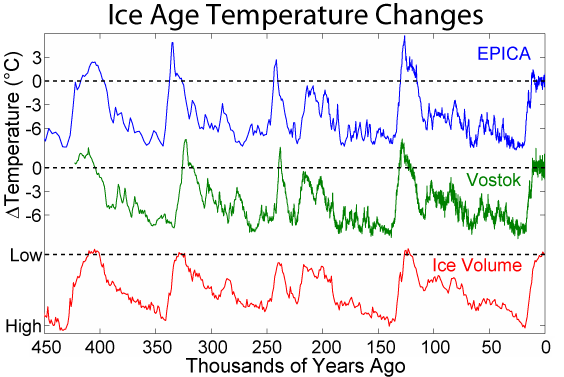
So once again you are quoting regional variations in temperature, not global ones. Here are some graphs of temperature variations determined from ice cores.

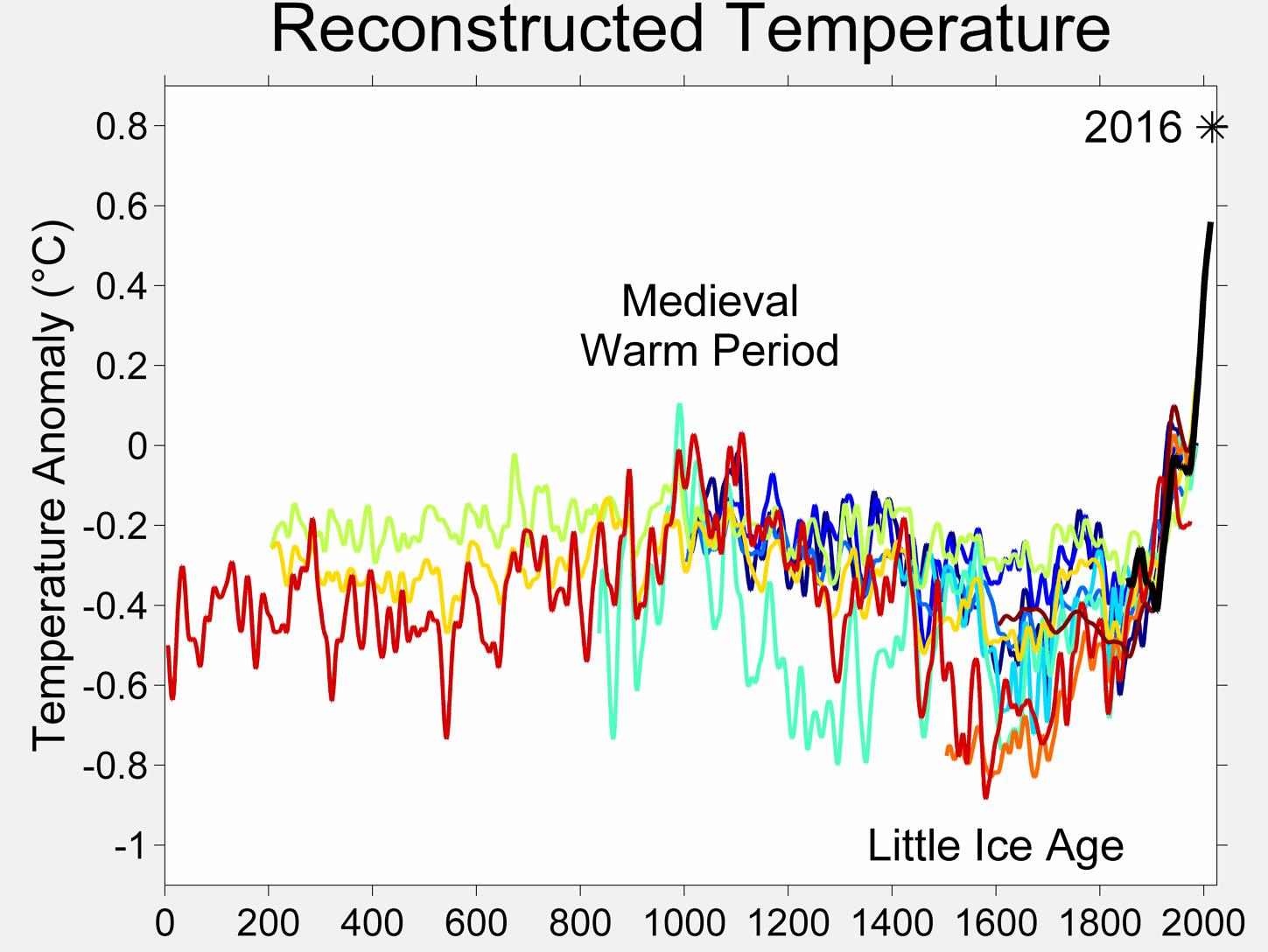
Please note that the variations between glacial and interglacial periods can range roughly 10º C whereas the difference between the peak of the "Medieval warming period" and "little ice age" was less than 1º C, not to mention that it was an even confined to the northern hemisphere. Meanwhile in the past 25 years alone, Global Temperature has increased .5°C, almost half of the difference between the "Medieval Warming Period" and the "little ice age", which took 250 years. In other words, the temperature is changing 10 times faster now, and it's happening globally.(Link)


Rhabe's Statement 6:

"O16/O18 relation is driven by the surface temperature of the ocean - the heavier isotope more difficult to evaporate."

Roger's Reply:

Your statement is true. Here is a link supporting your statement


Rhabe's Statement 7:

"Carbon-dioxide is one of the indicators of a warm period, methane another one - much more powerful - and dust acts in the opposite direction. All this in the ice-core-history."

Roger's Reply:

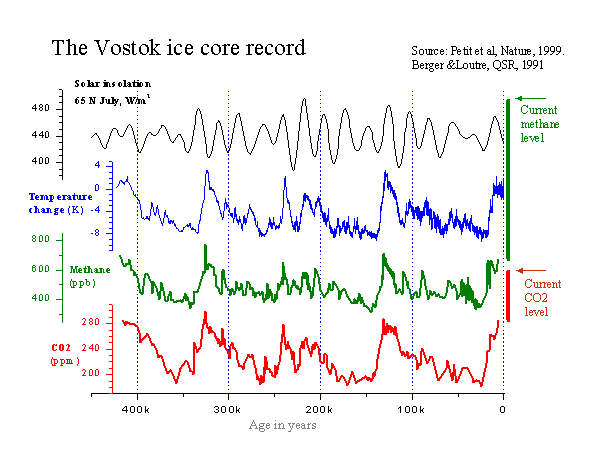
You are correct, mostly. It is true that variations in dust, methane and carbon dioxide can be found in the ice record. Although methane is a much more powerful greenhouse gas than carbon dioxide, there is much much less of it in the atmosphere. Methane accounts for 0.00017% and Carbon Dioxide accounts for 0.036%, 20 times more abundant than Methane(Link). Carbon Dioxide content and Methane content of the atmosphere is highly correlated to temperature changes in the past, that is true. Dust is also related to long range climate cooling (Peer Review Paper that supports Dust Forcing of Climate). Please notice in the graph below that demonstrates the correlation. Notice that methane is in parts per billion whereas Carbon Dioxide is in parts per million.

Rhabe's Statement 8:

"Nobody knows today why the pattern changed considerably 500.000 years ago, still ice-ages existing until 1 or 2 million years ago, nobody knows why there have been long periods (millions of years) without ice-ages (debated but some geologist agree that in the time of 20 to 2 million years ago there have not been at all or very few ice-ages."

Roger's Reply:

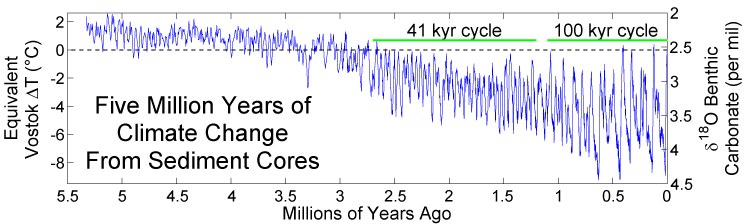
The beginning of the current ice age started roughly 2.5 million years ago, the one before this latest one was around 300 million years ago and the one before that was 450 million years ago. (Wikipedia Article on Ice Ages) As can be seen in the graph below there was no sudden change in climate 500,000 years ago.


It is true that the causes of ice ages are a source of debate for the scientific community, mostly because of the lack of data (there have only been three the past billion years). However the glacial and interglacial changes in the current ice age are well understood to be caused by precessions in the orbit, ellipticity, and tilt of the Earth Link.

Rhabe's Comment 9:

"So we really don't know much about climate and it's changes"

Roger's Reply:

This is partially correct. Climate change on the order of millions of years is not well understood due to lack of data to analyze. However, as you yourself have pointed out, we have a multitude of data available to us from ice cores that have been used to construct reliable models for the climate for the past million years.


Rhabe's Comment 10:

"The driving forces of nature are very likely to be much stronger than anything we can do."

Roger's Reply:

The fact that we have raised Carbon Dioxide and Methane levels 30% higher than they have been at any maximum anytime in the past 500,000 years is a clear indication that we can alter nature significantly.


Rhabe's Statement 11:

"So there is a strong necessity to prepare for rising sea-level. Or to prepare to move to safe locations. (If planning for decades)."

Roger's Reply:

I agree.

Rhabe's Statement 12:

"Burying CO2 is like burying money except the CO2 will not rot there and come up again."

Roger's Reply:

I agree, burying Carbon Dioxide is not a solution, it's insanity.

Rhabe's Statement 13:

"Polar bears will survive if we are willing to protect the last ice-fields from too many visitors."

Roger's Reply:

There won't be any ice fields. It's been shown that they can mate with grizzlies. They will probably either cross breed or die off. I don't care, I don't like Polar Bears (or penguins for that matter).


Rhabe's Statement 14:

"Much bigger dangers are waiting to astonish us."

Roger's Reply:

I'm sure that's true. Just as I'm sure that much greater wonders await our discovery.


Rhabe's Statement 15:

"Think about one major crop and a new virulent pest? Think about a really severe pandemic flu? Think about the recent spread of treatment resistant tuberculosis?"

Roger's Reply:

Think about advancements in medicine and genetic engineering to combat such threats.

Rhabe's Statement 16:

"Think about nuclear weapons and fundamentalist thinking?"

Roger's Reply:

Nuclear Weapons are a danger, but advancements in technology will help mitigate that danger (defense shield, better detection methods). Which fundamentalist thinking are you referring to? Islamic, Christian, Hindu, Buddhist?


Rhabe's Statement 17:

"What else?

Roger's Reply:

I guess there are no limits to the perils that face the human race. But I like to think that our potential is limitless as well to face and defeat these perils, as long as we are willing to admit they exist and are willing to put forth the effort to combat them.


Rhabe's Statement 18:

I wish to everybody a very happy Easter time.

Roger's Reply:

I do as well, to Rhabe and everyone else, and I do mean everyone, may your holidays be happy and healthy.

I hope that is a thorough enough response for everybody.

Roger

Register to Reply Good Answer (Score 2)
Guru
Popular Science - Weaponology - bwire Hobbies - Car Customizing - New Member

Join Date: Dec 2007
Location: Upper Mid-west USA
Posts: 7498
Good Answers: 97
#69
In reply to #68

Re: Arctic Sea Ice May Be Gone in 30 Years

04/07/2009 4:40 PM

Legalization is your point...

__________________
If death came with a warning there would be a whole lot less of it.
Register to Reply Off Topic (Score 5)
4
Guru
Hobbies - DIY Welding - New Member

Join Date: Oct 2008
Location: Cairns, Qld, Australia
Posts: 968
Good Answers: 65
#71
In reply to #68

Re: Arctic Sea Ice May Be Gone in 30 Years

04/08/2009 4:56 AM

Hi Roger Pink:

A GA for a well researched, informative and comprehensive post - even though I disagree with a lot of it. (I'm sure that's no surprise!)

It was localized to the Northern Atlantic Region. Peer Reviewed Scientific Journal Link.

I was not aware that the Takla Makan desert had shifted to the North Atlantic. During this period, the rivers into the desert flowed far more strongly than today, enabling irrigated landscapes which supported a fair size population and significant cities.

The only source for this flow is melting of glaciers, from the Kunlun, Pamir and Tien Shan mountains. As this is not happening to anywhere like that extent now, the conclusion is that the mountain regions were warmer than now.

Regardless of peer reviewed opinion, the medieval warm period was not localized.

Much of the reconstruction of historical temperatures relies on tree ring data.

Consider the formation of a tree ring. Warm summer means accelerated growth, tapering off to slow growth during the cold of winter, result is an obvious ring and generally one forms each year.

Suppose you get a cool summer followed by a mild winter. Average annual temperature will be only moderate, yet the tree ring will show only minor variation from summer to winter and the conclusion will be drawn that this was a warm year when it wasn't.

Consider a warm summer with good growth followed by winter with a month in mid winter unseasonally warm, then reverting to normal. This will show as a new ring and be interpreted as a cold year because the growth period was shortened. Thus one year of growth provides 2 rings, at least one of which will be interpreted as a cold year and due to the shortened growth period, it is likely that both years will be interpreted as cold.

A warm, dry winter is followed by a hot, dry summer. Growth of the rings is small due to water stress. Later interpretation is that this very hot year was cold!

I could go on, but the upshot is that the assumption of tree rings as an indicator of temperature is dubious. They are not even a completely reliable indicator of elapsed years!

No reconstruction is any better than the foundation on which it is based, and this one is flawed.

The correlation with ice core data is often cited in support of the tree rings.

http://www.warwickhughes.com/icecore/ (also read the links attached to this document as they provide further info).

This gives an indication of the type of manipulation done to ice core data to make it fit the "accepted wisdom". The 83 year correction to obtain the Siple data for CO2 levels is particularly blatant, yet this data is now accepted as fact!

I forget if he mentions the fact that gases are lost from ice cores during drilling. As some of this loss is due to diffusion through small cracks which form when the pressure on the core is released by drilling, there will be uneven isotopic losses, so analysis of these gases will be biased and not representative of the original.

Again, ice cores are not a reliable temperature indicator.

The discovery of WW2 P38's buried deep in ice after they landed there during the war also raises questions about how accurate our assessment of the number of years they represent, hence the date they are supposedly showing becomes suspect.

I'll make another post on the question of historic CO2 levels as to do so now would make this post far too long.

The medieval warm period was not restricted to the North Atlantic. It seems to have been world wide and must have been warmer than now. After all we can't grow grain in Greenland or grapes in Newfoundland or reliably grow grapes in Southern Scotland. The Takla Makan cannot support large cities and export significant grain and produce as the glacial melt is insufficient to support the required irrigation.

I haven't yet dug up the info for China and India, but it appears that the warming we now have is not "unprecedented" or even abnormal, and there is no reliable evidence that it is actually anthropogenic.

Register to Reply Good Answer (Score 4)
The Engineer
Engineering Fields - Engineering Physics - Physics... United States - Member - NY Popular Science - Genetics - Organic Chemistry... Popular Science - Cosmology - New Member Ingeniería en Español - Nuevo Miembro - New Member

Join Date: Feb 2005
Location: Albany, New York
Posts: 5060
Good Answers: 129
#72
In reply to #71

Re: Arctic Sea Ice May Be Gone in 30 Years

04/08/2009 9:39 AM

Give me a day or so and I'll try to convince you that it was a local event. I have go through the literature to see if I can make the case. Just wanted to respond now to let you know I'm still involved with this thread.

Register to Reply Off Topic (Score 5)
Anonymous Poster
#73
In reply to #72

Re: Arctic Sea Ice May Be Gone in 30 Years

04/08/2009 3:33 PM

Does anyone else see the irony in Roger's response?

Register to Reply Off Topic (Score 5)
Guru
Hobbies - DIY Welding - New Member

Join Date: Oct 2008
Location: Cairns, Qld, Australia
Posts: 968
Good Answers: 65
#77
In reply to #72

Re: Arctic Sea Ice May Be Gone in 30 Years

04/08/2009 9:21 PM

Thanks Roger. Look forward to it.

Register to Reply Off Topic (Score 5)
The Engineer
Engineering Fields - Engineering Physics - Physics... United States - Member - NY Popular Science - Genetics - Organic Chemistry... Popular Science - Cosmology - New Member Ingeniería en Español - Nuevo Miembro - New Member

Join Date: Feb 2005
Location: Albany, New York
Posts: 5060
Good Answers: 129
#80
In reply to #71

Re: Arctic Sea Ice May Be Gone in 30 Years

04/10/2009 11:58 AM

Hi Sceptic,

You Wrote:"Regardless of peer reviewed opinion, the medieval warm period was not localized."

Actually the things you quote afterward are from peer reviewed literature too. The peer review literature is a forum of scientific debate and often conflicting facts and data are presented. Over time, as more and more papers examine bits of evidence, a picture is formed.

To suggest "Regardless of peer reviewed opinion" is the equivalent of saying "Regardless of the facts". How is a debate possible if the sources of the facts are attacked rather than the facts themselves? This is the very definition of Ad Hominem. Regardless of your statement, I will proceed the only rational way I can, through the presentation of a summary of the peer reviewed data compiled by the IPCC in its reports on climate change. All of the sources they site are in the literature and can be checked.

Before I get to the IPCC report, I'd like to pull a section from the Wikipedia article on the medieval warm period. It says:

"The Medieval Warm Period was a time of warm weather around AD 800-1300 during the European Medieval period. Initial research on the MWP and the following Little Ice Age (LIA) was largely done in Europe, where the phenomenon was most obvious and clearly documented. It was initially believed that the temperature changes were global. However, this view has been questioned; the 2001 IPCC report summarizes this research, saying "…current evidence does not support globally synchronous periods of anomalous cold or warmth over this time frame, and the conventional terms of 'Little Ice Age' and 'Medieval Warm Period' appear to have limited utility in describing trends in hemispheric or global mean temperature changes in past centuries".
The wiki article sites the following paper from the IPCC (Here is a link to the paper)
The paper says regarding the little ice age: "......Evidence from mountain glaciers does suggest increased glaciation in a number of widely spread regions outside Europe prior to the 20th century, including Alaska, New Zealand and Patagonia (Grove and Switsur, 1994). However, the timing of maximum glacial advances in these regions differs considerably, suggesting that they may represent largely independent regional climate changes, not a globally-synchronous increased glaciation (see Bradley, 1999). Thus current evidence does not support globally synchronous periods of anomalous cold or warmth over this timeframe, and the conventional terms of "Little Ice Age" and "Medieval Warm Period" appear to have limited utility in describing trends in hemispheric or global mean temperature changes in past centuries."
"The paper goes on to say regarding the little ice age: "The "Little Ice Age" appears to have been most clearly expressed in the North Atlantic region as altered patterns of atmospheric circulation (O'Brien et al., 1995). Unusually cold, dry winters in central Europe (e.g., 1 to 2°C below normal during the late 17th century) were very likely to have been associated with more frequent flows of continental air from the north-east (Wanner et al., 1995; Pfister, 1999). Such conditions are consistent (Luterbacher et al., 1999) with the negative or enhanced easterly wind phase of the NAO, which implies both warm and cold anomalies over different regions in the North Atlantic sector. Such strong influences on European temperature demonstrate the difficulty in extrapolating the sparse early information about European climate change to the hemispheric, let alone global, scale."

With regards to the southern hemisphere during the little ice age:

"The evidence for temperature changes in past centuries in the Southern Hemisphere is quite sparse. What evidence is available at the hemispheric scale for summer (Jones et al., 1998) and annual mean conditions (Mann et al., 2000b) suggests markedly different behaviour from the Northern Hemisphere. The only obvious similarity is the unprecedented warmth of the late 20th century."

With regards to the Medieval Warm Period, the paper goes on to say:

"As with the "Little Ice Age", the posited "Medieval Warm Period" appears to have been less distinct, more moderate in amplitude, and somewhat different in timing at the hemispheric scale than is typically inferred for the conventionally-defined European epoch. The Northern Hemisphere mean temperature estimates of Jones et al. (1998), Mann et al. (1999), and Crowley and Lowery (2000) show temperatures from the 11th to 14th centuries to be about 0.2°C warmer than those from the 15th to 19th centuries, but rather below mid-20th century temperatures. The long-term hemispheric trend is best described as a modest and irregular cooling from AD 1000 to around 1850 to 1900, followed by an abrupt 20th century warming. Regional evidence is, however, quite variable. Crowley and Lowery (2000) show that western Greenland exhibited anomalous warmth locally only around AD 1000 (and to a lesser extent, around AD 1400), with quite cold conditions during the latter part of the 11th century, while Scandinavian summer temperatures appeared relatively warm only during the 11th and early 12th centuries. Crowley and Lowery (2000) find no evidence for warmth in the tropics. Regional evidence for medieval warmth elsewhere in the Northern Hemisphere is so variable that eastern, yet not western, China appears to have been warm by 20th century standards from the 9th to 13th centuries. The 12th and 14th centuries appear to have been mainly cold in China (Wang et al., 1998a,b; Wang and Gong, 2000). The restricted evidence from the Southern Hemisphere, e.g., the Tasmanian tree-ring temperature reconstruction of Cook et al. (1999), shows no evidence for a distinct Medieval Warm Period."
In conclusion the paper goes on to say:
"Medieval warmth appears, in large part, to have been restricted to areas in and neighbouring the North Atlantic. This may implicate the role of ocean circulation-related climate variability. The Bermuda rise sediment record of Keigwin (1996) suggests warm medieval conditions and cold 17th to 19th century conditions in the Sargasso Sea of the tropical North Atlantic. A sediment record just south of Newfoundland (Keigwin and Pickart, 1999), in contrast, indicates cold medieval and warm 16th to 19th century upper ocean temperatures. Keigwin and Pickart (1999) suggest that these temperature contrasts were associated with changes in ocean currents in the North Atlantic. They argue that the "Little Ice Age" and "Medieval Warm Period" in the Atlantic region may in large measure reflect century-scale changes in the North Atlantic Oscillation. Such regional changes in oceanic and atmospheric processes, which are also relevant to the natural variability of the climate on millennial and longer time-scales, are greatly diminished or absent in their influence on hemispheric or global mean temperatures."

From the IPCC 2007 Report on Climate Change

The following graph is important in that it uses a multitude of different experimental methods to develop a baseline for global temperature going back 1500 years. Each colored line represents peer reviewed temperature data.

Please note that these reconstructions are for the northern hemisphere only, as their is much less data available. In the graph above when all the data is taken from numerous peer reviewed papers are taken together, the regional nature of the medieval warm period is averaged out leaving only a very small change in temperature (<0.3° C) from the peak of the Medieval Warm Period to the minimum of the Little Ice Age.
Additional Peer Reviewed Papers (Individually these papers mean nothing, but taken together you start to get a picture)
A paper on the temperatures of the Tibetan Plateau over the past 1000 years. This paper does show evidence of a MWP and a LIA, however the LIA was not the coldest period of the last 1000 years. Furthermore the Tibetan Plateau data indicates today is the warmest it's been there in 1000 years.

A paper comparing the temperature trends in Europe during MWP and Today. The paper finds that the change in temperature today is unprecedented and exceeds that warming found in Europe during the MWP.

In Conclusion

There are all kinds of regional variations in the temperature history that can be found in the literature, not just during the MWP and the LIA. However the climate shift we have been witnessing over the past 100 years is unprecedented in the fact of its acceleration and its global nature.

It's not enough to pick and choose a fact here and fact there to support your argument. In that IPCC graph earlier, 17 different temperature data papers are used. This gives a much clearer picture of trends and helps separate out regional anomalies. I understand that you disagree with my assertion that carbon dioxide, released by the burning of fossil fuels has significantly altered the earths climate in a way that has not been seen in the past thousands of years. However, I don't make a statement like that base on a single paper, I make that statement based on the complete picture that 10s of thousands of research articles have written. Scientists do not find consensus easily in the literature, so when it happens, it should be taken seriously.

Best regards and happy holidays,

Roger

Register to Reply
Guru
Hobbies - DIY Welding - New Member

Join Date: Oct 2008
Location: Cairns, Qld, Australia
Posts: 968
Good Answers: 65
#84
In reply to #80

Re: Arctic Sea Ice May Be Gone in 30 Years

04/11/2009 8:14 AM

Hi Roger

Happy holiday to you.

Thank you for the reference to temps on the Tibetan Plateau.

Almost as an after thought, they mentioned that Eastern China was warmer than Western China, and that the warming also extended to India.

This now places the Medieval Warm Period as world wide, not predominantly a phenomenon of the North Atlantic as peer reviewed papers have suggested.

The significance of the MWP is that temps must have been warmer than now, despite the claims of many experts and the IPCC, because of the crops grown in locations where even now, they cannot be successfully grown.

It cannot have been due to a shift of ocean currents because the crops which would now be out of place were grown both sides of the Atlantic. If this was due to a current shift, then the Gulf Stream had to shift to Greenland, Newfoundland and still have increased effect on Britain and Western Europe.

This immediately tells us that the IPCC reconstruction of temperature for that period is nonsense. It may agree with the experts, but it doesn't agree with historical facts.

As I said earlier, reliance on tree rings and ice cores for temperature data is shaky, because the assumptions behind them are shaky. They should not be used to contradict eye witness reports.

Register to Reply
The Engineer
Engineering Fields - Engineering Physics - Physics... United States - Member - NY Popular Science - Genetics - Organic Chemistry... Popular Science - Cosmology - New Member Ingeniería en Español - Nuevo Miembro - New Member

Join Date: Feb 2005
Location: Albany, New York
Posts: 5060
Good Answers: 129
#88
In reply to #84

Re: Arctic Sea Ice May Be Gone in 30 Years

04/11/2009 4:06 PM

Sceptic,

Happy holidays to you as well.

"Almost as an after thought, they mentioned that Eastern China was warmer than Western China, and that the warming also extended to India. This now places the Medieval Warm Period as world wide, not predominantly a phenomenon of the North Atlantic as peer reviewed papers have suggested."

Here is why what you said above is not a valid conclusion, not invalid, but not valid. It is not enough that a region warms, it has to warm significantly. Europe experienced over 1°C increase in temperature during the Medieval Warming Period. This is a strong increase in local climate. Just because parts of China were warmer doesn't mean they were anywhere near 1ºC warmer and everything I've read seems to indicate less than 0.5ºC warmer (see IPCC graph of temperatures for Northern Hemisphere in other post).

Really I feel this sort of qualitative versus quantitative analysis is where the confusion of debate existing regarding man caused global warming originates. You see, it is true that there have been periods of warming in the past, and regionally in the recent past in Europe temperatures equivalent to today which then spurs the argument that this could be a natural warming cycle.

The reason I am so sure that this is an unnatural warming cycle is the speed at which the climate is changing. Even more damning is what they like to call the second derivative, or what we could colloquially call the acceleration of the warming. Although we may have had temperatures like those we are experiencing in the recent past in some regions, we have never, in the past million years, had a climate shift so dramatic in its speed, and what's scary is it's accelerating because natural feedback is kicking in.

I'm not saying its the end of the world. What I am saying is that things are going to change dramatically with our climate in the next 25 years. It is hard to impress the significance, meteorologically,of the disappearance of the arctic polar sea ice, which is at this point guaranteed to occur.

I think the best evidence I can present to you Sceptic is simply to say lets wait and see. At some point the data will be so many standard deviations from the norm that it will be almost impossible to rationalize it to natural causes.

Register to Reply Score 1 for Off Topic
Guru
Hobbies - DIY Welding - New Member

Join Date: Oct 2008
Location: Cairns, Qld, Australia
Posts: 968
Good Answers: 65
#86
In reply to #80

Re: Arctic Sea Ice May Be Gone in 30 Years

04/11/2009 8:32 AM

Hi Roger Pink

To suggest "Regardless of peer reviewed opinion" is the equivalent of saying "Regardless of the facts".

In context, I was actually saying that the "peer reviewed opinion" was contrary to the facts.

Give me facts any day over expert opinion.

("ex" means a has been, "spurt" is a drip under pressure. Totally irrelevant and irreverent, I admit).

Have fun.

Register to Reply Off Topic (Score 5)
The Engineer
Engineering Fields - Engineering Physics - Physics... United States - Member - NY Popular Science - Genetics - Organic Chemistry... Popular Science - Cosmology - New Member Ingeniería en Español - Nuevo Miembro - New Member

Join Date: Feb 2005
Location: Albany, New York
Posts: 5060
Good Answers: 129
#89
In reply to #86

Re: Arctic Sea Ice May Be Gone in 30 Years

04/11/2009 4:08 PM

I guess what I'm trying to say is that the facts that you quoted originated as peer reviewed literature.

Register to Reply Off Topic (Score 5)
Guru
Hobbies - DIY Welding - New Member

Join Date: Oct 2008
Location: Cairns, Qld, Australia
Posts: 968
Good Answers: 65
#91
In reply to #89

Re: Arctic Sea Ice May Be Gone in 30 Years

04/12/2009 5:10 AM

OK, fair comment

Register to Reply Off Topic (Score 5)
2
Guru

Join Date: Dec 2006
Location: Germany 49° 26' N, 7° 46' O
Posts: 1950
Good Answers: 109
#74
In reply to #68

Re: Arctic Sea Ice May Be Gone in 30 Years

04/08/2009 4:25 PM

Hi Roger Pink,

some of your comments need some further comment/ objections:

Rhabe Statement 1:

"there have been minimum 7 ice-ages in the last 1 million years."

Roger's Reply:

That's incorrect. There has been only one ice-age over the past million years. What you are calling "ice-ages" are actually referred to glacial periods. Wiki Link

RHABES reply: No further comment necessary this is playing with words, everybody will know the meaning.

Rhabe Statement 2:

"And in-between warm periods - much warmer than today, also warmer than the last "good" period 900 to 1200 years ago - the Viking time when Eric the Red and his companions sailed to "Greenland" and "Vinland"."

Roger's Reply:

The in between "warm periods" are referred to as "interglacials". The last glacial period is generally agreed to have ended 12,500 years ago (Link). The period you mention, from 900 to 1200 years ago was not a global warming event. It was localized to the Northern Atlantic Region. Peer Reviewed Scientific Journal Link. Your statement "much warmer than today" is also incorrect as the temperatures were about the same or were slightly lower than they are today (they are equivalent with temperatures around 1990, temperatures have since gone up). Nature Article on Variations in the Northern Hemisphere Climate

RHABES reply: If the warm period 900 to 1200 years ago was not really warmer than the mean in southern regions below the 30° this does not matter. (But is still doubtful). We were talking about arctic ice and this was affected without any doubt. The names of Greenland and Vinland are sufficient to demonstrate this.

Rhabe's Statement 3:

The ice was not gone completely -but had a considerably smaller extension than now.

Roger's Reply:

This statement is true. The ice age has not ended, though glaciation is receding and there is no doubt that the receding started before the industrial revolution, meaning we are in an interglacial period.


Rhabe's Statement 4:

"The latest very warm period was around 6000 years ago, when human beings in Cyprus invented the first copper handling (from native metallic copper) and then copper smelting from ores."

Roger's Reply:

The warming event to which you refer that occurred 6000 years ago is called the Mid-Holocene warming. This was a local warming event to the Northern Hemisphere, not a Global warming event. (Wikipedia Article Verify My Statement). You're wrong about the time copper handling occurred too. Archaeological evidence points to 6500 BC, that's 8500 years ago, not 6000 years ago as you stated. (Wikipedia Article on Copper Smelting). You confused B.P (Before Present) with B.C. (Before Christ) which is why you're roughly 2000 years off.

RHABES reply: Once more: talking about Arctic Sea Ice - I am not sure about global or only northern warming during this period, I would not rely on Wiki articles but accept this one.

In the Wiki article about copper there are some flaws to be discussed: a statement about a first known copper object (age 5000BC) - this may be made from the native pure copper that existed abundantly in Cyprus, until now some relics can be found.

The next statement about Cu-As-bronze matches my age statement.

The next statement about first Cu-Sn-bronze is definitely no longer valid. Much earlier bronzes are known.

And the site where the first tin was mined and smelted was detected near the Turkish coast just opposite Cyprus. A team of archaeologist did analyse with a sensitive spectral analysis any of the small river beds running down to the sea and found some tin enrichment, followed this until they found the relics of mining and smelting. This was only a minor deposit, so very early exhausted.

I do not know if there have been existing some other local tin mines. But I did see the temples of Malta and I am convinced that these are relics of early tin traders from Cornwall, southern England. The other long-lasting tin-source was from Afghanistan. Other harbours of tin-traders have been (i am convinced but never heard that anything was found) on the Portuguese west-coast. But these good natural harbors are widening rapidly by geologic stretching and thus accumulate rapidly thick layers of sediments, so we will not find these.

Rhabe's Statement 5:

"If the ice-cores that are drilled in central Greenland and Antarctica are examined this cycling pattern is seen in the relation of oxygen 16 to oxygen 18 and in carbon-dioxide entrapped in gas bubbles - most cycles much longer and the very cold periods much longer than the warm periods."

Roger's Reply:

It's true that Oxygen 16 to Oxygen 18 levels in air bubbles trapped in ice can be used to monitor temperature changes. From the Wikipedia Article on the Holocene:

"Climate has been fairly stable over the Holocene ice core records show that before the Holocene there were global warming and cooling periods, but climate changes became more regional at the start of the Younger Dryas."

So once again you are quoting regional variations in temperature, not global ones. Here are some graphs of temperature variations determined from ice cores.

Please note that the variations between glacial and interglacial periods can range roughly 10º C whereas the difference between the peak of the "Medieval warming period" and "little ice age" was less than 1º C, not to mention that it was an even confined to the northern hemisphere. Meanwhile in the past 25 years alone, Global Temperature has increased .5°C, almost half of the difference between the "Medieval Warming Period" and the "little ice age", which took 250 years. In other words, the temperature is changing 10 times faster now, and it's happening globally.(Link)

Rhabe's Statement 6:


"O16/O18 relation is driven by the surface temperature of the ocean - the heavier isotope more difficult to evaporate."

Roger's Reply:

Your statement is true. Here is a link supporting your statement


Rhabe's Statement 7:

"Carbon-dioxide is one of the indicators of a warm period, methane another one - much more powerful - and dust acts in the opposite direction. All this in the ice-core-history."

Roger's Reply:

You are correct, mostly. It is true that variations in dust, methane and carbon dioxide can be found in the ice record. Although methane is a much more powerful greenhouse gas than carbon dioxide, there is much much less of it in the atmosphere. Methane accounts for 0.00017% and Carbon Dioxide accounts for 0.036%, 20 times more abundant than Methane(Link). Carbon Dioxide content and Methane content of the atmosphere is highly correlated to temperature changes in the past, that is true. Dust is also related to long range climate cooling (Peer Review Paper that supports Dust Forcing of Climate). Please notice in the graph below that demonstrates the correlation. Notice that methane is in parts per billion whereas Carbon Dioxide is in parts per million.

RHABES reply: so if you multiply the lower methane percentage of the atmosphere with the higher greenhouse-factor of methane (near 70) then the effective warming by methane is higher than by CO2.

Rhabe's Statement 8:

"Nobody knows today why the pattern changed considerably 500.000 years ago, still ice-ages existing until 1 or 2 million years ago, nobody knows why there have been long periods (millions of years) without ice-ages (debated but some geologist agree that in the time of 20 to 2 million years ago there have not been at all or very few ice-ages."

Roger's Reply:

The beginning of the current ice age started roughly 2.5 million years ago, the one before this latest one was around 300 million years ago and the one before that was 450 million years ago. (Wikipedia Article on Ice Ages) As can be seen in the graph below there was no sudden change in climate 500,000 years ago.

It is true that the causes of ice ages are a source of debate for the scientific community, mostly because of the lack of data (there have only been three the past billion years). However the glacial and interglacial changes in the current ice age are well understood to be caused by precessions in the orbit, ellipticity, and tilt of the Earth Link.

RHABES reply: Incomplete and Wiki not to be trusted.

I agree about the astronomical influences on solar irradiation.

I saw by myself the relics of the (estimated) 22 million years ago ice-age in Switzerland near the city of Luzern - I have no means to be sure about their dating but I have no doubt that there are a lot of reputed geologists.

And: you like to include the total last 2.5 or so million years into one ice-age.

This is not adequate to the problem as there have been long warm periods. If some people call these the Interglacials, that's ok. But still count the individual growth and recede one "ice-age".

Nobody knows what changed 2.5 million years ago - there must have been an event or change in geologic ? reality.

I suspect that near that time the two Americas rejoined and barred the out-flux to the Pacific of warm water from the Caribbean Sea that results in the Gulf-Stream - as we see it today.

Change in pattern of cycling 500Kyears ago: this is called the "mid brunhes event", see

http://geology.geoscienceworld.org/cgi/content/abstract/31/3/239

http://www.sciencemag.org/cgi/content/abstract/232/4750/619

Rhabe's Comment 9:

"So we really don't know much about climate and it's changes"

Roger's Reply:

This is partially correct. Climate change on the order of millions of years is not well understood due to lack of data to analyze. However, as you yourself have pointed out, we have a multitude of data available to us from ice cores that have been used to construct reliable models for the climate for the past million years.

RHABES reply: I do not agree that we have reliable models. As long as nobody knows what changed the climate 2.5 ? million years ago, as long as the individual climate-changing mechanisms are debated and not agreed upon - I am not convinced nor satisfied by the models.


Rhabe's Comment 10:

"The driving forces of nature are very likely to be much stronger than anything we can do."

Roger's Reply:

The fact that we have raised Carbon Dioxide and Methane levels 30% higher than they have been at any maximum anytime in the past 500,000 years is a clear indication that we can alter nature significantly.
RHABES reply: OK, but this does not imply that we can stabilise the climate against natures drives nor our ability to stabilise against human influence.

Rhabe's Statement 11:

"So there is a strong necessity to prepare for rising sea-level. Or to prepare to move to safe locations. (If planning for decades)."

Roger's Reply:

I agree.

Rhabe's Statement 12:

"Burying CO2 is like burying money except the CO2 will not rot there and come up again."

Roger's Reply:

I agree, burying Carbon Dioxide is not a solution, it's insanity.

Rhabe's Statement 13:

"Polar bears will survive if we are willing to protect the last ice-fields from too many visitors."

Roger's Reply:

There won't be any ice fields. It's been shown that they can mate with grizzlies. They will probably either cross breed or die off. I don't care, I don't like Polar Bears (or penguins for that matter).

RHABES reply: maybe yes maybe no, the Polar Bears did survive some really warm times. What will happen to the seals they prey on? They need floating ice too.

Rhabe's Statement 14:

"Much bigger dangers are waiting to astonish us."

Roger's Reply:

I'm sure that's true. Just as I'm sure that much greater wonders await our discovery.


Rhabe's Statement 15:

"Think about one major crop and a new virulent pest? Think about a really severe pandemic flu? Think about the recent spread of treatment resistant tuberculosis?"

Roger's Reply:

Think about advancements in medicine and genetic engineering to combat such threats.

RHABES reply: That is ok, but are you sure about advances to come in time?

Rhabe's Statement 16:

"Think about nuclear weapons and fundamentalist thinking?"

Roger's Reply:

Nuclear Weapons are a danger, but advancements in technology will help mitigate that danger (defense shield, better detection methods). Which fundamentalist thinking are you referring to? Islamic, Christian, Hindu, Buddhist?

RHABES reply: Any fundamentalists: I did never see Buddhists behaving fundamentalistic, the others from your list: yes. Jewish and Atheistic and Political fundamentalists to be added.

Rhabe's Statement 17:


"What else?

Roger's Reply:

I guess there are no limits to the perils that face the human race. But I like to think that our potential is limitless as well to face and defeat these perils, as long as we are willing to admit they exist and are willing to put forth the effort to combat them.

RHABES reply: I agree. But today we neglect education and bury money and efforts in nonsense activities.

Rhabe's Statement 18:

I wish to everybody a very happy Easter time.

Roger's Reply:

I do as well, to Rhabe and everyone else, and I do mean everyone, may your holidays be happy and healthy.

I hope that is a thorough enough response for everybody.

Roger

RHABES reply:

Thank you for being precise and covering all my topics.

A nice Easter to everyone!

RHABE

Register to Reply Good Answer (Score 2)
Guru

Join Date: Oct 2007
Location: Transcendia
Posts: 2963
Good Answers: 93
#75
In reply to #74

Re: Arctic Sea Ice May Be Gone in 30 Years

04/08/2009 5:28 PM

Good Debate.

Might one day end up in a "Best Of CR4".

When you guys :Roger and Rhabe get to full agreement, will be a hoot.

Seems as if you guys are closing in on a good percentage, and it is aimed now at determining which studies, and sources to agree to as having veracity.

Possibly we may continue this thread out to a full resolution if the discussion was dependent on agreed facts, texts, reports or articles?

My suggestion is that Rhabe and Roger agree to certify limits to their debate according to an agreed list of authors, and books.

First they need to identify what both of them have read, or experienced in common.

Then they need to identify opposing or unshared influences.

Then take up a winnowed share there.

From there, argue it out to where all their differences are of no real affect on the overall view, and commitment to the same shared direction, regardless of differences concerning minutia. P.S. I suggest Rhabe and Roger agree to work from agreement, or disagreements with Jared Diamond as described in Gun Germs and Steel, and Collapse. I have to admit I myself come to some of this with those books most foundational due to both the research, and scholarship.

__________________
You don't get wise because you got old, you get old because you were wise.
Register to Reply
Guru
Popular Science - Weaponology - New Member Netherlands - Member - New Member Fans of Old Computers - Commodore 64 - New Member

Join Date: Sep 2007
Location: Japan
Posts: 2703
Good Answers: 38
#76
In reply to #75

Re: Arctic Sea Ice May Be Gone in 30 Years

04/08/2009 8:32 PM

It somewhat strikes me as a discussion between an Atheist and a religious person.

__________________
From the Movie "The Big Lebowski" Don't pee on the carpet man!
Register to Reply Off Topic (Score 6)
Guru

Join Date: Dec 2006
Location: Germany 49° 26' N, 7° 46' O
Posts: 1950
Good Answers: 109
#78
In reply to #75

Re: Arctic Sea Ice May Be Gone in 30 Years

04/09/2009 3:10 AM

Jared Diamond books:

Guns, Germs and Steel: yes.

The Rise and the Fall of the third Chimpanzee: to be included.

Collapse: no, too small communities considered.

Most important but not really related (as the above books to the original topic):

Steven Cunnane: Survival of the Fattest.

Richard Conniff:

some more to be posted on a list of book recommendations to be compiled from all interested contributors?

RHABE

Register to Reply Off Topic (Score 5)
Guru

Join Date: Oct 2007
Location: Transcendia
Posts: 2963
Good Answers: 93
#79
In reply to #78

Re: Arctic Sea Ice May Be Gone in 30 Years

04/09/2009 8:42 PM

I've not read Survival of the Fattest. I wrote the title down and have a list going for a visit to the real library.

__________________
You don't get wise because you got old, you get old because you were wise.
Register to Reply Off Topic (Score 5)
The Engineer
Engineering Fields - Engineering Physics - Physics... United States - Member - NY Popular Science - Genetics - Organic Chemistry... Popular Science - Cosmology - New Member Ingeniería en Español - Nuevo Miembro - New Member

Join Date: Feb 2005
Location: Albany, New York
Posts: 5060
Good Answers: 129
#81
In reply to #74

Re: Arctic Sea Ice May Be Gone in 30 Years

04/10/2009 12:04 PM

Rhabe,

I intend to respond to this post, just have to find the time.

Roger

Register to Reply
The Engineer
Engineering Fields - Engineering Physics - Physics... United States - Member - NY Popular Science - Genetics - Organic Chemistry... Popular Science - Cosmology - New Member Ingeniería en Español - Nuevo Miembro - New Member

Join Date: Feb 2005
Location: Albany, New York
Posts: 5060
Good Answers: 129
#82
In reply to #74

Re: Arctic Sea Ice May Be Gone in 30 Years

04/10/2009 4:15 PM

Hello Rhabe,

Here are my responses to your responses.

Hi Roger Pink,

some of your comments need some further comment/ objections:

Rhabe Statement 1:

"there have been minimum 7 ice-ages in the last 1 million years."

Roger's Reply:

That's incorrect. There has been only one ice-age over the past million years. What you are calling "ice-ages" are actually referred to glacial periods. Wiki Link

RHABES reply: No further comment necessary this is playing with words, everybody will know the meaning.

Roger's Rebuttal: An ice age is an ice age, a glacial period is a glacial period. If you read something on ice ages like "scientists are unsure what causes an ice age", can completely misunderstand the difference if you don't know what an ice age is (Something that lasts millions of years). This is how misconception and misinformation start.

Rhabe Statement 2:

"And in-between warm periods - much warmer than today, also warmer than the last "good" period 900 to 1200 years ago - the Viking time when Eric the Red and his companions sailed to "Greenland" and "Vinland"."

Roger's Reply:

The in between "warm periods" are referred to as "interglacials". The last glacial period is generally agreed to have ended 12,500 years ago (Link). The period you mention, from 900 to 1200 years ago was not a global warming event. It was localized to the Northern Atlantic Region. Peer Reviewed Scientific Journal Link. Your statement "much warmer than today" is also incorrect as the temperatures were about the same or were slightly lower than they are today (they are equivalent with temperatures around 1990, temperatures have since gone up). Nature Article on Variations in the Northern Hemisphere Climate

RHABES reply: If the warm period 900 to 1200 years ago was not really warmer than the mean in southern regions below the 30° this does not matter. (But is still doubtful). We were talking about arctic ice and this was affected without any doubt. The names of Greenland and Vinland are sufficient to demonstrate this.

Roger's Rebuttal: Sure Arctic Ice was effected then. Artic ice has been growing and retreating for 10s of thousands of years. However the speed and extent of this ice retreat today is unprecendented in our recent climate history (Holocene). Certainly the arctic hasn't been ice free during the Holocene, which is what this article was predicting. Just because all cars move doesn't make a Hyundai a Porsche. Just because there are natural cyclic variations in temperature doesn't make the current one, which is exhibiting unusual speed, natural. Your argument doesn't hold water when you start to quantify the changes.

Rhabe's Statement 3:

The ice was not gone completely -but had a considerably smaller extension than now.

Roger's Reply:

This statement is true. The ice age has not ended, though glaciation is receding and there is no doubt that the receding started before the industrial revolution, meaning we are in an interglacial period.


Rhabe's Statement 4:

"The latest very warm period was around 6000 years ago, when human beings in Cyprus invented the first copper handling (from native metallic copper) and then copper smelting from ores."

Roger's Reply:

The warming event to which you refer that occurred 6000 years ago is called the Mid-Holocene warming. This was a local warming event to the Northern Hemisphere, not a Global warming event. (Wikipedia Article Verify My Statement). You're wrong about the time copper handling occurred too. Archaeological evidence points to 6500 BC, that's 8500 years ago, not 6000 years ago as you stated. (Wikipedia Article on Copper Smelting). You confused B.P (Before Present) with B.C. (Before Christ) which is why you're roughly 2000 years off.

RHABES reply: Once more: talking about Arctic Sea Ice - I am not sure about global or only northern warming during this period, I would not rely on Wiki articles but accept this one.

In the Wiki article about copper there are some flaws to be discussed: a statement about a first known copper object (age 5000BC) - this may be made from the native pure copper that existed abundantly in Cyprus, until now some relics can be found.

The next statement about Cu-As-bronze matches my age statement.

The next statement about first Cu-Sn-bronze is definitely no longer valid. Much earlier bronzes are known.

And the site where the first tin was mined and smelted was detected near the Turkish coast just opposite Cyprus. A team of archaeologist did analyse with a sensitive spectral analysis any of the small river beds running down to the sea and found some tin enrichment, followed this until they found the relics of mining and smelting. This was only a minor deposit, so very early exhausted.

I do not know if there have been existing some other local tin mines. But I did see the temples of Malta and I am convinced that these are relics of early tin traders from Cornwall, southern England. The other long-lasting tin-source was from Afghanistan. Other harbours of tin-traders have been (i am convinced but never heard that anything was found) on the Portuguese west-coast. But these good natural harbors are widening rapidly by geologic stretching and thus accumulate rapidly thick layers of sediments, so we will not find these.

Roger's Rebuttal: The wikipedia article on copper clearly mentions a copper pendant in northern Iraq from 8700 BC, which was 10,700 years ago. If you're trying to suggest that a technology that existed 500 miles away from Cyprus took 5000 years to get to it.......well, let's just say that doesn't seem very likely, nor consistant with how fast other technologies spread. I think part of the problem is that you confused B.P and B.C., for which there is a 2000 year difference. Thus you read 6000 BC and thought that corresponded with 6000 BP when in fact there is a two thousand year difference. Now you are bringing tin into the conversation, but your first statement was specific to copper, not bronze. This is simply misdirection since Bronze production Does correspond with the dates we are talking about but that is not what you originally said. I do however agree that there was a more robust trade with England earlier than many believe.

Rhabe's Statement 5:

"If the ice-cores that are drilled in central Greenland and Antarctica are examined this cycling pattern is seen in the relation of oxygen 16 to oxygen 18 and in carbon-dioxide entrapped in gas bubbles - most cycles much longer and the very cold periods much longer than the warm periods."

Roger's Reply:

It's true that Oxygen 16 to Oxygen 18 levels in air bubbles trapped in ice can be used to monitor temperature changes. From the Wikipedia Article on the Holocene:

"Climate has been fairly stable over the Holocene ice core records show that before the Holocene there were global warming and cooling periods, but climate changes became more regional at the start of the Younger Dryas."

So once again you are quoting regional variations in temperature, not global ones. Here are some graphs of temperature variations determined from ice cores.

Please note that the variations between glacial and interglacial periods can range roughly 10º C whereas the difference between the peak of the "Medieval warming period" and "little ice age" was less than 1º C, not to mention that it was an even confined to the northern hemisphere. Meanwhile in the past 25 years alone, Global Temperature has increased .5°C, almost half of the difference between the "Medieval Warming Period" and the "little ice age", which took 250 years. In other words, the temperature is changing 10 times faster now, and it's happening globally.(Link)

Rhabe's Statement 6:


"O16/O18 relation is driven by the surface temperature of the ocean - the heavier isotope more difficult to evaporate."

Roger's Reply:

Your statement is true. Here is a link supporting your statement


Rhabe's Statement 7:

"Carbon-dioxide is one of the indicators of a warm period, methane another one - much more powerful - and dust acts in the opposite direction. All this in the ice-core-history."

Roger's Reply:

You are correct, mostly. It is true that variations in dust, methane and carbon dioxide can be found in the ice record. Although methane is a much more powerful greenhouse gas than carbon dioxide, there is much much less of it in the atmosphere. Methane accounts for 0.00017% and Carbon Dioxide accounts for 0.036%, 20 times more abundant than Methane(Link). Carbon Dioxide content and Methane content of the atmosphere is highly correlated to temperature changes in the past, that is true. Dust is also related to long range climate cooling (Peer Review Paper that supports Dust Forcing of Climate). Please notice in the graph below that demonstrates the correlation. Notice that methane is in parts per billion whereas Carbon Dioxide is in parts per million.

RHABES reply: so if you multiply the lower methane percentage of the atmosphere with the higher greenhouse-factor of methane (near 70) then the effective warming by methane is higher than by CO2.

Roger's Rebuttal: You quote a factor of 70, but you provide no link or explanation of how greenhouse factor is determined. I however here in this link. And in the table below show that Methane's effect is 1/3 of the effect of Carbon Dioxide on Global Warming:

GasPreindustrial LevelCurrent LevelIncrease since 1750

Radiative forcing (W/m2)

Carbon dioxide

280 ppm387ppm104 ppm1.46

Methane

700 ppb1,745 ppb1,045 ppb0.48

Nitrous oxide

270 ppb314 ppb44 ppb0.15

CFC-12

0533 ppt533 ppt0.17

Rhabe's Statement 8:

"Nobody knows today why the pattern changed considerably 500.000 years ago, still ice-ages existing until 1 or 2 million years ago, nobody knows why there have been long periods (millions of years) without ice-ages (debated but some geologist agree that in the time of 20 to 2 million years ago there have not been at all or very few ice-ages."

Roger's Reply:

The beginning of the current ice age started roughly 2.5 million years ago, the one before this latest one was around 300 million years ago and the one before that was 450 million years ago. (Wikipedia Article on Ice Ages) As can be seen in the graph below there was no sudden change in climate 500,000 years ago.

It is true that the causes of ice ages are a source of debate for the scientific community, mostly because of the lack of data (there have only been three the past billion years). However the glacial and interglacial changes in the current ice age are well understood to be caused by precessions in the orbit, ellipticity, and tilt of the Earth Link.

RHABES reply: Incomplete and Wiki not to be trusted.

I agree about the astronomical influences on solar irradiation.

I saw by myself the relics of the (estimated) 22 million years ago ice-age in Switzerland near the city of Luzern - I have no means to be sure about their dating but I have no doubt that there are a lot of reputed geologists.

And: you like to include the total last 2.5 or so million years into one ice-age.

This is not adequate to the problem as there have been long warm periods. If some people call these the Interglacials, that's ok. But still count the individual growth and recede one "ice-age".

Nobody knows what changed 2.5 million years ago - there must have been an event or change in geologic ? reality.

I suspect that near that time the two Americas rejoined and barred the out-flux to the Pacific of warm water from the Caribbean Sea that results in the Gulf-Stream - as we see it today.

Change in pattern of cycling 500Kyears ago: this is called the "mid brunhes event", see

http://geology.geoscienceworld.org/cgi/content/abstract/31/3/239

http://www.sciencemag.org/cgi/content/abstract/232/4750/619

Roger's Rebuttal: You seem to have a lot of personal theories. What I'm presenting is peer reviewed data and the standard scientific terms and timelines used. The links you have provided two links. The first one is talking about a unusually strong glacial event that occurred 430 thousand years ago and can not be explained by precession of orbit alone. Although interesting, I don't see the relevance to your response above. The second paper details a glacial and interglacial period from 400 thousand years ago and 300 thousand years ago that seem to correspond to orbital precession. Neither paper support your claim that an "extraordinary event shifted climate 500 thousand years ago.

Rhabe's Comment 9:

"So we really don't know much about climate and it's changes"

Roger's Reply:

This is partially correct. Climate change on the order of millions of years is not well understood due to lack of data to analyze. However, as you yourself have pointed out, we have a multitude of data available to us from ice cores that have been used to construct reliable models for the climate for the past million years.

RHABES reply: I do not agree that we have reliable models. As long as nobody knows what changed the climate 2.5 ? million years ago, as long as the individual climate-changing mechanisms are debated and not agreed upon - I am not convinced nor satisfied by the models.

Roger's Rebuttal:
I don't agree with your premise that if you don't know everything about a problem you know nothing. We may not know the initial factors of the ice age clearly, but that doesn't mean we don't understand the local cycles of climate and statistically significant deviations from them as we are experiencing now. Also, it is not the models job to satisfy you, merely to adhere to scientific principles and add to the collective knowlege of mankind so that educated and informed understandings can be formed when they are combined with the multitude of other evidence found in the literature.


Rhabe's Comment 10:

"The driving forces of nature are very likely to be much stronger than anything we can do."

Roger's Reply:

The fact that we have raised Carbon Dioxide and Methane levels 30% higher than they have been at any maximum anytime in the past 500,000 years is a clear indication that we can alter nature significantly.

RHABES reply: OK, but this does not imply that we can stabilise the climate against natures drives nor our ability to stabilise against human influence.

Roger's Rebuttal: I actually agree with you here. There is no certainty that we can undo what we've done by pouring greenhouse gases into the atmosphere over past 150 years. One thing is certain though, ignoring the problem, or taking no action, definitely won't fix it.

Rhabe's Statement 11:

"So there is a strong necessity to prepare for rising sea-level. Or to prepare to move to safe locations. (If planning for decades)."

Roger's Reply:

I agree.

Rhabe's Statement 12:

"Burying CO2 is like burying money except the CO2 will not rot there and come up again."

Roger's Reply:

I agree, burying Carbon Dioxide is not a solution, it's insanity.

Rhabe's Statement 13:

"Polar bears will survive if we are willing to protect the last ice-fields from too many visitors."

Roger's Reply:

There won't be any ice fields. It's been shown that they can mate with grizzlies. They will probably either cross breed or die off. I don't care, I don't like Polar Bears (or penguins for that matter).

RHABES reply: maybe yes maybe no, the Polar Bears did survive some really warm times. What will happen to the seals they prey on? They need floating ice too.

Roger's Rebuttal: That's true, the seals will adapt or die, just like the polar bears. Again, I don't like polar bears (or penguins), so this doesn't matter to me.

Rhabe's Statement 14:

"Much bigger dangers are waiting to astonish us."

Roger's Reply:

I'm sure that's true. Just as I'm sure that much greater wonders await our discovery.


Rhabe's Statement 15:

"Think about one major crop and a new virulent pest? Think about a really severe pandemic flu? Think about the recent spread of treatment resistant tuberculosis?"

Roger's Reply:

Think about advancements in medicine and genetic engineering to combat such threats.

RHABES reply: That is ok, but are you sure about advances to come in time?

Roger's Rebuttal:
I can be as sure they will as you can be sure that they won't.

Rhabe's Statement 16:

"Think about nuclear weapons and fundamentalist thinking?"

Roger's Reply:

Nuclear Weapons are a danger, but advancements in technology will help mitigate that danger (defense shield, better detection methods). Which fundamentalist thinking are you referring to? Islamic, Christian, Hindu, Buddhist?

RHABES reply: Any fundamentalists: I did never see Buddhists behaving fundamentalistic, the others from your list: yes. Jewish and Atheistic and Political fundamentalists to be added.

Roger's Rebuttal: Here, let me help remind you of what a fundamental buddhist looks like. The image is too disturbing to post, please see this link. Here is an wiki article to remind you of it (wiki article). All religons have fundamentalists. That's becuase fundamentalism is a human phenomenon, and all religons have humans involved.

Rhabe's Statement 17:


"What else?

Roger's Reply:

I guess there are no limits to the perils that face the human race. But I like to think that our potential is limitless as well to face and defeat these perils, as long as we are willing to admit they exist and are willing to put forth the effort to combat them.

RHABES reply: I agree. But today we neglect education and bury money and efforts in nonsense activities.

Roger's Rebuttal:
I couldn't agree more. I think we would find each other to be strong allies on this point despite our differences regarding Global Warming. In fact, I think we would probably agree on the foolishness or certain proposed solutions for Global Warming, such as the Carbon Tax and Trade model promoted by the kyoto agreement.

Rhabe's Statement 18:

I wish to everybody a very happy Easter time.

Roger's Reply:

I do as well, to Rhabe and everyone else, and I do mean everyone, may your holidays be happy and healthy.

I hope that is a thorough enough response for everybody.

Roger

RHABES reply:

Thank you for being precise and covering all my topics.

A nice Easter to everyone!

Roger's Rebuttal: No problem, thanks for the invigorating discussion. Happy Easter.

RHABE

Register to Reply
3
Guru

Join Date: Dec 2006
Location: Germany 49° 26' N, 7° 46' O
Posts: 1950
Good Answers: 109
#98
In reply to #82

Re: Arctic Sea Ice May Be Gone in 30 Years

04/13/2009 6:14 PM

Hi Roger Pink,

You answered:

A:"Your statement "much warmer than today" is also incorrect as the temperatures were about the same or were slightly lower than they are today"

I do not agree, the "Peers" may state this but they are blind on some eyes, the reality says there was a much warmer time: try to grow rye in Greenland and try to grow grapes (wild vitis vinifera) in northern Canada and you will not have success.

You need an Italian climate for grapes (not cultured, these survive far more to the north) and a southern Norwegian climate for rye. So the Peers that analyse scientific data got either wrong data or the modeling of data into temperature was not correct.

This is not unusual with Peer reviewed data!

B: if you insist on ice-age to be called the total period of periodical glaciations and interglacials then where are we now? How do you know that the ice-age has not come to an end?

So I prefer to call the cold times ice-ages and the interglacials warm periods. (As we learned at school when only 4 ice-ages were known, named according to 4 tributary streams of the Donau in southern Germany, not much of the parallel glaciation in northern America was known at that time.)

And during an ice-age there are proceeding glaciers down to lowlands (below 1000m) in mid-. Europe or America at 45°latitude. And during warm periods there are glaciers remaining above 2000 m above sea-level at 35 to 55° latitude but not very many.

C: If you're trying to suggest that a technology that existed 500 miles away from Cyprus took 5000 years to get to it.......well, let's just say that doesn't seem very likely, nor consistent with how fast other technologies spread.

This is not acceptable: Not the technology was existing but only one specimen. Very likely made from a piece of native copper from Cyprus. Maybe this was one of the first exports from Cyprus. I don't know about this. But the findings of more evolved CuAs and shortly later CuSn bronze are much later.

D: Global and regional climate variations:

We talked about regional Northern Atlantic to Antarctic climate. Nothing else. So what? I never insisted on my statements to be valid globally. I don't know. But I doubt on any of the statements you deduct from Wiki and the Peer-reviewed research activities.

E.: It is true that the causes of ice ages are a source of debate for the scientific community, mostly because of the lack of data.

Not because of lack of data but because of invalid modeling.

F.: You seem to have a lot of personal theories.

You are right, my successes are based on imagination and creativity to doubt about established theories. My work on errors in machines, sensors, machining and processes would not be possible without.

But these are hypotheses. To be proved with further work if the predictions made on the basis of the hypothesis can be proved or not.

So I suggest the rejoining of the two Americas to be responsible for the start of the the ice-ages.

G.: .What I'm presenting is peer reviewed data.

Forget about these partially! Most of the Peers behave like a flock of sheep, running towards the most likely point of good food (research money).

Think about: Galilei, Stephenson, Darwin, Einstein, Alfred Wegener, the first discussion about a meteoritic impact in Yucatan causing the Cretacian-Tertiarian extinction, and many many more.

Science is not an easy thing to play. Doubt is an essential necessity.

H.: Mid-Brunhes-Event

If you search for some more publications it will be clearer that something happened but we do not know what.

I: Climate change on the order of millions of years is not well understood due to lack of data to analyze.

The situation is much worse: You cannot explain the missing rain in the southwest of US and Mexico, you cannot explain the similar draught in the 11 to 13 century (same places including Rocky Mountains, you cannot explain the warm and cold recent (historical) periods.

H.: There is no certainty that we can undo what we've done by pouring greenhouse gases into the atmosphere over past 150 years.

Forget about this, we will not be able to undo any change. Nature is doing much more than humans. And if humans add to warming, then there will be warming. If humans oppose to natures warming then there will be warming.!

I: Think about advancements in medicine and genetic engineering to combat such threats.

This will help most often, I agree, but sometimes these benefits of science may be too late.

J.: Here, let me help remind you of what a fundamental buddhist looks like.

He is doing harm to himself. This I would categorise not as fundamentalistic. Other fundamentalists do harm to others to imprint their will: Napoleon, Hitler, Stalin ....

Here too weneed a better way to early diagnostics, intervention, punishment?

We do not have aworld police. So mad persons are able to kill hundreds or thousands (or the above three millions) and nobody seems to be able to stop them.

There are enough recent examples.

Why there is no agreed policy of the UN to put out: Wanted, Dead or alive, 10 M$...

Let's discuss this further.

We will not come to an end in the above discussion. Next generations will know more in maybe 50 or 100 years.

RHABE

Register to Reply Good Answer (Score 3)
Guru
United Kingdom - Member - Indeterminate Engineering Fields - Control Engineering - New Member

Join Date: Jan 2007
Location: In the bothy, 7 chains down the line from Dodman's Lane level crossing, in the nation formerly known as Great Britain. Kettle's on.
Posts: 32175
Good Answers: 839
#66

Re: Arctic Sea Ice May Be Gone in 30 Years

04/07/2009 6:52 AM
__________________
"Did you get my e-mail?" - "The biggest problem in communication is the illusion that it has taken place" - George Bernard Shaw, 1856
Register to Reply
Guru
Popular Science - Weaponology - New Member Netherlands - Member - New Member Fans of Old Computers - Commodore 64 - New Member

Join Date: Sep 2007
Location: Japan
Posts: 2703
Good Answers: 38
#70

Re: Arctic Sea Ice May Be Gone in 30 Years

04/07/2009 8:29 PM

Smaller icefield means we can evade the Somalian pirates?

__________________
From the Movie "The Big Lebowski" Don't pee on the carpet man!
Register to Reply Off Topic (Score 5)
Guru
Hobbies - DIY Welding - New Member

Join Date: Oct 2008
Location: Cairns, Qld, Australia
Posts: 968
Good Answers: 65
#85

Re: Arctic Sea Ice May Be Gone in 30 Years

04/11/2009 8:26 AM

This ice has melted before in reasonably recent history.

In 1904 (1905?) Amundsen sailed the NW Passage. Obviously the ice melted in summer for him to do this.

Commercially, a NW Passage that opened every summer would be a boon.

Is this global warming or is it a readjustment between North and South Hemispheres?

The Antarctic ice sheet is thickening! Some coastal ice may be melting although this appears to be a localized phenomenon rather than continent wide.

http://www.worldclimatereport.com/index.php/2006/10/11/antarctic-ice-sheet-and-the-plot-thickens/

This links to information which shows it is not due to increased precipitation, but seems to be more retained ice, ie cooling.

Why are we so worried about a localized, Northern Hemisphere phenomenon, which will probably be advantageous, if it doesn't spark wars about who owns the seabed involved.

Register to Reply
3
Guru
Hobbies - DIY Welding - New Member

Join Date: Oct 2008
Location: Cairns, Qld, Australia
Posts: 968
Good Answers: 65
#87

Re: Arctic Sea Ice May Be Gone in 30 Years

04/11/2009 9:36 AM

The question of CO2 levels and the link to temperature keeps coming up.

http://www.warwickhughes.com/icecore/zjmar07.pdf

In this paper Dr Zbigneiw Jaworowski makes some serious accusations about the IPCC report and the CO2 levels. (With A D.Sc, you would have to take his credentials pretty seriously).

Some highlights:

Only the lowest of the available historic chemical determinations of CO2 levels have been used to determine pre industrial CO2.


These are the ones circled on the graph above.

Between 1840 and 1880, it would seem to average around 400ppm for atmospheric CO2.

If they are all taken into account, they indicate a level of CO2 from 1812 which is consistently well above the Mauna Loa record for 1958 and later.

After pointing out that all ice core measurements are unreliable indicators of gas and isotopic gas levels, he shows the Siple curves which contradict Mauna Loa until they are arbitrarily shifted 83 years. This is purely to make the ice core evidence fit what theory said they should be, not taking them as they are. Suspect scientific method at best.

In their correct relationship. 1661 about 278ppm, 1890 about 330 ppm. Mauna Loa has 1990 about 350ppm.

If you take the Siple data as is, there is absolutely no significant relationship between temperature and CO2 levels.

I still don't understand why Mauna Loa is taken as the baseline station. It is on an active volcano, not far from 2 more active volcanoes on a volcanically active Island.

Surely leakage from cracks in the rock all over the Island will affect the readings. It is all very well to say that the presence of other gases enables this to be corrected for, but every correction adds a component of uncertainty to the reliability of the results. There must be better sites to use as a baseline, and it would be interesting to do a check of Mauna Loa against these.

http://web.archive.org/web/19980114152259/http://mloserv.mlo.hawaii.gov/publish/steve/VolcCO2.htm This gives some data on contamination of Mauna Loa readings from the volcano itself but doesn't cover the influence of the other volcanoes or unknown leakage from cracks in the rock.

The "hockey stick" graph used by the IPCC (although now somewhat modified) is strongly criticised by MacIntyre et al in "McIntyre, S. and R. McKitrick, Corrections to the Mann et al. (1998) proxy data base and Northern hemispheric average temperature series. Energy & Environment, 2003. 14(6): p. 751-771"

MacIntyre gives an interesting account elsewhere of the hassles he went through trying to get "Nature" to print an abbreviated version of his criticisms of Mann's work. Who says there is no bias in the mainstream peer reviewed periodicals against those who dare to criticise AGW?

Temperatures for the US from 1900 to 2008 are shown below.

Where is the consistent global warming? Where is the supposed relationship to CO2 levels?

In particular, look at the filtered value variation.

This post is already far too long. I'll post more data another time.

Have a good holiday

Register to Reply Good Answer (Score 3)
Guru
Popular Science - Cosmology - Let's keep knowledge expanding Engineering Fields - Retired Engineers / Mentors - Hobbies - HAM Radio - New Member

Join Date: Dec 2006
Location: North America, Earth
Posts: 4528
Good Answers: 106
#90

Re: Arctic Sea Ice May Be Gone in 30 Years

04/11/2009 8:16 PM

Hi Roger,

I'm back!

One reason I don't want to debate you is because I'm not sure which side I am on. Frankly, I don't know what to believe. Nevertheless there is published material in opposition to your stand. I present some of it for discussion, not debate. Here is a link about Warming of Mars:

http://news.nationalgeographic.com/news/2007/02/070228-mars-warming.html

He is criticized because "His views are completely at odds with the mainstream scientific opinion,"

That seems typical of scientists. Anybody these days who doesn't believe the universe was created by a Big Bang is considered a quack by the "mainstream". Here is another link:

http://www.heartland.org/policybot/results/17977/Mars_Is_Warming_NASA_Scientists_Report.html

This following one opposes, but points out that Pluto is getting warmer even though it is getting farther away from the sun:

http://www.newscientist.com/article/dn11642

"Direct measurements of solar output since 1978 show a steady rise and fall over the 11-year sunspot cycle, but no upwards or downward trend ."

The following link is about solar irradiance:

http://science.jrank.org/pages/6875/Total-Solar-Irradiance.html

It mentions a disagreement of scientists: "Some researchers are convinced solar irradiance has increased between 1986-1996 (the years of the twentieth century's last two solar minima) and this increase is consistent with the conclusion that long term solar irradiance changes are occurring. But other scientists disagree, citing data inconsistent with such a conclusion."

You have implied, using terms like "peer reviewed" and other language that there is consensus among scientists about global warming. I think that is refuted above. I would guess that the National Geographic and NASA reports were peer reviewed. Remember, there was once consensus that the earth was flat!

Some have suggested that it's not solar irradiance to blame but the sun's magnetic field:

http://news.bbc.co.uk/1/hi/sci/tech/358953.stm

The scientists produce evidence that since 1964 the interplanetary magnetic field has increased in strength by 40%. Evidence from before the space age suggests that the magnetic field is 2.3 times stronger than it was in 1901.

I may have more, but that is enough to discuss for now. HAPPY EASTER.

-S

__________________
“I would rather have questions that can't be answered than answers that can't be questioned.” - Richard Feynman
Register to Reply
Guru
Hobbies - DIY Welding - New Member

Join Date: Oct 2008
Location: Cairns, Qld, Australia
Posts: 968
Good Answers: 65
#106
In reply to #90

Re: Arctic Sea Ice May Be Gone in 30 Years

04/13/2009 9:56 PM

Hi StandardsGuy:

Here is a link about Warming of Mars

I was expecting Roger to give his answer to this one and I was busy looking up info on other aspects.

On another thread I posted a response to this but I have lost it, so here goes, from scratch:

I originally saw this and also Pluto, Triton, Jupiter and Saturn all heating up.

Roger pointed out that Mars warming was due to albedo change.

When I looked up his reference, I found that while this was true, it needed heating from some unexplained cause to start the cycle off.

Looking at the evidence, Jupiter and Saturn both emit more heat than they receive. I don't know why (gravitational shrinkage is not the reason, their diameters are not changing enough). Heating, cooling etc from them is almost certainly from causes peculiar to those planets and is unlikely to have anything to do with earth.

Triton and Pluto are so far from the sun, and have so little atmosphere, that greenhouse effects will be negligible. If it is due to solar activity, the effect would be so much greater at our orbit that currently observed warming would be totally inadequate, so it is from something peculiar to those planets. The effect is so far unexplained but is unlikely to have anything to do with earth.

If it is solar system wide, why aren't Ganymede, Venus, Mercury and Titan heating up also?

Whatever triggered off the warming on Mars, it is not solar system wide, so it is unlikely to have a common cause to earth's warming.

Interesting coincidence though.

Register to Reply
Guru
Popular Science - Cosmology - Let's keep knowledge expanding Engineering Fields - Retired Engineers / Mentors - Hobbies - HAM Radio - New Member

Join Date: Dec 2006
Location: North America, Earth
Posts: 4528
Good Answers: 106
#107
In reply to #106

Re: Arctic Sea Ice May Be Gone in 30 Years

04/14/2009 11:54 PM

Hi sceptic,

One of my links was opposing the warming of mars. They explained it by saying that the pole is pointed toward the sun because of the season, so that is why the ice is melting. I take it that the melting if ice is the only indicator of warming on mars. You would think in this day and age that the temperature could be measured by measuring the reflected infrared energy or something. We have thermometers nowadays that you just point at things to measure their temperature. Why can't that work for planets? Anyway, I'm not convinced that mars is warming, but one of the links sheds doubt that the earth is warming either. What is your take on the links I presented? How do you decide if they are telling the truth? How do you separate the facts from the fiction?

I was hoping someone would comment on the sun's magnetic field being 2X+ what it was in 1900. That is a very significant change. Let's make this a discussion now that the debate is over. What do you say?

-S

__________________
“I would rather have questions that can't be answered than answers that can't be questioned.” - Richard Feynman
Register to Reply
Guru

Join Date: Dec 2006
Location: Germany 49° 26' N, 7° 46' O
Posts: 1950
Good Answers: 109
#108
In reply to #107

Re: Arctic Sea Ice May Be Gone in 30 Years

04/15/2009 3:26 AM

Hi Standards Guy,

measurement of Mars temperature by infrared radiation would require imaging of

a spot on Mars (maybe 1000 km diameter this spot) at a distance of 50 to 150 million Km onto the detector.

So the spot will be seen as a IR light cone of near 10µrad (2 arcsec).

To convert this to a pixel size of 100µm (IR pixels are larger than VIS pixels) would require a focal length of 10 m - no problem with a mirror.

To get a resolution of 10µrad you need an entrance aperture of near 1m.

This has to be done outside the Earths atmosphere else the IR-radiation of the atmosphere will contribute to the signal.

And shielding from surrounding radiation has to be effective to have the instrument at 150K or below as Mars temperature is not really high.

If carefully imaging total Mars then a little bit better, but any part of the dark space inside the field of view will falsify the data.

So this will be a multi-million-$ instrument.

RHABE

Register to Reply
Guru
Popular Science - Cosmology - Let's keep knowledge expanding Engineering Fields - Retired Engineers / Mentors - Hobbies - HAM Radio - New Member

Join Date: Dec 2006
Location: North America, Earth
Posts: 4528
Good Answers: 106
#110
In reply to #108

Re: Arctic Sea Ice May Be Gone in 30 Years

04/15/2009 8:00 PM

Hi RHABE,

Good insight. We have the Hubble telescope, but it may not have the proper equipment for this. In any case I assume the measurement has not been done. There would have to be one from a few years ago, and a recent one to make a comparison. I have not heard of it happening, so I think we only have the ice melting to go on, and that's not enough. I think we can rule out mars temperature for aiding or hindering a conclusion about the earth. Do you agree or disagree with that statement?

-S

__________________
“I would rather have questions that can't be answered than answers that can't be questioned.” - Richard Feynman
Register to Reply
Guru

Join Date: Dec 2006
Location: Germany 49° 26' N, 7° 46' O
Posts: 1950
Good Answers: 109
#112
In reply to #110

Re: Arctic Sea Ice May Be Gone in 30 Years

04/16/2009 3:44 AM

Hi Standards Guy,

I don't really know about Mars temperature.

This shall be radiation balanced, so the suns radiation will have the biggest part of energy input.

The solar wind and its charged particles may have an influence too as charging dust in Mars atmosphere.

If electrons are predominant or protons the dust will be either negative or positive and depending on ground potential be cleared out of the atmosphere or not.

So I am not sure. As the solar wind is also said to trigger cloud nucleation on Earth.

What about your new thread, start this and declare this one finished, and put a link?

RHABE

Register to Reply
Guru
Hobbies - DIY Welding - New Member

Join Date: Oct 2008
Location: Cairns, Qld, Australia
Posts: 968
Good Answers: 65
#113
In reply to #112

Re: Arctic Sea Ice May Be Gone in 30 Years

04/16/2009 7:05 AM

For those who think CO2 is a good greenhouse gas, the partial pressure of CO2 on Mars is about 25x that on earth.

The water vapor is very low, which is why the greenhouse effect is not particularly good.

I'm not sure that this is totally relevant to any of the discussion here, but it may restore a little perspective to the greenhouse debate ie CO2 is a lousy greenhouse gas. The amount in our atmosphere is only a poofteenth, so small numeric changes show as huge % changes.

I suspect this is where the AGW fraternity have lead themselves astray.

Register to Reply
Guru
Popular Science - Cosmology - Let's keep knowledge expanding Engineering Fields - Retired Engineers / Mentors - Hobbies - HAM Radio - New Member

Join Date: Dec 2006
Location: North America, Earth
Posts: 4528
Good Answers: 106
#121
In reply to #112

Re: Arctic Sea Ice May Be Gone in 30 Years

04/16/2009 10:55 PM

"What about your new thread, start this and declare this one finished, and put a link?"

Do you mean the one about the ancient maps that Roger Pink was needling me to post so that he could give me fact after fact after fact? I declined that. However a new thread would bring in more responses, so it may be a good idea. Feel free if either of you want to post it. The question would be the title. Let's brainstorm some titles. I'll start:

  • Why are scientists all over the world lying about the global warming data?
  • Why is the IPCC leaving out the major green house gas in their computer models of G.W.?
  • Is the sun's magnetic field increase of 2.3X the major contributor to G.W.?
  • Would you call 690 dissenting scientists from over 400 research institutions a consensus?
__________________
“I would rather have questions that can't be answered than answers that can't be questioned.” - Richard Feynman
Register to Reply
Guru
Hobbies - DIY Welding - New Member

Join Date: Oct 2008
Location: Cairns, Qld, Australia
Posts: 968
Good Answers: 65
#109
In reply to #107

Re: Arctic Sea Ice May Be Gone in 30 Years

04/15/2009 5:46 AM

Hi StandardsGuy

Let's make this a discussion now that the debate is over. What do you say?

Agreed.

When I get a bit more time I'll have a look at a couple of the points you raised.

Bear in mind that in this area I'm no more than a sceptical amateur.

Regards

Register to Reply Off Topic (Score 5)
Register to Reply Page 1 of 2: « First 1 2 Next > Last »

Good Answers:

These comments received enough positive votes to make them "good answers".

"Almost" Good Answers:

Check out these comments that don't yet have enough votes to be "official" good answers and, if you agree with them, vote them!
Copy to Clipboard

Users who posted comments:

2tinker (1); agua_doc (1); Anonymous Poster (12); Bayes (33); bwire (4); Delmar (4); dkwarner (1); edignan (2); emc_c (2); Epke (8); HoleInTheSnow (1); marcot (2); North of 60 (1); palinurus (1); PWSlack (1); RHABE (11); sceptic (19); Shadetree (2); StandardsGuy (17); Transcendian (5); U V (4)

Previous in Forum: Why Are People Like This?   Next in Forum: vegetable wastes

Advertisement