Previous in Forum: Condition for PQR to support WPS.   Next in Forum: Flow and Pressure Through Stand-By Centrifugal Pump
Close
Close
Close
14 comments
Rate Comments: Nested
Commentator

Join Date: Sep 2009
Posts: 59

Vortex Problems in Pump Applications

09/11/2009 1:59 AM

I heard a couple of engineers discuss vortex issue with pump application. What is the issue or problem that can occur?

My online research I found that vortex allows air into the pump suction, which is bad. Pump run harder. It's like a pump running dry.

Did I hit the money? How does vortex happen if a pump is sucking water from a canal and pumping it into another canal?

Register to Reply
Interested in this topic? By joining CR4 you can "subscribe" to
this discussion and receive notification when new comments are added.
Guru
Popular Science - Biology - New Member Hobbies - Musician - New Member APIX Pilot Plant Design Project - Member - New Member Hobbies - CNC - New Member Fans of Old Computers - ZX-81 - New Member

Join Date: Jan 2007
Location: Centurion, South Africa
Posts: 3921
Good Answers: 97
#1

Re: What is the issue with vortex in pump application?

09/11/2009 2:41 AM

A vortex may form due to insufficient water depth of the suction / strainer or suction surface area. Sometimes it is aggravated by the shape and dynamics of the suction sump.

Each situation have to be corrected on its own.

__________________
Never do today what you can put of until tomorrow - Student motto
Register to Reply
Guru
Popular Science - Biology - New Member Hobbies - Musician - New Member APIX Pilot Plant Design Project - Member - New Member Hobbies - CNC - New Member Fans of Old Computers - ZX-81 - New Member

Join Date: Jan 2007
Location: Centurion, South Africa
Posts: 3921
Good Answers: 97
#2
In reply to #1

Re: What is the issue with vortex in pump application?

09/11/2009 3:04 AM

Hi again

The telephone rang an I exceeded the time for editing.

I don't have time now just remember that a bubble of air will expand under low pressure found in the eye of the pump.

__________________
Never do today what you can put of until tomorrow - Student motto
Register to Reply
Commentator
Technical Fields - Technical Writing - New Member Engineering Fields - Environmental Engineering - New Member

Join Date: May 2009
Location: The 'Hub of the South Pacific'; 18.15°S, 178.45°E
Posts: 68
Good Answers: 1
#4
In reply to #2

Re: What is the issue with vortex in pump application?

09/11/2009 10:58 PM

Hello all,

As guru Hendrik pointed out, increased flow velocity in the eye of the pump means pressure will be lower at or near the impellers - okay (air bubble will expand, etc,). With these lower pressures should cavition (at the impeller blades) also be a cause for concern for RABAT?

Cheers....

__________________
VT
Register to Reply
Guru
United Kingdom - Member - Indeterminate Engineering Fields - Control Engineering - New Member

Join Date: Jan 2007
Location: In the bothy, 7 chains down the line from Dodman's Lane level crossing, in the nation formerly known as Great Britain. Kettle's on.
Posts: 32175
Good Answers: 839
#3

Re: What is the Issue with Vortex in Pump Application?

09/11/2009 11:32 AM

It indicates that the pump is running too hard for the good of its internals. Lower the pumping flowrate before damage occurs!

__________________
"Did you get my e-mail?" - "The biggest problem in communication is the illusion that it has taken place" - George Bernard Shaw, 1856
Register to Reply
Commentator
Technical Fields - Technical Writing - New Member Engineering Fields - Environmental Engineering - New Member

Join Date: May 2009
Location: The 'Hub of the South Pacific'; 18.15°S, 178.45°E
Posts: 68
Good Answers: 1
#5

Re: Vortex Problems in Pump Applications

09/11/2009 11:02 PM

Sorry folks, misspelling - cavitation not cavition.

__________________
VT
Register to Reply
Guru

Join Date: Oct 2008
Location: I'm outa here
Posts: 1924
Good Answers: 196
#6

Re: Vortex Problems in Pump Applications

09/11/2009 11:55 PM

Sam Yedidiah's book has your answers. See below.

It's not simple. Yedidiah devotes most of the first 12 pages of Chapter 14 on Pumping System Layout to this issue. Figure 14.2 on page 166 gives a general set of curves showing minimum submergence versus flow rate for various suction pipe sizes for a properly designed inlet chamber (sump). A lot of this has to do with fluid velocities in the sump.

Sam Yedidiah, "Centrifual Pump User's Guidebook,Problems and solutions". Chapman and Hall, New York, 1996. ISBN 0-412-99111-X

Available from Amazon in the USA or contact the publisher, who has a number of international offices if you can't deal with Amazon directly.

http://www.amazon.com/Centrifugal-Users-Guidebook-Shmariahu-Yedidiah/dp/041299111X

A Google search will turn up many other sources and a few references to his other work.

Your organization needs this book if you are involved in the design or operation of pumping systems of industrial scale. Already 3 of your engineers are interested in the subject. Fairly expensive at $245 US it can be a very wise investment. Better to learn from a real expert and get it right the first time than learn by your mistakes.

I worked with Sam for 4 years 1969-73 in the same engineering group at Worthington Pump. In a group of pump design engineers Sam was by far the expert among us. At the time I guess he was ariound 50. Since then I lost touch with him so I don't know whether he is still with us. He'd be well on in years by now. To this day I have a huge respect for this soft spoken genius.

Ed Weldon

Register to Reply
Member

Join Date: Dec 2010
Posts: 9
#14
In reply to #6

Re: Vortex Problems in Pump Applications

12/17/2010 9:39 AM

Ed, You gave a very good answer for my circumstances. I am designing an intake to pull water out of a ravine for a 7kw hydro generator on my farm in Vermont. I have 20 in depth from which to fill a 12 inch pipe and I want to eliminate vortices. The depth (submersion) chart for different size pipe you mention in "Yedidiah" might help me but $245 for a look at it is too much for me. I am also looking at bell mouths, tapered ends vortex shields etc. Any further advice you can give would be appreciated. Thankyou Charlie

Register to Reply
Guru

Join Date: Jan 2007
Location: Sitting directly behind my keyboard in Albuquerque - USA
Posts: 592
Good Answers: 19
#7

Re: Vortex Problems in Pump Applications

09/12/2009 12:09 AM

A vortex is a type of pressure drop and a bubble may be formed.

If the bubble enters a centrifugal pump, it is lighter than the fluid being pumped, so it will be displaced by fluid being slung to the outside of a impeller since the fluid is heavier, and centrifugal forces throw the fluid outwards.

So the bubble is trapped in the center and physically blocks more fluid from entering the eye of the impeller. The bubble cannot be 'pumped' to the outside of the impeller vanes because centrifugal forces cannot throw it to the edges ... only the fluid is throw due to weight of the fluid versus the bubble.

So, with the impeller eye partially blocked, flow is greatly reduced and pressure (head capacity) is reduced as any fluid being pumped begins its centrifugal journey half way up the impeller vane instead of at the root of the impeller vane where it can begin gaining energy sooner. the bubble won't let the fluid begin at the root and crawl along the entire vane before being thrown out into the volute where velocity is reduced and pressure increased.

Tah dahhhh !!!

__________________
If it eats, it's going to be trouble!
Register to Reply
Guru

Join Date: May 2009
Location: S of LCD
Posts: 654
Good Answers: 30
#8

Re: Vortex Problems in Pump Applications

09/12/2009 4:23 AM

There are 3 areas of vortex interest. 1. Impeller front (also known as cavitation) which is a void due to dissolved or inducted air expansion (causes covered above). 2. Impeller back, which is a void generally due to poor circulation design or over speed or pressure imbalance distorting a thin impeller. Or a mismatch of pumps in series 'evacuating' the pump ahead of it. This vortex means the shaft seal runs 'dry' and so fails. 3. Suction vortex (causes covered above)

To address the last part; "How does vortex happen"

In a canal to canal system the most likely problem is a suction vortex due to big transfer volumes, limited depth and narrow inflow (canal width).

However, a vortex is analogous to water flow out of sink forming a "whirlpool". This happens when the velocity in the line becomes faster than the ability of the water in the sink to 'fill in' the hole.

Three factors are at play in this; firstly the static water has inertia and so out-flow down the drain will cause a 'dent' in the surface. This dent provides motive force via gravity (overcoming inertia). The faster the out-flow, the deeper the dent, so the higher the filling rate. BUT, force 2 is the Coriolis effect, which causes the inflow into the dent to spin. This introduces force 3, centrifugal force which causes the water to want to 'clime out' of the dent. Thus a vortex takes the classic cone shape, as does a tornado.

To prevent this cone forming several things can be done. The principal of all is to reduce the velocity at the suction interface to below the energy available to overcome the inertia of the static fluid.

More depth provides more 'head' to fill the dent and a 'broader' dent.
A cone attached to the line reduces the velocity at the intake interface.
A 'clam' – (two shallow semi-spherical discs, separated a distance) – spreads the dent to a donut and provides more intake interface area, so reduced intake velocity.

__________________
“Don’t worry, they usually don’t swim backwards.” Steve Irwin
Register to Reply Score 1 for Off Topic
Guru
Engineering Fields - Piping Design Engineering - New Member Egypt - Member - Member since 02/18/2007

Join Date: Feb 2007
Location: Cairo, Egypt
Posts: 1733
Good Answers: 248
#9

Re: Vortex Problems in Pump Applications

09/12/2009 4:59 AM

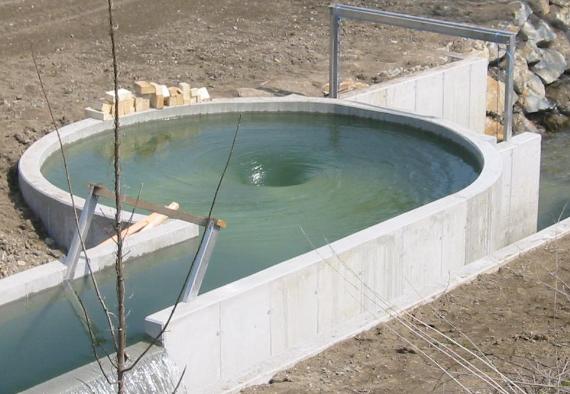
In pump operation, and due to insufficient height of liquid surface covering the suction end of the pump, the reduction in pressure causes a swirling or spiral motion of the liquid which forms what we call vortex. The swirling or vortex is occurred in a form of a cone of air through the liquid with its base at water surface and its head at suction end of pump.

The vortex causes entrance of air into the pump which leads to reduce its efficiency, and may be lead to pump damage.

This type of vortex can be controlled may be by adding a vortex breaker or by increasing the liquid height over the end suction of pump.

Where Cavitation is another type of male function in a pump operation where due to reduction in pressure at suction of a pump up to attaining the vapor pressure of the liquid, the liquid molecules start to boil (yes boiling) and forming a bubbles at very low pressure, where when these bubbles arrived to the impeller (with its higher pressure side), the bubbles start to collapse at the surface of the impeller causing knocking and pitting of the impeller and lead to reduce the pump efficiency, and may be lead to damage of the pump.

See CR4 Thread :Vortex Breaker.

Vortex shape (swirling)

__________________
It is better to be defeated on principles, than to win on lies!
Register to Reply
Power-User

Join Date: Mar 2009
Location: Southern IN.
Posts: 219
#10

Re: Vortex Problems in Pump Applications

09/12/2009 8:34 AM

Sir

The vortex is a powerfull force when applied with other airflow combinations,

Just 1 problem when a combinations of more than 2 flows are combined at that point without proper defussion it will cause a atmosphiere tornado, OPEN LOOP!,

simmliar to the fire tornado's in the wild fires where they come together, the heat wave twisting together makes a bigger vortex, riseing up !

This is just 1 part of the 8 naturals that make up the system known as the

RENEWABLE ( THERMAL )= WIND POWER THE ENERGY POWER SCOURE.

__________________
Renewable energy Researcher/Inventor
Register to Reply Score 1 for Off Topic
Guru
Engineering Fields - Marine Engineering - New Member

Join Date: Aug 2007
Location: Australia
Posts: 1630
Good Answers: 20
#11

Re: Vortex Problems in Pump Applications

09/12/2009 11:03 AM

As pointed out by some the respondents, a vortex can cause mechanical damage to the pump, caused by air being drawn into the pump inlet.

Cavitation will also cause severe mechanical damage to a pump. Holes are formed in the liquid being pumped, in the eye of the impeller and as these holes in the liquid are pumped into the discharge side of the impeller. The increased pressure causes these holes to implode and thousands of particles of liquid travel at hundreds of miles an hour across the holes delivering "hammer like blows" on the vanes of the impeller. Cavitation is worse in cold liquids, in hot liquids these holes can be filled with vapour which tends to slow the droplets of liquid down.

Bad designed inlet systems are a major cause of cavitation, or if a valve on the inlet side is not fully opened, or a partially blocked strainer, can cause cavitation. If it is possible to hear the pump, over other running machinery, cavitation can be heard............it sounds like the pump is pumping nuts and bolts.

__________________
TO BE. or NOT TO BE. That is the question!! The Bard
Register to Reply
Guru

Join Date: Mar 2007
Posts: 2550
Good Answers: 103
#12

Re: Vortex Problems in Pump Applications

09/12/2009 1:04 PM

Check up this site. It has extensive literature on pumps. here it deals with cavitation.

__________________
Fantastic ideas for a Fantastic World, I make the illogical logical.They put me in cars,they put me in yer tv.They put me in stereos and those little radios you stick in your ears.They even put me in watches, they have teeny gremlins for your watches
Register to Reply
Power-User

Join Date: Mar 2009
Posts: 162
Good Answers: 5
#13

Re: Vortex Problems in Pump Applications

09/12/2009 5:04 PM

Several people have said that when a pump doesn't get enough water on the suction side, the pump has to work harder. This is not completely true. The pump actually works less. It does less work and pumps less water. I have worked on high pressure high volume 3 stage forestry fire pumps for years. They are powered by a single cylinder Rotax engine. When the pump inlet becomes restricted or sucks air the gasoline engine speeds up and trips an overspeed switch shutting the engine down before it self destructs. The fact that the engine overspeeds tells me that the pump sucking air at the inlet does not work harder. Maybe it is just bad terminology why people say that the pump works harder. Certainly not good for it or the seals to run dry though.

Register to Reply Off Topic (Score 5)
Register to Reply 14 comments
Copy to Clipboard

Users who posted comments:

Abdel Halim Galala (1); chalifouxcharlie (1); Ed Weldon (1); Hendrik (2); kennynabb6 (1); Kyzine (1); MOBI (1); PetroPower (1); PWSlack (1); rickwil (1); sb (1); VT (2)

Previous in Forum: Condition for PQR to support WPS.   Next in Forum: Flow and Pressure Through Stand-By Centrifugal Pump

Advertisement