|
Aviation was still a relatively new concept in the decade preceding the start of World War II. However, engineers and scientists on both sides saw the possibilities that a superior air force could make, and the war years saw the rapid growth of the fighter plane technology. The first rudimentary onboard computers were installed, and the first aircraft equipped with radar took the skies. Improved devices, such as the Norden bombsight, allowed bombardiers to deliver their payloads with greater accuracy.
Both Germany and England developed jet-propelled military aircraft although neither side produced a sufficient number soon enough to make any significant difference in the course of the war. Most of the engineering changes during World War II involved designing planes that improved fuel range, climbing rates, maneuverability and load capacity. Although numerous aircraft were developed during the war by both sides, three stand out as distinguished examples of wartime technology.
B-17 Flying Fortress

The B-17 was initially given its nickname because it sported an impressive complement of machine guns, including one in its nose, which was a unique feature at the time. The nickname was reinforced during the war as the B-17 had a reputation for getting its crews home safely even after the aircraft incurred heavy damage.
The "Memphis Belle" portrayed in the movie of the same name was a B-17, and like the aircraft portrayed in the film, the aircraft was used extensively for daylight precision bombings in Europe. In the South Pacific and North Africa, the B-17 was less successful although the aircraft participated in the Battle of Midway, the Battle of Coral Sea and the Battle of Bismarck Sea. Nevertheless, B-17s dropped more tons of bombs than any other aircraft used in World War II.
Much of the B-17's success was due to its ceiling -- 35,600 feet -- and range -- 2,000 miles when loaded with 6,000 pounds of bombs. It had a cruising speed of 182 mph with the power provided by four Wright "Cyclone" engines, each producing 1,200 horsepower. Thirteen 0.50 caliber machine guns bristled from eight different positions, making the B-17 formidable prey for enemy fighters. Despite the strengths of the B-17, losses over Europe were heavy, especially in the days prior to the introduction of the P-51 Mustang.
P-51 Mustang

The P-51 was a long-range fighter that was capable of escorting Allied bombers conducting raids on Germany. Other Allied fighters lacked either the range or the armaments to compete successfully against the German fighters although modifications made as the war progressed gave the Allies additional options.
The Mustang had a service ceiling of 41,900 feet and a cruising speed of 362 mph. With a maximum range of 1,650 miles and six 0.50 caliber machine guns, the P-51 was ideally suited for not only escort duty, but for running sweeps ahead of the bombers to intercept enemy fighters. Depending on the model, the P-51 could be equipped with up to 10 rockets or 2,000 pounds of bombs.
Although an American plane, the Mustang first saw action in the service of other nations, notably the British RAF and Polish Air Force, before the U.S. entered the war. The P-51 took part in operations in North Africa and Italy, but saw limited action in Pacific operations.
For range and altitude, the P-51 far surpassed the Messerschmitt Bf 109 and Focke-Wulf Fw 190A flown by the Germans early in the war. However, Mustangs were less successful against the Japanese Zero.
Mitsubishi A6M Zero
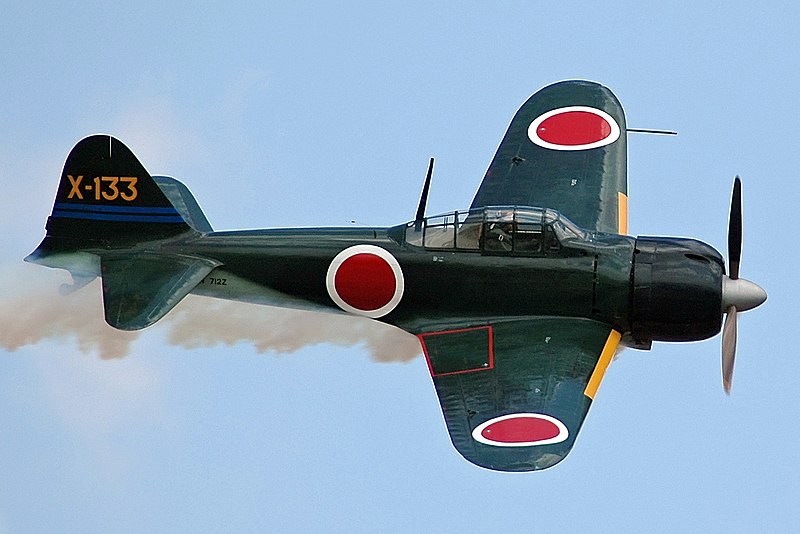
The Mitsubishi Zero was the fighter chosen by the Japanese Navy for carrier operations as well as limited land-based use. Zeros participated in the attack on Pearl Harbor, Midway, Coral Sea and even an assault against Dutch Harbor in Alaska. In the final days of the war, the Zero was used for kamikaze attacks as well. Today, it's one of the most commonly recognized World War II aircraft models, forever associated with the Kamikaze attacks on Pearl Harbor.
The Zero had a range of 1,929 miles, a maximum speed of 331 mph and an effective ceiling of 33,000 feet. Mounted in the engine cowling were two 7.7 mm machine guns, and a 20 mm cannon was attached to each wing. The first Allied fighters to encounter the Zero lost at a rate of approximately 12 to 1. However, as Allied technology improved and pilots developed new tactics, the dogfights became more evenly matched.
Editor's Note: Jeff Johnston is the Director of Marketing at Squadron, a store offering model aircraft, cars, tanks, ships and more ranging from World War I to modern technology; and is a huge fan of World War II history, particularly in the area of aviation.
image credits - Wikimedia
| 

 4
4


 Re: Top World War II Planes


Good Answers:
"Almost" Good Answers: