Aerospace Blog Blog

Aerospace Blog

The Aerospace Blog is the place for conversation and discussion about aeronautics, astronautics, fixed-wing aircraft, future space travel, satellites, NASA, and much more.

Previous in Blog: Another Attempt at Airships   Next in Blog: Missing! Reward! 210-Foot, 328-Ton Airliner
Close
Close
Close
Page 2 of 2: « First < Prev 1 2 Last »
Rate Comments: Nested

Top World War II Planes

Posted March 08, 2014 9:00 AM by CR4 Guest Author

Aviation was still a relatively new concept in the decade preceding the start of World War II. However, engineers and scientists on both sides saw the possibilities that a superior air force could make, and the war years saw the rapid growth of the fighter plane technology. The first rudimentary onboard computers were installed, and the first aircraft equipped with radar took the skies. Improved devices, such as the Norden bombsight, allowed bombardiers to deliver their payloads with greater accuracy.

Both Germany and England developed jet-propelled military aircraft although neither side produced a sufficient number soon enough to make any significant difference in the course of the war. Most of the engineering changes during World War II involved designing planes that improved fuel range, climbing rates, maneuverability and load capacity. Although numerous aircraft were developed during the war by both sides, three stand out as distinguished examples of wartime technology.

B-17 Flying Fortress

The B-17 was initially given its nickname because it sported an impressive complement of machine guns, including one in its nose, which was a unique feature at the time. The nickname was reinforced during the war as the B-17 had a reputation for getting its crews home safely even after the aircraft incurred heavy damage.

The "Memphis Belle" portrayed in the movie of the same name was a B-17, and like the aircraft portrayed in the film, the aircraft was used extensively for daylight precision bombings in Europe. In the South Pacific and North Africa, the B-17 was less successful although the aircraft participated in the Battle of Midway, the Battle of Coral Sea and the Battle of Bismarck Sea. Nevertheless, B-17s dropped more tons of bombs than any other aircraft used in World War II.

Much of the B-17's success was due to its ceiling -- 35,600 feet -- and range -- 2,000 miles when loaded with 6,000 pounds of bombs. It had a cruising speed of 182 mph with the power provided by four Wright "Cyclone" engines, each producing 1,200 horsepower. Thirteen 0.50 caliber machine guns bristled from eight different positions, making the B-17 formidable prey for enemy fighters. Despite the strengths of the B-17, losses over Europe were heavy, especially in the days prior to the introduction of the P-51 Mustang.

P-51 Mustang

The P-51 was a long-range fighter that was capable of escorting Allied bombers conducting raids on Germany. Other Allied fighters lacked either the range or the armaments to compete successfully against the German fighters although modifications made as the war progressed gave the Allies additional options.

The Mustang had a service ceiling of 41,900 feet and a cruising speed of 362 mph. With a maximum range of 1,650 miles and six 0.50 caliber machine guns, the P-51 was ideally suited for not only escort duty, but for running sweeps ahead of the bombers to intercept enemy fighters. Depending on the model, the P-51 could be equipped with up to 10 rockets or 2,000 pounds of bombs.

Although an American plane, the Mustang first saw action in the service of other nations, notably the British RAF and Polish Air Force, before the U.S. entered the war. The P-51 took part in operations in North Africa and Italy, but saw limited action in Pacific operations.

For range and altitude, the P-51 far surpassed the Messerschmitt Bf 109 and Focke-Wulf Fw 190A flown by the Germans early in the war. However, Mustangs were less successful against the Japanese Zero.

Mitsubishi A6M Zero
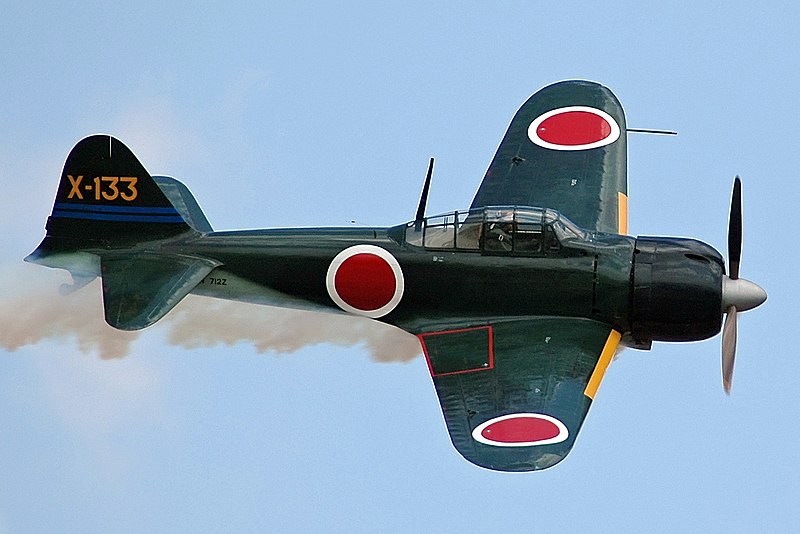
The Mitsubishi Zero was the fighter chosen by the Japanese Navy for carrier operations as well as limited land-based use. Zeros participated in the attack on Pearl Harbor, Midway, Coral Sea and even an assault against Dutch Harbor in Alaska. In the final days of the war, the Zero was used for kamikaze attacks as well. Today, it's one of the most commonly recognized World War II aircraft models, forever associated with the Kamikaze attacks on Pearl Harbor.

The Zero had a range of 1,929 miles, a maximum speed of 331 mph and an effective ceiling of 33,000 feet. Mounted in the engine cowling were two 7.7 mm machine guns, and a 20 mm cannon was attached to each wing. The first Allied fighters to encounter the Zero lost at a rate of approximately 12 to 1. However, as Allied technology improved and pilots developed new tactics, the dogfights became more evenly matched.


Editor's Note: Jeff Johnston is the Director of Marketing at Squadron, a store offering model aircraft, cars, tanks, ships and more ranging from World War I to modern technology; and is a huge fan of World War II history, particularly in the area of aviation.

image credits - Wikimedia

Reply

Interested in this topic? By joining CR4 you can "subscribe" to
this discussion and receive notification when new comments are added.

Good Answers:

These comments received enough positive votes to make them "good answers".

"Almost" Good Answers:

Check out these comments that don't yet have enough votes to be "official" good answers and, if you agree with them, vote them!
Guru
Popular Science - Weaponology - New Member Safety - ESD - New Member Hobbies - Fishing - New Member

Join Date: Sep 2006
Location: Near Frankfurt am Main, Germany. 50.390866N, 8.884827E
Posts: 17996
Good Answers: 200
#67
In reply to #66
Find in discussion

Re: Top World War II Planes

03/11/2014 4:49 PM

The Kaiser, as a young boy, had to allow that field animals would be killed, slit open and tied onto his deformed arm.....all from Quacks as Germany had no form of proper health regulation till the end of the 19th Century.....

He spent many happy summer holidays with his Grandmother, Queen Victoria, in the UK......

His mother Princess Vicky, had had a breech birth that damaged his spine, Erbs Palsey....his emotional development suffered. See here:-

Kaiser_Wilhelm_II

__________________
"What others say about you reveals more about them, than it does you." Anon.
Reply
Guru

Join Date: Aug 2008
Location: England & Ireland
Posts: 1063
Good Answers: 61
#51
In reply to #45
Find in discussion

Re: Top World War II Planes

03/11/2014 9:53 AM

Thanks so much for your input. It's pretty pointless putting a flimsy article on CR4 about WW2 aircraft. The facts have covered many, many times in books, magazines and factual films for about 50 years. It's very annoying to find someone new to WW2 history hashing out an article on events that took place decades before they were born.

My father was a bomber pilot in WW2, flew the very vulnerable Bristol Blenheim on his first tour of duty (30 raids over enemy territory) and was lucky to survive. He sunk the first German U-boat from the air in 1940, for which he was awarded the DFM. His second tour was flying the Douglas Boston (lend lease from USA) which was a much more capable aircraft. He specialized in low level bombing, approaching at treetop height. He took part in many important raids, including the bombing of the Phillips Valve Factory in Eindhoven (occupied by the Germans) and was awarded the DFC. His luck ran out in 1943 when leading a raid on the St. Denain Steelworks in France, he was shot down. He was captured, gunner was killed and navigator escaped back to UK via, Spain & Gibraltar. He spent 2 years in POW camps in Germany and occupied Poland, which probably saved his life as the attrition rate of bomber pilots rapidly increased thereafter. Bomber Command lost about 55,500 aircrew, and only recently has Britain finally erected a monument to them.

Looking at his log book from that period is fascinating. A typical brief entry: "Raid on St. Malo Lock Gates, dropped 2 x 1,000 lb. and 4 X 250 lb. bombs, chased by Me-410 fighter on return. Sustained some damage and crash landed at Attlebridge."

We have a photo of him and his navigator leaning against their inverted Blenheim casually smoking cigarettes. They did a ground loop on landing the damaged plane and tipped over forwards. On another occasion, he took off but found that the ground crew had reversed the cables going to the rudder!

He is featured in Air Commodore Graham Pitchfork's book "The Men behind the Medals" and in Flypast Magazine: "The Men behind the Medals" series and "A tale of two pilots."

Reply
Guru
Safety - Hazmat - New Member United States - US - Statue of Liberty - New Member Engineering Fields - Chemical Engineering - Old Hand

Join Date: Mar 2011
Location: Lubbock, Texas
Posts: 14331
Good Answers: 162
#54
In reply to #51

Re: Top World War II Planes

03/11/2014 10:23 AM

So with the rudder cables reversed, I don't suppose he zigged when he intended to zag did he? A good pilot should not have to use much rudder in flight, as this only slows you down more than is necessary (IMHO). There are times when that rudder is handy in lining up on a target though, I do suppose.

At least he did not attempt flying backwards, which is a very bad thing to do in bombers. I am not surprised at a Boston escaping an Me 410, especially at altitude, as the 410 was reputed to be even more under-powered than the Me 110 destroyer. Both had some 30mm cannon, 20mm cannon that had a real knock-out punch though.

Bostons with only a top gun turret were especially vulnerable to faster fighters.

__________________
If it ain't broke, don't fix it. Just build a better one.
Reply
Guru

Join Date: Aug 2008
Location: England & Ireland
Posts: 1063
Good Answers: 61
#57
In reply to #54

Re: Top World War II Planes

03/11/2014 12:58 PM

When taking off with a twin propeller powered aircraft under full power, there can be a strong tendency to yaw. Therefore the rudder is absolutely essential in those early seconds. Fortunately he diagnosed the problem fast enough to do a circuit and land. I have no idea what he said to the ground crew afterwards, but having been on the receiving end myself, I can guess.

Reply
Guru
Popular Science - Evolution - New Member Popular Science - Weaponology - New Member

Join Date: May 2006
Location: The 'Space Coast', USA
Posts: 11119
Good Answers: 918
#58
In reply to #57

Re: Top World War II Planes

03/11/2014 1:12 PM

We are taught to always preflight the aircraft prior to takeoff and check that the control surfaces operate in the correct direction and operate smoothly.

Reply
Guru

Join Date: Aug 2008
Location: England & Ireland
Posts: 1063
Good Answers: 61
#61
In reply to #58

Re: Top World War II Planes

03/11/2014 1:31 PM

Yes, well this was about 74 years ago and in the middle of a war!

Reply
Guru

Join Date: Aug 2008
Location: England & Ireland
Posts: 1063
Good Answers: 61
#60
In reply to #51

Re: Top World War II Planes

03/11/2014 1:18 PM

Raid on Phillips Factory, Eindhoven was known as "Operation Oyster." See newsreel on YouTube:

http://www.youtube.com/watch?v=AZzgDkFvHbI

Reply
Reply to Blog Entry Page 2 of 2: « First < Prev 1 2 Last »

Good Answers:

These comments received enough positive votes to make them "good answers".

"Almost" Good Answers:

Check out these comments that don't yet have enough votes to be "official" good answers and, if you agree with them, vote them!
Copy to Clipboard

Users who posted comments:

Andy Germany (11); Anonymous Hero (5); Bricktop (3); energyconversion (5); Fredski (3); GM1964 (1); Hooker (9); James Stewart (8); JWthetech (4); KillerGig (4); lyn (5); micahd02 (17); phoenix911 (24); roy hammy (5); sbruel (1); Usbport (2)

Previous in Blog: Another Attempt at Airships   Next in Blog: Missing! Reward! 210-Foot, 328-Ton Airliner

Advertisement