|
Friday marks the 70th anniversary of D-Day, June
6, 1944. It would be thoughtless to not mention the bravery of the American
(and British and Canadian) men who made the ultimate sacrifice for the sake of
the world during a pre-dawn operation on the French coastline. Memorial Day was
last week here in the United States, but the Greatest Generation deserves its
own commemoration.
The fighting men on the front lines provided the heroics and
willpower that ultimately would lead to Hitler's downfall, but as with any
military operation, a sizeable team of engineers and scientists provided the
technical support that would lead an army ashore, and in this case fuel it to
victory less than a year later.
So let's take a peek at some of the forgotten contributions
to the machines, structures, and systems that wrestled Europe away from the
Axis.
Mulberry harbors
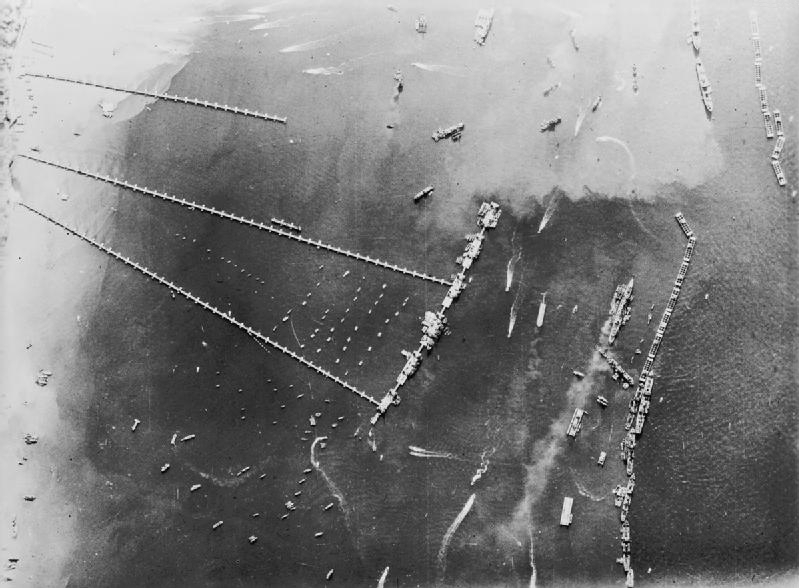 Once the D-Day invasion had established a beachhead, a
ludicrous amount of troops and supplies had to land to support the push through
occupied France. The problem was that any harbor that could support large
freighters was still held by the Germans. The Corps of Royal Engineers
conducted a test of three jetty designs on the English coast that were
prefabricated, modular, and robust enough to withstand the considerable loads
and weather conditions expected at Normandy Beach. However, a severe storm
washed away two of the three experiments before the test were completed,
leaving Major Allan Beckett's design the de facto winner. Once the D-Day invasion had established a beachhead, a
ludicrous amount of troops and supplies had to land to support the push through
occupied France. The problem was that any harbor that could support large
freighters was still held by the Germans. The Corps of Royal Engineers
conducted a test of three jetty designs on the English coast that were
prefabricated, modular, and robust enough to withstand the considerable loads
and weather conditions expected at Normandy Beach. However, a severe storm
washed away two of the three experiments before the test were completed,
leaving Major Allan Beckett's design the de facto winner.
To construct these, a series of caissons were sunk parallel
to Normandy Beach and rigid roadways were constructed between them. Floating
pontoons measuring 80 ft. long brought vehicles, troops, and supplies ashore.
These floating sections were flexible and adapted to tide and wave patterns.
After 10 months of service-though originally expected to last just 3 months-the
Mulberry harbor at Arromanches had landed 2.5 million troops, 500,000 vehicles,
and 4 million tons of supplies. The pontoon sections, known as whales, were so
strong they were later used as temporary fixes for some of France's destroyed
bridges, and a few of them remain today. The ruins of the Mulberry harbor has
protected historical status in France today.
"The Most Important Weather Forecast Ever"
 General Eisenhower required a full moon, low tide, low
swells, limited cloud cover, and light winds to have an
optimal chance of taking the Normandy defenses. But an unusual seasonal
weather pattern had doused the English Channel with days of storms and rain; on
June 4, 1944, convoys and ships were called back from the first invasion
attempt as conditions worsened. The Germany Navy had lost influence in the
Atlantic, and as a result had less accurate weather forecasts. German
meteorologists predicted a week of rain and rough seas, so the commanders
granted passes and free time, leaving the front line with a minimal garrison. General Eisenhower required a full moon, low tide, low
swells, limited cloud cover, and light winds to have an
optimal chance of taking the Normandy defenses. But an unusual seasonal
weather pattern had doused the English Channel with days of storms and rain; on
June 4, 1944, convoys and ships were called back from the first invasion
attempt as conditions worsened. The Germany Navy had lost influence in the
Atlantic, and as a result had less accurate weather forecasts. German
meteorologists predicted a week of rain and rough seas, so the commanders
granted passes and free time, leaving the front line with a minimal garrison.
But two teams of English scientists and one American
forecaster conferred and recognized a potential break in the weather-enough of
one to prompt an argument amongst themselves. Swells would be high and clouds
numerous, but it was sufficient for an invasion. Eisenhower gave the go-ahead,
and some estimates say the detailed forecast saved up to 60,000 lives on D-Day.
Flying, floating tanks
While it was easy (logistically, at least) to land personnel
on Normandy, it was more difficult to supply infantry with the firepower needed
to get through the German barricades. Tanks were an absolute requirement, but
the flat-bottomed Higgins boats that brought men were ineffective. So engineers
conceived two ways to mobilize the big guns.
 The first way was to fly light tanks behind enemy lines,
where their speed and agility could assault targets and hold them until
reinforced. Thirty British light tanks, known as Tetrarchs,
were loaded into the hold of gliders and towed towards Normandy along with
their crew in the late afternoon of June 6. While these were meant to spearhead
the invasion, they actually hindered D-Day operations more than they helped.
Germans had erected many glider poles in the area to prevent stealth landings,
and paratroopers had to remove them from "hot" landing zones. Considerable time
had been spent making a heavy-duty glider to carry a tank into battle, but the
gliders handled terribly due to the extreme weight; several of them crashed
without taking fire. Finally, the Tetrarchs that made it to action were
severely outgunned by German tanks in the area, and they frequently became
entangled in parachute lines from personnel and the gliders. The first way was to fly light tanks behind enemy lines,
where their speed and agility could assault targets and hold them until
reinforced. Thirty British light tanks, known as Tetrarchs,
were loaded into the hold of gliders and towed towards Normandy along with
their crew in the late afternoon of June 6. While these were meant to spearhead
the invasion, they actually hindered D-Day operations more than they helped.
Germans had erected many glider poles in the area to prevent stealth landings,
and paratroopers had to remove them from "hot" landing zones. Considerable time
had been spent making a heavy-duty glider to carry a tank into battle, but the
gliders handled terribly due to the extreme weight; several of them crashed
without taking fire. Finally, the Tetrarchs that made it to action were
severely outgunned by German tanks in the area, and they frequently became
entangled in parachute lines from personnel and the gliders.
The second way was to float
tanks in from the ocean and land them on the beach, side-by-side with the
infantry. Although under development since WWI, floating tanks did not see
battle until D-Day. Engineers continually struggled with providing enough
buoyancy, and most solutions were so impractical they were immediately
scrapped.  However, Nicholas Straussler demonstrated that a collapsible,
waterproof screen around the tank perimeter could make a Tetrarch buoyant, and
this concept was eventually applied to British Valentine and American Sherman
tanks, which were also outfitted with a propeller. On D-Day, these tanks were
mostly successful, but 27 of 29 floating tanks sank off Omaha Beach, most of
them within minutes. Along this section of Normandy, waves were six times the
height of the screens. However, floating tanks on Utah, Juno, Gold, and Sword
beaches fared much better. By the time the American invaded Okinawa less than a
year later, the screens had been replaced with pontoons which made the tanks
infinitely more seaworthy. However, Nicholas Straussler demonstrated that a collapsible,
waterproof screen around the tank perimeter could make a Tetrarch buoyant, and
this concept was eventually applied to British Valentine and American Sherman
tanks, which were also outfitted with a propeller. On D-Day, these tanks were
mostly successful, but 27 of 29 floating tanks sank off Omaha Beach, most of
them within minutes. Along this section of Normandy, waves were six times the
height of the screens. However, floating tanks on Utah, Juno, Gold, and Sword
beaches fared much better. By the time the American invaded Okinawa less than a
year later, the screens had been replaced with pontoons which made the tanks
infinitely more seaworthy.
All in all, the Allied victory in World War II was a team
effort, but it was the skilled analytics of key engineers and scientists that
liberated Europe of Nazi powers.
| 


 Re: Engineers Save the World--June 6, 1944


"Almost" Good Answers: