Challenge Questions Blog

Challenge Questions

Stop in and exercise your brain. Talk about this month's Challenge from Specs & Techs or similar puzzles.

So do you have a Challenge Question that could stump the community? Then submit the question with the "correct" answer and we'll post it. If it's really good, we may even roll it up to Specs & Techs. You'll be famous!

Answers to Challenge Questions appear by the last Tuesday of the month.

Previous in Blog: Autumnal Glow: Newsletter Challenge (December 2014)   Next in Blog: Jovian System: Newsletter Challenge (February 2015)
Close
Close
Close
11 comments
Rate Comments: Nested

Launch Location: Newsletter Challenge (January 2015)
Posted January 01, 2015 12:00 AM
Pathfinder Tags: challenge question

This month's Challenge Question: Specs & Techs from IHS Engineering360:

The Kennedy Space Center at Cape Canaveral is located at latitude 28.5° North. Besides being close to the Equator to facilitate launching, why is this latitude especially important for launching lunar satellites? The center's location gave clear edge to the US Apollo program compared to the Soviet satellite launch location at Tyuratam.

And the answer is:

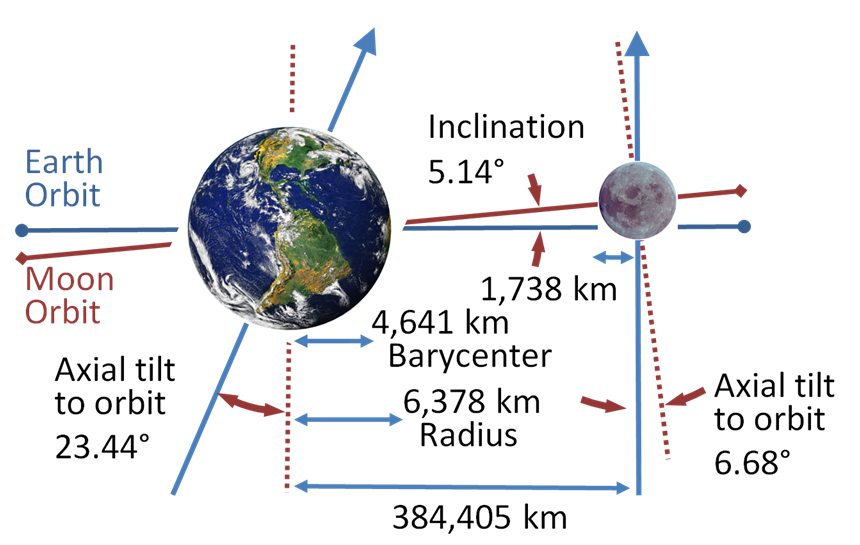
The orbit of the Moon is affected by the gravity exerted by the Sun, causing the lunar orbit to be inclined by about ±5 degrees and 9 minutes with respect to the Earth's orbital plane. Add this to the normal tilt of the Earth's Equator with respect to the orbital plane 23 degrees and 28 minutes, the inclination of the Moon orbit with respect to the Earth's Equator varies from 18 degrees and 19 minutes to 28 degrees and 37 minutes, close to the exact latitude of Cape Canaveral. This allowed NASA to launch the spacecraft directly into orbits that lie almost exactly in the plane of the moon.

On the other hand, the Soviet launch site is located at 45.6 degrees North latitude. They had to launch the spacecraft into an orbit with inclination of 45.6 degrees; this orbit is inclined about 17 degrees respect to the lunar orbit. Once the spacecraft is in this plane, it must change direction to the Moon's orbital plane, requiring high fuel consumption and complicated logistics.

Reply

Interested in this topic? By joining CR4 you can "subscribe" to
this discussion and receive notification when new comments are added.

Good Answers:

These comments received enough positive votes to make them "good answers".

"Almost" Good Answers:

Check out these comments that don't yet have enough votes to be "official" good answers and, if you agree with them, vote them!
6
Guru
Popular Science - Evolution - New Member Popular Science - Weaponology - New Member

Join Date: May 2006
Location: The 'Space Coast', USA
Posts: 11119
Good Answers: 918
#1

Re: Launch Location: Newsletter Challenge (January 2015)

01/01/2015 9:10 AM

Counter to what most people would think, the Earth and the Moon do not orbit each other with their axis of rotation co-aligned. In other words, the Moon's orbital plane is not the same as the Earth's equatorial plane.

The trans-lunar injection is performed from an orbit that is offset from the Earth's equator (axis of rotation) that puts it in the same plane that the Moon orbits Earth.

Here is an illustration from Wikipedia that loosely illustrates my point:

Trans-lunar injection actually follows the plane of the Moon's orbit, but as shown below, it cuts under the Moon and then begins an orbit by cutting in front of the Moon in the opposite orbital direction from Earth. To do this the space craft must approach on the Moon's orbital plane.

Lastly, the location of departure on Earth must also be timed with the Earth's rotation to make this work. That is why NASA has "launch windows" that take into account the Earth departure point, the Earth's rotational position, and the Moon's orbital position.

Reply Good Answer (Score 6)
3
Guru
Engineering Fields - Aerospace Engineering - Retired South Africa - Member - The Rainbow-nation Engineering Fields - Engineering Physics - Relativity & Cosmology Popular Science - Cosmology - The Big Picture!

Join Date: May 2006
Location: Pretoria, South Africa
Posts: 3804
Good Answers: 69
#2
In reply to #1

Re: Launch Location: Newsletter Challenge (January 2015)

01/02/2015 2:45 AM

Add to what AH has said the interesting fact that the ~23.5° of Earth's tilt plus the ~5° between the moon's and Earth's orbital planes add up to ~28.5°, the latitude of Cape Canaveral. This means that the moon's orbital plane cuts the Cape at least twice a year and the energy to put the vehicle onto the Moon's plane is minimized. The Soviet Tyuratam base, at ~45N° never has this benefit.

I used to live in Pretoria at 26° South and have observed the full moon directly overhead a few times. I then realized that I must be on the moons orbital plane. It was winter, with the Sun low, but the full moon high. The orbital plane alignment must happen in summer as well, but then it will be the new moon, not so?

__________________
"Perplexity is the beginning of knowledge." -- Kahlil Gibran
Reply Good Answer (Score 3)
Guru
Popular Science - Evolution - New Member Popular Science - Weaponology - New Member

Join Date: May 2006
Location: The 'Space Coast', USA
Posts: 11119
Good Answers: 918
#4
In reply to #2

Re: Launch Location: Newsletter Challenge (January 2015)

01/02/2015 8:25 AM

Yes, I live about 25 miles due south of the Apollo launch site and the Moon's zenith does appear to pass about strait up overhead.

I am also told by some long term residents here that the local historical weather conditions were another factor in the decision for the launch site. NASA does get a lot of electrical storms, but they do seem to be spared most of the hurricane damage that Florida seems to get.

You are absolutely right that the Hohmann transfer orbit used for the Moon shot is all about energy conservation.

Reply Score 1 for Good Answer
Guru
Engineering Fields - Optical Engineering - Member Engineering Fields - Engineering Physics - Member Engineering Fields - Systems Engineering - Member

Join Date: Apr 2010
Location: Trantor
Posts: 5363
Good Answers: 647
#8
In reply to #2

Re: Launch Location: Newsletter Challenge (January 2015)

01/03/2015 9:55 AM

Also, due to the rotation of the Earth, Canaveral has about a 170 miles/hour liftoff advantage in getting into orbit due its latitude. At Canaveral (28.5 deg N) the launchpad is already moving eastward at about 880 miles/hour, whereas the launchpad in Tyuratam (~45 deg N) is moving eastward at about 710 miles/hour.

__________________
Whiskey, women -- and astrophysics. Because sometimes a problem can't be solved with just whiskey and women.
Reply
Guru

Join Date: Apr 2010
Location: About 4000 miles from the center of the earth (+/-100 mi)
Posts: 9910
Good Answers: 1141
#9
In reply to #1

Re: Launch Location: Newsletter Challenge (January 2015)

01/04/2015 8:22 PM

Good Answer.

It stands to reason: when you launch, your "satellite" will be travelling in a plane defined by (1) The center of the earth, (2) The launch location, and (3) the direction of launch. To rendezvous with the moon, you have to be travelling in the plane of the moon's orbit. The planes are no where near parallel for the Russians launch location, no matter what the launch direction, whereas they very closely match for a launch from Cape Canaveral.

Another way to look at it is that the earth's gravity imparts a southern directional velocity when you launch from a high northern latitude (the earth's center is to the south). This velocity has to be cancelled out to rendezvous with the moon.

Reply
Guru
Popular Science - Weaponology - New Member Safety - ESD - New Member Hobbies - Fishing - New Member

Join Date: Sep 2006
Location: Near Frankfurt am Main, Germany. 50.390866N, 8.884827E
Posts: 17996
Good Answers: 200
#3

Re: Launch Location: Newsletter Challenge (January 2015)

01/02/2015 4:04 AM

Does anyone know if this was a known given when the space center was first built/decided upon, or was it simply a lucky accident?

I had a look around and it appears to have been in use since sometime around the end of the 50s, but I could not find a definite date. But well before JFK's statement about going to the moon.

Many thanks for any help possible.

__________________
"What others say about you reveals more about them, than it does you." Anon.
Reply
Guru
Popular Science - Evolution - New Member Popular Science - Weaponology - New Member

Join Date: May 2006
Location: The 'Space Coast', USA
Posts: 11119
Good Answers: 918
#5
In reply to #3

Re: Launch Location: Newsletter Challenge (January 2015)

01/02/2015 8:39 AM

There were a lot of factors in the decision process, but the lunar orbit was not really one of them.

The main factors were:

1. Proximity to the equator
2. They wanted an eastern coast to avoid launching over populated areas.
3. The area (Brevard County) was virtually desolate at the time with no population.
4. There were several military air bases close by to provide logistical support.
5. There was already a road infrastructure in place to serve the military bases.
6. Water access to the facility via the ocean and Indian river that runs along the east Florida coast.

Reply Score 1 for Good Answer
Guru
Engineering Fields - Optical Engineering - Member Engineering Fields - Engineering Physics - Member Engineering Fields - Systems Engineering - Member

Join Date: Apr 2010
Location: Trantor
Posts: 5363
Good Answers: 647
#6
In reply to #5

Re: Launch Location: Newsletter Challenge (January 2015)

01/03/2015 7:21 AM

7. And the Atlantic Coast Railway had a rail line nearby.

__________________
Whiskey, women -- and astrophysics. Because sometimes a problem can't be solved with just whiskey and women.
Reply Score 1 for Good Answer
Guru
Popular Science - Evolution - New Member Popular Science - Weaponology - New Member

Join Date: May 2006
Location: The 'Space Coast', USA
Posts: 11119
Good Answers: 918
#7
In reply to #6

Re: Launch Location: Newsletter Challenge (January 2015)

01/03/2015 9:03 AM

That's right! I forgot about that, but there are a lot of lines running right through all the east coast cities here in Florida.

I just take them for granted.n That is, until you are stuck waiting for one. ;-)

Reply
Guru

Join Date: Mar 2009
Posts: 507
#10

Re: Launch Location: Newsletter Challenge (January 2015)

01/13/2015 11:28 AM

the earth axis is declined by 27.5 degrees (not fahrenheit or celsius) and the moon's eclipse is declined by nearly 5° to the earth's ecliptic.

the latitude of CC 28.5° is inside the sum of earths axis angle and moons ecliptic angle 27.5+5=32.5°, this is not allways but often and by this reason the journey to the moon can start in cycles of 4 weeks only. It is optimal just only if moons ecliptic + earth axis is equal the CC-latitude.

Reply
Guru
Engineering Fields - Aerospace Engineering - Retired South Africa - Member - The Rainbow-nation Engineering Fields - Engineering Physics - Relativity & Cosmology Popular Science - Cosmology - The Big Picture!

Join Date: May 2006
Location: Pretoria, South Africa
Posts: 3804
Good Answers: 69
#11
In reply to #10

Re: Launch Location: Newsletter Challenge (January 2015)

01/13/2015 11:58 AM

I guess you just had a 'slip of the lip', because Earth's spin axis declination is about 23.45° relative to the ecliptic, not 27.5°, so the sum just about reaches the Cape's latitude.

-J

__________________
"Perplexity is the beginning of knowledge." -- Kahlil Gibran
Reply
Reply to Blog Entry 11 comments

Good Answers:

These comments received enough positive votes to make them "good answers".

"Almost" Good Answers:

Check out these comments that don't yet have enough votes to be "official" good answers and, if you agree with them, vote them!
Copy to Clipboard

Users who posted comments:

Andy Germany (1); Anonymous Hero (4); Jorrie (2); Rixter (1); Usbport (2); WilhelmHKoen (1)

Previous in Blog: Autumnal Glow: Newsletter Challenge (December 2014)   Next in Blog: Jovian System: Newsletter Challenge (February 2015)

Advertisement
