|
Guns are so early 20th century. Depending on
country and culture, they may even be so 19th century. Yes, they
remain the primary means of personal self-defense for both military and
civilian purposes. But for military needs, the large calibers mounted on wagons,
trucks, trains and ships for about 100 years have been replaced by advanced
weapons that can strike with pinpoint accuracy from remote distances.
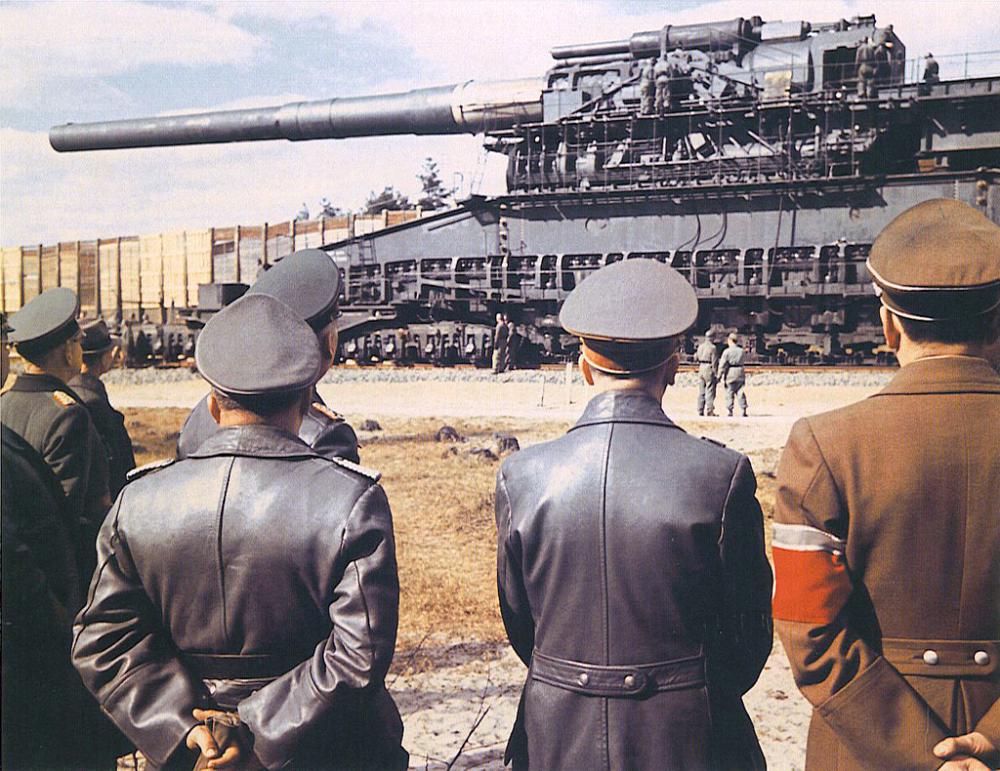 Guided missiles and precision bombing ultimately eliminated
battleships from the Naval Vessel Register. Even the world's largest gun ever
built, the Schwerer
Gustav (80 cm caliber; pictured left), was obsolete by the time it reached the
battlefield, and is more of a footnote than anything else. In fact large caliber artillery experienced a
relatively short duration of supremacy on the battlefield, from--at most-- the
beginning of industrialization until the Atomic Age. Guided missiles and precision bombing ultimately eliminated
battleships from the Naval Vessel Register. Even the world's largest gun ever
built, the Schwerer
Gustav (80 cm caliber; pictured left), was obsolete by the time it reached the
battlefield, and is more of a footnote than anything else. In fact large caliber artillery experienced a
relatively short duration of supremacy on the battlefield, from--at most-- the
beginning of industrialization until the Atomic Age.
But new developments in a technology that's been touted for
20 years may put guns back on the front lines. There have been numerous media
stories in recent years about the potential for railguns, and most concluded
with a variation of "this technology needs further development before
battlefield realization." They've done a good job capturing imagination due to the extreme destruction capable from one shot, which obliterates targets with nary an explosive.
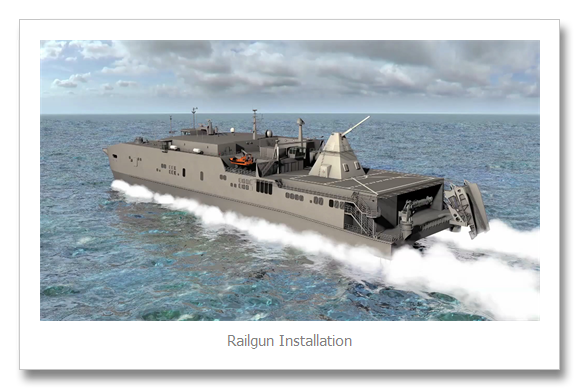 Now the U.S. Navy is experimentally mounting a
railgun onto a catamaran, known as a joint high-speed vessel (JHSV), to ascertain
seaworthiness in hopes of integrating
the weapon into a next-generation destroyer in 2018. Now the U.S. Navy is experimentally mounting a
railgun onto a catamaran, known as a joint high-speed vessel (JHSV), to ascertain
seaworthiness in hopes of integrating
the weapon into a next-generation destroyer in 2018.
Despite only recently entering mainstream awareness the earliest incarnation
of a railgun dates to a 1922 U.S. patent filed by Frenchman Louis Octave
Fauchon-Villeplee, who created a gun that fired bullets with stabilizing fins.
The concept of the railgun is the same today as it was then. Two long, parallel
rails connected to a power supply, each representing an  opposite pole. When a
conductive projectile is placed between the rails the circuit is completed.
Also created is a magnetic field that is directed at right angles away from the
rails and armature, which ultimately is what provides kinetic force to the
projectile. Higher energy along the rails creates an equivalent increase in
projectile speed, and experimental projectile speeds of 20 km per second have
been achieved. opposite pole. When a
conductive projectile is placed between the rails the circuit is completed.
Also created is a magnetic field that is directed at right angles away from the
rails and armature, which ultimately is what provides kinetic force to the
projectile. Higher energy along the rails creates an equivalent increase in
projectile speed, and experimental projectile speeds of 20 km per second have
been achieved.
However, materials science has lagged behind, as creating
rails that resist the excessive thermal loads has proved troublesome. Current
rates of fire are limited to about 2 or 3 per minute because of this challenge,
even on the type the Navy plans to implement. Railguns also require immense
electrical energy, in this instance 34 megajoules. Next-gen warships are the
only platforms able to supply this type of power. However, such warships will
also require a railgun that can communicate with planned weapons systems, as
well as one that can be scaled to fit in available deck space. These are the obstacles
that will hopefully be solved with the at-sea tests on the JHSV.
Why invest in such a troublesome technology? Sustainability
and safety. One shot from a railgun will cost significantly less than a
missile. It's also exponentially more powerful, in some cases obliterating
armored vehicles before continuing to travel for miles. Since the projectiles
aren't explosive themselves, they also don't present a risk to personnel or the
ship.
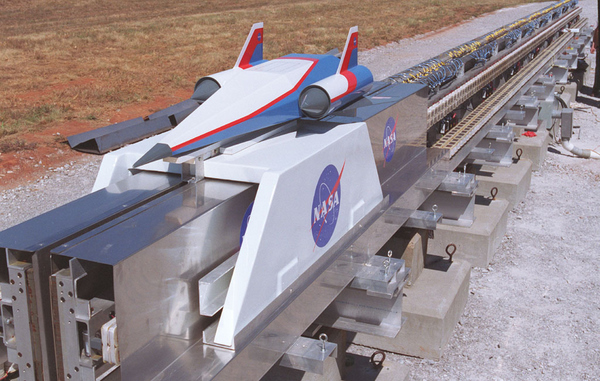 Of course there are other applications for railguns, such as
designs to launch space craft via a railgun system. Humans cannot survive the
inertia that would be applied to a spacecraft projectile, but cargo could be
supplied to space stations at a much lower cost. There is also the potential
for using railguns to initiate inertial confinement nuclear fusion, where the
guns will replace lasers to fire energetic plasma at a fuel. Such guns will
need to be scaled down to a great degree. Of course there are other applications for railguns, such as
designs to launch space craft via a railgun system. Humans cannot survive the
inertia that would be applied to a spacecraft projectile, but cargo could be
supplied to space stations at a much lower cost. There is also the potential
for using railguns to initiate inertial confinement nuclear fusion, where the
guns will replace lasers to fire energetic plasma at a fuel. Such guns will
need to be scaled down to a great degree.
While the Navy needs a new weapon, the world may gain new
accessibility to space and maybe even a groundbreaking power source. For now,
railguns should still be filed under "needs development."
| 


 Re: Velocitas Eradico (I, Who Am Speed, Eradicate)


