|
This month's Challenge Question: Specs & Techs from IHS Engineering360:
A 2-cube (square) has 4 vertices and 4 edges. A 3-cube
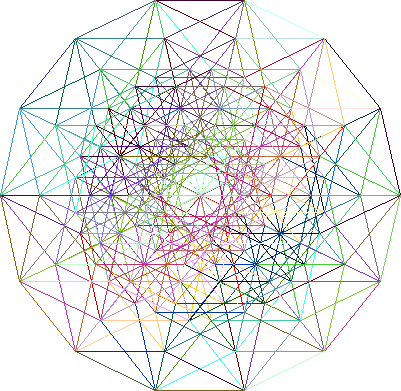
(cube) has 8 vertices, 12 edges, and 6 faces. A 4-cube (tesseract) has 16
vertices, 32 edges, 24 faces, and 8 cells. In three dimensions, the Euler characteristic
says that vertices + faces - edges = 2. What is the right side of the Euler
characteristic equation equal to when generalized and calculated for a
3464-cube?
And the answer is:
The answer is 0. The vertex (0-face), edge (1-face), face
(2-face), cell (3-face), 4-face, etc. are the smaller dimensional objects that
make up a larger dimensional shape. There are always n-1 dimensional objects
that make up an n dimensional shape.
For instance, in 2 dimensions, a square is made up of 1
dimensional lines (edges) and the zero dimensional points (vertices). A three
dimensional cube is made up of 2 dimensional sides (faces), 1 dimensional lines
(edges) and zero dimensional points (vertices). When the Euler Characteristic
is generalized for all dimensions, it says add up the number of even
dimensional components and subtract from them the number of odd dimensional
components. For an n-cube, that difference will be 0 if n is even and 2 if n is
odd. So in the case of a cube in three dimensions, vertices + faces - edges =
2. For a 3464-cube, vertices + faces + 4-faces +…+ 3462-faces - edges -cells -
5-faces - … - 3463-faces = 0.
http://en.wikipedia.org/wiki/Hypercube#Elements
(See Hypercube Elements Chart)
Editor's Note: This question was previously titled "3463-Cube." It was an error and has since been corrected to "3464-Cube."
| 




 Re: 3463-Cube: Newsletter Challenge (March 2015)




"Almost" Good Answers: