|
Perhaps I’ve watched too many episodes of Bones, but I was under the impression that the scientific community had Neandertal injuries figured out. It turns out, like true scientists, they’re still questioning the data.
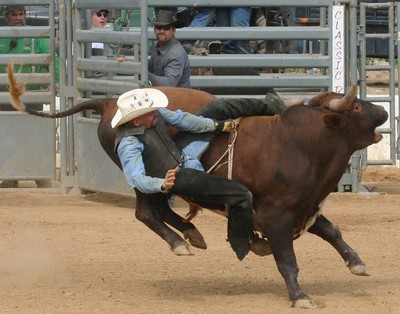 A recent analysis presented by Libby Cowgill at the 2017 meeting of the American Association of Physical Anthropologists presented the idea that “[a]ctivities that cause injuries most resembling the Neandertal patterns have no apparent relation to Stone Age behavior.” A recent analysis presented by Libby Cowgill at the 2017 meeting of the American Association of Physical Anthropologists presented the idea that “[a]ctivities that cause injuries most resembling the Neandertal patterns have no apparent relation to Stone Age behavior.”
This idea contradicts a 1995 report that “Neandertals, like modern rodeo riders, suffered lots of head and above-the-waist injuries and little hip and leg damage.”
The new analysis, completed by Cowgill and James Bain, examined the bone fractures of 61,851 patients between January 2009 and December 2014, ignoring a broader range of skeletal injuries like “signs of degenerative bone disease.” This analysis found that rodeo riders had fewer skull injuries, and more hand wounds, ruling them out of the Neandertal comparison since about 30% of Neandertal injuries affected the face and head.
 Of 84 activities that resulted in bone fractures, “only 16 activities showed any statistical similarities to Neandertals’ injury patterns.” Comically, water tubing and table run-ins had the most similarities, followed by accidents involving golf, lawn chairs, and Frisbee. Of 84 activities that resulted in bone fractures, “only 16 activities showed any statistical similarities to Neandertals’ injury patterns.” Comically, water tubing and table run-ins had the most similarities, followed by accidents involving golf, lawn chairs, and Frisbee.
Cowgill and Bain suggest that none of these injuries have any bearing on the types of activities Neandertals may have undertaken.
In the 1995 research that inspired this new analysis, the researchers suggested the rodeo rider-like injuries came from violent, up-close clashes with large prey—similar to the clashes rodeo riders have with bucking broncos.
 In 2012, one of the co-authors of that study, Erik Trinkaus, questioned their findings in 2012, claiming the injuries could have resulted from many other causes. Trinkaus posits intraspecies clashes or even that fractures could have occurred during fossilization, meaning they may not even reflect specific behaviors. Trinkaus also points out those with lower body injuries may have “been left to die before reaching rock shelters where most fossils have been found,” giving us a disproportionate view of injuries. In 2012, one of the co-authors of that study, Erik Trinkaus, questioned their findings in 2012, claiming the injuries could have resulted from many other causes. Trinkaus posits intraspecies clashes or even that fractures could have occurred during fossilization, meaning they may not even reflect specific behaviors. Trinkaus also points out those with lower body injuries may have “been left to die before reaching rock shelters where most fossils have been found,” giving us a disproportionate view of injuries.
Image credit: E. Trinkaus via ScienceNews
| 


 Re: Did Neandertals Enjoy Water Sports?