|
This month's Challenge Question: Specs & Techs from GlobalSpec:
Viewing a common LCD display from straight on, you see a figure in pink. Tilting the screen so that it is at a sharp angle in your field of vision, the figure appears to have changed to bright blue. Why has the apparent color of the figure changed?
And the answer is:
The apparent change in color of images on the screen is due to the structure of the LCD screen.
A liquid crystal display (LCD) monitor’s screen is composed of millions of elements known as pixels (picture elements). Each pixel is made up of three individual subpixels: red, green and blue. Each of these subpixels controls the amount of light that passes through them, regulating the amount of each color emitted by a pixel. The mixture of the three primary colors determines the final color that the eye perceives for a given pixel.
An LCD is comprised of layers of filters, liquid crystals, and transistors. For each subpixel, light emitted by a backlight passes through a polarizing glass filter, travels through twisted, nematic liquid crystals, and continues through another polarizing glass filter.
The first glass filter polarizes light so that all light waves except those vibrating horizontally are blocked. The light passes to the liquid crystal layer where all of the light vibrating horizontally passes through since the liquid crystals are by default twisted to the correct orientation to allow horizontally vibrating light to pass. The light then arrives at the second glass filter, which is structured to only allow light vibrating vertically to pass. Since all of the light at this point is vibrating horizontally, none of it can pass through the second filter, resulting in a dark subpixel.
To illuminate the same subpixel, all that is needed is to twist the liquid crystals to the appropriate orientation. This is accomplished through the use of transistors. Each of the subpixels is controlled by a transistor that switches on and off to control the flow of electricity through each of the liquid crystals. When liquid crystals have current flowing through them, they twist and rotate light waves passing through them by 90 degrees. Rotating the horizontally vibrating light by 90 degrees causes it to vibrate vertically, allowing it to pass through the second glass filter. The result is an illuminated subpixel. A color filter over each subpixel gives each element its color.
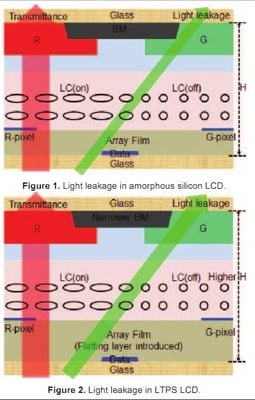
The reason the figure on the screen appears to change color is that by tilting the screen you are viewing light escaping before it has passed through the liquid crystals and polarizing filters in the same manner as it does from a face-on angle. Colors that would have been blocked are therefore able to leak through, resulting in the apparent change in color.
For more on how colors are displayed on computer monitors, see this article.
| 



 Re: Stumped by the Screen: Newsletter Challenge (December 2017)


"Almost" Good Answers: