Challenge Questions Blog

Challenge Questions

Stop in and exercise your brain. Talk about this month's Challenge from Specs & Techs or similar puzzles.

So do you have a Challenge Question that could stump the community? Then submit the question with the "correct" answer and we'll post it. If it's really good, we may even roll it up to Specs & Techs. You'll be famous!

Answers to Challenge Questions appear by the last Tuesday of the month.

Previous in Blog: Airbags: CR4 Challenge (06/17/08)   Next in Blog: Cylinder Load: Newsletter Challenge (07/01/08)
Close
Close
Close
40 comments
Rate Comments: Nested

Car Front End: CR4 Challenge (06/24/08)

Posted June 22, 2008 12:00 AM

This week's CR4 Challenge Question:

Tom and John are sitting in John's new Ford Mustang at a stop light. When the light turns green, John accelerates and the car's front end rises a little. John jokes "Imagine if we were in zero-g, we could really raise the front end". Tom thinks for a moment and says "if we were in zero-g there probably wouldn't be any surface in contact with the wheels". John responds "Yes, but the front end would still move up, though more slowly." Why does John think the front end would rise?

And the Answer Is...(July 1, 2008: 10:02 AM EST)

John is thinking of conservation of angular momentum. The spinning of the tires would require the body of the car to spin in the opposite direction though much much more slowly.

Reply

Interested in this topic? By joining CR4 you can "subscribe" to
this discussion and receive notification when new comments are added.

Good Answers:

These comments received enough positive votes to make them "good answers".

"Almost" Good Answers:

Check out these comments that don't yet have enough votes to be "official" good answers and, if you agree with them, vote them!
4
Active Contributor

Join Date: Jun 2008
Location: eastern Canada
Posts: 16
Good Answers: 2
#1

Re: Car Front End: CR4 Challenge (06/24/08)

06/23/2008 11:37 AM

John Thinks that the front end would rise because when he accelerates it applies a moment about the rear wheels, normally this moment would not be enough to counteract gravity and lift the front end up ( equal and opposite reaction), but if they were in zero g there would be no force( ie. gravity to hold the front end down)

his theory is similar to a helicopter, without the tail rotor applying an opposite force(gravity in the case of the mustang) to the spin of the main rotor, the helicopter would begin to spin in an opposite direction to the spin of the main rotor.

another example is how motocross motorcycles level themselves in mid air, to pitch the bike forward you apply the brakes, to pitch the bike backwards you increase the throttle.

in actuality, in zero g there would be no force to counteract the moment the engine itself is applying and the car would pitch to the right side, more quickly that it would lift the front end, and would send the car into an interesting spin :D ... sounds like fun :P

Cheers all,

Reply Good Answer (Score 4)
Guru
Popular Science - Evolution - New Member Popular Science - Weaponology - New Member

Join Date: May 2006
Location: The 'Space Coast', USA
Posts: 11119
Good Answers: 918
#2
In reply to #1

Re: Car Front End: CR4 Challenge (06/24/08)

06/23/2008 11:54 AM

Correct, the car would spin along the center axis, or roll axis, and it would pitch upward at the same time.

The degree that it would roll and pitch would be dependent on the amount of rotational mass in the engine (the roll axis component) and the rotational mass of the rear wheels (the pitch axis component) and the rotational acceleration of those components compared to the static mass of the car and the mass distribution. That was a mouthful!. Obviously, the gear selected (if it is a manual transmission) would affect the pitch amount.

Reply Score 1 for Good Answer
Power-User

Join Date: Sep 2007
Location: Christchurch, New Zealand
Posts: 168
Good Answers: 18
#7
In reply to #1

Re: Car Front End: CR4 Challenge (06/24/08)

06/23/2008 8:42 PM

I may be totally wrong here but I think the reason John thinks the front end will rise is due to the fact that the engine is transverse mounted rather than longitudinal mounted.

Now the funny thing is I've just checked my old Toyota Corolla which is transverse mounted but the moment exerted by the engine on the car when I rev the engine is in such a direction as to drive down the front of the car ( I.E. The engine tips backward when revving).

I'm still guessing here, but I'll bet that the mustang has a transverse engine with rear-wheel drive and rotates in the opposite direction to a front-wheel drive transverse engine which would then give the mustang that front lifting effect under zero g.

Can someone who owns a mustang please confirm that:-

A. The engine is transverse mounted

and

B. If you look at the engine while revving the car, does the engine tip forward rather than backward?

This should confirm or negate my theory.

Reply
Power-User

Join Date: Feb 2008
Posts: 124
Good Answers: 24
#8
In reply to #7

Re: Car Front End: CR4 Challenge (06/24/08)

06/24/2008 12:23 AM

I am no expert but I think that most rear wheel drives (such as the mustang) have a longitudinaly mounted engine. The corolla is probably a front wheel drive vehicle as they normally have transverse mounted engines

Reply
Power-User

Join Date: Sep 2007
Location: Christchurch, New Zealand
Posts: 168
Good Answers: 18
#9
In reply to #8

Re: Car Front End: CR4 Challenge (06/24/08)
06/24/2008 1:35 AM

Yes BobD, I believe you are right,

I've done some internet searching and it appears that the mustang does indeed have a V6/V8 longitudinal mounted engine, which would mean that the car, under zero g, would certainly roll sideways, as mentioned by LP_Ultima in post#1, much faster than the front would rise. The reason for this is that the rotational torque produced by the engine is far greater than that produced by the wheels (When there is no gravity pressing the wheels onto the road that is).

Maybe John was wrong in his thinking...

Reply
Power-User

Join Date: Feb 2008
Posts: 124
Good Answers: 24
#11
In reply to #9

Re: Car Front End: CR4 Challenge (06/24/08)

06/24/2008 4:44 AM

MPM - I agree in general that the car would roll sideways, however, the relative difference between the sideways roll and the backwards roll will not necessarily be that different since the torque produced by the engine is being applied to the crankshaft then via the gear train to the rear wheels. Only the torque necessary to provide rotational acceleration to the wheels is being applied by the engine.

Reply Score 1 for Good Answer
Active Contributor

Join Date: Jun 2008
Location: eastern Canada
Posts: 16
Good Answers: 2
#15
In reply to #11

Re: Car Front End: CR4 Challenge (06/24/08)

06/24/2008 11:17 AM

the mass of the crank, transmission, clutch, drive shaft, would exceed the mass of the rear wheels and axle, so most of the torque produced by the engine would be used in the turning the longitudinal elements, this is why the car would roll more quickly than pitch

Reply
Guru

Join Date: Apr 2007
Posts: 3531
Good Answers: 59
#10
In reply to #1

Re: Car Front End: CR4 Challenge (06/24/08)

06/24/2008 4:03 AM

Although most of this post is spot-on (apparently LP_U even checked the direction of engine rotation), I think the helicopter analogy could be (is?) misleading.

The major function of the tail rotor is to counter the air forces on the continuously rotating main rotor, rather than as a counter to angular momentum. The main rotor is spun up while the helicopter is on the ground.

Reply
Active Contributor

Join Date: Jun 2008
Location: eastern Canada
Posts: 16
Good Answers: 2
#12
In reply to #10

Re: Car Front End: CR4 Challenge (06/24/08)

06/24/2008 8:21 AM

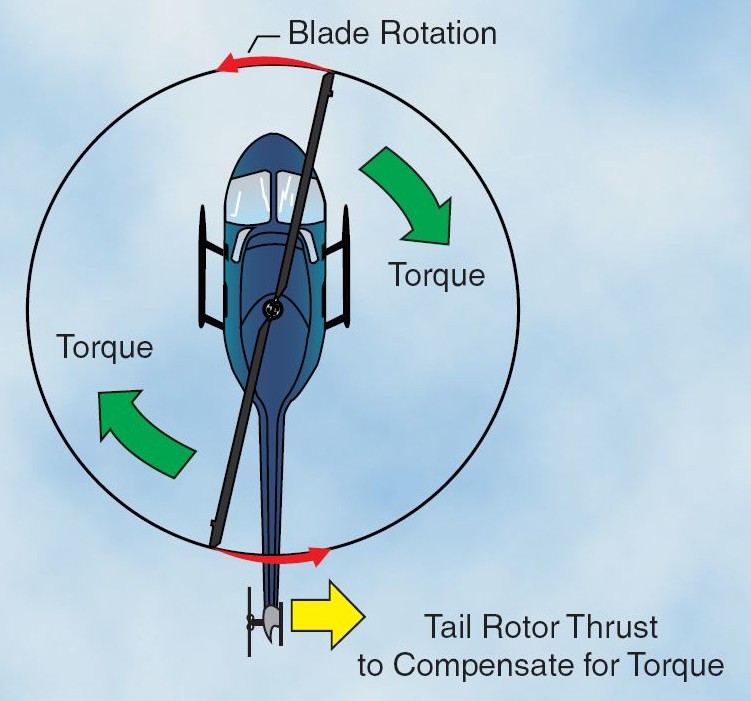
I've included a diagram so it's more apparent ... the tail rotor uses the same propulsion forces that the main rotor uses to lift the aircraft, but it is used to apply a force to counteract the angular momentum more so than the air resistance (The air resistance on the main rotor just serves to apply more angular momentum to the craft, something to push against in layman's terms. But the mass of the rotors and the engine and all the links, gears, shafts, etc. play a major role here). this is why a dual rotor helicopter works and remains stable, the two rotors rotate in opposite directions effectively cancelling each others rotational forces(mind you there are some air resistance forces here also, it's not a closed system).

As far as the main rotor spinning up on the ground, so does the tail rotor, resistance with the ground plays a role here in holding the helicopter steady during take-off but the tail rotor spins up while on the ground as well, so that when the lift from the main rotor starts to lift the machine off the ground (reducing the reactionary forces between the helicopter and the ground, resistance is related to the force applied to a surface) the force of the tail rotor takes the place of the resistance force in holding the helicopter steady.

In mid air torque is constantly applied to the main rotor to keep the craft in the air , increased to elevate the craft, and decreased to lower the craft. That being said there is constantly some torquing.

Also If the aircraft were hovering the rpm of the tail rotor would be increased to turn the craft one way, and decreased (allowing the angular momentum of the main rotor to prevail) to turn the other way.

I hope this cleared up my post, and made the example more useful

Cheers everyone :D

Reply
Guru

Join Date: Apr 2007
Posts: 3531
Good Answers: 59
#18
In reply to #12

Re: Car Front End: CR4 Challenge (06/24/08)

06/24/2008 11:40 AM

I did say misleading, not point-blank wrong.

But- SFIK:
In general, helicopter main rotors are designed to operate at constant RPM**. The rotor is spun up to full speed before take-off, and the blade angle etc. adjusted to provide lift. So the tail rotor is there primarily to counter aerodynamic forces, not to counter changes in the angular momentum of the rotors - other than those due to gyroscopic effects when changing orientation. It has some function during spin-up, but correction immediately before take-off is more important than during the initial part of spin-up when the angular acceleration is greatest, as may be seen by the tendency for single-rotor helicopters to twist as they leave the ground.
Of course, in steady flight the tail rotor is only required to counter aerodynamic forces - the helicopter equivalent of the torque between the frictional force on the base of the wheels and the inertia of the vehicle.

**Among other reasons, this makes it simpler to avoid creating undesirable resonances.

Reply Score 1 for Good Answer
Commentator

Join Date: Apr 2005
Posts: 71
Good Answers: 2
#28
In reply to #12

Re: Car Front End: CR4 Challenge (06/24/08)

06/25/2008 8:37 AM

If the blades are turning CCW, the torque on the body of the helicopter wants to turn it CW. So isn't the thrust arrow for the tail rotor pointing the wrong direction? It looks like it's adding additional torque to the body of the helicopter in the CW direction, making it spin faster.

Otherwise, I agree with what you've said. Very well put.

Reply
Guru

Join Date: Apr 2007
Posts: 3531
Good Answers: 59
#29
In reply to #28

Re: Car Front End: CR4 Challenge (06/24/08)

06/25/2008 9:05 AM

Yes, the top blade applies torque to the 'copter, but under flight conditions the consistent torque in the expected direction is entirely due to air resistance, not the inertia of the blades* - which means it is not entirely helpful as an analogy for the zero-g car, unless you wish to consider the effect of the cooling fan?

On the topic of fan placement - presumably the tail fan would be placed upwind of an aerofoil to allow the outgoing air to be redirected - then it can provide multi-axis control of attitude. [Do you think this could have application to some of the CR4 threads?]


*Amusing to think what might happen if they accelerated continuously - perhaps that's the reason for all those crashes

Reply
Commentator

Join Date: Apr 2005
Posts: 71
Good Answers: 2
#30
In reply to #29

Re: Car Front End: CR4 Challenge (06/24/08)

06/25/2008 10:30 AM

Not quite sure what you're implying here. You say: "under flight conditions the consistent torque in the expected direction is entirely due to air resistance". But for helicopters the flight conditions can change continually; the copter can speed up, slow down, rise, descend, tilt, hover, even back-up. The air can be dead-calm or there can be cross winds, variable head winds, etc. The tail rotor is used constantly to align and steer.

A helicopter starting up on an icy surface would spin wildly if the tail rotor wasn't there to provide counter-balancing torque; even on a dry surface I doubt that the skids can provide enough friction to keep it from spinning.

I think LP's analogy to the car is not for the zero-g condition, but for normal conditions when the road provides the balancing torque to the engine's torque.

Reply
Guru

Join Date: Apr 2007
Posts: 3531
Good Answers: 59
#31
In reply to #30

Re: Car Front End: CR4 Challenge (06/24/08)

06/25/2008 11:56 AM

You are winding me up, surely?
LP introduced the helicopter analogy with the comment "his theory is similar to a helicopter, without the tail rotor applying an opposite force..."; do you still say this was intended to be for normal conditions? Misleading at best - shame, as the effects that he describes appear to be spot on.

(N.B. that is why my comments were related the physical effects that underlay the challenge. They assumed the irrelevancy of air resistance, rather than its non-existence)

Reply
Power-User

Join Date: Apr 2007
Location: Pittsburgh
Posts: 208
Good Answers: 1
#26
In reply to #1

Re: Car Front End: CR4 Challenge (06/24/08)

06/25/2008 7:45 AM

Yes I agree, the sideways motion will be more prominent. I have a friend who test drove one of those motor cycles with the V-8 engine in it and he said you have to be careful not to dump the bike over on it's side when you rev it. My neighbor has a BMW bike and that engine also has the drive shaft axis running front to back instead or transverse as most bikes, and it has the same problem, albeit a bit less impressive.

This reminds me of the question: If you are sitting in a quality Limo, all the windows closed, holding a helium balloon by the string, moving at a fast speed and the car verves off to the right very quickly. Which way will the balloon sway?

Reply
Guru
Popular Science - Biology - New Member Hobbies - Musician - New Member APIX Pilot Plant Design Project - Member - New Member Hobbies - CNC - New Member Fans of Old Computers - ZX-81 - New Member

Join Date: Jan 2007
Location: Centurion, South Africa
Posts: 3921
Good Answers: 97
#3

Re: Car Front End: CR4 Challenge (06/24/08)

06/23/2008 11:57 AM

With the wheels resting on the road without any reason to move away, there will be some grip on the road. and the car should flip.

If I remember correctly the differential on a rear wheel drive on the Mustang attempts to supply power to the wheel with the best grip. With both wheels not touching the ground one of the wheels may spin backwards and cancel the effect of the other wheel.

The corkscrew twirl effect on the car would be even worst than held in post 1.

__________________
Never do today what you can put of until tomorrow - Student motto
Reply
Guru

Join Date: Apr 2007
Posts: 3531
Good Answers: 59
#4

Re: Car Front End: CR4 Challenge (06/24/08)

06/23/2008 12:12 PM

Assuming a rationale, and that 'raise' is defined with respect to the orientation of the vehicle: he's assuming that the net angular momentum of the rotating components (wheels, gears, differential, flywheel, etc) is in a similar direction to that of the driven wheels.

With forward drive selected, the car spins the wheels with the front of the wheel going downwards. Conservation of angular momentum means the front of the car must move in the opposite direction.

Initially, the movement might be slower, but there is no gravity to combine with the suspension to produce a counter-torque - so (failing other effects) the car will continue to rotate until John brakes and stops the wheels rotating with respect to the car.

Notes: Even starting the engine will cause the car to spin - and the direction will depend on the configuration of the Mustang's transmission. This could become confusing.
Now, in the unlikely case that the rear wheels are is still in contact with the road when John starts to accelerate, the rotation will also cause the rear end to drop for a while, so there could even be some forward acceleration until the wheels leave the ground. Another side effect would be that the additional torque generated between forward acceleration and the road surface would mean that braking and stopping the engine would no longer stop the forward rotation of the car.

Reply
Guru

Join Date: Apr 2007
Posts: 3531
Good Answers: 59
#6
In reply to #4

Re: Car Front End: CR4 Challenge (06/24/08)

06/23/2008 3:54 PM

Sorry, poor editing - but needs qualification in any case:

"stopping the engine would no longer stop the forward rotation of the car" should read "stopping the engine would no longer stop the rotation of the car on the original absolute nose-up orientation" (the car could be side-on, reversed and thus rotating tail-upwards, etc.).

Reply
Guru
Hobbies - Fishing - Old Salt Hobbies - CNC - New Member United States - US - Statue of Liberty - New Member

Join Date: Mar 2007
Location: Rosedale, Maryland USA
Posts: 5197
Good Answers: 266
#5

Re: Car Front End: CR4 Challenge (06/24/08)

06/23/2008 1:10 PM

Newtons third law. With out gravity holding the front end of the car down. The car would start to spin in the opposite direction of the wheels.

__________________
Life is not a journey to the grave with the intention of arriving in a pretty, pristine body but rather to come sliding in sideways, all used up and exclaiming, "Wow, what a ride!"
Reply
Power-User

Join Date: May 2008
Posts: 103
Good Answers: 6
#13

Re: Car Front End: CR4 Challenge (06/24/08)

06/24/2008 10:11 AM

If gravity were suddenly switched off when the light turned green, the centre of gravity of the combined car, people, fuel would remain in the same place unless acted upon by an "External force". The angular momentum would remain unchanged unless acted upon "Externaly" When the accelerator were pressed, the engine, being internal, would rotate faster, causing the other elements to counter-rotate so that angular momentum is preserved.

The only force I can see that would move the car forward is the escaping exhaust gases, which would also cause the car to rotate if they were not lined up with the combined C of G.

Sounds to me that the car would pitch, roll, yaw, heave, sideslip away from the lights.

Reply
Active Contributor

Join Date: Jun 2008
Location: eastern Canada
Posts: 16
Good Answers: 2
#14
In reply to #13

Re: Car Front End: CR4 Challenge (06/24/08)

06/24/2008 10:52 AM

like you said ... without any "external forces" (ie Gravity) the other elements would counter rotate to compensate for the internal rotational forces of the engine, rear wheels etc.

so the rest of the car would rotate to counter act this internal

Example: If you sit in your car, in neutral, and rev the engine ... you will notice the car feeling like it wants to flip over on its side ... the reactionary forces from the ground prevent this form happening ... without gravity ... the car would flip over

your right in saying that the car would not move forward ... the forward motion usually experienced when driving a car comes from the wheels being in contact with the ground and the friction between the two(ie:Traction, and anyone that's ever driven in a Canadian winter and been stuck on ice will know that without traction the car will not move forward :P)

the exhaust would propel the car forward tho I agree ... to what extend I can't say I suppose that since exhaust pipes usually point slightly down this may counteract the lifting of the front end somewhat ... more evenly of course if your mustang is equipped with a dual exhaust :P

there are so many forces applied to the car that gravity counteracts it's hard to say exactly what would happen to the car in the long run but initially the major forces are the torques applied to the crankshaft, transmission, clutch, shaft and rear wheels.

I was thinking about it a while ago and in a four stroke engine the predominant force is applied in a downward direction ( piston in the up position fires down, returns up as other pistons fire expelling exhaust, follows through down again taking in oxygen, returns up compressing the oxygen, and start over) some of the energy from this firing would be retained to compress the gas and exhaust and the rest of it, but a lot of it would be used in other ways (transfered to the drive train) so this is a downward force that has no upward equivalent. So the piston firing would require an opposite upward force to the front end of the car for it to remain stationary, but without gravity there is none. This may lift (accelerate upwards) the front end ... what do you think?

Reply
Power-User

Join Date: May 2008
Posts: 103
Good Answers: 6
#16
In reply to #14

Re: Car Front End: CR4 Challenge (06/24/08)

06/24/2008 11:36 AM

Hi LPUltima

You answered the problem correctly in your first post. This all comes down to conservation of momentum, both linear and rotational.

Take for instance the exhausing gas. It has a mass flow and a velocity, and therefore a momentum of m*v. as it moves to the right (say) the remaining mas M will move to the left at velocity V. For conservation of momentum M*V = m*v. NOTE THAT THE c of g OF THE ENTIRE SYSTEM (GAS + CAR) REMAINS IN THE SAME PLACE. It's the same with a bullet and a gun. as the bullet streaks away, the gun recoils in the opposite direction but the combined C of G remains in the same place.

As to what is happening to the energy of the engine, some will go to increasing the rotational energy of the moving parts (note that even when momentum is conserved, parts moving in opposite directions still have energies that are additive) some energy will leave in the exhaust gases but the majority will be converted to heat via friction.

Try thinking of the car in outer space where "up" and "down" have no meaning

Reply
Active Contributor

Join Date: Jun 2008
Location: eastern Canada
Posts: 16
Good Answers: 2
#21
In reply to #16

Re: Car Front End: CR4 Challenge (06/24/08)

06/24/2008 12:47 PM

hey slide-rule,

I was taking my reference plane as inside the car. So that as it rotates, in whichever direction it is going to, the forces that are applied are applied in directions that are relative to the car always ... up being away from the top of the car and visa versa ... I do see what your saying and the only propulsion the car would undergo is from the exhaust.

what I was saying is that the rotational forces of the engine, drive-train, etc would cause the car to spin, and yes around it's center of gravity, if the ground was not there at all the car would stay in one spot and spin. neglecting the thrust from the exhaust of course.

what I was thinking about the pistons firing was that the small explosion withing the cylinders while propelling the pistons down-wards would also propel the engine block upwards, and since the pistons are not coming back with the same energy the initially left with that this would also be an internal force, but a linear one .. now it is a linear force but it's not inline with the center of gravity so it would only contribute to the rotation of the car and unless the exhaust is directly inline with the center of gravity of the car it would have the same effect. don't you think?

the reason I was saying lifting the front end is because, if the rear of the car is against the ground and the center of gravity is roughly in the center of the car and there is a force that is going to cause the car to rotate it's not going to rotate about it's center of gravity but rather around the point of contact with the ground(the reactionary force with the ground would be an external force). until it loses contact, then it would begin to rotate around it's center of gravity. this contact with the ground would propel the car in the direction of rotation how much depends on the specific dimensions (how far the contact point is from the center of gravity. In the case that we are talking about it will (in reference to the car's original position) move backwards

Cheers,

LP

Reply
Power-User

Join Date: May 2008
Posts: 103
Good Answers: 6
#22
In reply to #21

Re: Car Front End: CR4 Challenge (06/24/08)

06/24/2008 1:44 PM

I think as far as the engine is concerned, it is best solved by general principles. Any change in the engine's CofG position will result in a counter movement of the remainder of the system to ensure that the CofG of the total remains fixed. This means there will be small linear and rotational movements of the car's body to counteract the movement of the engine's CofG, the unbalanced wheels, flywheels, people movements etc. The bonnet (hood) would be oscillating in response to this. But the engine cannot exert a continuous "up or down" force without creating an equal and opposite reaction elsewhere.

cheers SR

Reply
Active Contributor

Join Date: Jun 2008
Location: eastern Canada
Posts: 16
Good Answers: 2
#23
In reply to #22

Re: Car Front End: CR4 Challenge (06/24/08)

06/24/2008 2:15 PM

agreed,

my thought was more of an energy thought, and it was just a thought.

I was thinking where the pistons were expelling the exhaust that would propel the car and that the explosion within was unbalanced somewhat. Because of this I was thinking that a force was being applied and that it required an oposite one.

my theory has a few(ok more than a few) holes in it ... I was just thinking out loud ... in an engineering forum :P

Reply
Anonymous Poster
#17
In reply to #13

Re: Car Front End: CR4 Challenge (06/24/08)

06/24/2008 11:36 AM

I believe that SlideRuler has it correctly..... the only force that would act external to the car in zero gravity would be the excaping exhaust gases.

These exhaust gases would send the car forward and upward and likely with rotation depending on how centered the exhaust is relative to the center of gravity of the car.

Dwight

Reply
Guru

Join Date: Apr 2007
Posts: 3531
Good Answers: 59
#19
In reply to #13

Re: Car Front End: CR4 Challenge (06/24/08)

06/24/2008 11:55 AM

If the car were still on the ground at that point, the moment of inertia of the wheels would produce some tendency for the car to rotate about its centre of gravity - front "up", back "down". That would result in a downward force through on the rear axle, which would be counteracted by the ground. Overall, the vertical force would drive the car upwards, but also provide friction, so the car would go upwards and forward, spinning, rolling and and yawing the while.

Reply
Power-User

Join Date: May 2008
Posts: 103
Good Answers: 6
#20
In reply to #19

Re: Car Front End: CR4 Challenge (06/24/08)

06/24/2008 12:04 PM

True - good point

Reply
Power-User

Join Date: Sep 2007
Location: Christchurch, New Zealand
Posts: 168
Good Answers: 18
#24
In reply to #19

Re: Car Front End: CR4 Challenge (06/24/08)

06/25/2008 1:38 AM

Slideruler and Fyz,

I am firstly assuming that gravity does not just switch to zero when the lights go green because, if it did, the potential energy in the suspension would surely eject the entire vehicle vertically upwards before anything else had a chance to happen.

Therefore I am assuming that there is no springing up action but that all 4 tyres are just touching the surface of the road and there is no normal force and hence no friction available between tyres and road surface before the acceleration pedal is applied.

Now in this scenario, regardless of whether the car is manual or automatic, the engine will have to have rotational acceleration before the clutch allows power to be transmitted to the rear wheels. This means that the car will roll first, thereby putting downwards force on the front and rear wheel on one side only. Thus, by the time power is transmitted to the rear end the car will already have the tyres on one side leave contact with the road.

Once this happens, no traction is possible because the raised rear tyre will simply spin due to the action of the differential ( Am I correct in assuming this is the way the differential works on the mustang? ). Surely this means the car will not have any forward motion as both rear wheels are not gripping the road.

The sideways rolling will be quicker than the pitching which will be caused by the now freely spinning wheel on one side and hence the car will almost certainly roll over as the predominant action taking place.

Two factors contribute to make the rolling predominant.

Firstly, the engine due to the mass of the flywheel clutch and other components rotating in the same direction will generate far more torque than a single spinning back wheel.

Secondly, the rotational inertia to be overcome by the torque is less for the car to roll than it is for the car to pitch. What do you think?

Reply
Guru

Join Date: Apr 2007
Posts: 3531
Good Answers: 59
#25
In reply to #24

Re: Car Front End: CR4 Challenge (06/24/08)

06/25/2008 6:10 AM

I agree your comment that the car will roll much easier than it will pitch - but you don't need to rev the engine when starting in zero g, because the wheel forces are relatively low. [However, I was assuming a racing start - engine already revving, and clutch slipping - or torque converter doing its equivalent, where the is still some small roll-inducing acceleration of the transmission on the downside of the clutch/torque-converter]

Assuming the driver does rev the engine after the lights change, losses in the differential and the inertia of the raised wheel will cause some force on the other wheel, so there will always be some drive forward, and some consequent "righting" behaviour because of the increased forces on the lower side of the vehicle.

The levels of the various effects comes comes down to driver behaviour (revving the engine, gear selection if available, etc.)

Reply
Power-User

Join Date: Sep 2007
Location: Christchurch, New Zealand
Posts: 168
Good Answers: 18
#33
In reply to #25

Re: Car Front End: CR4 Challenge (06/24/08)

06/25/2008 6:42 PM

"but you don't need to rev the engine when starting in zero g, because the wheel forces are relatively low"

I must disagree here.

To accelerate the car forward requires the same force with or without gravity.

The mass of the car is still the same regardless of gravity and will hence need a force which equals Mass X Acceleration.

The force applied, due to losses in the differential, to the one rear wheel in contact with the road is going to be minuscule in terms of the force needed to move the mass of the vehicle forward - it just will not happen. Likewise the force exerted by the exhaust gases is going to be even more minuscule.

This is why I believe there will be no forward motion worth talking about.

As LP and slideruler have said, the car will simply rotate off sideways and leave the road surface at some angle and with an initial linear velocity. It will now keep moving linearly in this direction while all the time rotating until air friction eventually stops it.

I would imagine that this would take some time.

Reply
Guru

Join Date: Apr 2007
Posts: 3531
Good Answers: 59
#35
In reply to #33

Re: Car Front End: CR4 Challenge (06/24/08)

06/26/2008 5:04 AM

There is a difference between small and zero.

If you rev the engine before engaging gear, one wheel will become free of the ground. The free wheel will spin - but the torque needed to provide its angular momentum will also be applied to the wheel that is on the groundcar will move forward as well - albeit the acceleration will be low.

Of course, if the driver actually wishes to move forwards, he will engage the gear without initially revving the engine (as many drivers of automatics already do in practice). Both wheels will be in contact with the ground; there will be two sources of downwards force on them - first, due to the torque that is required to accelerate the wheels, this will be sufficient to provide some friction; this will allow a small forward acceleration, which will provide more downwards force on the ground (roughly depending on the ratio of the 'height' of the CofG to the distance between the CofG and the ground contact of the rear wheels).
So, with practical tyres the wheels will slip, but the car will still move forwards.

Perhaps the best way to view this is that, assuming the rate of increase of engine revs allows most of the force to be applied to the back wheels, the forward force on the car is directly related to the upwards force on it - via the coefficient of friction. Typical safe stopping distances assume a coefficient of friction of about 2/3, but presumably a Mustang would use more adherent tyres. Can we agree on the car primarily 'rising', but at an angle somewhat greater than 33-degrees from the 'vertical'?

Reply
Power-User

Join Date: May 2008
Posts: 103
Good Answers: 6
#32
In reply to #24

Re: Car Front End: CR4 Challenge (06/24/08)

06/25/2008 1:33 PM

MathsPhysMan.

I love the idea of the car being shot to a great height by its own springs, taking all of this fanciful conjecture with it!

You're probably right about the tyres on one side being in contact with the road and so the car moves forward; but as soon as it does, it loses contact with the spherical Earth. It would stop relatively quickly due to air friction, and would hover coping with a reving engine, gear-changing, moving passengers, Bernoulli effects on spinning wheels; gyroscopic precessions, exhausting gas, etc..

I realize we left the "Engineering" world after the first post answered the question (which probably wasn't "challenging" enough) so well, and I'm now debating in the "Physicists" world where everything seems to be relevant!

Good for the old brain cells I suppose

SR

Reply
Guru
Engineering Fields - Marine Engineering - New Member

Join Date: May 2007
Location: Australia.
Posts: 1642
Good Answers: 81
#27

Re: Car Front End: CR4 Challenge (06/24/08)

06/25/2008 8:37 AM

I at first thought that the car would not rise because of the gyroscopic effect of the engine, this only being if the engine is mounted length ways, but with the event that the engine could be mounted side ways, that made me reconsider? also to be taken in account is that the driven wheels have a differential Axel, therefore the driven wheels will run in opposite directions to each other, an effect whether rear or front drive, and would not provide a reactive force? I therefore agree with a previous conclusion that lift could only occur if the engine is mounted sideways, and the reactive force throws the engine backwards.

Regards JD.

Reply
Guru

Join Date: Apr 2008
Location: Chicago
Posts: 3990
Good Answers: 144
#34

Re: Car Front End: CR4 Challenge (06/24/08)

06/25/2008 11:59 PM

This is just one the major reasons we don't drive cars in space.

I just wonder if the tailpipe will provide sufficient forward thrust?

__________________
High Tolerance is Beautiful
Reply
Anonymous Poster
#36
In reply to #34

Re: Car Front End: CR4 Challenge (06/24/08)

06/26/2008 5:07 AM

Sufficient for what? [But would the cooling fan be as effective?]

Reply Off Topic (Score 5)
Guru

Join Date: Apr 2008
Location: Chicago
Posts: 3990
Good Answers: 144
#37
In reply to #36

Re: Car Front End: CR4 Challenge (06/24/08)

06/26/2008 8:08 AM

to get me to the beach of course!

What kind of mileage and top speed would a space fearing ford mustang that is propelled by means of exhaust and cooling fans expect?

Would the whole works improve if you reduced your losses and kept it in neutral to avoid the wasted energy creating worthless counter rotational forces, or would you eventually be spinning at a rate that could provide enough gravity to enjoy a beverage that doesn't come resemble a kids drink?

__________________
High Tolerance is Beautiful
Reply Off Topic (Score 5)
Guru

Join Date: Apr 2007
Posts: 3531
Good Answers: 59
#38
In reply to #37

Re: Car Front End: CR4 Challenge (06/24/08)

06/26/2008 10:47 AM

If it's in space, all bets are off (no air for the engine), and all the water at the beach will have evaporated.

Zero g, and ignoring effects of of exhaust or fan, and indeed air resistance:

the rate of spin of the vehicle would of course only be such as to maintain the total angular momentum (car plus wheels plus engine) constant once the vehicle has left the ground. That allows a range (that will include zero) as you change the relative spin of the engine-plus-wheels combinations. I can't be bothered to find the numbers for the Mustang (there's doubtless a range anyway), but here are some very rough estimates based on nothing at all:

Wheel radius: 10"
Mass of wheels + differential: 100-lb
Radius of inertia of wheel-differential combinations: 8"
Mass of car: 3000-lb
Radius of inertia of car: 40"

Suppose we spin the wheels equivalent to 150-mph (220-ft/sec), the angular velocity of the wheels will be 264 rad/sec (seems v high - but I can't find the error). The angular velocity of the car will be [264*100/3000*(8/40)^2], or 0.35 rad/sec. That means you would go head-over-heals about three times a minute. Significant, but basically quite gentle.
[Given the mass and (especially) the dimensions of the rotating engine components, I would expect slightly lower rotation about the longitudinal axis (in spite of the lower MofI of the car about that axis) - but I could easily be wrong, as I don't know any details of the clutch or flywheel]

Reply Off Topic (Score 5)
Participant

Join Date: Jun 2008
Posts: 1
#39

Re: Car Front End: CR4 Challenge (06/24/08)

06/28/2008 1:52 AM

Tom is correct that the front end would move in the direction we associate with up in relation to the wheels, because the whole car would react to the acceleration of the rear wheels (Mustangs are rear wheel drive) by accelerating in the opposite direction. It wouldn't be "up" because up is a concept dependent upon the existence of gravity.

Reply
Associate

Join Date: Jul 2007
Location: Sausalito, CA
Posts: 41
Good Answers: 1
#40
In reply to #39

Re: Car Front End: CR4 Challenge (06/24/08)

07/14/2008 4:19 PM

Hey, this sounds like New Mexico logic. Gravity in NM is directly affected by the quantity of vino de mezcal drunk by the one attempting to formulate a thought.

__________________
No mind like your own mind.
Reply Off Topic (Score 5)
Reply to Blog Entry 40 comments

Good Answers:

These comments received enough positive votes to make them "good answers".

"Almost" Good Answers:

Check out these comments that don't yet have enough votes to be "official" good answers and, if you agree with them, vote them!
Copy to Clipboard

Users who posted comments:

Anonymous Hero (1); Anonymous Poster (2); BobD (2); El Gavilan (1); Hendrik (1); jdretired (1); JE in Chicago (2); Kinsale (2); LP Ultima (6); Maths_Physics_Maniac (4); MerMayde (1); ozzb (1); Physicist? (10); RickLee (1); SlideRuler (5)

Previous in Blog: Airbags: CR4 Challenge (06/17/08)   Next in Blog: Cylinder Load: Newsletter Challenge (07/01/08)

Advertisement
