Rockaholic Adventures Blog

Rockaholic Adventures

Rockaholic Adventures is the place for conversation and discussion about geologic phenomena and mountaineering excursions. You'll also read reviews written from the perspective of today's technologically-advanced outdoorsman - one with a background in engineering and geology.

Rockaholic Adventures also covers topics such as unconventional oil & gas technologies and environmental geochemistry. The blog's owner, Shawn, is a technical writer at IHS where he writes a quarterly newsletter, Unconventional Oil & Gas News. He graduated magna cum laude in 2006 from the University at Albany where he majored in geology.

Previous in Blog: Difficulties in Characterizing Uranium   Next in Blog: <b>The Missing Carbon Problem (Part 2)</b>
Close
Close
Close
26 comments
Rate Comments: Nested

<b>The Missing Carbon Problem (Part 1)</b>

Posted January 27, 2009 5:00 AM by Shawn

Current estimations of the carbon cycle allude to an unbalanced model of the exchange of carbon throughout observed reservoirs. Since the industrial revolution, we have been unable to compensate for anthropogenic emissions and changes in land use which have impacted the carbon cycle. Throughout the past few decades, scientists observed an increase in the net flux of carbon into atmosphere, but cannot identify a definite sink that would balance the carbon budget as portrayed by most models.

What is the Carbon Cycle?

The carbon cycle refers to the fluxing of the element carbon throughout the carbon-containing reservoirs existing at or near the surface of the earth. The largest reservoir by far is the solid lithosphere, which contains carbon-rich deposits that also share the longest residence time. The next two largest reservoirs are the ocean and the atmosphere. When combined with the lithosphere, they would account for most of the carbon existing on Earth. The biosphere is also an important reservoir, but has been excluded from most fundamental models of the carbon cycle as it can be accounted for by fluxes of carbon to the oceanic and terrestrial reservoirs.

Carbon Flux: Natural and Anthropogenic

There are fluxes of carbon that occur naturally, and then there are also fluxes that originate from human involvement which are called anthropogenic sources. From models based on the carbon cycle, we have agreement up until the time that anthropogenic sources were introduced into the system. This new flux has entered the carbon cycle through the atmosphere, but can not be accounted for.

References

Chester, Roy. Marine Geochemistry Second Edition. Malden, MA: Blackwell Science Ltd. 2000, 2003

Richard Houghton, Senior Scientist, Carbon Research. Understanding the Global Carbon Cycle. Woods Hole Research Center, http://www.whrc.org/carbon/

Hesshaimer, Vago, Heimann, Martin, Levin, Ingeborg. Radiocarbon evidence for a smaller oceanic carbon dioxide sink than previously believed. Nature (London). 370 (6486), p. 201-203, 1994.

Frankignoulle, Michel , Borges, Alberto V. European Continental shelf as a significant sink for atmospheric carbon dioxide. Global Biochemical Cycles. Pages 569-576, September 1, 2001

Houghton, R. A. , Davidson, E. A. , Woodwell, G.M. Missing sinks, feedbacks, and understanding the role of terrestrial ecosystems in the global carbon balance, Global Biochemical Cycles. Vol. 12, No. 1, Pages 25-34, March 1998

Tsunogia, Shizuo , Ono, Tsuneo , Watanabe, Shuichi. Increase in total carbonate in the western North Pacific water and a hypothesis on the missing sink of anthropogenic carbon, Journal of Oceanography, Vol. 49, Pages 305-315, 1993

Burdige, David J. , Alperin, Marc J., Homstead, Juliana, Martens, Christopher S., The role of benthic fluxes of dissolved organic carbon in oceanic and sedimentary carbon cycling. Geophysical Research Letters, Vol.19, Pages 1851-1854, 1992

http://en.wikipedia.org/wiki/Carbon_cycle

Reply

Interested in this topic? By joining CR4 you can "subscribe" to
this discussion and receive notification when new comments are added.

Good Answers:

These comments received enough positive votes to make them "good answers".

"Almost" Good Answers:

Check out these comments that don't yet have enough votes to be "official" good answers and, if you agree with them, vote them!
Guru

Join Date: Dec 2006
Location: Germany 49° 26' N, 7° 46' O
Posts: 1950
Good Answers: 109
#1

Re: <b>The Missing Carbon Problem (Part 1)</b>

01/28/2009 5:01 AM

These data are far from accurate!

Soit is quite natural that the budget is not adding up to 100%.

Think about produced CO2 in soils around the globe, who will measure with adequate accuracy the decay of organic material and how much of the CO2 is escaping into the atmosphere?

Same situation for CO2 capture by biological and chemical activity.

Same on the oceans: dissolution is a strong function of agitation, partial pressure, temperature, droplet size of fog and rain and some other variables I do not think of.

Being an interested engineer but not a professional in these fields I have no idea how many sources and sinks are missing and to which level the needed accuracy is not existing.

But absolutely clear that the today existing numbers are a first rough estimate that may be upgraded in time and may be fluctuating as our weather is.

RHABE

Reply
Power-User

Join Date: Apr 2005
Location: Averill Park, NY
Posts: 250
Good Answers: 4
#2
In reply to #1

Re: <b>The Missing Carbon Problem (Part 1)</b>

01/28/2009 5:45 AM

Houghtons' paper on missing sinks and feedbacks was quite interesting to me. If you normalize the terrestrial carbon budget on an annual basis and exclude years with several thawing cycles coupled by other years where there is a deep frreze and considerate snowpack preventing respiration from occuring you come to see that the terrestial influence seems irrelevant to the carbon budget.

Subtract the yearly cycle we see due to Northern hemisphere vegitation influence and we see a budget that is best balanced neglecting any terrestrial influence. I've come to realize that having the perfect model that accounts for all sources and sinks is much less important than understanding feedbacks and response systems that allow Earth to evolve... What next? will we see the aforeclaimed release of methane hyrdates and flooding of all coastal cities?

If that is what is meant to be then we are dealing with forces that are much less than controllable, but maybe if we understood the science to a higher degree we could decipher how crucial to lifes existence fossil fuels really are.

__________________
"There isn't a scientific community. It's a culture. It is a very undisciplined organization." ~ Francois Rabelais
Reply
Guru

Join Date: Dec 2006
Location: Germany 49° 26' N, 7° 46' O
Posts: 1950
Good Answers: 109
#4
In reply to #2

Re: <b>The Missing Carbon Problem (Part 1)</b>

01/29/2009 12:40 PM

"the terrestial influence seems irrelevant to the carbon budget"

I cannot believe this. I suspect that this may be the result of insufficient data and/or insufficient observation time or too short an overview to detect the terrestrial influence.

"will we see the aforeclaimed release of methane hyrdates and flooding of all coastal cities?"

Maybe. I cannot be sure. You will have the possibility to look at the reports on temperature measurements in ice-core samples and pollen analysis to reconstruct the temperature profile for the last 10,000 years and compare these with the estimated sea-level at that time.

There has been one period that was much warmer than today, so maybe this was together with high sea-level and and some methane-release triggered the warming.

If so, we should try hard to recover the today existing methane and burn it.

RHABE

Reply Score 1 for Good Answer
Power-User

Join Date: Apr 2005
Location: Averill Park, NY
Posts: 250
Good Answers: 4
#5
In reply to #4

Re: <b>The Missing Carbon Problem (Part 1)</b>

01/29/2009 2:11 PM

The work has already been completed. The one true tracer of ice volume on Earth is recorded in SMOW... standard mean ocean water. lighter stable isotopes are more reactive than their counterpart and heavier stable isotopes are less reactive. Well what does this mean? Heavy isotopes resist evaporation, and as air circulates precipitation becomes lighter... so as when we isotopically analyze a core of ice we look for changes in the isotope ratios. In all studies, whether it is coral or ice cores these readings have correlated with ice volume and the level of our oceans...

As for today the terrestrial reservoir is not growing right>? even if woody tissue bearing more carbon content uproots we chop down too many 300yr old trees and no terretrial vegative growth will every replace the amount of carbon that we harvest and displace for human occupancy... At best it is a wash... a mature forest neither sequestors nor releases CO2 into the atmosphere... there was a study in Harvard that proved that to me.

If you can safety tap into the Methane Hydrates and harvest that fuels... go for it... I dont think anyone believes they can...

__________________
"There isn't a scientific community. It's a culture. It is a very undisciplined organization." ~ Francois Rabelais
Reply
Guru

Join Date: Dec 2006
Location: Germany 49° 26' N, 7° 46' O
Posts: 1950
Good Answers: 109
#8
In reply to #5

Re: <b>The Missing Carbon Problem (Part 1)</b>

01/29/2009 3:59 PM

For further discussion the function of sea-level over time,

and the function of mean sea-temperature would be needed.

Do you have these, then please post here. To see what may happen at which temperature.

Methane-hydrates will not be a big problem to harvest. But legal issues and financing are today an obstacle.

RHABE

Reply
Power-User

Join Date: Apr 2005
Location: Averill Park, NY
Posts: 250
Good Answers: 4
#9
In reply to #8

Re: <b>The Missing Carbon Problem (Part 1)</b>

01/30/2009 9:07 AM

mean sea-temperature may be misleading and rather unpractical to measure... even using satellites over the past two decades to observe mean sea-surface temperatures is only a rough estimate of how climate is affecting the deep oceans.

Wikipedia goes on to show that todays sea-level is near its lowest elevations ever... Its just a question of how quick will things change and has our influence since the indutrial revolution complicated the dynamic equilibrium... Are we switching to a solid-state equilibrium where history only represents how things were before?

http://en.wikipedia.org/wiki/Sea_level

__________________
"There isn't a scientific community. It's a culture. It is a very undisciplined organization." ~ Francois Rabelais
Reply
The Engineer
Engineering Fields - Engineering Physics - Physics... United States - Member - NY Popular Science - Genetics - Organic Chemistry... Popular Science - Cosmology - New Member Ingeniería en Español - Nuevo Miembro - New Member

Join Date: Feb 2005
Location: Albany, New York
Posts: 5060
Good Answers: 129
#10
In reply to #9

Re: <b>The Missing Carbon Problem (Part 1)</b>
01/30/2009 11:05 AM

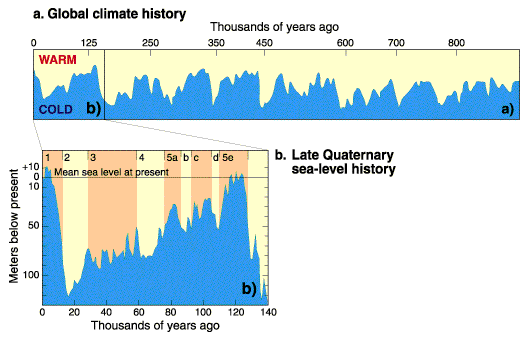
You're reading the graph wrong on wikipedia. Look at it again, we are at some of the highest sea levels. Here's the graphs:

Reply
Power-User

Join Date: Apr 2005
Location: Averill Park, NY
Posts: 250
Good Answers: 4
#12
In reply to #10

Re: <b>The Missing Carbon Problem (Part 1)</b>

01/30/2009 2:49 PM

Wrong graph Roger~! You need to look further back in time than the latest stadial if you want to look at trends in ocean water level.

__________________
"There isn't a scientific community. It's a culture. It is a very undisciplined organization." ~ Francois Rabelais
Reply Score 1 for Good Answer
The Engineer
Engineering Fields - Engineering Physics - Physics... United States - Member - NY Popular Science - Genetics - Organic Chemistry... Popular Science - Cosmology - New Member Ingeniería en Español - Nuevo Miembro - New Member

Join Date: Feb 2005
Location: Albany, New York
Posts: 5060
Good Answers: 129
#13
In reply to #12

Re: <b>The Missing Carbon Problem (Part 1)</b>

01/30/2009 3:05 PM

You're right.

When you go back that far in time the sea levels were much higher. This is because location of the landmass with respect to the poles becomes the major factor. For instance, 250 million years ago sea levels were near minimum levels. At that time of the super continent Pangaea (250 million years ago, a large amount of land mass was in polar regions which allow significant glaciation. As time passed and Pangaea broke up and the distribution of land became more equatorial, these glaciers melted and sea levels rose. Then the continents migrated to the north and south poles which resulted in increased glaciation again. Sorry, I thought you were talking about short term trend.

Reply
Power-User
Engineering Fields - Mechanical Engineering - BSME Clarkson University 1992 Engineering Fields - Software Engineering - BSME Clarkson University 1992 Fans of Old Computers - TRS-80 - DataRock 1.0

Join Date: Apr 2008
Location: Troy, NY
Posts: 388
Good Answers: 3
#14
In reply to #12

Re: <b>The Missing Carbon Problem (Part 1)</b>

01/30/2009 4:32 PM

Hi Shawn

Not so sure we can trust your graph here.

This issue boils down to who's paying the scientists to say what, from my point of view.

If they were all retired and independently wealthy, no worries. But they're not, and we need to know who funds their research to make a judgement on trusting their data.

- Larry

Reply
Power-User

Join Date: Apr 2005
Location: Averill Park, NY
Posts: 250
Good Answers: 4
#21
In reply to #14

Re: <b>The Missing Carbon Problem (Part 1)</b>

02/02/2009 2:03 PM

Hallam et. al is an independent research done by reputable geologist and the Exxon curve may have been funded by Exxon but regardless is a well funded research from several geoloigist that shows to a high confidence level that our ocean are at a historical low level.

This is an oil funded research that is telling us that climate change is inevitable... they aren't blowing it out of proportion and the missing point is climate change has taken place in short period in earths history. We are playing with fire and if we push the dynamic equilibrium we may flood vasts parts of the civilized world with rising ocean waters... nevermind what we may be doing that might be irreversible.

__________________
"There isn't a scientific community. It's a culture. It is a very undisciplined organization." ~ Francois Rabelais
Reply
Guru

Join Date: Dec 2006
Location: Germany 49° 26' N, 7° 46' O
Posts: 1950
Good Answers: 109
#22
In reply to #21

Re: <b>The Missing Carbon Problem (Part 1)</b>

02/02/2009 3:12 PM

Hi,

I don't know who is misinterpreting the data.

But I know definitely - and the graphs above show this too - that the sea-level has been 100m deeper than now during the maximum of glaciation.

(Fishing in 20 m deep North sea is dragging up antlers of deer 15,000 years old).

So something is wrong with your statement of ocean historical? low level.

Despite this I am convinced that we may have a significant sea-level rise.

And I am convinced that we (taking the mean action of human population of this Earth) neither can nor will do anything significant against this.

Look at Don Quichote!

RHABE

Reply
Power-User

Join Date: Apr 2005
Location: Averill Park, NY
Posts: 250
Good Answers: 4
#23
In reply to #22

Re: <b>The Missing Carbon Problem (Part 1)</b>

02/02/2009 3:35 PM

Using the Exxon Curve I see in the most recent history a time when the Oceans were approximately 75m lower than todays' levels, but going back beyond that event there are several periods reaching about 275m higher than current. When I say we are a historical low level I am averaging the mean level of ocean water and suggesting over the long term ocean waters will rise... it is inevitable...

Regardless of what the noaa site suggests, which I am unable to find their resources for, is it safe to say that ice is not accumulating in todays climate? this is against forecasted predictions and brings concern that the unprescedented high levels will come sooner than later...

Where we are supposed to be headed:

"Accordingly, the model predictions for the next 100,000 years are used as a basis for forecasting how climate would evolve when forced by orbital variations in the absence of anthropogenic disturbance. The long-term cooling trend which began some 6,000 years ago will continue for the next 5,000 years; this first temperature minimum will be followed by an amelioration at around 15 kyr A.P. (after present), by a cold interval centered at 23 kyr A.P., and by a major glaciation at around 60 kyr A.P."

http://www.agu.org/pubs/crossref/1988/RG026i004p00624.shtml

__________________
"There isn't a scientific community. It's a culture. It is a very undisciplined organization." ~ Francois Rabelais
Reply
Guru

Join Date: Dec 2006
Location: Germany 49° 26' N, 7° 46' O
Posts: 1950
Good Answers: 109
#24
In reply to #23

Re: <b>The Missing Carbon Problem (Part 1)</b>

02/02/2009 4:52 PM

In this context of longterm averaging I agree.

It would be helpful if you make your statements with more precision: "historical low level" may be within 100 years, 1000 years, 10Kyears, 100Kyears, 1Myears..."

So to draw consequences: do not interact with climate, you may do the wrong,

certainly you will waste a lot of money that can be spent in a much better way.

Think about longterm necessities: removal of coastal cities and installations!

Or dikes for some time and then catastrophic failure?

RHABE

Reply
Guru

Join Date: Dec 2006
Location: Germany 49° 26' N, 7° 46' O
Posts: 1950
Good Answers: 109
#11
In reply to #9

Re: <b>The Missing Carbon Problem (Part 1)</b>

01/30/2009 12:17 PM

This is not possible as there was a land bridge from Europe to England during the last ice-age and any estimates indicate that the sea-level was approximately 80m down from todays level.

The prehistoric memory of fast sealevel rise is in the tales of Bible and Gilgamesch about the flood and Noah rescuing all.

RHABE

Reply
Anonymous Poster
#17
In reply to #11

Re: <b>The Missing Carbon Problem (Part 1)</b>

02/02/2009 11:59 AM

Actually, current thinking is that the flood mythologies are based in a major localized flooding event related to the flooding of the depression that we now call the Black Sea. This might be different that a rapid rise in Sea levels, as it involved the inflow of waters into a depression, more similar to the flooding of the Salton Sea in California (just way deeper and larger).

Reply
The Engineer
Engineering Fields - Engineering Physics - Physics... United States - Member - NY Popular Science - Genetics - Organic Chemistry... Popular Science - Cosmology - New Member Ingeniería en Español - Nuevo Miembro - New Member

Join Date: Feb 2005
Location: Albany, New York
Posts: 5060
Good Answers: 129
#18
In reply to #17

Re: <b>The Missing Carbon Problem (Part 1)</b>

02/02/2009 12:05 PM

Actually I just saw something where they were discussing a comet impact in the indian ocean 10,000 years ago being the source. The result was torrential rains due to the water thrown up during the impact and coastal flooding.

http://discovermagazine.com/2007/nov/did-a-comet-cause-the-great-flood/article_view?b_start:int=1&-C=

Reply
Guru

Join Date: Dec 2006
Location: Germany 49° 26' N, 7° 46' O
Posts: 1950
Good Answers: 109
#20
In reply to #17

Re: <b>The Missing Carbon Problem (Part 1)</b>

02/02/2009 2:01 PM

"current thinking"

Flooding of Black Sea at end of any ice-age is accepted.

But any early myths is most likely related to the crescent half-moon down to the Persian-Arabian gulf.

At any end of an ice-age there are the "Heinrich-events", large down-pourings of sweet-water from the continental US when the ice-barrier at the St.Lawrence river is breaking down.

These events are documented in sea-floor drilling results. These showed a lot of pebbles, size from 10cm down to below 5mm depending on distance from mound. This 7 times for the last 1 million years. So this is a usual event at any end of ice-age.

This will result in a temporary marked cooling with accompanying heavy rainfall for weeks or months,maybe years. And it will result in some sea-level rise.

This will have only minor consequences in the black sea: there the shores are steep.

But this will have heavy impact in the Euphrates and Tigris delta (then much up to the location we see now.

There is near only a few meter per 100Km slope in shallow waters, so large sea ingression at moderate sea-level rise is a fact.

By these facts I would bet that the location of Noah's telltale was there.

RHABE

Reply
Associate

Join Date: Jan 2008
Location: 1,000,000 miles from somewhere else, 846' above sea level in N.A.
Posts: 46
Good Answers: 1
#3

Re: <b>The Missing Carbon Problem (Part 1)</b>

01/28/2009 7:14 PM

The carbon problem is simple- more people=more co2, less trees(see South America) =less co2 being removed from atmosphere, make more cars to burn fossil fuels= more co2 in atmosphere, less trees= less co2 being pulled from atmosphere; so sooner or later the natural balance will go goofy. Just remember, there are more cars in the U.S. than there are people, so like i said the problem is simple, too many people, more is not always a good thing......kind regards.......

__________________
I started with nothing, and I still have some left
Reply
The Engineer
Engineering Fields - Engineering Physics - Physics... United States - Member - NY Popular Science - Genetics - Organic Chemistry... Popular Science - Cosmology - New Member Ingeniería en Español - Nuevo Miembro - New Member

Join Date: Feb 2005
Location: Albany, New York
Posts: 5060
Good Answers: 129
#7
In reply to #3

Re: <b>The Missing Carbon Problem (Part 1)</b>

01/29/2009 3:25 PM

I guess less people is a solution if you're another type of animal, like a wolf, or bear, but otherwise I think we need something a bit more practical.

Reply
Power-User
Engineering Fields - Mechanical Engineering - BSME Clarkson University 1992 Engineering Fields - Software Engineering - BSME Clarkson University 1992 Fans of Old Computers - TRS-80 - DataRock 1.0

Join Date: Apr 2008
Location: Troy, NY
Posts: 388
Good Answers: 3
#6

Re: <B>The Missing Carbon Problem (Part 1)</B>

01/29/2009 3:04 PM

Hi Shawn - Many thanks for blogging on this topic:

I guess I've taken it as "gospel" (scientific fact) that human activity is impacting the climate, ever since a professor at Rensselaer Polytechnic Institute (RPI) first assigned me calculations from a Scientific American textbook, as part of my graduate course in Combustion Systems, way back in 1992.

I think my understanding was partly proportional to the amount of money I paid for this course, but also came from the fact that the professor teaching me was extremely competent, and a leader in his field. I've always supported political leaders who would prevent climate change, ever since taking that RPI course.

If you draw a control volume around the planet, you account for 100% of the earth's carbon. Calculations start from there. What you don't return to the ground, through sequestration and trees in the rain forest, ends up accumulating in the atmosphere. The model is unbalanced because the carbon is accumulating, causing climate change to happen. I'll look for my Scientific American text and bring it into the office.

I heard this week that it's irreversible, but don't expect anyone to apologize to me or any of us who've been "crying wolf" since the early 90's. Instead, I'll adapt, Darwin-style, and be investing in those new freight ships that will be crossing the Northern Passage.

- Larry

Reply
Guru

Join Date: Dec 2006
Location: Germany 49° 26' N, 7° 46' O
Posts: 1950
Good Answers: 109
#15

Re: <b>The Missing Carbon Problem (Part 1)</b>

01/31/2009 7:20 AM

We are talking here about todays and tomorrows situation, so looking at the last 20Kyears is better than extended geological times, although these may give some additional insights.

From both plots in post 10 and 12 I deduct a high degree of correlation of temperature and sea-level bot also some important influences from other (nonhuman) effects.

So as long as we don't know these we will waste our time to scratch in the noise of measurements.

Look at the graph in post 12: without any indication how much of the "noise" is from nonideal measurement and how much is really changing sea-level we cannot draw any conclusions.

RHABE

Reply
Power-User

Join Date: Apr 2005
Location: Averill Park, NY
Posts: 250
Good Answers: 4
#19
In reply to #15

Re: <b>The Missing Carbon Problem (Part 1)</b>

02/02/2009 1:52 PM

If we only look at the past 20K years we are only looking at a snapshot in history. there are three long term known modes of climate variability outlined by the Milankovitch Cycles. Some cycles elapse as along as 100K years. If we know today we are at a near historical low in ocean water level it is obvious even without taking into account continental drift that we will see rising ocean waters in our near future. This leads us back to the discussion of how alarmed we should be about our contribution to global warming?

__________________
"There isn't a scientific community. It's a culture. It is a very undisciplined organization." ~ Francois Rabelais
Reply
2
Guru
Hobbies - Fishing - Popular Science - Paleontology - New Member

Join Date: May 2008
Location: Holeincanoe Ontario
Posts: 2169
Good Answers: 27
#16

Re: <b>The Missing Carbon Problem (Part 1)</b>

01/31/2009 8:07 AM

A new phenomenon is occuring in the actic regions. First, if one looks at an aerial map that was made 30 years ago and compare it to one made, say, 5 years ago, one would immediately notice a dramatic increase in small, shallow lakes and ponds.

One would also notice that significant areas of exposed rock are snow and ice free. These have become heat sinks.

It is reported that it is not unusual for escaping methane to collect under the frozen ponds and escape along the shore lines. The release of methane has become dangerous for some who travel in those vicinities and whose vehicles can ignite it.

Is it possible the missing carbon is in what is known as the permafrost which is now melting and releasing hydrocarbons? Has anybody done the math as to how much of this carbon is stored in the arctic permafrost?

As one who has travelled there in the past and recently I have come across specific areas that are begining to stink of rotting vegetation. That's something new.

Any Inu will tell you there is nothing in their ancestral memory that describes what is occuring now.

__________________
Prophet Freddy has the answer!
Reply Good Answer (Score 2)
Participant

Join Date: Feb 2014
Posts: 4
#25

Re: <b>The Missing Carbon Problem (Part 1)</b>

03/01/2014 1:15 AM

these numbers may not represent the correct situation.

There are many things which people miss, Example how about the co2 escaping in the environment from different parts of globe can any one give 100% accurate number for that, I do not understand how people get these numbers.

Reply
Power-User

Join Date: Apr 2005
Location: Averill Park, NY
Posts: 250
Good Answers: 4
#26
In reply to #25

Re: <b>The Missing Carbon Problem (Part 1)</b>

03/03/2014 8:37 AM

Since this article was published there have been many studies claiming to have solved this missing sink in the global carbon budget. That is from the known source of atmospheric CO2, burning of fossil fuels, coupled with deforestation the affected flux of carbon cannot be accounted for by the increasing concentration measured in the atmosphere and amplified sink to the oceans. Conclude that:

  • There is no longer a direct correlation to global climate and atmospheric CO2 concentrations. Modern civilizations have disrupted what was previous an accurate means of reconstructing paleoclimatology.
  • There is no solid theory that explains what negative feedbacks exist that naturally sequester atmospheric CO2

The issue was that prior models were not even close to balancing the carbon budget even with rather wide error margins. It was more of a case study to identify the transport of carbon from crude oil through the atmosphere to another reservoir. Atmospheric concentrations are still rising, and the jury is still out as to how an equilibrium will reached and what it truly means for us.

__________________
"There isn't a scientific community. It's a culture. It is a very undisciplined organization." ~ Francois Rabelais
Reply
Reply to Blog Entry 26 comments

Good Answers:

These comments received enough positive votes to make them "good answers".

"Almost" Good Answers:

Check out these comments that don't yet have enough votes to be "official" good answers and, if you agree with them, vote them!
Copy to Clipboard

Users who posted comments:

Anonymous Poster (1); april05 (2); Bayes (4); Duckinthepond (1); genx (1); manojCC (1); RHABE (8); Shawn (8)

Previous in Blog: Difficulties in Characterizing Uranium   Next in Blog: <b>The Missing Carbon Problem (Part 2)</b>

Advertisement