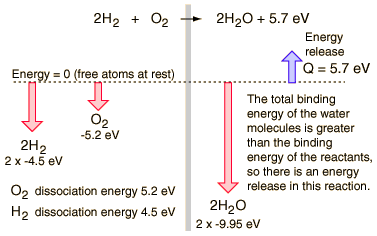
Here's a question : I have dabbled in Quantum Mechanics and Nuclear Equations , but I still have a question that I can't find an answer to. Take one of the simplest elemental combinations in the Periodic Table , the 2 element chemical bond we know as water . Taken as a molecular weight equation , H 2 0 is finite - It has a molecular weight , it is either gaseous or liquid ( or solid , ice ) and it is so predominant in every elemental compound and equation known to chemical science that we seldom attribute normal water with anything spectacular . I'm going to change that point of view . If you add something to water that has not been around , something the Romans didn't have , something Plato and Proclus didn't have , water takes on a rather different makeup . Add an electric arc to H 2 O , and any physics 11 major will tell you what happens : It changes , the chemical bond is broken , the two elements are released as gas , in fact , not any gas , two gasses : Hydrogen and Oxygen . Both very flammable and in the combination of one Oxygen Atom and 2 Hydrogen atoms , so volatile that the two gasses immediately ignite . By coincidence , the main rocket thrusters on board NASA's most powerful space delivery device , or one of them , contains noting more than good old hydrogen and oxygen , in a compressed gas form .
My question is this : Exactly how much electricity does it take to change a large amount of liquid H 2 0 into it's volatile gaseous counterpart , Oxygen and Hydrogen Gas , and what rate of E.M.F. would be required to constantly apply to say , sea water , to make it perform the task of igniting and staying lit , that is to say , a continuous flame , produced from nothing else other that an application of electricity and an electric current . Given , the clean fresh H 2 0 is , by itself , and electrical insulator , and so would need an electrolyte dissolved into it . Like pure salt . I'm guessing here , and try it if you think I'm wrong , but common houshold North American current , 115 V.A.C. is enough , at between 15 and 20 amperes , to create a pretty violent explosion of hydrogen gas and oxygen , and all you have to do is add table salt to a lukewarm 2 cup Pyrex measuring glass to acheive this . Try it . Boom . Fancy nuclear equation aside , what two elements are most common on earth ? H 2 0
How much difficulty does it require to electrify salt water ? Not much . What then happens ? Usually , you get a jolt , and you know you are touching live voltage , it's a ground . Increase that voltage , and it may be possible to reach a point where the seawater , electrified , can sustain a free burn , as Hydrogen gas and Oxygen gas , and that this free burn can itself be harnessed to produce the electricity required to split the liquid H 2 ) into gas , and thereby cause ignition . Perpetually , until all the water is used up . That's my question . Have fun with it , see what you think .
Dragon 113


 4
4
 Oceans of Energy

 Re: Oceans of Energy




Good Answers:
"Almost" Good Answers: