Login | Register

Roger's Equations

This blog features weekly an equation, formula, or constant that occurs frequently in Engineering or Science. I will try to present the subject matter in a nonformal, conversational style that can be easily followed. Criticism and corrections are encouraged, as are suggestions for future discussions.

Previous in Blog: Hyperspheres Part II: General Properties   Next in Blog: Functions Part II
Close

Comments Format:


Close

Subscribe to Discussion:

CR4 allows you to "subscribe" to a discussion
so that you can be notified of new comments to
the discussion via email.

Close

Rating Vote:


10 comments

Functions Part I

Posted February 10, 2007 2:27 PM by Roger Pink

The key to solving differential equations are functions. In fact, the more functions you know and understand, the better you will be at solving differential equations, yet we are never really given a course on commonly used functions. We are supposed to pick them up as we go. I've decided to compile a list of some common functions and their corresponding graphs. Best to start with the basics:

The Linear Function

Equation: f(x) = ax + b


Example:

Velocity due to constant acceleration

a=dv/dt
a∫dt = ∫dv
at + v0 = v
v= at + v0

where v0 is the intial speed


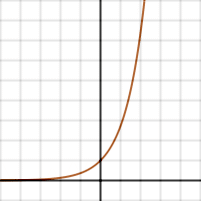
The Exponential Function

Equation: f(x) = ex


Example:

Radioactive decay with decay rate λ

dN/dt = -λN
∫1/N dN = -λ ∫dt
ln N - ln N0 = -λt
ln N/N0 = -λt
N/N0 = e-λt
N = N0 e-λt

where N0 is the intial number of particles


The Logarithmic Function

Equation: f(x) = ln(x)

Example:

Work done during isothermal expansion of an ideal gas

dW/dv=P
dW/dv= nRT/v
W = nRT ∫ 1/v dv
W = nRT(lnvf - lnvi)
W = nRT(ln(vf/vi))

where W is work done, vi is the intial volume, vf is the final volume, n is the number of moles of the gas, R is the Gas Constant, and T is the temperature.

The Quadratic Function

Equation: f(x)= ax2 + bx + c

Example:

Postion due to constant acceleration

v=dx/dt
∫vdt= ∫dx
∫(v0+at) dt = x-x0
v0t + 1/2at2 = x-x0
x(t) = 1/2at2 + v0t + x0

where x0 is the initial position and v0 is the initial velocity

The Cubic Function

Equation: f(x) = ax3 + bx2 + cx + d


Example:

Position as a function of constant jerk (or jolt if you're British) (J=da/dt)

j = da/dt
a = jt + a0
dv/dt = jt + a0
v= 1/2 jt2 + a0t + v0
dx/dt = 1/2 jt2 + a0t + v0
x(t) = 1/6 jt3 + 1/2 a0t + v0t + x0

where a0 is the initial acceleration, v0 the initial velocity and x0 the initial position.

The Sine Function

Equation: f(x)= Sin(x)


Example:

Motion of a mass attached to a spring with spring constant k

F=-kx
ma=-kx
d2x/dt2 = -(k/m)x
d2x/dt2 + ω2x = 0
d2x/dt2 = -ω2x
x(t) = Asin(ωt + φ)

where ω=√k/m


The Tangent Function

Equation: f(x) = Tan(x)


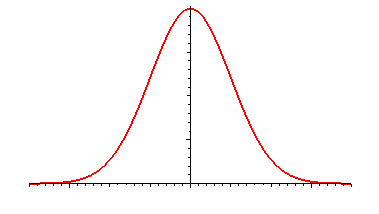
The Gaussian Function

Equation:


The Modulus Function

Example: f(x) = |x|

The Square Root Function

Equation:


That's all for now, next week I will add additional functions. If you have any functions in particular you'd like to see discussed, let me know.

Thanks to the following websites:

http://en.wikipedia.org/wiki/Main_Page
http://www.stephenwolfram.com/


Interested in this topic? By joining CR4 you can "subscribe" to
this discussion and receive notification when new comments are added.
Guru

Join Date: May 2006
Location: Placerville, CA (38° 45N, 120° 47'W)
Posts: 1556
Good Answers: 43
#1

Re: Functions Part I

02/11/2007 1:33 AM

Please do show how these functions relate to real world applications of differential equations. Its been over 40 years since I dealt with differential equations in college, and didn't really understand them then.

__________________
Hopefully, by quoting no one, I am offending no one.
The Engineer
Engineering Fields - Engineering Physics - Physics... United States - Member - NY Popular Science - Genetics - Organic Chemistry... Popular Science - Cosmology - New Member

Join Date: Feb 2005
Location: Albany, New York
Posts: 3559
Good Answers: 81
#6
In reply to #1

Re: Functions Part I

02/12/2007 1:46 AM

I have done as you requested. I have only provided examples for some, I will try to give the other functions examples. If its any help, differential equations are to functions what algebra is to numbers. In algebra, you try to find the number that satisfies the equation.

If x + 3 = 9, what is x?

x= 9-3 = 6

Similarly in differential equations, you try to find the function (equation) that satisfies the differential equation.

If dx/dy + 3 = 9, what is x?

dx/dy = 9-3 = 6
∫dx= ∫6dy
x-x0 = (y-y0) 6
x = x0 + 6(y - y0)

If you look carefully at the solution, you'll see it's just a line (remember x0 and y0 are just "initial conditions" ie constants)

x = 6y + (x0 - 6y0)
x = ay + b (equation of a line)

In fact, the point is that ANY time you have the differential equation:

dx/dy = K= Constant;

The solution will be a line

x= Ky + b

What if the differential equation is,

d2x/dy2= K = Constant

then the solution is

x= 1/2Ky2 + by + c (quadratic equation)

If the differential equation is

d3x/dy3 = K = Constant

then the solution is

x = 1/6Ky3 + by2 + cy + d (cubic equation)

hopefully you're starting to see a general solution emerging in the equations above.

The point I'm trying to make is that each differential equation type has a solution. Now you may be thinking, "but there are so many possible types of differential equations", that's true in MATH, but in physics and engineering, the same old differential equations tend to pop up over and over and over again. If you memorize the solutions of 5 to 10 particular types of differential equations, you're well equipped to most engineering and physics problems.

For instance, if some tells you that:

dN/dt = -λN

then you know that N decreases (decreases because of the sign on lamda) exponentially in time. Notice you didn't need to solve it with calculus, you just needed to remember that differential equations of the form:

dx/dy = Kx

where k is constant, has solution:

x = Ae-Ky

If you memorize that fact, you don't have to worry about the calculus unless you need to know exact numbers.

The point is, we are forced to memorize all kinds of things like trig identies, derivatives, multiplication tables, but all of a sudden we can't memorize differential equation solutions? Why not?

__________________
Cause you said the brains I had went to my head
Guru

Join Date: May 2006
Location: Placerville, CA (38° 45N, 120° 47'W)
Posts: 1556
Good Answers: 43
#8
In reply to #6

Re: Functions Part I

02/12/2007 9:08 PM

To answer your last question, I believe because we really didn't understand either the original equations or know of uses for them.

You've given me a good start that I should have had 40 years ago! BTW I commonly tend to skip the equations when reading similar text, but I read (and I think understood) all of yours...

Thanks

Dick

__________________
Hopefully, by quoting no one, I am offending no one.
Guest
#9
In reply to #6

Re: Functions Part I

02/26/2007 2:36 PM

/////////////////////////////////////////////////////////////////////////////////////

For instance, if some tells you that:

dN/dt = -λ

then you know that N decreases (decreases because of the sign on lamda) exponentially in time. Notice you didn't need to solve it with calculus, you just needed to remember that differential equations of the form:

dx/dy = K = constant

have exponential solutions

x = Ae-Ky
////////////////////////////////////////////////////////

There is a mistake in this portion. I believe that you meant to write

ydx/dy = K has exponential solutions. As you have it written, there would be linear solutions as you pointed out at the beginning of your article.

DaMoNarch

The Engineer
Engineering Fields - Engineering Physics - Physics... United States - Member - NY Popular Science - Genetics - Organic Chemistry... Popular Science - Cosmology - New Member

Join Date: Feb 2005
Location: Albany, New York
Posts: 3559
Good Answers: 81
#10
In reply to #9

Re: Functions Part I

02/26/2007 3:19 PM

You're correct that I was mistaken. I should have written:

dN/dt = -λN

which is the differential equation that has an exponential solution. I have corrected my mistake in my original response. Thank you for catching it.

You wrote:

ydx/dy = K has exponential solutions

dx/dy = (1/y) k

∫dx = k∫ (1/y) dy

x = k lny

x = k(lny)

Your differential equation has a logarithmic solution.

__________________
Cause you said the brains I had went to my head
Member

Join Date: Feb 2007
Location: Johannesburg, South Africa
Posts: 5
#2

Re: Functions Part I

02/11/2007 2:20 AM

What does the Gaussian function relate to? All the other graphs are sort of familiar/common functions. I have never seen the Gaussian one before.

I suppose that equation has got some special engineering or mathematical significance?

Mike Kovacik,

Joburg South Africa

(2d/3d draughtsman & permanent engineering student!)

Guru
United States - Member - Engineering Consultant Popular Science - Evolution - Understanding

Join Date: Nov 2006
Location: Bay Shore, NY
Posts: 726
#3
In reply to #2

Re: Functions Part I

02/11/2007 2:50 AM

Mike,

One of its most common usages is in probability/statistics where it represents the density function of the "normal distribution": it defines the bell shaped curve.

For more information and applications:

http://en.wikipedia.org/wiki/Gaussian_function

Greg

__________________
"The more I learn, the more ignorant I realize I am."
Member

Join Date: Feb 2007
Location: Johannesburg, South Africa
Posts: 5
#4
In reply to #3

Re: Functions Part I

02/11/2007 3:03 AM

Greg

Thanks for that quick answer. I thought it looked vaguely familiar. I have just found it in one of my engineering mathematics books. Thanks for that website address.

Mike

Guru
Hobbies - HAM Radio - CE3AM....4X4SW....CE3NSW

Join Date: Aug 2006
Location: Santiago Chile.
Posts: 749
Good Answers: 5
#5
In reply to #2

Re: Functions Part I

02/11/2007 9:08 PM

Hello Mike,

My answer to your question mat not be very popular as it has to do more with the philosophical aspects, rather than the mathematical. As a common answer it could be said that that the Gaussian function represent the NATURAL DISTRIBUTIN of things. Take for example a mathematical description of a weather storm, from very low values through an apex and back to the starting low values. Or as another, the political distribution of the human society: the extremists Will be represented in both sides of the of the curve, left and right, (and BTW, this is actually where these names are derived from), while the center will represent the majority. The Axes will represent the quantitative values such as number of persons, age distribution belief in world peace, or what have you... Another example could be your own history: age vs. your physical condition. or your career. Start at zero,go through the apex and ends at zero. and so on. Practically speaking this function describes most of the day to day events, chemical reactions, statistics and much more.

The rest of thinking about the Gaussian function I'll leave up to you...

Wangito

p.s Gauss is spelt with double "S"

__________________
Never trade luck for skill.
Guest
#7
In reply to #5

Re: Functions Part I

02/12/2007 2:17 PM

It goes even beyond that. If you take an infinite number of random non-gaussian distributions and add them together, you get a gaussian distribution!

10 comments
Interested in this topic? By joining CR4 you can "subscribe" to
this discussion and receive notification when new comments are added.
Copy to Clipboard

Users who posted comments:

dkwarner (2), Greg G (1), Guest (2), Mike Kovacik (2), Roger Pink (2), wangito (1)

Previous in Blog: Hyperspheres Part II: General Properties   Next in Blog: Functions Part II
You might be interested in: Diacs, Gate Turn-off (GTO) Thyristors, Flip-flops