|
Redheads, gingers, carrot tops….all affectionate names for
our flaming hair friends. The phenotype for red hair is recessive, meaning both
parents must have it for their children to be blessed with ginger locks. While redheads have hit recent pop culture
with gusto, there is also an urban legend among anesthesiologists and dentists
that redheads require more anesthetic during surgical and dental procedures.
 Lucille Ball (Not actually a redhead, but famous for it
anyway). Image Credit: Marie Claire Lucille Ball (Not actually a redhead, but famous for it
anyway). Image Credit: Marie Claire
The Science
The red hair phenotype is caused by distinct mutations of
the melanocortin-1 receptor gene (MC1R). MC1R is expressed on the surface of
melanocytes, which are the melanin-producing cells found in the lower layer of
the skin's epidermis. The gene is a
regulator of intracellular signaling to the pathway governing pigment
formation. The phenotype
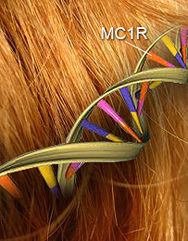
results from excess pheomelanin, a yellow-red pigment,
production caused by well-identified mutations of the MC1R. MC1Rs are found in
the midbrain and they participate in pain and pain inhibition.
While anesthetic requirements are remarkably uniform in
humans, they are known to be affected by the age and body temperature of the
patient. Genetic markers have not been shown to contribute to anesthetic
requirements in humans.
Before I get too far with this explanation, I want to
give you a couple definitions.
Image Credit: Thehistoryofthehairsworld.com
Anesthesia-
Numbs the senses. Anesthesia blocks the transmission of nerve impulses between
a part of the body and the spinal cord. Anesthesiologists give patients
anesthetics before they go in for surgery.
Analgesia-
Relieves pain. Analgesic drugs act on the peripheral and central nervous system
to inhibit enzymes reducing pain and inflammation. They can be available over
the counter in the form of acetaminophen pills or as a topical application such
as lidocaine (the gross stuff dentists put on your gums before they start
drilling).
The Research
Research on red haired women is not new, but it was recently
brought to my attention by a terrible experience my red-headed best friend had
at the dentist. She needed a significantly higher dose of the numbing agent to
be "comfortable" while the dentist worked. But as I did a little more research
I found it was an interesting topic for discussion.
Two studies came out around the same time and showed
somewhat conflicting results. The studies looked at the effect of anesthetics,
analgesics, and pain threshold in red-headed women.
Study 1
was published in 2004, headed by Dr. Daniel Sessler. The hypothesis was that more
anesthetic was required for red-haired women than dark-haired women. The group
tested a set of 20 women (10 with red hair and 10 with dark hair) by giving
them a general anesthesia and then desflurane (an ether used to maintain
general anesthesia). The women were then
given an unpleasant electrical stimulation to their thighs. A positive response
was defined as "distinct, purposeful movement of the legs or arms within the
first minute following stimulation." The volunteers with red hair required 19%
more anesthetic. The next year, this group published a study
about sensitivity to thermal pain and resistance to topical and subcutaneous
analgesia (lidocaine) in red-haired women. This hypothesis was brought about by
their previous study, suggesting that if redheads need more anesthetic then
they have a lower tolerance for pain. This study showed that redheads are more
sensitive to thermal pain and are resistant to the analgesic effects of
subcutaneous lidocaine. It also proved that mutations of MC1R modulate pain
sensitivity since red heads were significantly more sensitive to cold pain
perception, cold pain tolerance, and heat pain tolerance.

Pain Tolerance Thresholds to
2000-Hz, 250-Hz, or 5-Hz stimulation with dark hair (dark, solid lines) or red
hair (pale, dashed lines). Areas of the arm were tested with 4% liposomal
lidocaine, and an area injected with 1 mL of 1% lidocaine. Data were plotted as
Kaplan-Meier survival curves, and the curves were compared with Log-Rank tests.
Y-axis represents the fraction of the study population still able to reach a
particular threshold. The curves for the two groups were significantly
different for all three frequencies on the area treated subcutaneously with
lidocaine. Graph Credit: Sessler, D.
Study 2,
done by neuroscientist Jeffery Mogil suggests the opposite of Dr. Sessler's
studies. His findings show that mice with the same gene mutation for red hair
have a higher pain tolerance and react less strongly to painful stimuli. This
study also concluded that redheads have a heightened sensitivity to analgesics.
What this means?
How MC1R regulates pain is still unclear, but it is
possible that MC1R mutation upregulates production of the receptor's primary
ligands, melanocortins including a α-MSH,
which also stimulates other melanortin receptors-including the melanocortin 4
receptor that modulates cold and mechanical allodynia in a rat neuropathic pain
model.
To sum up both the research studies, red haired women
require more anesthetics (what puts people to sleep before surgery) but fewer
analgesics (pain killers) for medical and dental procedures. But there isn't an
easy resolution to whether or not red heads have a higher or lower pain
tolerance since the research is still contradictory and therefore, requires
more study.
For what it's worth, Mythbusters busted the
myth that natural redheads have a lower pain tolerance than people of other
hair colors as well as some other
pain myths.
Resources
Do
redheads really feel more pain? The jury's still out
| 

 3
3


 Re: Hate The Dentist…Blame Being a Redhead


Good Answers: