Login | Register

Great Engineers & Scientists

In 1676, Sir Isaac Newton wrote "If I have seen further it is by standing on ye shoulders of Giants." In this blog, we take Newton's words to heart, and recognize the many great engineers and scientists upon whose shoulders we stand.

So who do you think of when you hear "Great Engineer"? Let us know! Submit a few paragraphs about that person and we'll add him or her to the pantheon. Please provide a citation for the material that you submit so that we can verify it. Please note - it has to be original material. We cannot publish copywritten material or bulk text taken from books or other sites (including Wikipedia).

Previous in Blog: Charles Proteus Steinmetz: The Wizard of GE (Part 1)   Next in Blog: Charles Proteus Steinmetz: The Wizard of GE (Part 3)
Close

Comments Format:


Close

Subscribe to Discussion:

CR4 allows you to "subscribe" to a discussion
so that you can be notified of new comments to
the discussion via email.

Close

Rating Vote:


3 comments

Charles Proteus Steinmetz: The Wizard of GE (Part 2)

Posted September 16, 2008 4:42 PM by april05

When Charles Proteus Steinmetz began his career with General Electric (GE) in 1892, the German-born mathematician and electrical engineer was assigned to the company's "Calculating Department", then located in Lynn, Massachusetts. There, Charles Steinmetz was given an even greater opportunity to conduct research and formulate his ideas. Eventually, he would become one of GE's first "Chief Engineers".

Beyond the War of the Currents
By the time that Steinmetz arrived in Lynn, it was clear to GE that alternating current (AC) power would triumph over Thomas Edison's original direct current (DC) concept. With the so-called "War of the Currents" nearly complete, Steinmetz was recruited to play a part in General Electric's efforts to compete in AC technology against rival Westinghouse Electric Company.

Patents and Power Generation
GE's Calculating Department, the company's in-house "brain trust", was staffed by college-educated engineers who served as consultants for other GE divisions. Steinmetz's work led to patents for reducing induction in power transmission lines. His efforts also helped him to develop the algebraic techniques that he used to tackle practical problems in transformer, circuit, and transmission-line design. Eventually, Steinmetz would formalize these techniques in a series of textbooks that had tremendous influence over the electrical-engineering curriculum across the United States.

In 1894, General Electric's Calculating Department moved to Schenectady, New York. By that time, Steinmetz had effectively become GE's "Chief Engineer", a term still heard within the walls of GE's engineering buildings in the Electric City. All of GE's design calculations were under Charles Steinmetz's control. As GE built electric power-generation facilities around the world (buildings dedicated to products for export to Japan are shown on the map below), the Steinmetz-led "brain trust" was responsible for the design of alternators, motors, transformers, and similar equipment - resulting in even more patents.
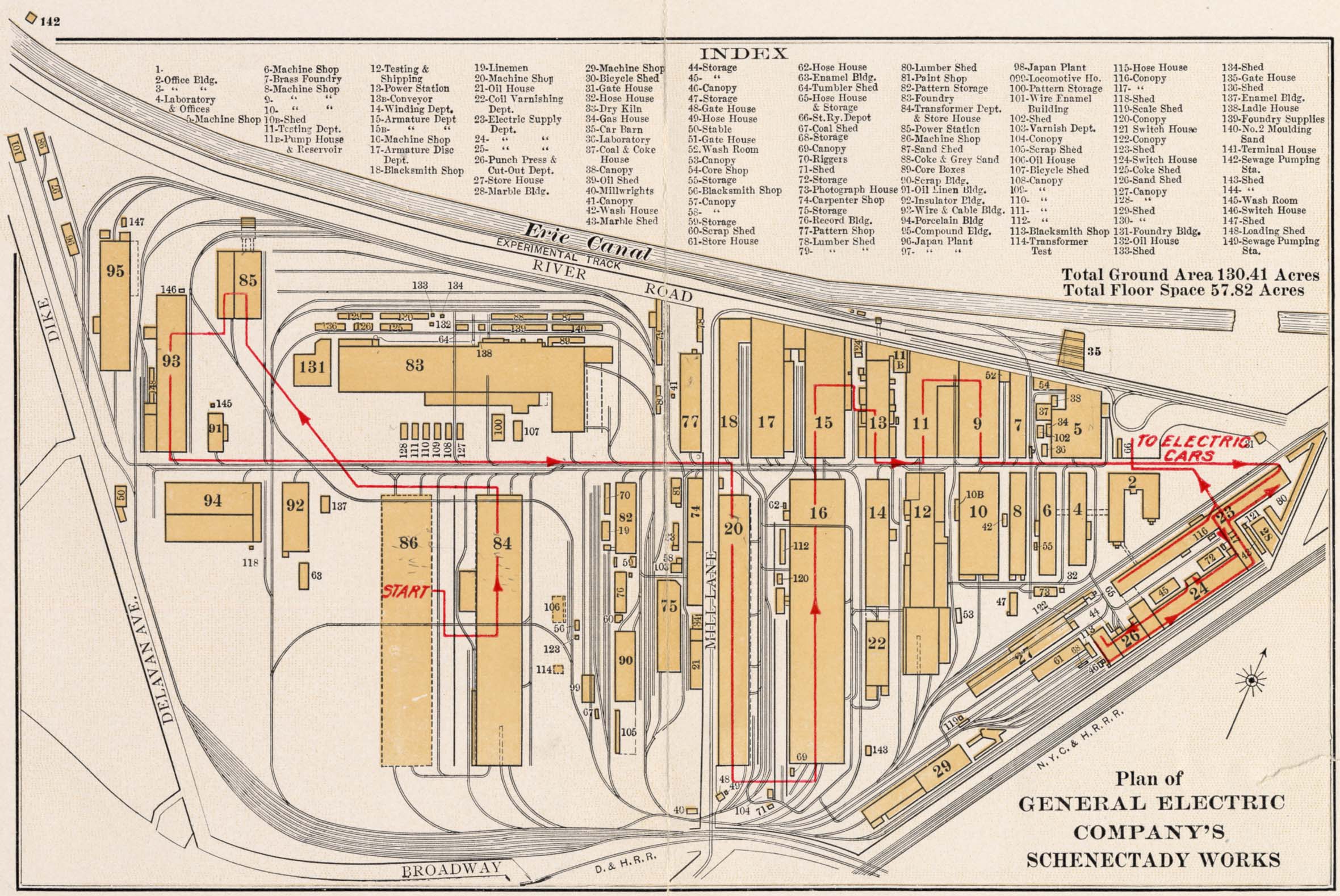
<-- Map of General Electric Company's "Schenectady Works". The Calculating Department was housed in a building on this campus. Zoom for a more detailed view within your browser.

GE Energy's Gas, Steam, Generator and Wind engineering divisions, along with other GE divisions, still actively use many of the same historic buildings shown on this map.

Below: Visit from Lord Kelvin, developer of the absolute temperature scale, to the Schenectady Works. Steinmetz is 4th from left.

The Electric Car and the Internal Combustion Engine
Later in his career, Steinmetz - like many modern-day engineers and entrepreneurs who are concerned about $4 per gallon gasoline – became a passionate advocate of the electric car. In both Europe and in the United States, Steinmetz was regarded as a leading thinker and writer about the technological and social issues of the day. For his engineering work, this translated to better ideas for practical concepts such as the automobile.

Editor's Note: This is the second in a multi-part series about Charles Proteus Steinmetz. Click here for Part 1. Part 3 will run later on CR4.

Resources:

Wikipedia - http://en.wikipedia.org/wiki/Charles_Proteus_Steinmetz

Union College - http://www.union.edu (various web sites at this domain)

Institute of Electrical and Electronics Engineers (IEEE) -
http://www.ieee.org/organizations/pes/public/2005/sep/peshistory.html

Institute of Chemisty, The Hebrew University of Jerusalem - http://chem.ch.huji.ac.il/history/steinmetz.html

Schenectady History –
http://www.schenectadyhistory.org (various sites at this domain)

Encyclopedia.com -
http://www.encyclopedia.com/doc/1G2-3468300289.html


Interested in this topic? By joining CR4 you can "subscribe" to
this discussion and receive notification when new comments are added.
Guru
United States - Member - New Member Engineering Fields - Electrical Engineering - New Member

Join Date: Jul 2008
Posts: 683
Good Answers: 24
#1

Re: Charles Proteus Steinmetz: The Wizard of GE (Part 2)

09/16/2008 8:46 PM

I was completely fascinated with your tale of Charles Proteus Steinmetz. I have been in the generator/turbine buildings in Schenectady multiple times and always wonder how such magnificent machines started as a sketch on a piece of paper... but then again, isn't that how most wonderful things start?

I can't wait to read the upcoming third installment in this series!

Power-User
Engineering Fields - Mechanical Engineering - BSME Clarkson University 1992 Engineering Fields - Software Engineering - BSME Clarkson University 1992 Fans of Old Computers - Commodore 64 - New Member

Join Date: Apr 2008
Location: Troy, NY
Posts: 346
Good Answers: 3
#2
In reply to #1

Re: Charles Proteus Steinmetz: The Wizard of GE (Part 2)

09/17/2008 7:44 AM

Hi Jaxy - Thanks for your kind comments and interest. Related FYI: The public is invited to a tour, sponsored by ASME, of the Mechanicville Hydro Plant, the oldest continuously-running facility of its kind in the United States, designed by Charles Steinmetz. The tour is on September 27th (2 tours, Saturday at 10am and noon). I posted a section newsletter with driving and other details this week on the Hudson-Mohawk ASME section web site. Feel free to download the PDF newsletter and share the link with anyone who might have an interest in attending. There's no charge. - Larry

__________________
Follow Larry Kelley --- on Twitter: http://twitter.com/Larry_Kelley --- and on CR4: http://cr4.globalspec.com/search/sitesearch?do=show&us=15248&srchobjs=t,be
Power-User
Engineering Fields - Mechanical Engineering - BSME Clarkson University 1992 Engineering Fields - Software Engineering - BSME Clarkson University 1992 Fans of Old Computers - Commodore 64 - New Member

Join Date: Apr 2008
Location: Troy, NY
Posts: 346
Good Answers: 3
#3

Re: Charles Proteus Steinmetz: The Wizard of GE (Part 2)

09/22/2008 8:17 AM

Author's note: part three is now available - click here to view.

__________________
Follow Larry Kelley --- on Twitter: http://twitter.com/Larry_Kelley --- and on CR4: http://cr4.globalspec.com/search/sitesearch?do=show&us=15248&srchobjs=t,be
3 comments
Interested in this topic? By joining CR4 you can "subscribe" to
this discussion and receive notification when new comments are added.

Previous in Blog: Charles Proteus Steinmetz: The Wizard of GE (Part 1)   Next in Blog: Charles Proteus Steinmetz: The Wizard of GE (Part 3)
You might be interested in: Computers, All Types, Handheld and Portable Computers, Desktop Personal Computers