|
Off the top of my head, there are only two sports I would
never try (and I could totally do competitive eating).

Look out Chestnut. via Diets in Review
The
first would be some crazy Gaelic game called hurling. It's similar to 30
unprotected baseball players swinging bats at the ball all at once. No, wait--that's exactly what it is. As soon as I figure
out something reasonable scientific about this game, I'll be sure to include it in an upcoming blog.
The second would be jai alai (pronounced like "hi lie"), which promotes standing around small
rubber balls going 180 mph.
The conclusion is I'm terrified of sports where head
injuries need their own stat category.
While
I may never be up for taking a beating from a pelota (a jai alai ball), examining how jai alai
players have been able to crank the velocity of a pelota to 188 mph will surely
be as much fun.
The Pelota and Cesta
Having once earned the Guiness distinction as the world's
fastest ball, the pelota is made of hard Brazilian rubber filled with
pressurized gas. Pelotas are about 25% smaller than baseballs and are covered
with goatskin to increase durability. The need to replace the goatskin every game means pelotas are handmade
and expensive.

Una pelota. via Euskadi Bet
A unique glove is worn during jai alai, called a cesta. The
cesta is essentially a padded glove with a long, curved basket attached. The
ball is meant to be caught in the basket and a long, sweeping arm action whips
the ball through the basket curvature and at the player's (called a pelotaris)
target, always the front wall of a jai alai court (called a fronton or cancha).
The cesta is always worn on the right hand due to a fronton only incorporating
a front, left and rear wall.
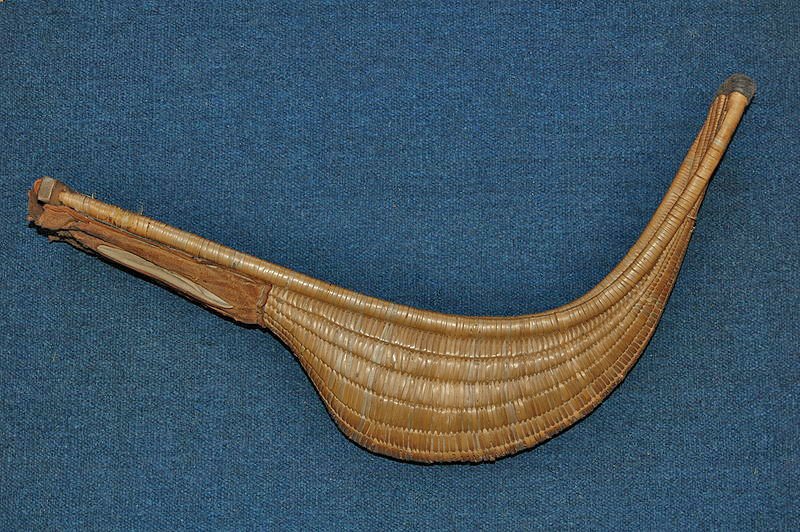
Una cesta via Alex Waterhouse Hayward
The Gameplay
I
don't anticipate going over every detail of jai alai here but hopefully this
post piques your interest and motivates you to learn more about this waning Spanish-culture import.
The most important aspects of the game are as follows. A
frontcourt player on the blue team serves the ball against the front wall.
Behind him stands his teammate and two red players, and the served ball must
bounce between a set of lines on the court before being fielded by the red
team. The ball is then thrown against the wall by the red team, so the blue
team has an opportunity to field. Points are awarded for poorly served pelotas,
misplayed fielding opportunities, going out of bounds or for interfering with the
other team. Several teams participate in the same game of jai alai, where after
giving up a point, the team must await another turn to play.
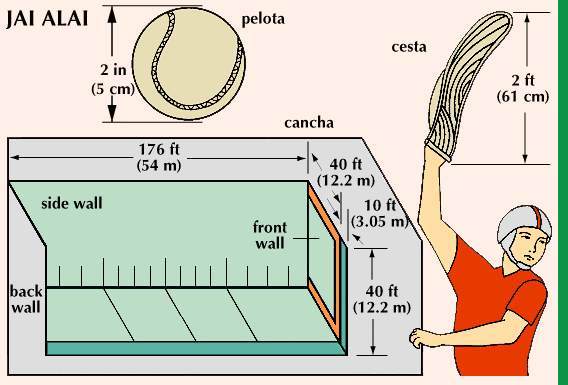
via The Art of Manliness
The Science
Jai alai has been called the fastest of all ball sports due
to the blistering nature at which the ball is played. (Side note: golf has now
sufficiently earned that title, with drives capable of exceeding 200 mph.)
Like many sports, the velocity of the thrown pelota is
determined by two major factors: the momentum delivered to the ball by the
pelotaris, and the trajectory at which the ball is delivered.
Jai alai players are allowed to run or crow-hop with the
pelota, provided they both field and deliver the pelota in a continuous motion.
This initial potential energy is stored through the legs, where once the
pelotaris plants his or her left foot (remember, jai alai is for righties only)
the body weight's momentum is being transferred from the large-mass and
weight-bearing legs, to the large-mass torso, to the low mass-arm. This is
called the sequential summation of movement and by beginning with the largest,
heaviest of the body parts, and summing that momentum with diminished-mass body
parts, jai alai players are able to maintain maximum efficiency during their
serve.
The unique cesta is also responsible for the high velocities
obtainable during play. By elongating the pelotaris' right arm with the cesta,
the angular momentum of the pelota is significantly higher. Consider spinning a rock tied to a string: the
longer the string, the faster the rock spins as it also follows the same
principle of angular momentum.
That is how the pelota reaches 188 mph. That is how 4 people
have been killed by
a pelota in the last 90 years.
So, what is there left to cover about jai alai?
I won't play it? Check. It's terrifyingly fast? Check.
It's played by the Most Interesting Man in the World? Check.
Oh right! The gambling. Jai alai was once very prevalent in
Florida, Connecticut and Rhode Island. Similar to horse racing, spectators
(i.e., old men drinking beer and smoking cigars) are allowed to bet on outcomes.
As gaming restrictions in these states have relaxed in recent decades, jai alai
frontons became locales for poker, dog racing and other table games. Only about
a dozen frontons remain in America today. I feel I can say jai alai was the
best thing to come out of Basque's Spain, perhaps second to only pintxos.

"OH MAN! You've never have pintxos!?" via Wikimedia
Resources:
The Art of Manliness - The Return of Jai Alai
Jai Alai Info
| 


 Re: Take Me Out to the 188 MPH Ballgame!


