|
While invented in Birmingham, England, in the 19th
Century, tennis has become popular worldwide, perhaps only second
to soccer/football. The game is fast, easy to grasp, and accessible to
spectators, participants and an inexplicable number of young, attractive
Russian females (see: Kournikova, Kirilenko, Pivovarova, Sharapova, etc.) The
game's worldwide following is evidenced by the locations of its four biggest
tournaments (Melbourne, Paris, London, New York) and its induction as an
Olympic sport in 1896.

Thank you, Mother Russia. Thank you. ...via All Posters
Tennis also features some of the most notable intersections
between sport and physics. Intelligently designed balls, rackets and courts,
and precision biomechanics compel tennis' case as more of a physics review
course than a sport.
"Pop" Goes the Tennis Ball Can
Tennis
balls are packaged in unique, air-tight containers that are subject to two
atmospheric pressures. Tennis balls have a high inner pressure (27 psi) to
increase their bounce rate; yet regular air pressure on a ball outside of the
package is about 14.7 psi. When a ball bounces, air inside the ball is
compressed, resulting in the high return force. However, with each bounce some
air is lost, along with some energy in the expenditure of sound and heat. The
rubber of the ball is exposed to sliding friction, which allows minute amounts
of the pressurized air to escape. In professional matches, the life of a tennis
ball can be as little as a few serves. To be deemed suitable for competitive play, a
tennis ball must have a return bounce of 53%-58%.
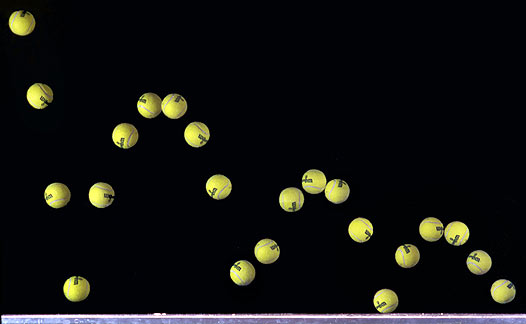
...via Hong Kong University
Tennis
balls are covered in a layer of durable felt, which decreases the drag on the
ball through the Magnus effect. The felt also assists in separating the
boundary layer and allows
a tennis ball to curve downwards during flight.
Veritasium's Youtube channel has a great animation of the Magnus effect and tennis balls. Control on the topspin of the ball is a valuable asset in
winning matches.
"Swoosh" Goes the Racket
Watch a pro tennis match and you'll witness pros switch
their racket regularly. It may seem obvious, but professionals like to keep
their rackets precise. By having very taught string tension across the racket,
players are able to better control their top spin, being able to deliver 100
mph+ volleys aimed over their opponent's
head, but still landing the ball in the court.
This has a lot to do with a recent technology in tennis
racket strings with a long-existent material.

...via The Happiest Mom
YEP. Until 1997, a Belgian company named Luxilon produced
elastic strings and straps mainly for women's undergarments. Gustavo Kuerten,
1997 French Open winner began stringing his rackets with their polyester
strings for unknown reasons and found good enough tension in the strings to
make a permanent change. He'd win two more French Opens and several more
championships in following years. Today, rackets are almost exclusively strung
by Luxilon polyester strings or competitors' alternates. TAKE THAT CHAUVINISTS!
"UHHHGGG!" Goes the Player
It's that weird moan a player makes when striking the tennis ball: an outburst of
energy expenditure that occasionally is the butt of a joke or two. The
noise has little to do with the quality of the serve, but may provide a passionate
or intimidating edge.
Tennis badboy John McEnroe knows a thing about passionate tennis. (It feels weird to label someone "tennis badboy.")
Of note though is the windup of a tennis player. As the player tosses the ball to themselves,
preparing to strike the ball forward, he or she has begun to build kinetic
energy to drive the ball. The player plants their rear foot, which
begins to explode toward their opponent, along with a hop to gain elevation. The hips rotate
along with the torso, and the shoulder completes the kinetic explosion. This is
called the kinetic chain principle, as linking mechanics of potential energy
overlap to develop a sum of their energy, in this case concluding with a
powerful serve.
The location of the serve toss is important as well. With a
high serve about a foot in front of the body, a player gains significant angular
momentum, ensuring the ball is struck with the maximum amount of kinetic energy
available.
"(Insert Onomatopoeic Sound Here?)" go the Courts
The most important factor in determining how the ball
bounces on varying court types is the coefficient of friction, which gauges the
abrasion between the court and the ball. Official court materials extend to
over 160 kinds, but can be generalized to three categories: hard court, grass
court and clay court. Grass courts tend to have the lowest frictional coefficient,
losing 33% of the ball's velocity speed on contact. This is due to the slick nature of
well watered and groomed grass. A clay court will insulate the impact of a tennis
ball slightly more and a will reduce the ball speed by about 43%. Finally, hard
courts, ordinarily concrete or asphalt, play just slightly slower than grass
courts, absorbing about 36% of the tennis ball's energy speed. (s/t welderman)

Yeahhh...not playing tennis here. Nor is my Anna. ...via Archinect
Because the ball is in rotation
as it strikes the court, the top half of the ball continues to rotate, while
the bottom half of the ball has some of its rotation arrested. A high-friction
court means a high bounce, and more time for the player to assess the speed and
direction of the ball.
And there it is folks! Tennis: a game invented by nobility
to pass time at functions that has been severely altered by bras, dirty
courtships and pressure. Wait, I thought
Valentine's Day was yesterday.
Resources
Wikipedia - Tennis Ball
Physics Dept., UIUC
Popular Mechanics - Tennis Serve; Tennis Racket
Grantland - The Physics of Grass, Clay, and Cement
| 

 2
2


 Re: Technically Tennis


Good Answers:
"Almost" Good Answers: